I’m pleased to pass on the link to my most recent interview about Red Vienna, this one on the NPR affiliate in San Luis Obispo, KCBX.
The interview was aired on my best birthday ever. As my voice reached thousands of people, I was enjoying a lunch at Cafe Leila in Berkeley with two old and dear girlfriends. We opened the place and we closed it.
I’d already had a terrific meal out the night before with my son-and daughter-in-law, and a magnificent gluten-free breakfast with my Berkeley family. Mariposa Bakery is the best!
After lunch, we took BART back to Pleasanton, where I’ve been staying to help out with our daughter’s three-year old boy and newborn baby.
Imagine our surprise as this character came out of the station.
The day ended with a superb paella at my daughter’s place in Pleasanton.
It was over the top. I am grateful beyond words to my family and friends for making it all happen.
Questions have been coming up at my book talks and interviews about the origins of the philosophy behind the utopian vision that is now called Red Vienna, which is also the title of the first volume of Two Suitcases. This article from Jacobin Magazine is the best one on the subject that I’ve come across:
Well, that title is a little deceptive on my part. Red Vienna is indeed in the news, but it’s the historical period, not my book.
Still, take a look at how much interest there is in that brief utopian experiment right now, especially in the social housing model that plays such a big role in my book.
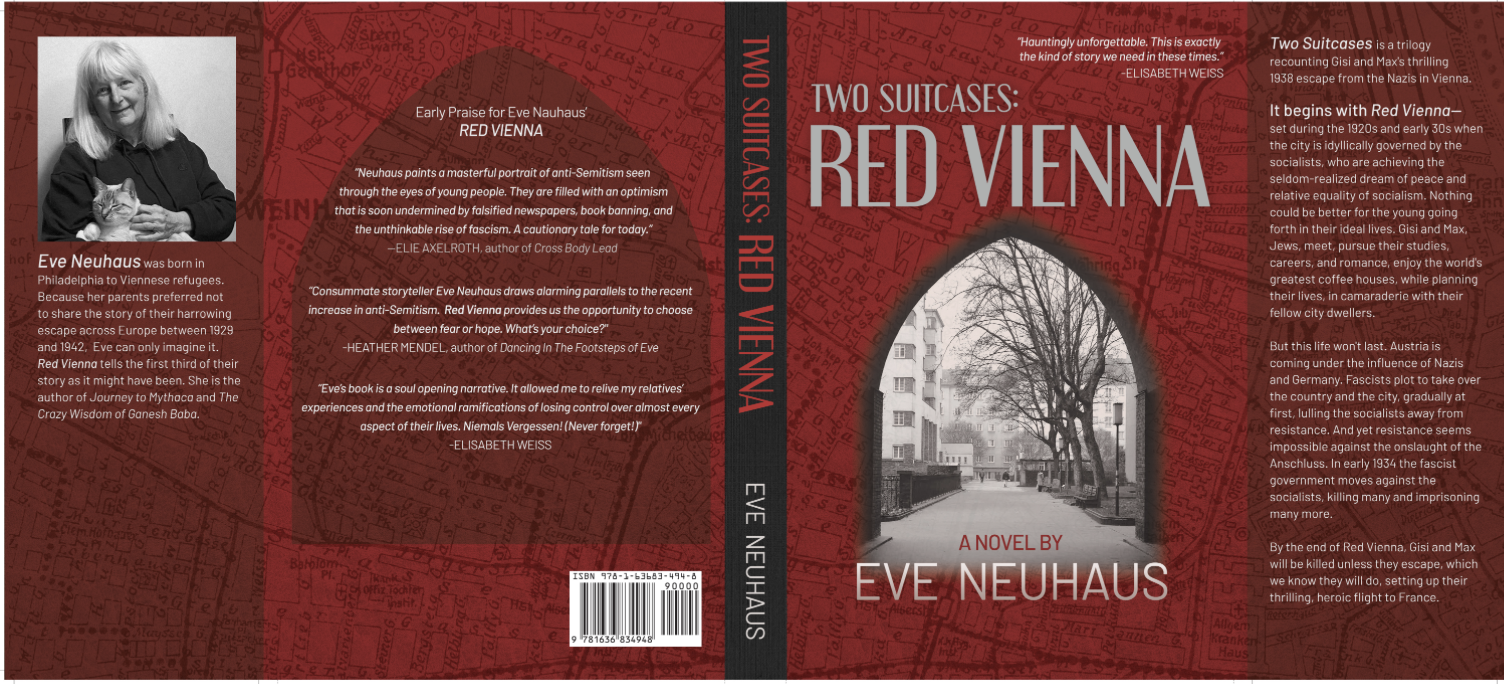
Draft of the cover for the hardback version of Red Vienna
Red Vienna is coming, I promise you. But, as anyone who has published a book will tell you, it always takes longer than you hoped.
While I wait I’ve been working on Underground, the second volume of Two Suitcases. After the fascist government of Austria banned the Social Democratic party, its activist members went underground, hence the title of the volume. In the outer world Leo works as a printer, and Hugo grinds lenses for an optician, but their real work takes place very discretely in a basement room in one of the social housing complexes.
Here’s the part I wrote today.
Chapter 19
Hijinks
April 20, 1935
a hidden room in the basement of Goethe-hof, a social housing complex
Leo and Hugo lean over a heavily crossed out and written over text, the harsh light above them creating a circle on the old table. Next to them is a stack of the official stationery of the President of the Police, Dr. Skubl. The pages even have his rubber-stamped signature at the bottom.
“No,” says Leo, pointing to the text. “Change it to make Skubl say, ‘As our noble police are currently occupied with arresting Socialists, Communists, and other anti-Fascists, the duty falls upon the public to keep down common crime.’ Add the word ‘noble.’”
“Right, right, that works better,” Hugo answers, looking up a moment and cleaning his glasses. “And the next part is good too, but let’s also make him assure the people that their taxes are being well-spent. Huh. Why don’t we invite people to inspect the police headquarters so they can see with their own eyes the absurd sums of money our government is spending on armaments to deploy against political opponents?”
Leo laughs. “Great idea!”
Hugo thinks. “How about advertising an Open House at police headquarters every Sunday morning? The invitation would specifically say it’s to see the vast armory of tanks, machine guns, rifles, gas weapons, etc., etc., ready to kill their neighbors and co-workers, all funded by their taxes. Let Skubl say it’ll start in May.”
“That’s it, perfect. Write down what you want it to say. I’ll get the type set.”
“We have a dozen sheets of this stationery, more than enough to get it out to the state newspaper, the radio, and the foreign press.”
“I can do some posters and flyers announcing the Sunday Open Houses, too.” Leo smiles at the thought of the police headquarters being overrun with people demanding to see the armory.
“Excellent. Make sure they give the reason for the Open House clearly: to see the weaponry meant to control the opposition.”
“It’ll have to be very carefully worded.”
“Of course. I trust you,” Hugo says, putting on his jacket. “Show me the first drafts when they’re ready.”
At just the same time in another neighborhood
Frau Selma Schmid of Habbichergasse is looking out of the window of her small apartment. The weather is changing. Soon it’ll be raining again, she thinks, and it’s so cold for April. I should start a fire. As she takes some old papers from the pile to throw into the cold coal stove, she glances at the program from an event she and her husband attended the week before. How proud she felt to see Major Fey, noble leader of the Heimwehr, as he was installed as Regent of Austria. Such an honor. Frau Schmid loves pageantry. Fondly, she recalls standing next to her father as the funeral procession of Emperor Franz Josef went by in 1916. Life was much better under the monarchy, even at the end, during that horrible war.
As she’s about the crumple the program up, she notices the words, “Free to the bearer of this program” and she looks more closely. What is free? Nothing is free anymore.
The door opens and Herr Schmid, disheveled after his afternoon nap, comes in. “What are you doing?” he asks grumpily. “We can’t afford a fire. It’s the middle of spring, what are you thinking?”
“But look, my dear! To think I almost threw this away! On the back of the program to Regent Fey’s installation is a generous donation by his supporters. It says that if we bring this program to any of the shops listed here, we’ll be offered our choice of goods worth 10 schillings! That’s three loaves of bread!”
“Now, why would anyone do that? It makes no sense at all to me,” mutters Herr Schmid, sitting down to look at the program.
“But that’s what it says,” his wife points out. “Look at the list. All these merchants are making the offer just to celebrate Regent Fey.”
“Well,” grunts her husband. “That’s what it says alright. Put on your coat. We’ll go to Oberhoffer’s—you see, he’s listed here—and see what’s left in his shop. Very little, I’m betting. He’s an old fool to have made such an offer.”
“Herr Oberhoffer is an honorable man, Richard. And a patriot. I’ll get my bag.”
Ten minutes later, the couple is entering the bakery while another couple opens an umbrella outside the shop.
“Georg! I told you it was a scam!” the woman is saying.
“But it was the official program. The guard at the gate was handing them out. I saw it myself,” her husband insists as they walk away.
“Ha,” says Herr Schmid to his wife Selma. “I told you so. You heard that. It’s a scam.”
“I’m going in anyway. I want to hear what Herr Oberhoffer has to say,” she replies, entering the shop.
“Nothing!” comes a shout from behind the counter. “I have nothing to say! Except that it’s not true, I’m not offering anybody anything for free!”
The Schmids stare at the baker.
“Nobody gets anything for free from me!” the baker goes on.
“What a miser!” says Herr Schmid to Selma as he turns and leaves. “He should have been generous and gone along with it even if it was a scam. That’s the last he’ll see of me!”
His wife hurries out after him.
In the hidden room in the basement of Goethe-hof
Leo says to Hugo, “Before you go, do you happen to have heard how the programs for Fey’s installation as Regent of Austria worked out? I printed a thousand of them even though they only expected a few hundred at the event. Franz said they’d be distributed at the event itself and that the rest would be left here and there all over the city.” He chuckles. “Halfway through the program we said Fey would be officially declaring himself Regent of the country he destroyed. That was the exact language. Of the country he destroyed. I wonder how many people read far enough to see that.”
“I’ll bet they read far enough on the back to see the list of shops in Vienna where they could get 10 schillings worth of free goods by presenting the program. I’ll have to ask around to see how that turned out.”
“It makes me laugh just to think of it,” Leo smiles.
“It’s incredibly frustrating, though, that our communication system is so limited. Without being able to use the post, telephone, or the telegraph, sometimes it takes weeks before I hear the results of something we planned and printed right here.”
“That’s true. Our illegal network is disrupted ridiculously often. Collection points can’t be accessed because a new neighbor moved onto the block, or worse, because one of our ‘postmasters’ has been arrested. All too frequently I send out a draft of something to someone who doesn’t dare come here in person to check it, and I get a reply days or weeks after the event I was printing the flyers for was supposed to have happened.”
Hugo opens the door to leave. “It feels like we’re in the middle ages, doesn’t it?” he says.
Heinrich Schmidt’s iconic image of Austerlitz-hof in the late 1920’s
At last.
After—how many years is it? roughly ten?—I just submitted the first volume of Two Suitcases to the publisher, WingSpan Press, the same people who published my fantasy, Journey to Mythaca, in 2006.
Red Vienna will be available in paperback or ebook format in about six weeks. I’m working on a website for it, which can be seen in its incomplete state here. At this point, nothing will happen if you push the “buy the book” button because there isn’t a book to buy yet, but if you sign up for the email list, you’ll be among the first know when it becomes available.
The trilogy, Two Suitcases, will eventually cover 1929 to 1942, from when the main characters, Gisi and Max, meet until they leave for America. The first two volumes are set in Vienna and the third in France.
When I began the book, which I thought would be one book and not three, I intended it to be a work of non-fiction, telling the story of my parents’ escape from Nazi Austria as accurately as possible. Early on, though, the characters began to claim their independence, and I made the decision to let the story unfold as it wanted. So, though most of the main characters are based on real people and some of them are historical figures, it’s not only the dialogue that I added. What could I do? The characters fell in and out of love, they developed quirks, their lives followed trajectories that might have happened, given the setting, but probably didn’t. It’s fiction.
I tried much harder to keep the setting accurate, which I think it is. Writing historical fiction is entirely different from writing fantasy. It takes years of reading and researching, probably the main reason all this has taken this long.
If you’d like a look into my writing process, much of it is explored on this blog in posts tagged “Two Suitcases.” Some of the posts are linked below.
The second volume, tentatively called Underground, is about half written and now I’m eager to get back to it. I hope it takes less than ten years to finish.
In the middle of this very very hot, very very dry summer, when we would stay inside our wonderfully cool little house all day every day, Ella, our lively little cat, was eight months old, and Mocha, our sensitive and often reactive dog, was ten years old.
One day the shit hit the fan.
Mocha was on her bed, sleeping lightly. Ella came flying into the room, skittered across the wood floor, attacked the dog’s tail with one flying paw, claws fully extended, turned, and zoomed out of the room. But Mocha was ready. Suddenly the dog had the cat cornered under the coat rack, and her jaws were closing around Ella’s ribs.
I shrieked, shouting at Mocha in my fiercest voice, pushing her away from the cat, and sending her to her bed. There was no need really; Mocha knew where to go, and as usual, she seemed genuinely remorseful.
But the incident was over the top for me. All afternoon, I stormed around, imagining the quiet home in the country I’d find for Mocha, designing in my mind the sign I’d hang at the vet’s and the Facebook post I’d write. I was done with her, this difficult, traumatized animal who’d shown up in our lives just when we arrived in our idyllic new setting four years ago. Despite some good progress, she still terrorized tourists, lurched and bared her teeth at moving wheels of all sorts, and snarled at children who approached her uninvited.
I’d had enough. Which picture would I choose for the ad?
Meanwhile, Ella was fine, relaxing on her chair next to Mocha’s bed, stretching, washing herself.
As these things go – more and more frequently it seems – when I sat down and opened my computer, there was an offer to watch a short series of videos on working with sensitive animals. Needless to say, I watched them.
For a little over a month now, I’ve been practicing a new form of meditation that I learned from the series, which is about James French’sTrust Technique. After 40 years of practicing more or less the same technique I’d learned from Ganesh Baba, I feel like I’m being offered a promotion. The open-eyed, focused Buddhist-style practice French uses takes the inner skills I’ve honed all these years and redirects them outward, slowly refining my awareness of my own state of mind and Mocha’s. I’m only on the second lesson of the paid series, and my relationship with her has changed.
I haven’t replaced my Ganesh-Baba-style kriya yoga practice with the new practice – I do both; they enhance each other – and I look forward to both my private practice and my twenty minutes of meditation with Mocha with renewed enthusiasm.
Based on Reiki, the trick to meditating and eventually cooperating with animals is to master moving into a deeply peaceful state of presence easily, a stillness without thought, that they find comforting. Now, using my attention increasingly skillfully and progressing at Mocha’s pace, I’m learning to communicate that peace to her. She likes it very much, and so does Ella, who regularly volunteers to join in our experiments.
Today, as I drifted back into ordinary consciousness after a particularly satisfying session with both dog and cat, it occurred to me that the skills I’m gaining may be very useful in these increasingly chaotic times. I’m practicing being undisturbed by passing cars, by Tom passing through the room, being unruffled by feelings of failure or frustration, detached from thoughts of the future and the past. I sit on the floor next with Mocha and Ella, breathing softly, fully present.
I continue to find painting cats on stools a most satisfying activity. Discovering a new old stool at Emmaüs, a brocante, vide maison, or eBay or Leboncoin is always magical. Repairing, sanding, and painting it gives me enormous pleasure.
Je continue à trouver que peindre des chats sur des tabourets est une activité des plus satisfaisantes. Découvrir un nouveau tabouret ancien chez Emmaüs, une brocante, vide maison, ou eBay ou Leboncoin est toujours magique. Le réparer, le poncer et le peindre me procure un énorme plaisir.
Mostly, I work from photos or, in the case of Minoushka à Cordes and my current project, Henri IV à Cordes, a painting. I’m using one of Cordes by Yves Breyer that I have on a postcard. Brayer’s work is perfect for using a a model because he gets so much character into simple strokes.
La plupart du temps, je travaille à partir de photos ou, dans le cas de Minoushka à Cordes et de mon projet actuel, Henri IV à Cordes, une peinture. J’utilise une des Cordes d’Yves Breyer que j’ai sur une carte postale. Le travail de Brayer est parfait pour utiliser un modèle car il donne tellement de caractère à des traits simples.
For Minoushka I didn’t have the exact photo I needed to work from so I combined a few. Here’s her face in a picture that Jon Davison, one of her humans, took:
Pour Minoushka, je n’avais pas la photo exacte dont j’avais besoin pour travailler, alors j’en ai combiné quelques-unes. Voici son visage sur une photo prise par Jon Davison, l’un de ses humains :
And here she is on her stool:
Et la voici sur son tabouret :
I’m just beginning the one of Henri IV, our extraordinary half-Siamese cat who met his match tragically last fall. He was two years old and King of all he could see; his nemesis was a car on our street, which he had recently claimed. My heart broke at losing him so young – I’m not sure I’ll be able to part with the stool when I finish it.
Je commence tout juste celle d’Henri IV, notre extraordinaire chat demi-siamois qui a tragiquement rencontré son match l’automne dernier. Il avait deux ans et était le roi de tout ce qu’il pouvait voir ; son ennemi juré était une voiture dans notre rue, qu’il avait récemment revendiquée. Mon cœur s’est brisé de le perdre si jeune – je ne suis pas sûr de pouvoir me séparer du tabouret quand je l’aurai fini.
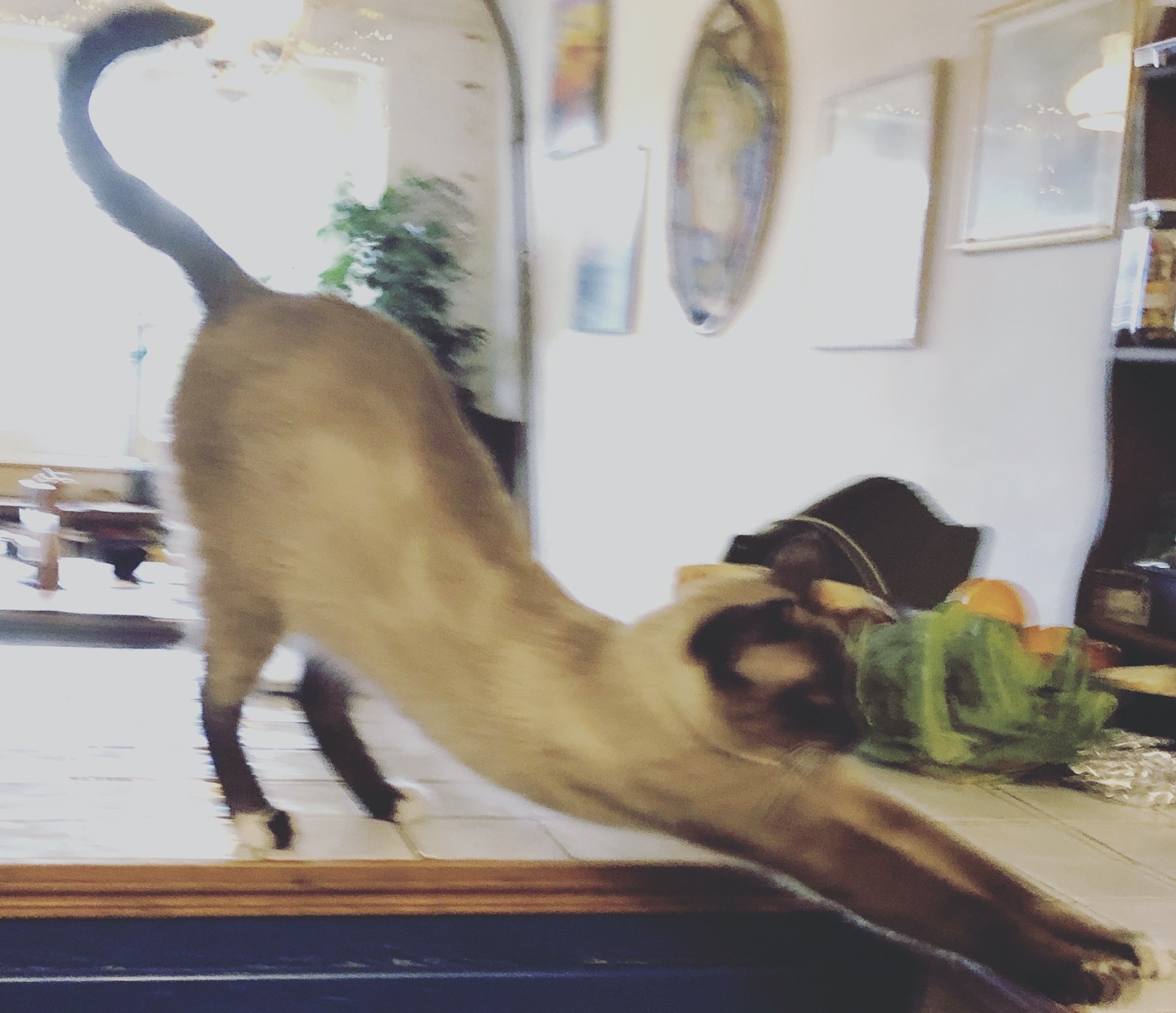
Here’s Henri IV on his throne:
Voici Henri IV sur son trône :
I’m using this out-of-focus picture of him for the painting.
J’utilise cette image floue de lui pour la peinture.
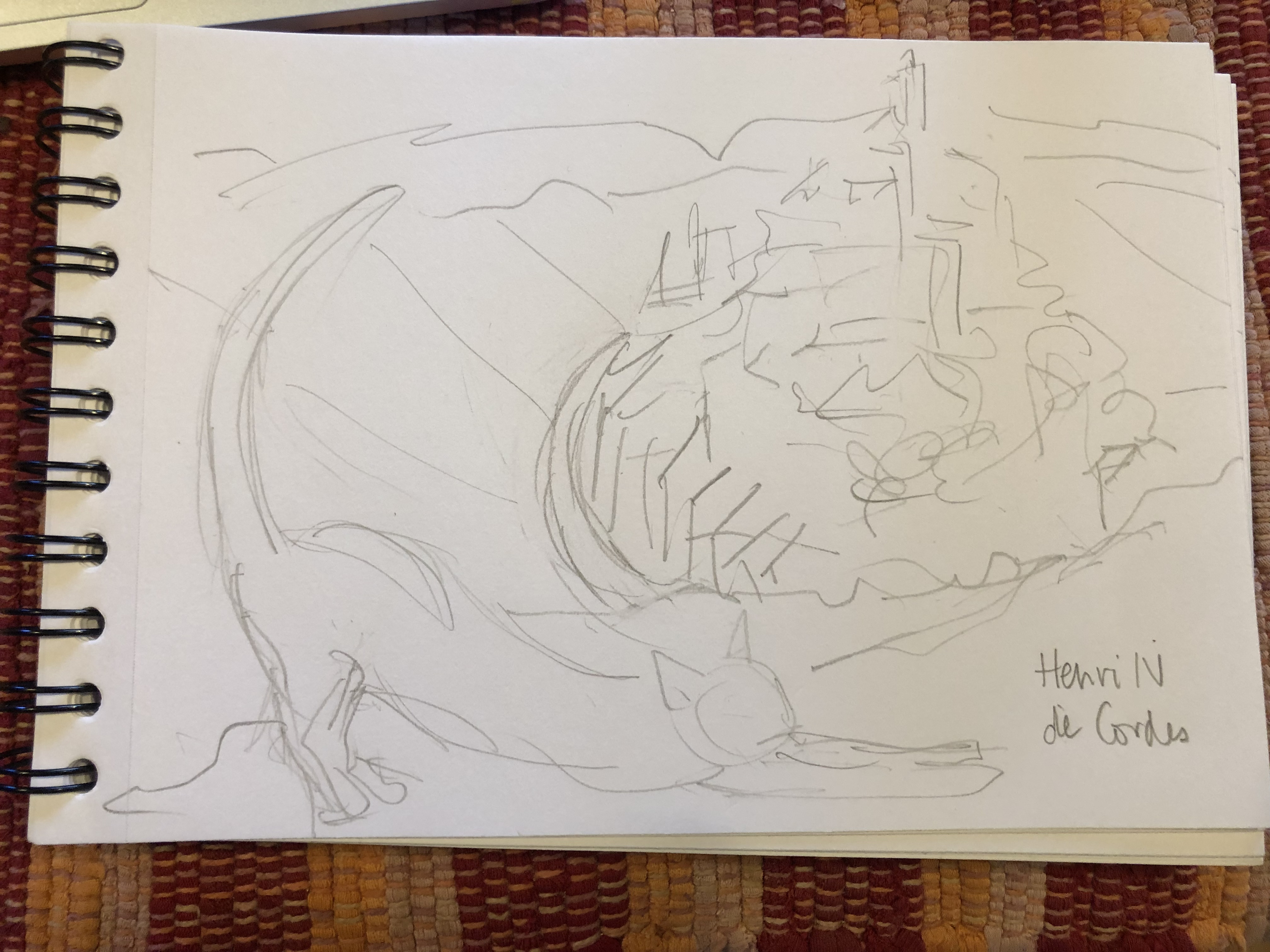
I changed the tail a little to make it echo the shape of our street on the picture of Cordes.
J’ai un peu modifié la queue pour qu’elle fasse écho à la forme de notre rue sur la photo de Cordes. It’ll go on the in-process stool above.
Voici le croquis que j’ai fait cet après-midi. Il ira sur le tabouret en cours ci-dessus.Il ira sur le tabouret en cours ci-dessus.
It occurs to me now that this series, Cats on Stools, is in part one of the gifts of Henri’s death. The other is that my heart has settled back into my chest after being in my mouth for the months when Henri was claiming more and more territory in the village. He’d taken to walking around it with me and Mocha in the weeks before his boldness caught up with him. He was fearless.
Il me vient à l’esprit maintenant que cette série, Cats on Stools, est en partie l’un des cadeaux de la mort d’Henri. L’autre est que mon cœur s’est réinstallé dans ma poitrine après avoir été dans ma bouche pendant des mois où Henri revendiquait de plus en plus de territoire dans le village. Il avait pris l’habitude de s’y promener avec moi et Mocha dans les semaines avant que son audace ne le rattrape. Il était sans peur.
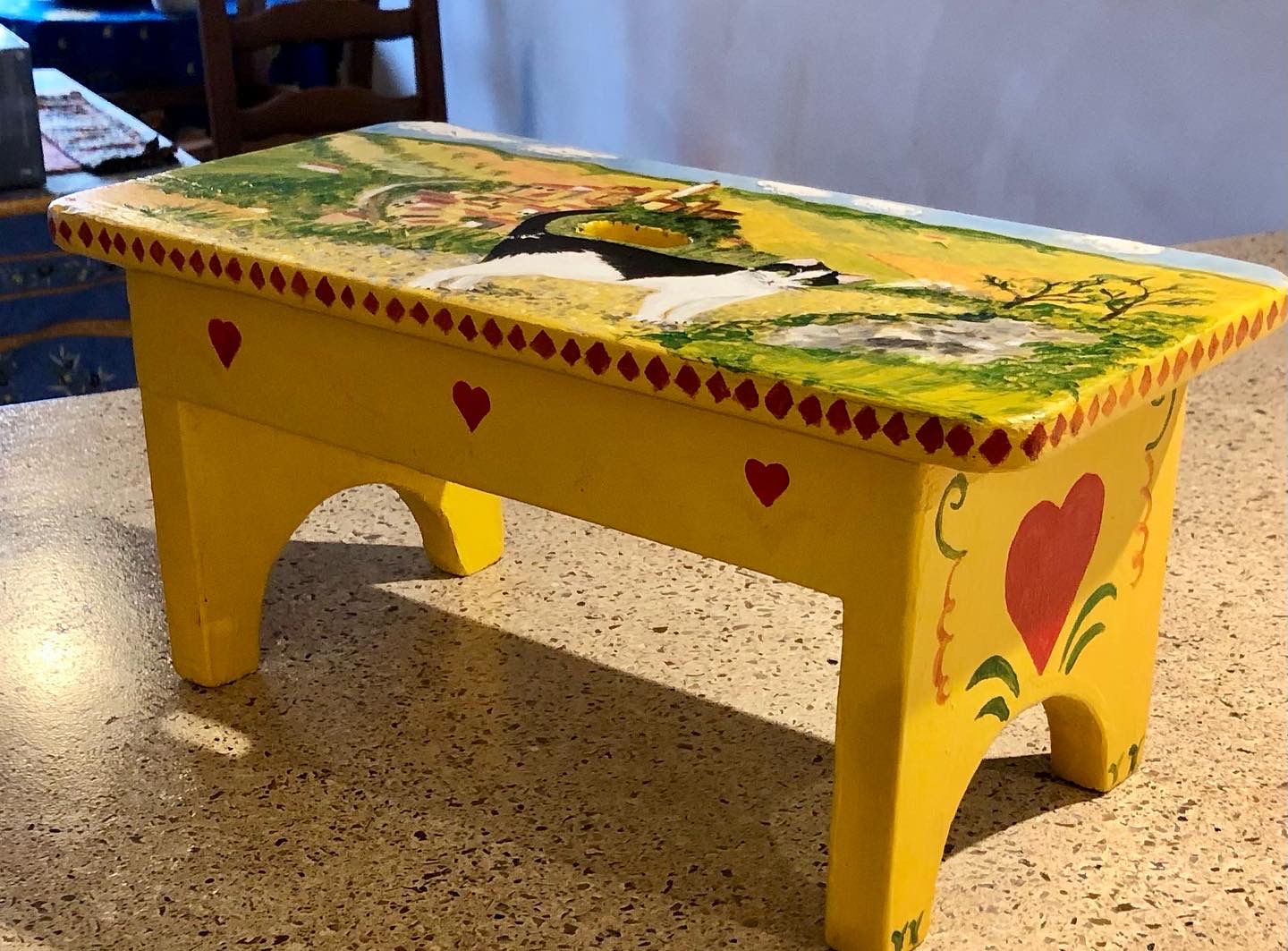
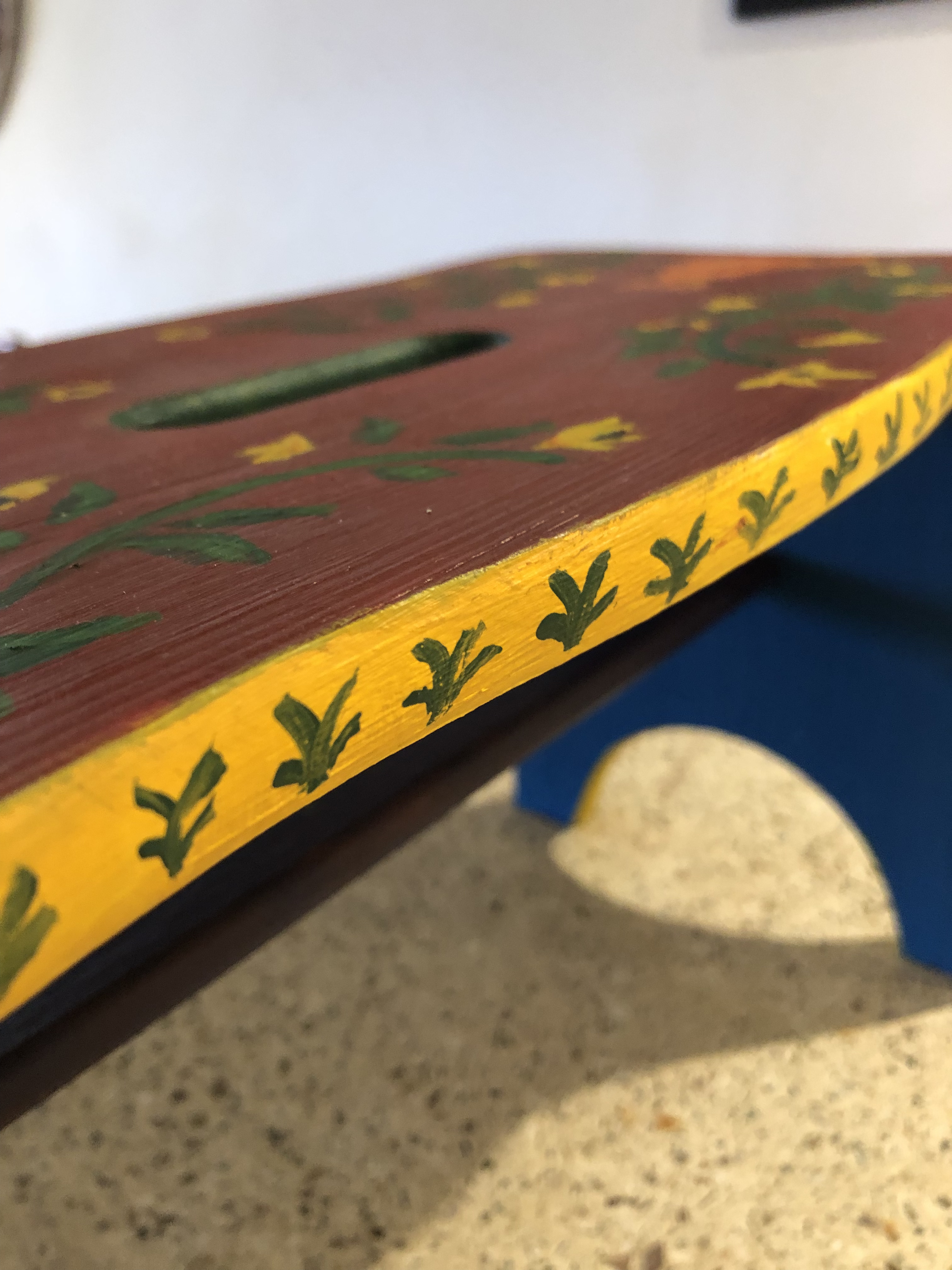
I’ve recently begun a series of painted footstools featuring cats. This is the first one.After choosing which stool I want to paint – I have a few on hand, some new, some old – I practice drawing the images I’ll put on it, and I start a search for the right quotation or poem for the bottom.
Then I paint the stool using acrylics. If I’m working on a stool for someone, I try to choose the right colors. Once the color is dry I begin on the design, usually on paper first and then on the stool.
Usually I add folk art designs at the end.
The second one in the series is in spring colors.
And now I’m beginning the sketches for the third one.
Please join me and Mocha on our walk around the village this afternoon.
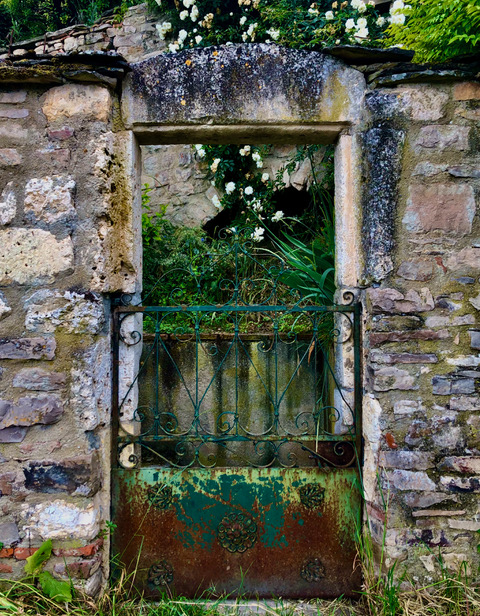
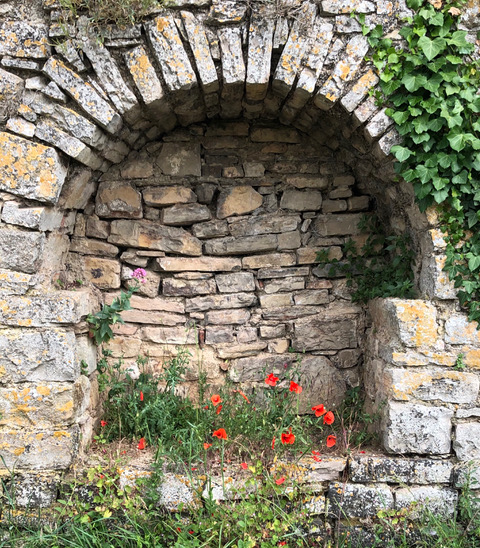
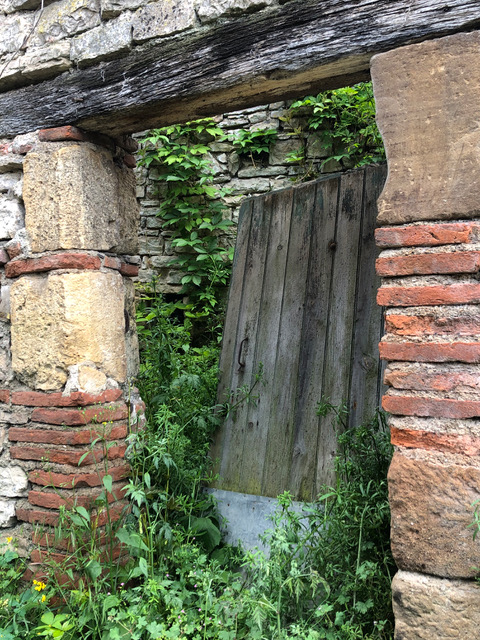
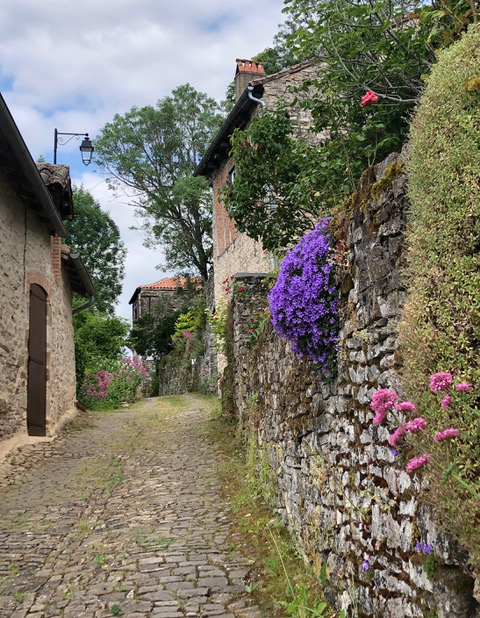
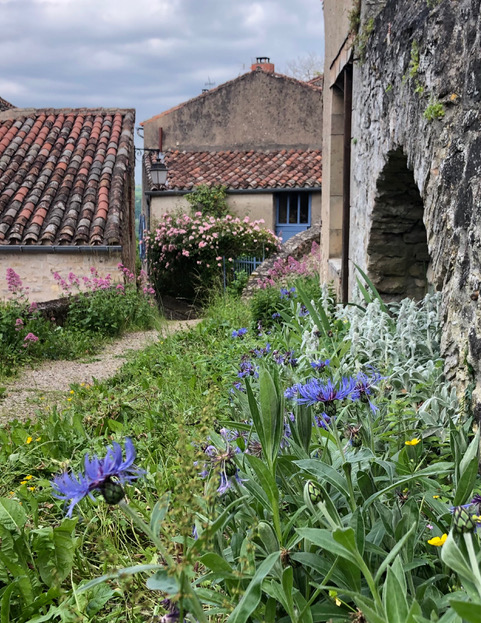
Along the footpath between le Barri and le Bouysset. C D B ?The new owners have cleaned up the area behind a house along the path.This is part of a ruin that now has a sign on it saying it will soon be renovated.A lovely old garden gate in le BouyssetI know this valerian is an invasive plant but it’s so beautiful!Poppies root anywhere. The walls in Cordes have lots of these arches built into them.
Now I’ve come round the west end of the village. This is the guardian of a garage, I think.
Abandoned gardens like this one aren’t uncommon.
Heading down the north side now.
I’m walking on footpaths mostly.
It’s high rose season now.
Almost home now. The cat disappeared when he sensed Mocha coming.
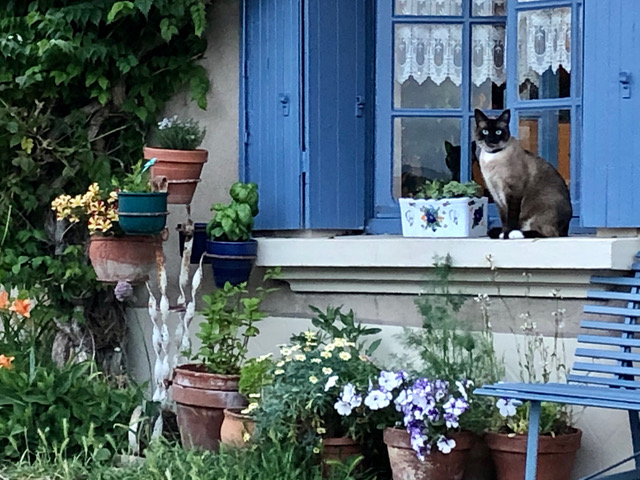
And look! Henri IV is in his place waiting for us again.
Our house in Cordes has two windows, one up and one down. Well, that’s not exactly true. There’s also the front door, which has a panel of obscure glass, (just learned that kind of mottled glass is called “obscure”), two bathroom windows, also obscure glass, and a skylight, obscured mostly by dirt since cleaning requires climbing on the roof.
The point is, there are only two windows where you can see out.
For obvious reasons, I started taking pictures out of them the day we moved in. Sometimes I take more than one, sometimes I miss a few days or even weeks because we’re traveling, or it’s dark when I get up, or it’s raining and the view is less inviting.
I don’t keep every picture I take, either. (I probably should have done that, but it’s too late now.)
Most of the time I face directly south, looking out of the windows.
Cordes is shaped like a fish, and we are on its belly, letting us see both the sunrise and the sunset. Sometimes I lean out to catch the sun.
I like the fog that rises from the creek, l’Aurausse.
It’s green in the winter here, but we get hard frosts and once in a while a dusting of snow.
Occasionally it rains enough for the valley to flood.
The trees change color and lose their leaves in the fall.
Rainbows aren’t uncommon.
And the clouds are spectacular!
In the late spring hot air balloons start to come over Cordes.
Our cats appreciate the window sills as much as I do.
Sometimes you get incredible clouds and fog at the same time.
I took screenshots of all these pictures to post them here, so you can’t click on them individually to enlarge them. Too bad.
Maybe I’ll put them all upon Flickr so they’re more accessible.
Or maybe I won’t.
In any case, I’ll keep taking more of them.
Because the extraordinary beauty right out the window never stops amazing me.