Living a symbolic life: the significance of the sun cross (part 3)

Vivre une vie symbolique : la signification de la croix solaire (3e partie)
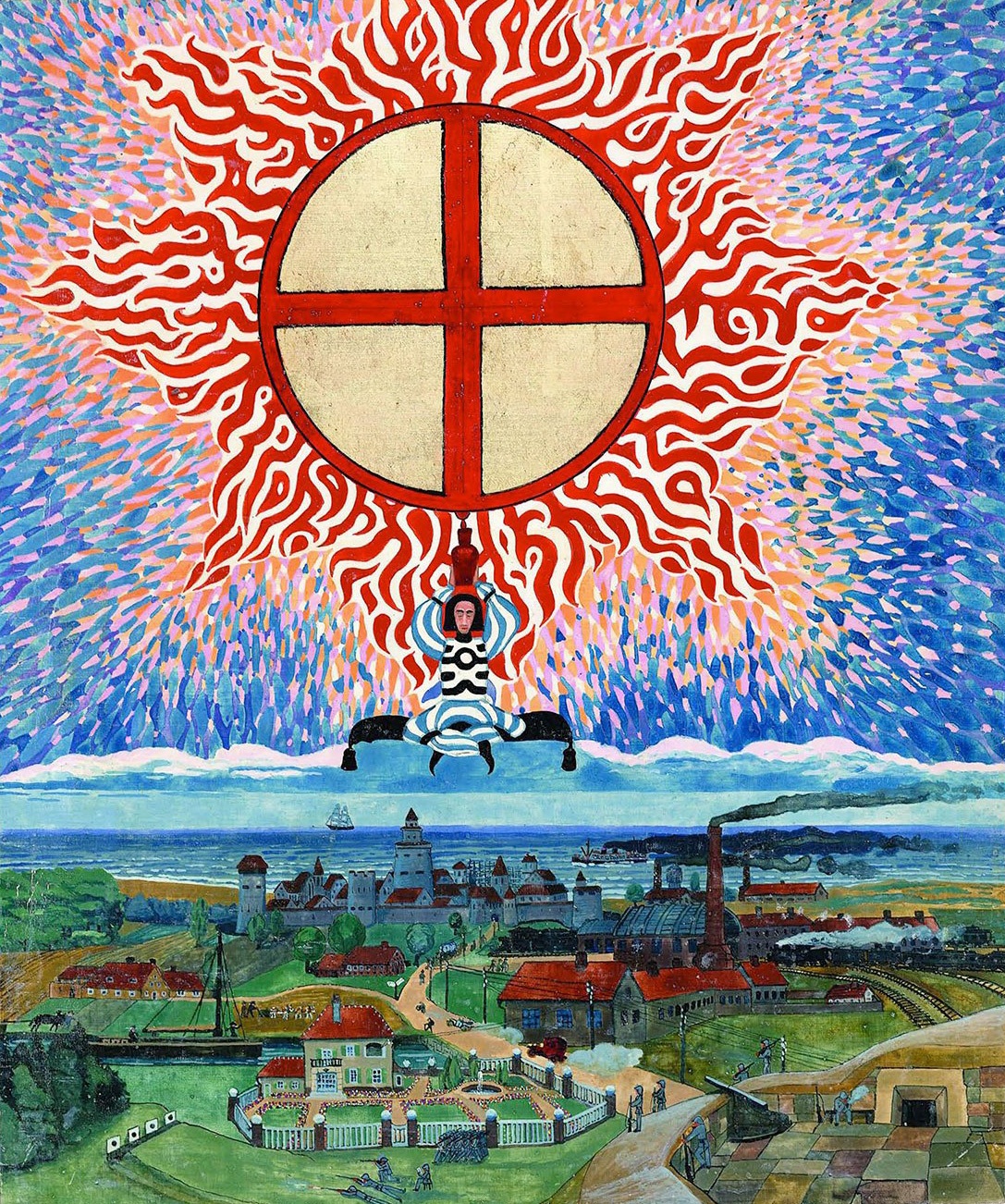
from C.G. Jung’s Red Book

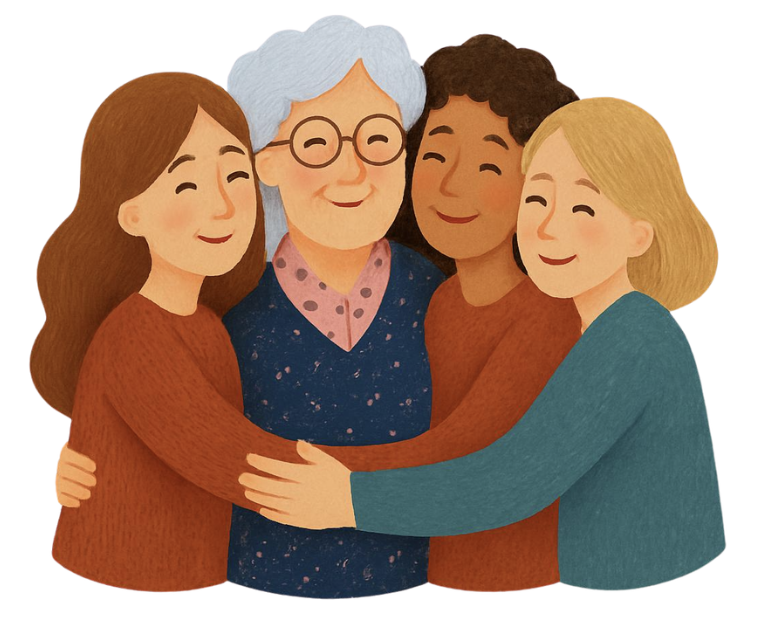
Over the days and weeks leading up to the solar eclipse on August 12, 2026, I unexpectedly found myself surrounded by most of my closest women friends. They flew across the ocean to see me, they sent hand-written letters through the increasingly dysfunctional postal system, we connected in texts, video chats, phone calls, and dog walks. The depth of the gratitude I feel for each one of you and for you all for being with me is almost overwhelming. That fullness, that warmth, that love, has become a touchstone for me whenever I seek heart coherence.

Au cours des jours et des semaines qui ont précédé l’éclipse solaire du 12 août 2026, je me suis retrouvée, de manière inattendue, entourée de la plupart de mes amies les plus proches. Elles ont traversé l’océan en avion pour venir me voir, elles m’ont envoyé des lettres manuscrites via un service postal de plus en plus défaillant, et nous avons gardé le contact par SMS, appels vidéo, coups de fil et promenades avec nos chiens. La profondeur de la gratitude que je ressens envers chacune d’entre vous et envers vous toutes pour avoir été à mes côtés est presque bouleversante. Cette plénitude, cette chaleur, cet amour, sont devenus pour moi une référence chaque fois que je cherche la cohérence du cœur.

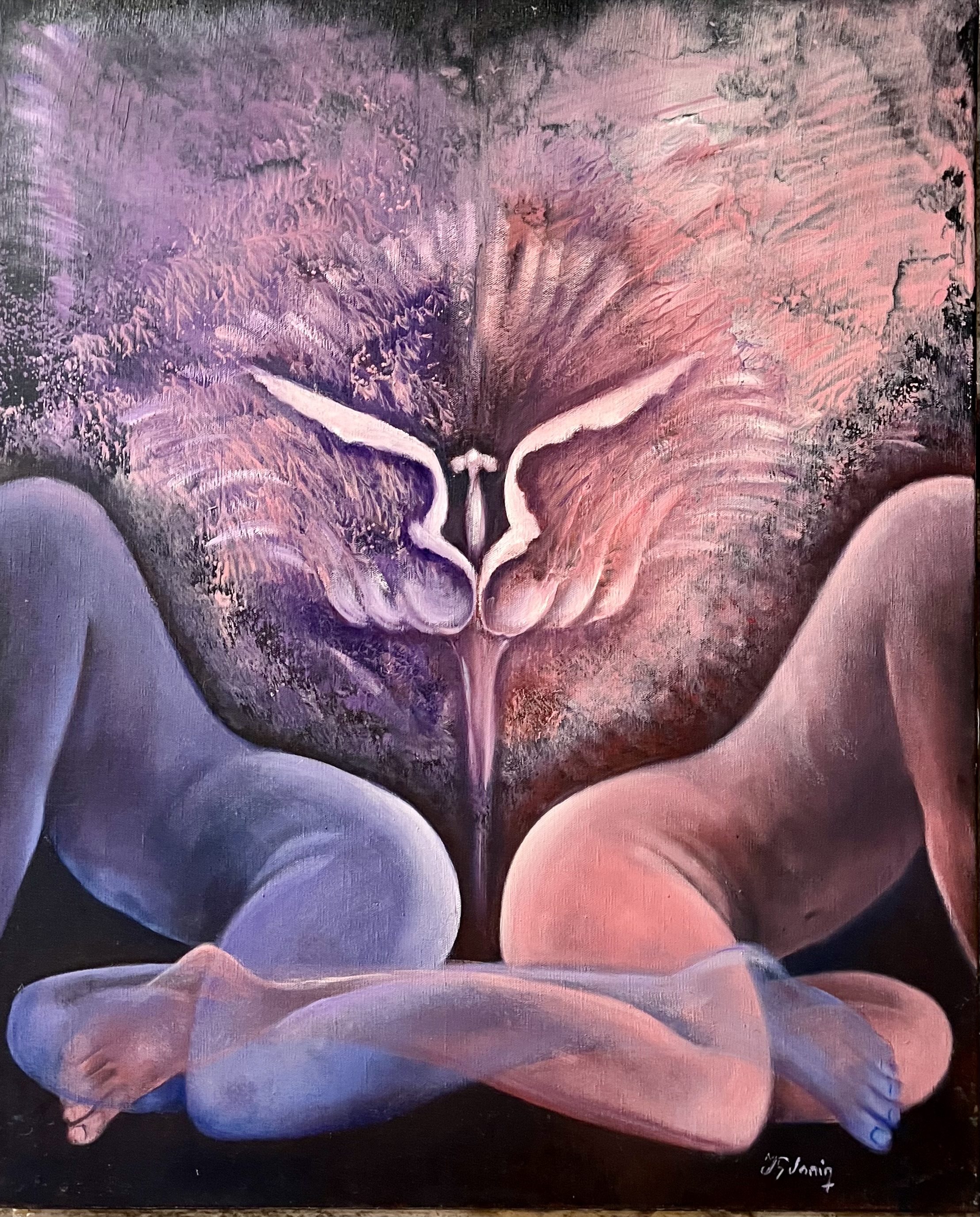
On August 8, several of us attended the opening of an exhibition of the surrealist painter Jean-Gabriel Jonin’s paintings here in my village in France, Cordes-sur-Ciel.

Le 8 août, nous étions plusieurs à assister au vernissage d’une exposition consacrée aux tableaux du peintre surréaliste Jean-Gabriel Jonin, ici même, dans mon village en France, à Cordes-sur-Ciel.

This particular series of Jonin’s works, the last he did before his death in 2014, portrays the coming together of the Sacred Feminine and Masculine. The symbolism is apparent to anyone versed in Jungian and neo-Jungian symbolism as well as tantrism in its many forms. The Masculine enters in the Feminine over and over. It’s an impressive body of work.

Cette série particulière d’œuvres de Jonin, la dernière qu’il a réalisée avant sa mort en 2014, illustre la union du Féminin et Masculin sacré. Le symbolisme est évident pour quiconque connaît bien la symbolique jungienne et néo-jungienne, ainsi que le tantrisme sous ses multiples formes. Le Masculin pénètre sans cesse dans le Féminin. C’est une œuvre impressionnante.

At 4 in the morning following the opening, I woke suddenly, knowing it was exactly 4, with the image of the form I explored in my previous blogs in this series, an equilateral cross in a circle, shining brilliantly on my inner eye.

À 4 heures du matin, au lendemain du vernissage, je me suis réveillé en sursaut, sachant qu’il était exactement 4 heures, tandis que l’image de la forme que j’avais explorée dans mes précédents articles de cette série – une croix équilatérale inscrite dans un cercle – brillait de mille feux dans mon œil intérieur.

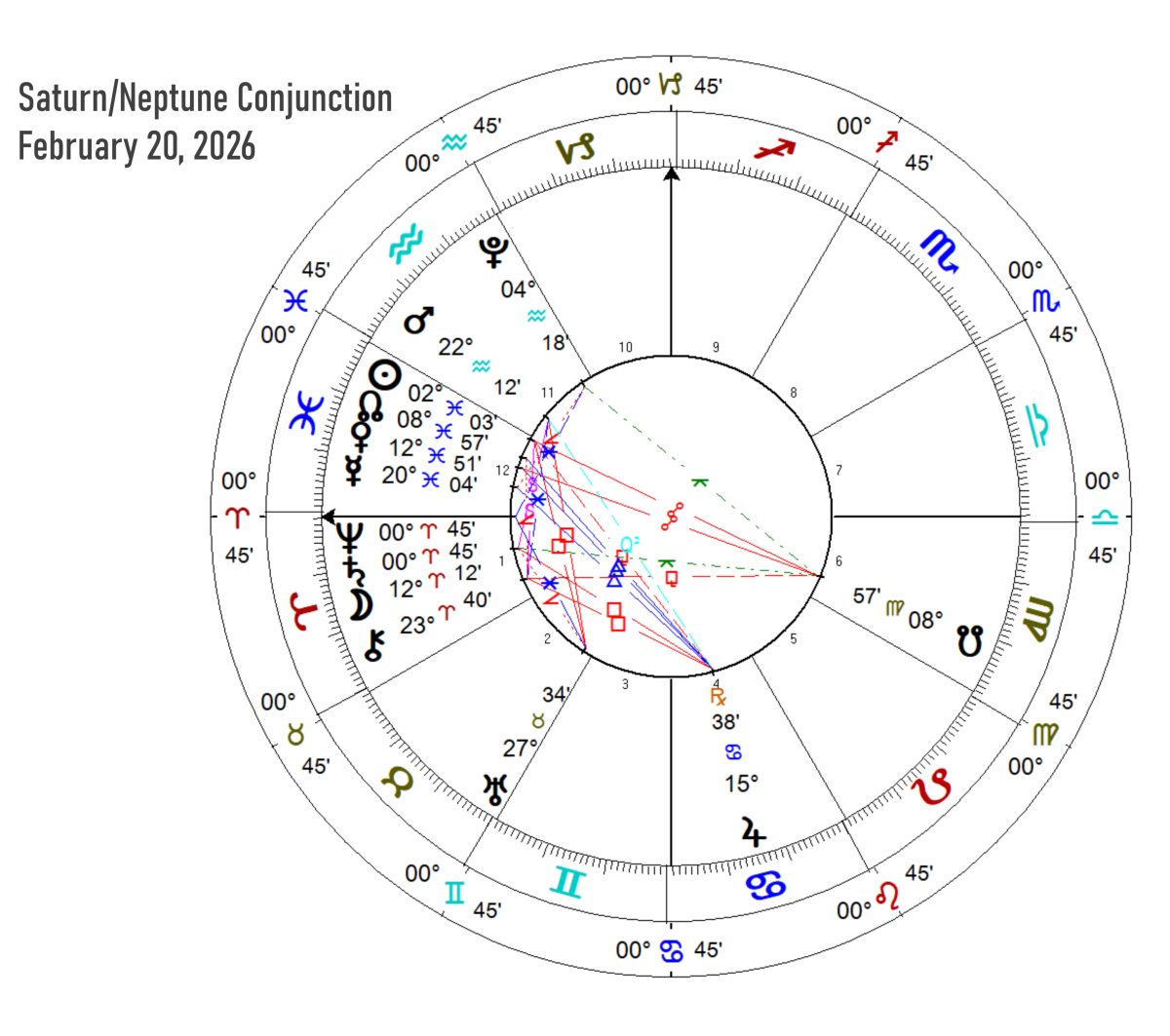
The version of the image below represents four figures in a circle, feet touching, arms open to the outside. It’s my souvenir of February 20, when three woman friends and I were in a Japanese hot tub at the exact moment the Saturn-Neptune conjunction perfected at 1° Aries.

La version de l’image ci-dessous représente quatre personnages formant un cercle, les pieds joints, les bras ouverts vers l’extérieur. C’est mon souvenir du 20 février, jour où trois amies et moi-même étions dans un bain japonais au moment précis où la conjonction Saturne-Neptune s’est réalisée à 1° du Bélier.
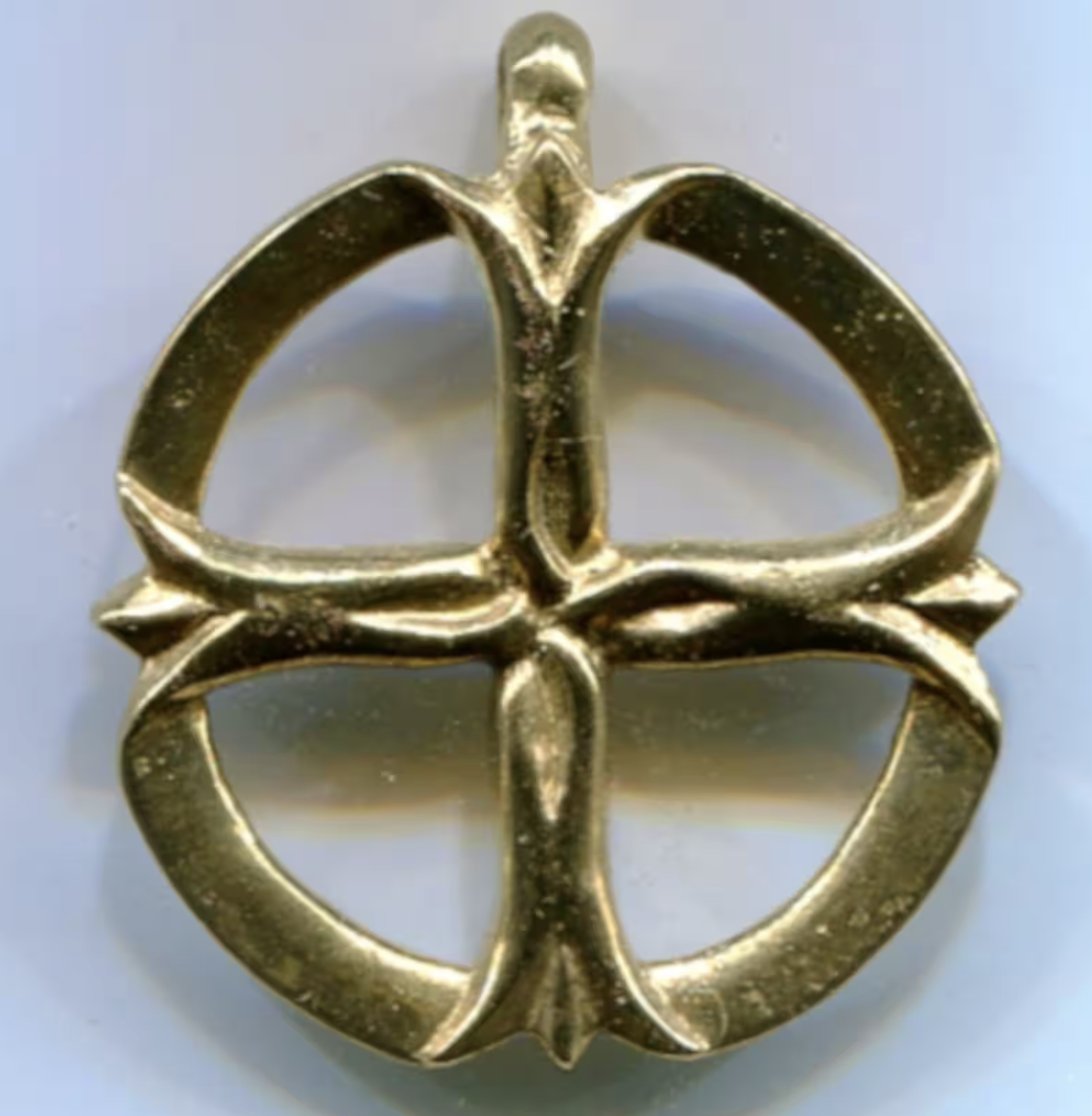
In my previous post in this series, I explore some traditional meanings associated with the cross within a circle. The straight line can represent the masculine, the circle the feminine, or the vertical line could the Masculine, the horizontal the Feminine. The center, the point of connection, is the heart. You can see the horizontal line as time, the vertical as space. The six directions, north, south, east, west, above and below are encompassed within it. It is central to my teacher Ganesh Baba’s theory of everything, Cycle of Synthesis.

Dans mon précédent article de cette série, j’ai exploré certaines significations traditionnelles associées à la croix inscrite dans un cercle. La ligne droite peut représenter le masculin, le cercle le féminin, ou bien la ligne verticale pourrait symboliser le masculin et la ligne horizontale le féminin. Le centre, le point de connexion, est le cœur. On peut considérer la ligne horizontale comme le temps, et la verticale comme l’espace. Les six directions – nord, sud, est, ouest, haut et bas – y sont englobées. Ce concept est au cœur de la théorie du tout de mon maître Ganesh Baba, le « Cycle de la synthèse ».
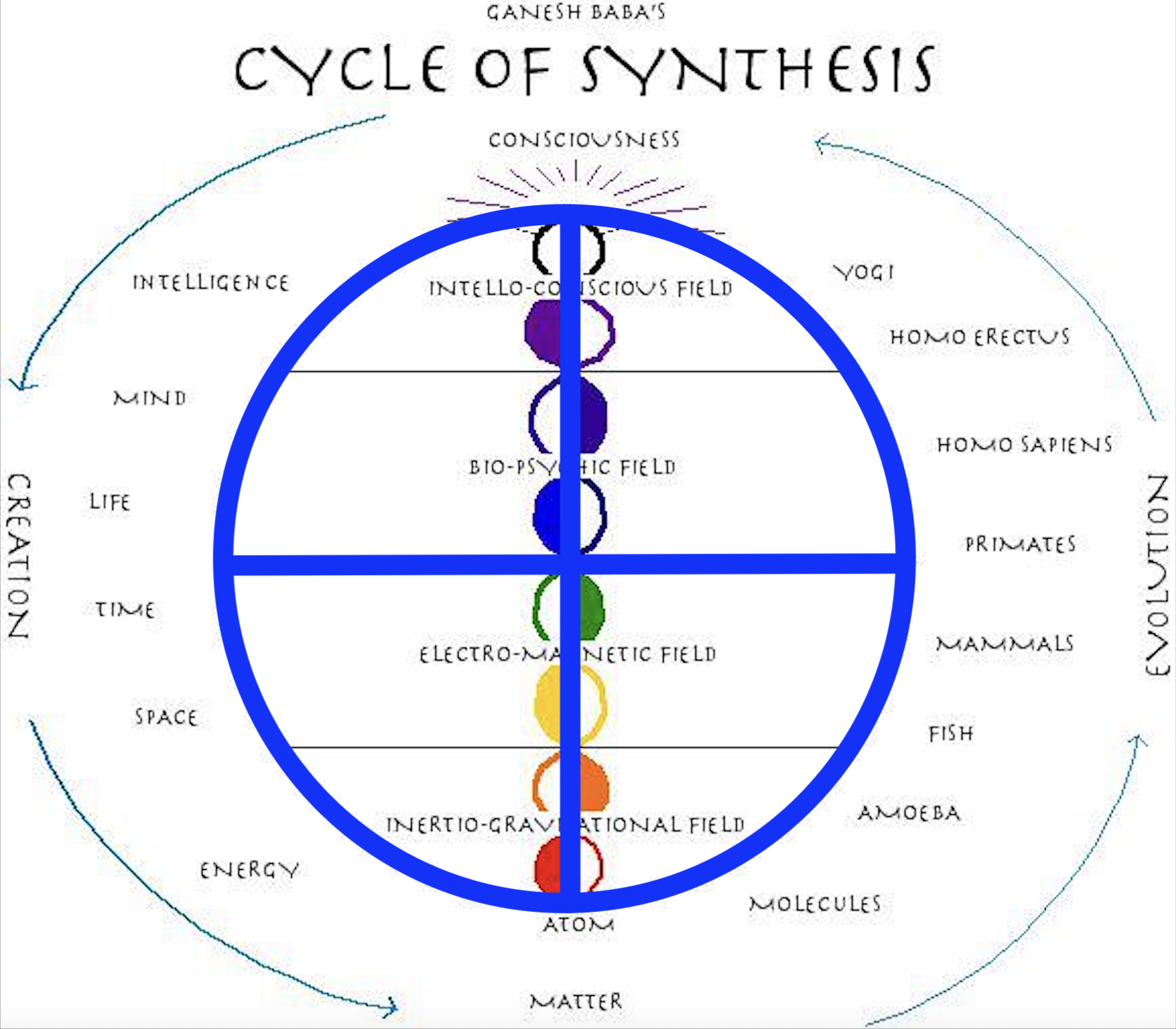
But I’d thought about all these things before. What came to me at 4 in the morning was the difference between the symbol of the cross in the circle and the symbolism in Jean-Gabriel Jonin’s work.

Mais j’avais déjà réfléchi à tout cela auparavant. Ce qui m’est venu à l’esprit à 4 heures du matin, c’était la différence entre le symbole de la croix dans le cercle et la symbolique présente dans l’œuvre de Jean-Gabriel Jonin.

Both represent the coming together of the Sacred Feminine and Sacred Masculine. In most traditional esoteric understandings, and in Jonin’s work, the Feminine is seen as the physical, the earth, the body, matter, and the masculine is the spirit, the unseeable, the unknowable. A single, tiny, nearly invisible sperm enters the egg. The active man shoots his life-force into the receptive woman, who holds and carries and nurtures their creation into adulthood. In Jonin’s work the Feminine Principle is depicted as the female body. The Masculine is a ray of light. His work is luminous, delightfully geometric, and rich with symbolism. The curves of the Feminine play with the lines of the Masculine.

Ces deux éléments représentent l’union du Féminin sacré et du Masculin sacré. Dans la plupart des conceptions ésotériques traditionnelles, ainsi que dans l’œuvre de Jonin, le Féminin est considéré comme le physique, la terre, le corps, la matière, tandis que le Masculin incarne l’esprit, l’invisible, l’inconnaissable. Un seul spermatozoïde, minuscule et presque invisible, pénètre dans l’ovule. L’homme actif projette sa force vitale dans la femme réceptive, qui accueille, porte et nourrit leur création jusqu’à l’âge adulte. Dans l’œuvre de Jonin, le principe féminin est représenté par le corps féminin. Le principe masculin est un rayon de lumière. Son œuvre est lumineuse, délicieusement géométrique et riche en symbolisme. Les courbes du féminin jouent avec les lignes du masculin.

The unencumbered cross in a circle offers a different interpretation of the same idea.

La croix libre, inscrite dans un cercle, propose une interprétation différente de cette même idée.

The lines are the Masculine, and the circle the Feminine. In this powerful image that has gripped my imagination for months, the Feminine is holding the Masculine.

Les lignes représentent le Masculin, et le cercle, le Féminin. Dans cette image puissante qui occupe mon imagination depuis des mois, le Féminin tient le Masculin dans ses bras.

And, at the heart of the image is the heart, the point of connection, and the doorway to other dimensions. It’s where fertilization and creation take place, where the new is born and where the old dies. It’s the ultimate möbius twist, the coming together of the opposites, the looking glass, the black hole and the newborn star.

Et, au cœur de l’image, se trouve le cœur, le point de connexion et la porte vers d’autres dimensions. C’est là que s’opèrent la fécondation et la création, là où le nouveau naît et où l’ancien meurt. C’est la torsion de Möbius par excellence, la réunion des contraires, le miroir, le trou noir et l’étoile naissante.

No wonder it’s called the Sun Cross.

Pas étonnant qu’on l’appelle la « Croix du Soleil ».

The astrological symbol for the sun is a circle with a dot at the center.

Le symbole astrologique du Soleil est un cercle avec un point au centre.

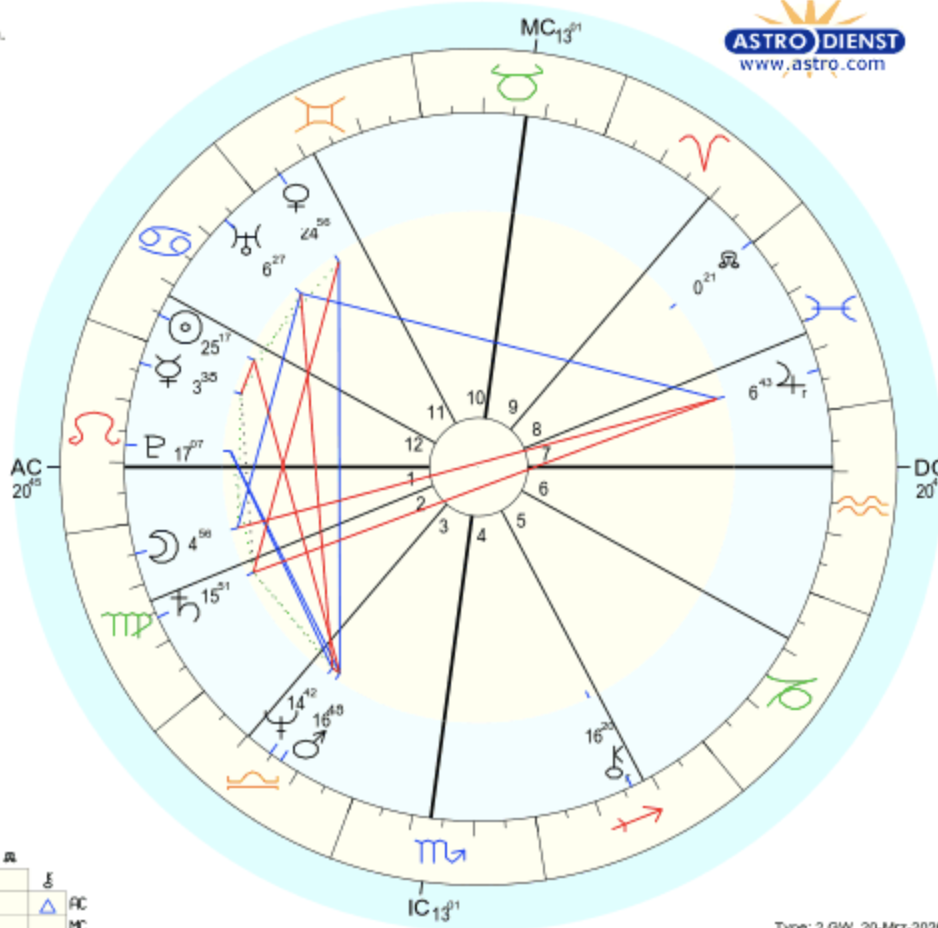
I began this piece three days before the solar eclipse, when the shadow of the moon crosses the sun.

J’ai commencé cet article trois jours avant l’éclipse solaire, lorsque l’ombre de la Lune passe devant le Soleil.

The eclipse was 92.3% complete in Cordes À Cordes, l’éclipse a atteint un taux de couverture de 92,3 %.

May the Feminine and Masculine Principles, manifest as the women and men on earth now, connect, hold each other, and work together to create a better balanced, more just, and more loving new world.

Puissent les principes féminin et masculin, qui se manifestent aujourd’hui sur Terre sous la forme des femmes et des hommes, se rapprocher, se soutenir mutuellement et œuvrer ensemble pour créer un monde nouveau, plus équilibré, plus juste et plus aimant.
Living a symbolic life: where a Celtic cross took me (part 1)

A Celtic Cross

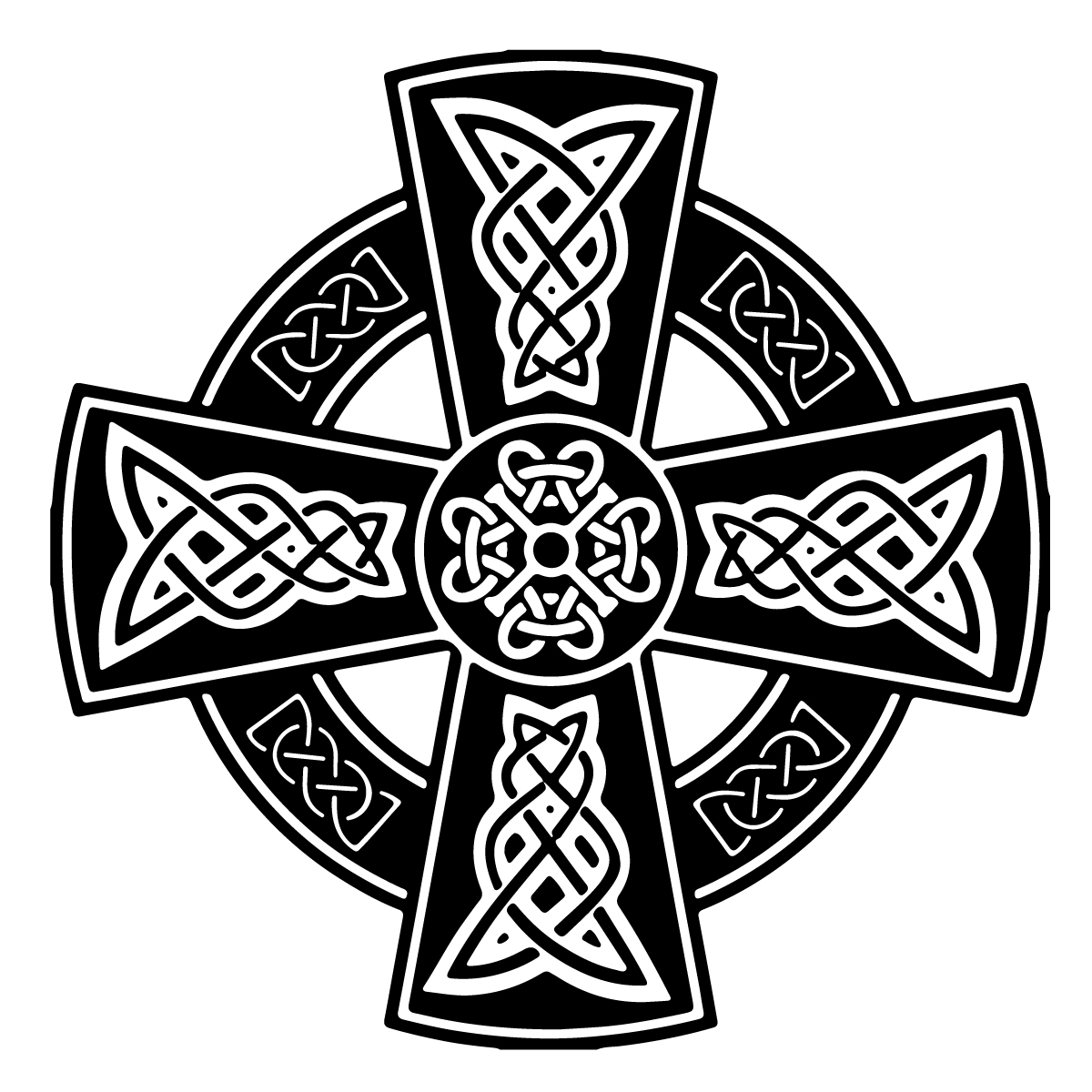
At just before six in the evening on February 20, 2026, I was immersed in a Japanese-style hot tub, perfectly round and not too hot, with three dear women friends. With our legs bobbing in the warm water in front of us, the four of us formed a Celtic cross.

It was a seminal moment. We all knew it.

At just that time, the conjunction of Neptune and Saturn was exact. Not only was it exact, which happens every 36 years, but it was exact at 0° Aries, which only happens every 6000 years.

And, not only was it exact, but it fell exactly on the north node of the moon in my birth chart. And we were at that spa at that moment to celebrate the birthday of one of the other women.

That’s a lot of astrology to unpack, and I’ll do it, but first, take a look the Sabian symbol for 0° Aries:

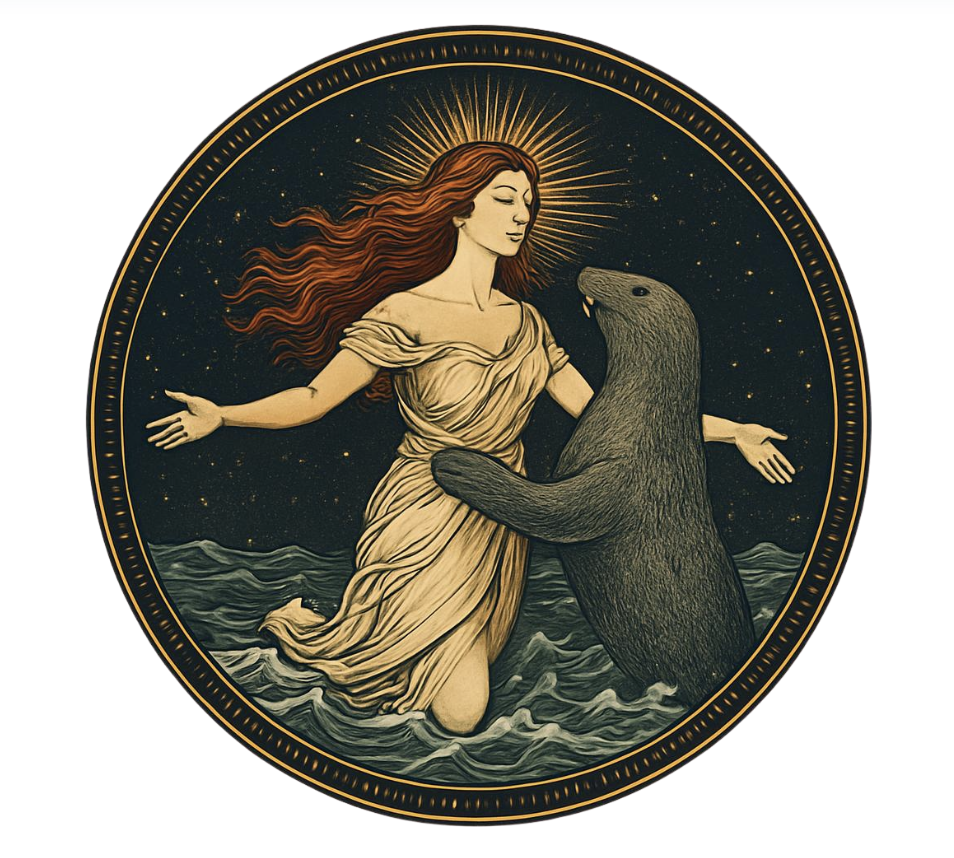
A Woman Just Risen From The Sea; A Seal Is Embracing Her

I hoped the four of us would take that moment to rise from the water and embrace, but, sadly, the water wasn’t welcoming enough for any of us to feel like submerging.

So we meditated and emerged from there to embrace.

What’s the significance of all this?

Last night I dreamed that I was deep in a forest with a group of people. We’d had to escape from somewhere and there was a question about whether we had brought the right stuff with us and whether there was enough food. It was a fairly large group of people, maybe twenty or thirty. I was at the back of the group, walking slowly with a companion. When we caught up with the others, they were cooking and eating. I was happy to see that they had roasted some chicken and that I had a choice of either a leg or a breast piece—I didn’t want them both because it seemed like too much.

Our whole civilization is entering the deep woods of uncertainty, and the question of whether we’re bringing the right things with us matters. The dream is reassuring—there’s enough chicken for us to have a choice, even if we’re the last to be served. Yet it would be a mistake to take it literally. Most of us won’t have to carry chickens along as we navigate the deep woods. We have to take some form of symbolic sustenance.

In the fall, while preparing a presentation for the Seeker’s Compass (watch it here: https://youtu.be/iQIEb5dbF9w), I remembered the profound importance of living symbolically. I’ve appreciated the idea since I was fourteen or so, when the marvelous creative writing teacher at my summer camp introduced us to the power of myth through the work of CG Jung and Joseph Campbell. (My eternal thanks go to Joe Beatty at Lighthouse Art and Music Camp). Ever since, I’ve attended to the metaphors behind details of daily life. I even studied myth at Pacifica and, in my work with Alice O. Howell, focused on seeing the sacred on the commonplace as well as on astrology—but when I used those words “living a symbolic life” in that talk, something powerful reawakened in me.

In the talk I said something like, “In these liminal times, living a symbolic life is surely one of the ways through to the next world.” It wasn’t a phrase I intended to put into that talk, which I gave several times, live and on camera, with and without notes. It wasn’t in my notes.

After the talk, I thought, huh, good thing nobody asked me a question about that—I wouldn’t have known what to say, or who to attribute it to for certain. I thought I remembered hearing it first in a talk by James Hillman at Pacifica, and had assumed it was his. It actually comes from Jung himself. In The Symbolic Life: a collection of miscellaneous writings, he says,

You see, man is in need of a symbolic life – badly in need. We only live banal, ordinary, rational, or irrational things . . . but we have no symbolic life. Where do we live symbolically? Nowhere except where we participate in the ritual of life. . . .

Have you got a corner somewhere in your house where you perform the rites, as you can see in India? Even the very simple houses there have at least a curtained corner where the members of the household can perform the symbolic life, where they can make their new vows or their meditation. We don’t have it; we have no such corner. We have our own room, of course, – but there is a telephone that can ring us up at any time, and we always must be ready. We have no time, no place.

We have no symbolic life, and we are all badly in need of the symbolic life. Only the symbolic life can express the need of the soul – the daily need of the soul, mind you! And because people have no such thing, they can never step out of this mill – this awful, banal, grinding life in which they are “nothing but.” . . .

Everything is banal; everything is “nothing but,” and that is the reason why people are neurotic. They are simply sick of the whole thing, sick of that banal life, and therefore they want sensation. They even want a war; they all want a war; they are all glad when there is a war; they say, “Thank heaven, now something is going to happen – something bigger than ourselves!”

These things go pretty deep, and no wonder people get neurotic. Life is too rational; there is no symbolic existence in which I am something else, in which I am fulfilling my role, my role as one of the actors in the divine drama of life.

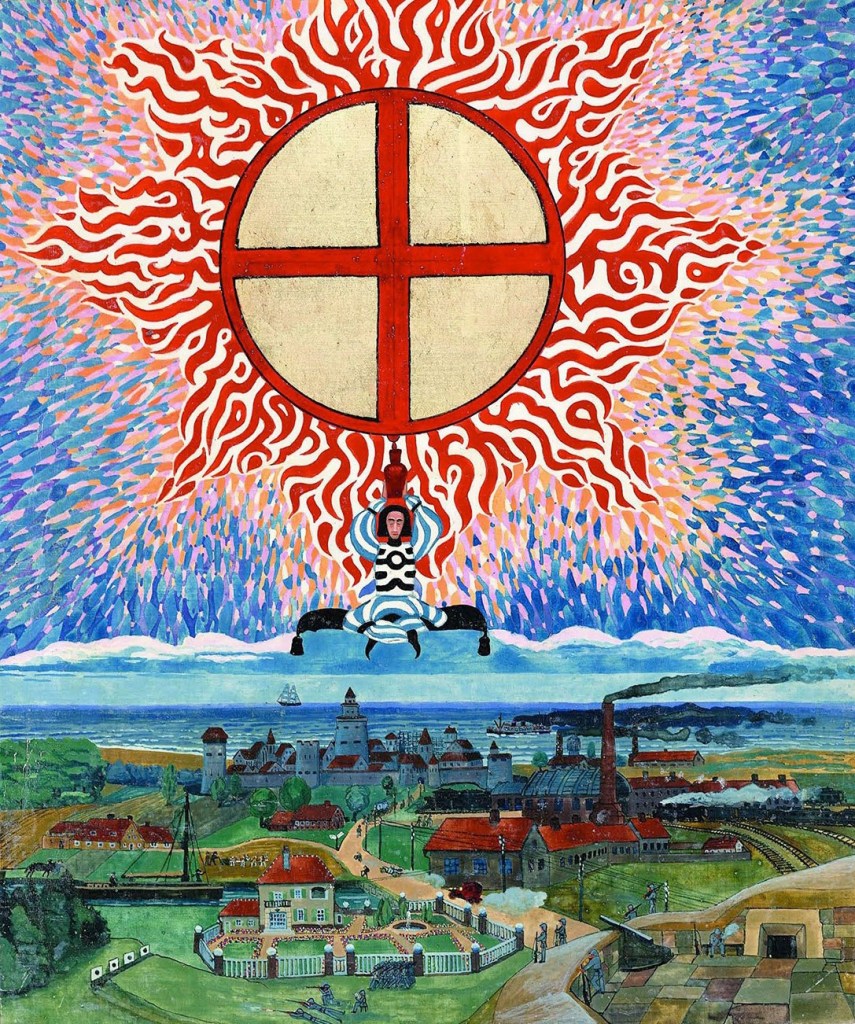
After I copied and pasted the above text into this essay, I thought I’d look for an image to illustrate the concept, maybe something from Jung’s The Red Book. The very first image that came up in my search was this one:

Over the top synchronicity.

But to return to the astrology that marked the moment: when the woods get deep and all the trees look alike, I often look up at the stars. Astrology provides a symbolic map for understanding changes in our personal and civilizational lives.

Astrology divides the celestial sphere into 12 sections or signs of 30 degrees each, for a total of 360 degrees. 0° Aries is considered the first degree of the zodiac, the threshold of a new level in the upward spiral of change. The exact passage, or conjunction, of two planets that appear to be moving slowly through the heavens, occurring at 0° Aries begs exploration.

Saturn is the furthest away of the seven “planets,” which in astrology include the sun and the moon, which are visible to the naked eye. Thus, it’s what holds the “world” together, the outer boundary, the structure.

Neptune, discovered using a telescope in 1846, was assigned the farthest out concepts of the time: imagination, illusions, dreams, the abstract, the mysterious.

The conjunction of Saturn and Neptune indicates a merger of structure with dreams.

In a birth chart, the planets are laid out on the zodiac in the position they were in at a person’s birth, each planet at a certain degree in one of the twelve segments, or signs.

In 1925, an astrologer, Marc Edmund Jones, and a clairvoyant, Elsie Wheeler, created a series of 360 images, one for each of the degrees of the zodiac. They called them the Sabian symbols. Each one is completely unique. For example, the woman rising from the sea embraced by the seal is followed by a man entertaining a group of people, and a few degrees later, by a triangle with wings.

In addition to the planets, there are other markers that are assigned meaning, among them the lunar nodes, which mark the moon’s orbit as it intersects the apparent path of the sun. The south node is said to show what a person comes into life with, and the north node what their purpose is.

One of the basic things astrologers do is to compare the position of the planets in the sky at present, or at any given time, to their positions at the time of one’s birth. Thus, I knew that the rare conjunction of Saturn and Neptune at 0° Aries coincided with the position of the north node in my birth chart at 0° Aries. When I looked up the significance of that, Astrology.com said, “When planetary transits touch your north node directly, you’ll find significant, destined events and meetings take place. The north node is uncharted terrain and unlocks the key to your life’s purpose.”

So, there I was, creating one of the four limbs of that cross in a circle at the exact moment of the structure/dream collaboration, at the exact point in time when I am supposed to come into whatever I came into this life to do. And with three dear friends, one of whose birthday was at the same time.

It’s taken too many words and too much time to get to this point in the story, so I’ll explore where the experience took me in my next post.

A drop of love

Une goutte d’amour

This is a vision that came to me not long ago when I was doing longer than usual meditations in the morning. I’d been sitting for maybe 45 minutes when it floated into my head.

C’est une vision qui m’est venue il n’y a pas longtemps, alors que je faisais une méditation plus longue que d’habitude le matin. J’étais assise depuis environ 45 minutes quand elle m’est venue à l’esprit.

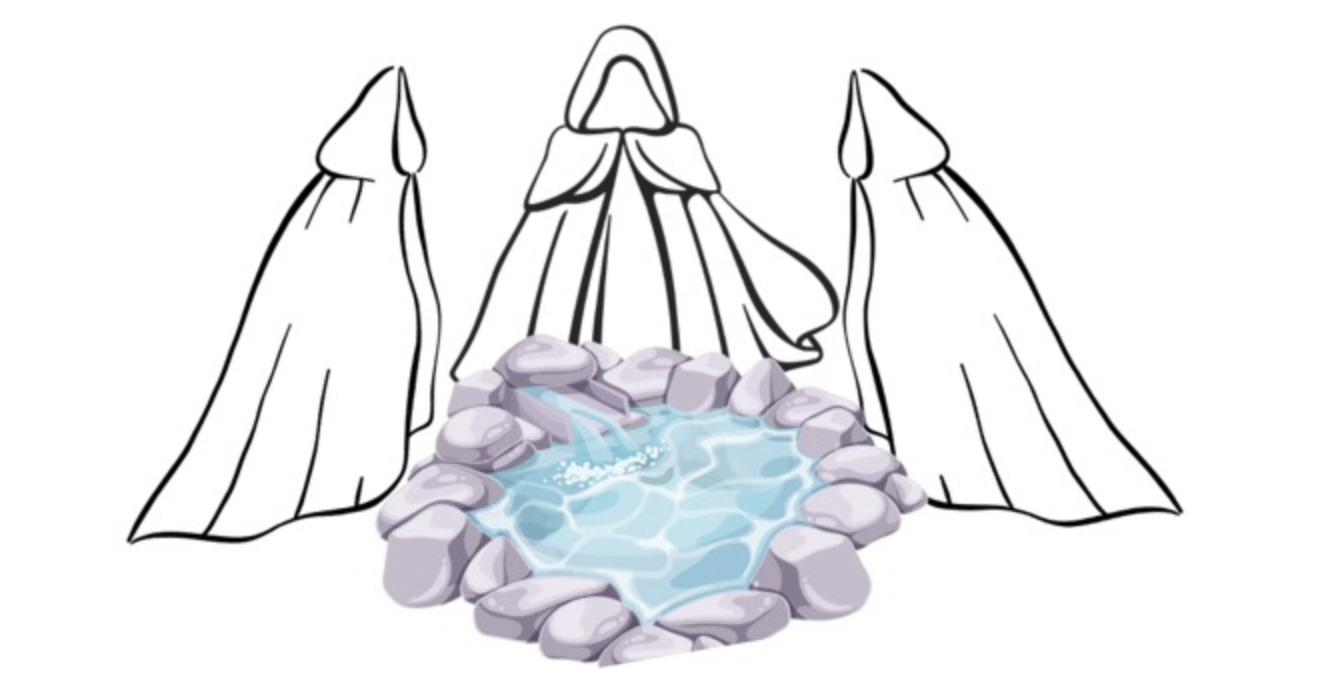
In the vision, I am sitting in front of a spring with low circular wall around it. 

Dans cette vision, je suis assise devant une source entourée d’un muret circulaire. 

From my left comes a figure in a white cape and hood. Without saying anything, she seats herself on the opposite side of the spring. I see that she is a very, very old woman. 

De ma gauche arrive une silhouette vêtue d’une cape blanche à capuche. Sans dire un mot, elle s’assoit à l’autre côté de la source. Je vois qu’il s’agit d’une femme très, très âgée.

 We sit together quietly for a while. I close my eyes.

Nous restons assises ensemble en silence pendant un moment. Je ferme les yeux.

When I open them, I see that many women in white have come.

Quand je les rouvre, je vois que de nombreuses femmes vêtues de blanc sont arrivées.

I’m so pleased to be there,  I feel full of joy. I love these women. I love being part of a circle of women sitting around a spring. I feel so blessed.

Je suis tellement heureuse d’être là,  je me sens remplie de joie. J’aime ces femmes. J’aime faire partie d’un cercle de femmes assises autour d’une source. Je me sens tellement bénie.

Then I remember something I had read the night before.

Puis je me souviens de quelque chose que j’avais lu la veille au soir.

It’s something a friend, Robert Sachs, said in a response on Facebook. His exact words don’t come to me, but what I remember is “One drop of love can overcome all the difficulties going on around you.”

C’était quelque chose qu’un ami, Robert Sachs, avait dit en réponse sur Facebook. Je ne me souvenais pas exactement de ses mots, mais ce dont je me souvenais, c’était : « Une goutte d’amour peut surmonter toutes les difficultés qui vous entourent. »

“One drop of love can overcome all the difficulties going on around you.”

« Une goutte d’amour peut surmonter toutes les difficultés qui vous entourent. »

The idea pleases me. It makes me even happier to have remembered it.

Cette idée me plaît. Je suis encore plus heureux de m’en être souvenu.

.While I’m feeling that ebullient love bubbling up inside me, and that deep, deep comfort that being loved brings, I notice a disturbance off to the right.

Alors que je sentais cet amour bouillonnant monter en moi, et ce profond réconfort que procure le fait d’être aimée, j’ai remarqué une agitation sur ma droite.

A man is coming, a man who, for his head, has the tip of a penis.

Un homme s’approchait, un homme dont la tête était remplacée par le bout d’un pénis.

So I look at him, and while I’m looking at him, lots of other guys join him from all directions. As I watch, all of their penis-heads start growing and getting bigger and bigger, and their necks are stretching longer and longer, until one of them hits another one and then suddenly they’re all bashing each other with their penises, with their long penises.

Je le regarde, et pendant que je le regarde, beaucoup d’autres hommes le rejoignent de tous parts. Alors que je les observe, leurs têtes de pénis commencent à grossir et à devenir de plus en plus grosses, et leurs cous s’allongent de plus en plus, jusqu’à ce que l’un d’eux en frappe un autre et qu’ils se mettent soudainement à se frapper les uns les autres avec leurs pénis, leurs longs pénis.

And we women, we‘re just sitting there, around the source, in meditation, in silence, holding that space.

Et nous, les femmes, nous sommes simplement assises là, autour de la source, en méditation, en silence, gardant cet espace.

And that’s the vision.

Et voilà la vision.