This morning I had a surprisingly coherent vision during my morning meditation. It has a number of the same elements as the one I call A Drop of Love here, but call the dickhead vision in less formal settings. (Read the blog about that one and you’ll see why.)
Ce matin, j’ai eu une vision étonnamment cohérente pendant ma méditation matinale. Elle comporte plusieurs éléments communs avec celle que j’appelle ici « Une goutte d’amour », mais que j’appelle « la vision du connard » dans un contexte moins formel. (Lisez l’article de blog à ce sujet et vous comprendrez pourquoi.)
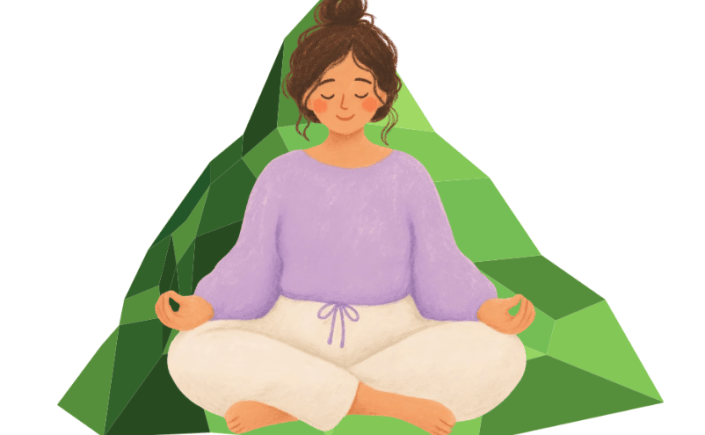
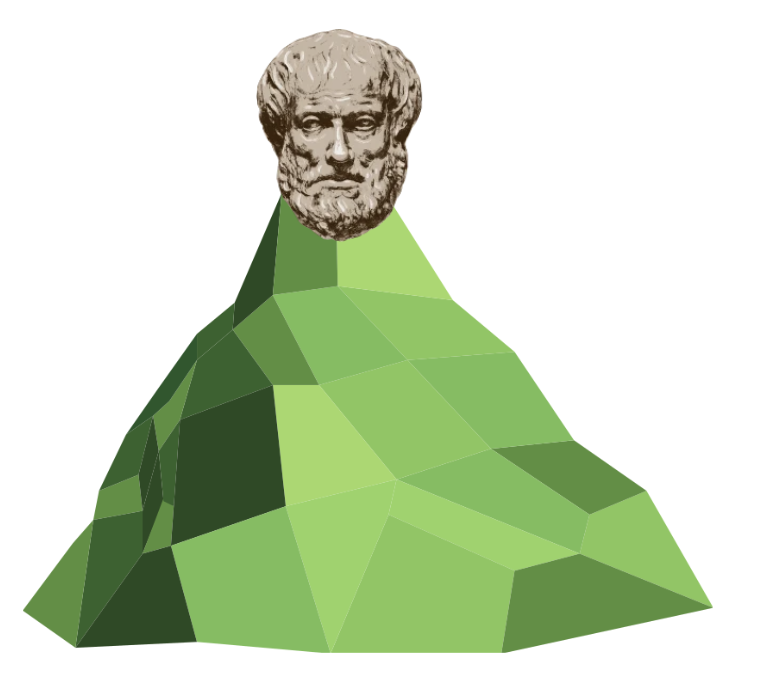
In the new vision, I can see a mountain in the distance. Most of my recent dreams have been set on a mountain, but this time I’m not at the top. I’m standing far enough away to be able to see the whole thing.
Dans cette nouvelle vision, j’aperçois une montagne au loin. La plupart de mes rêves récents se déroulaient sur une montagne, mais cette fois-ci, je ne suis pas au sommet. Je me tiens suffisamment loin pour pouvoir l’admirer dans son intégralité.
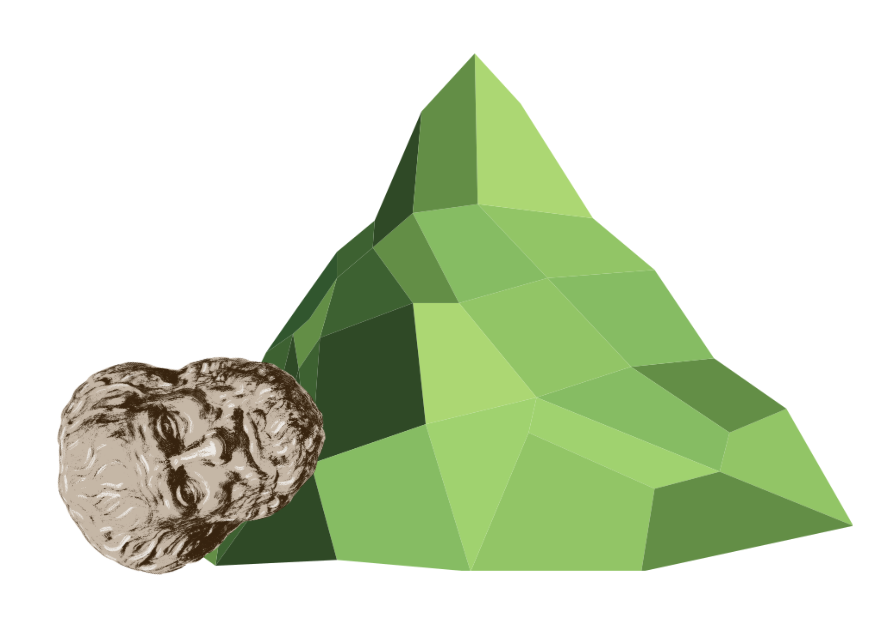
At the top, I can see a man’s head. As I watch, it grows bigger and bigger. I think, is that God? But it’s not a bearded old man – it’s a mature man with a full head of hair and rugged features. A Greek god? It continues to get bigger, like a balloon being blown up, bigger and bigger, until it’s bigger than the mountain. At last it’s so big that it tips to one side and rolls down to the bottom of the mountain.
Tout en haut, j’aperçois la tête d’un homme. À mesure que je la regarde, elle grossit de plus en plus. Je me dis : « Est-ce que c’est Dieu ? » Mais ce n’est pas un vieil homme barbu : c’est un homme d’âge mûr, avec une chevelure abondante et des traits anguleux. Un dieu grec ? Il continue de grossir, comme un ballon qu’on gonfle, de plus en plus, jusqu’à devenir plus grand que la montagne. Finalement, il est si grand qu’il bascule d’un côté et dévale la montagne jusqu’en bas.
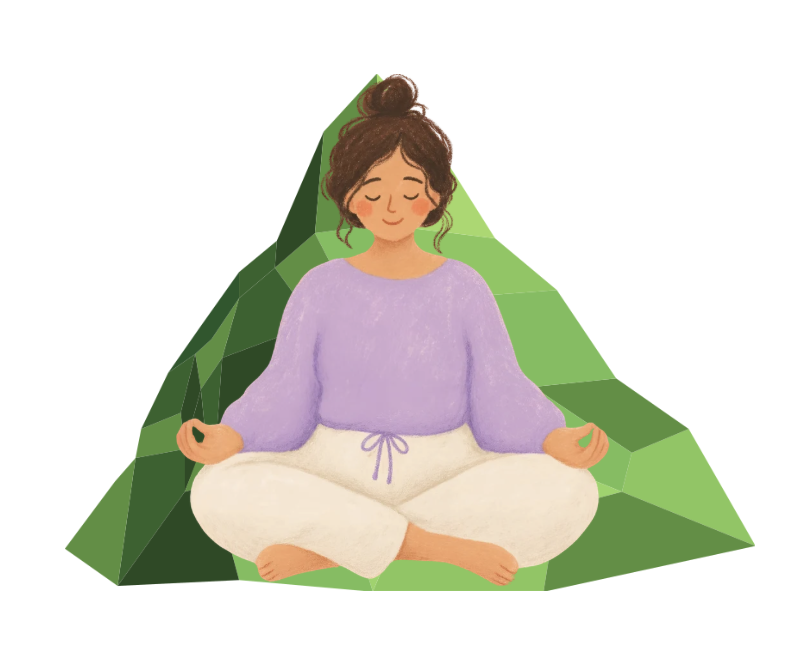
Then I am the mountain, and I sit there for a long time just being the mountain.
Alors je suis la montagne, et je reste assis là pendant un long moment, simplement en étant la montagne.
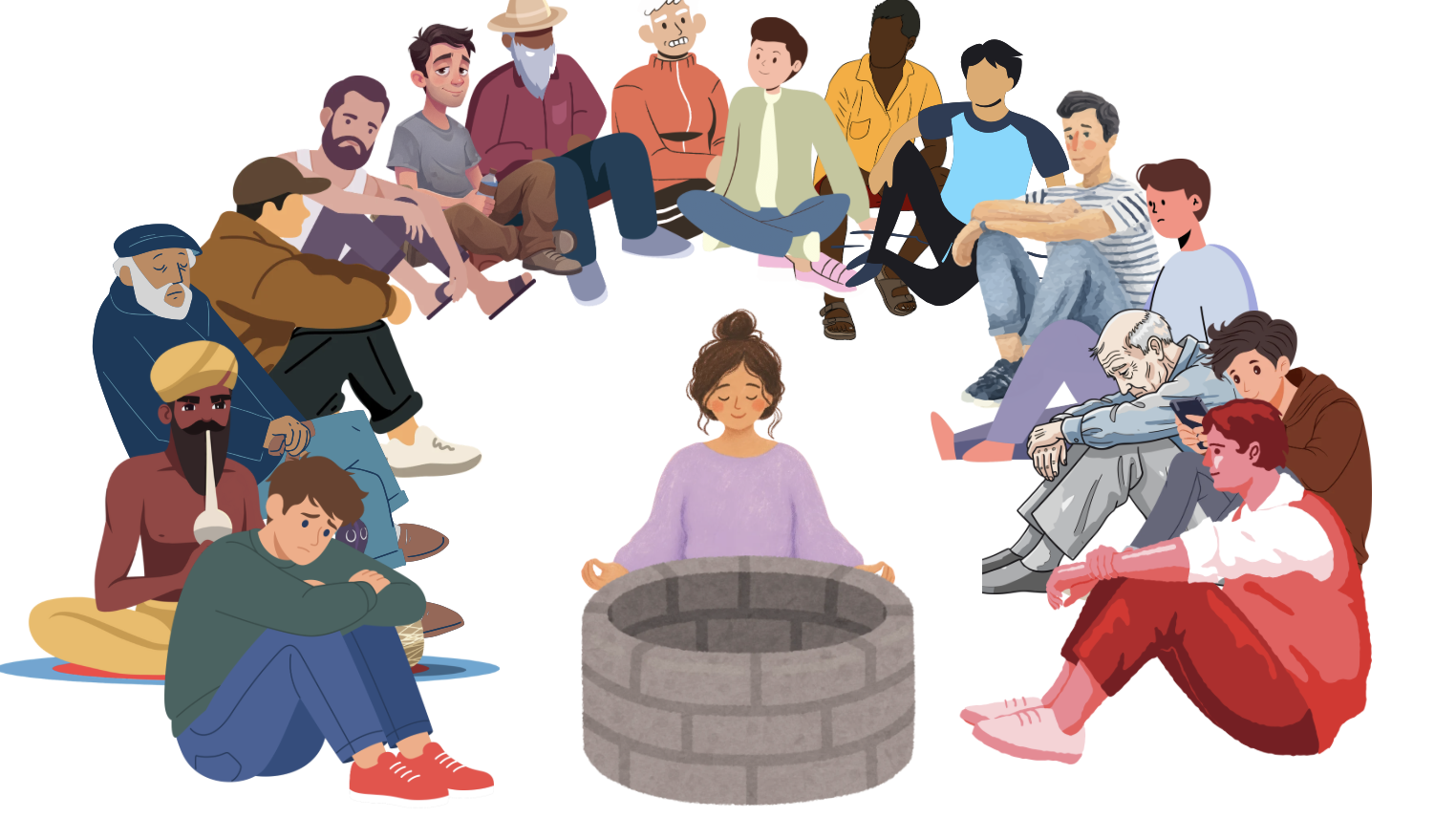
Finally I find myself inside the mountain, right at the center of the base. I’m sitting at a table across from the man who is my size now. I realize that the table is set on a well. We sit opposite each other on either side of a well comfortably. And as I look at the man, he morphs into a different man, and then a different man, and a different man, and a different man. men from all walks of life, all times and places. As each new one appears, the other ones go and sit against the inside wall of the mountain in a circle, until I am completely surrounded by the seated men and I am alone at the well.
Je me retrouve enfin à l’intérieur de la montagne, en plein cœur de la base. Je suis assis à une table en face de l’homme qui a désormais ma taille. Je me rends compte que la table est posée sur un puits. Nous sommes confortablement assis face à face, de part et d’autre du puits. Et tandis que je regarde cet homme, il se transforme en un autre homme, puis en un autre, et encore en un autre, et encore en un autre. Des hommes de tous horizons, de toutes les époques et de tous les lieux. À mesure que chacun d’entre eux apparaît, les autres s’en vont s’asseoir en cercle contre la paroi intérieure de la montagne, jusqu’à ce que je sois complètement entouré par ces hommes assis et que je me retrouve seul près du puits.
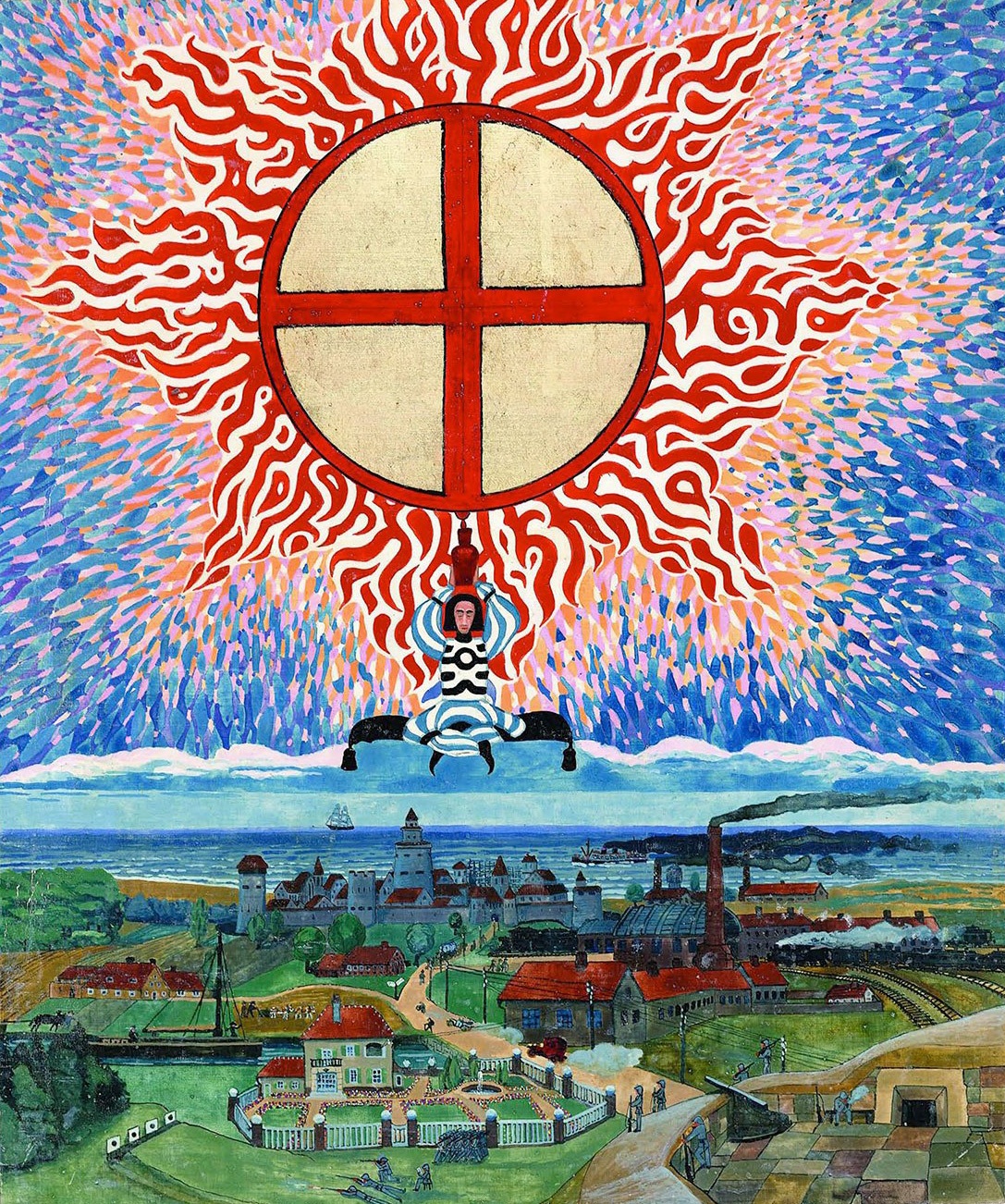
Vivre une vie symbolique : la signification de la croix solaire (3e partie)
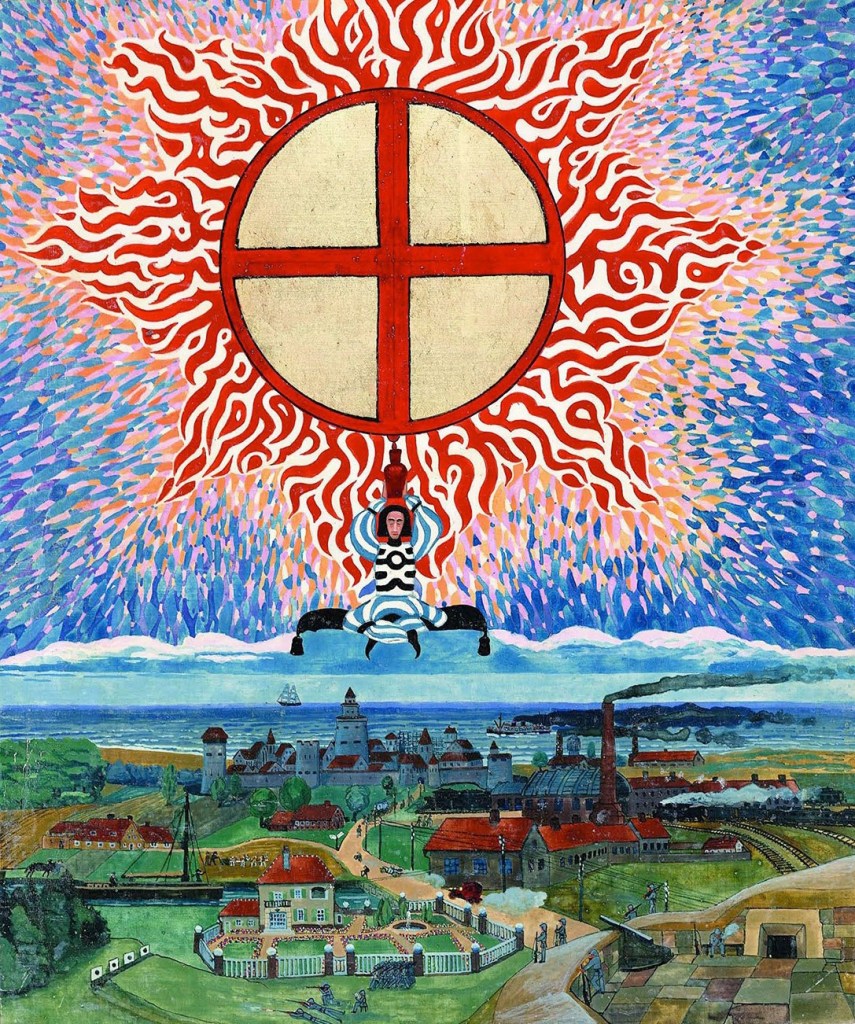
from C.G. Jung’s Red Book
Over the days and weeks leading up to the solar eclipse on August 12, 2026, I unexpectedly found myself surrounded by most of my closest women friends. They flew across the ocean to see me, they sent hand-written letters through the increasingly dysfunctional postal system, we connected in texts, video chats, phone calls, and dog walks. The depth of the gratitude I feel for each one of you and for you all for being with me is almost overwhelming. That fullness, that warmth, that love, has become a touchstone for me whenever I seek heart coherence.
Au cours des jours et des semaines qui ont précédé l’éclipse solaire du 12 août 2026, je me suis retrouvée, de manière inattendue, entourée de la plupart de mes amies les plus proches. Elles ont traversé l’océan en avion pour venir me voir, elles m’ont envoyé des lettres manuscrites via un service postal de plus en plus défaillant, et nous avons gardé le contact par SMS, appels vidéo, coups de fil et promenades avec nos chiens. La profondeur de la gratitude que je ressens envers chacune d’entre vous et envers vous toutes pour avoir été à mes côtés est presque bouleversante. Cette plénitude, cette chaleur, cet amour, sont devenus pour moi une référence chaque fois que je cherche la cohérence du cœur.
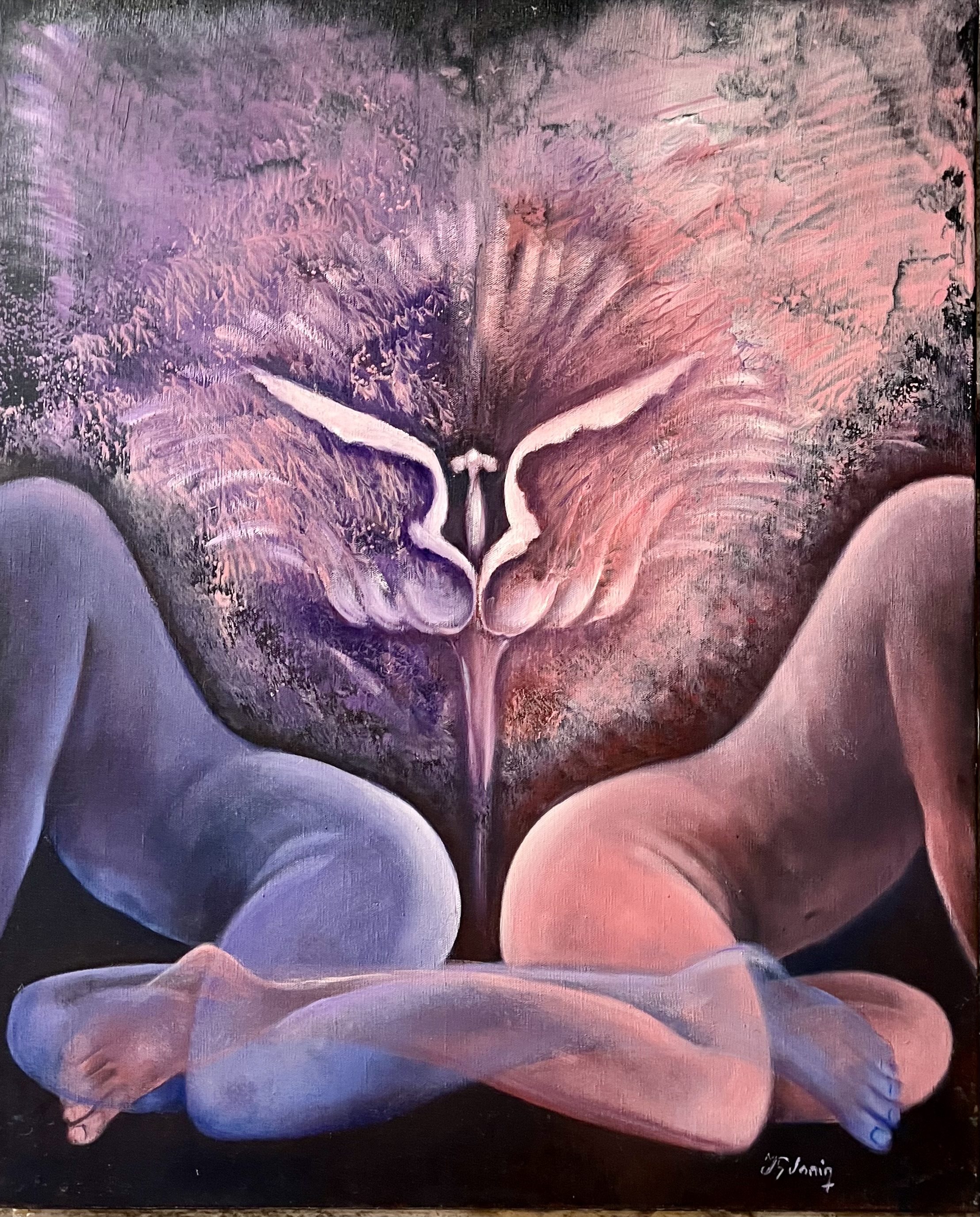
On August 8, several of us attended the opening of an exhibition of the surrealist painter Jean-Gabriel Jonin’s paintings here in my village in France, Cordes-sur-Ciel.
Le 8 août, nous étions plusieurs à assister au vernissage d’une exposition consacrée aux tableaux du peintre surréaliste Jean-Gabriel Jonin, ici même, dans mon village en France, à Cordes-sur-Ciel.
This particular series of Jonin’s works, the last he did before his death in 2014, portrays the coming together of the Sacred Feminine and Masculine. The symbolism is apparent to anyone versed in Jungian and neo-Jungian symbolism as well as tantrism in its many forms. The Masculine enters in the Feminine over and over. It’s an impressive body of work.
Cette série particulière d’œuvres de Jonin, la dernière qu’il a réalisée avant sa mort en 2014, illustre la union du Féminin et Masculin sacré. Le symbolisme est évident pour quiconque connaît bien la symbolique jungienne et néo-jungienne, ainsi que le tantrisme sous ses multiples formes. Le Masculin pénètre sans cesse dans le Féminin. C’est une œuvre impressionnante.
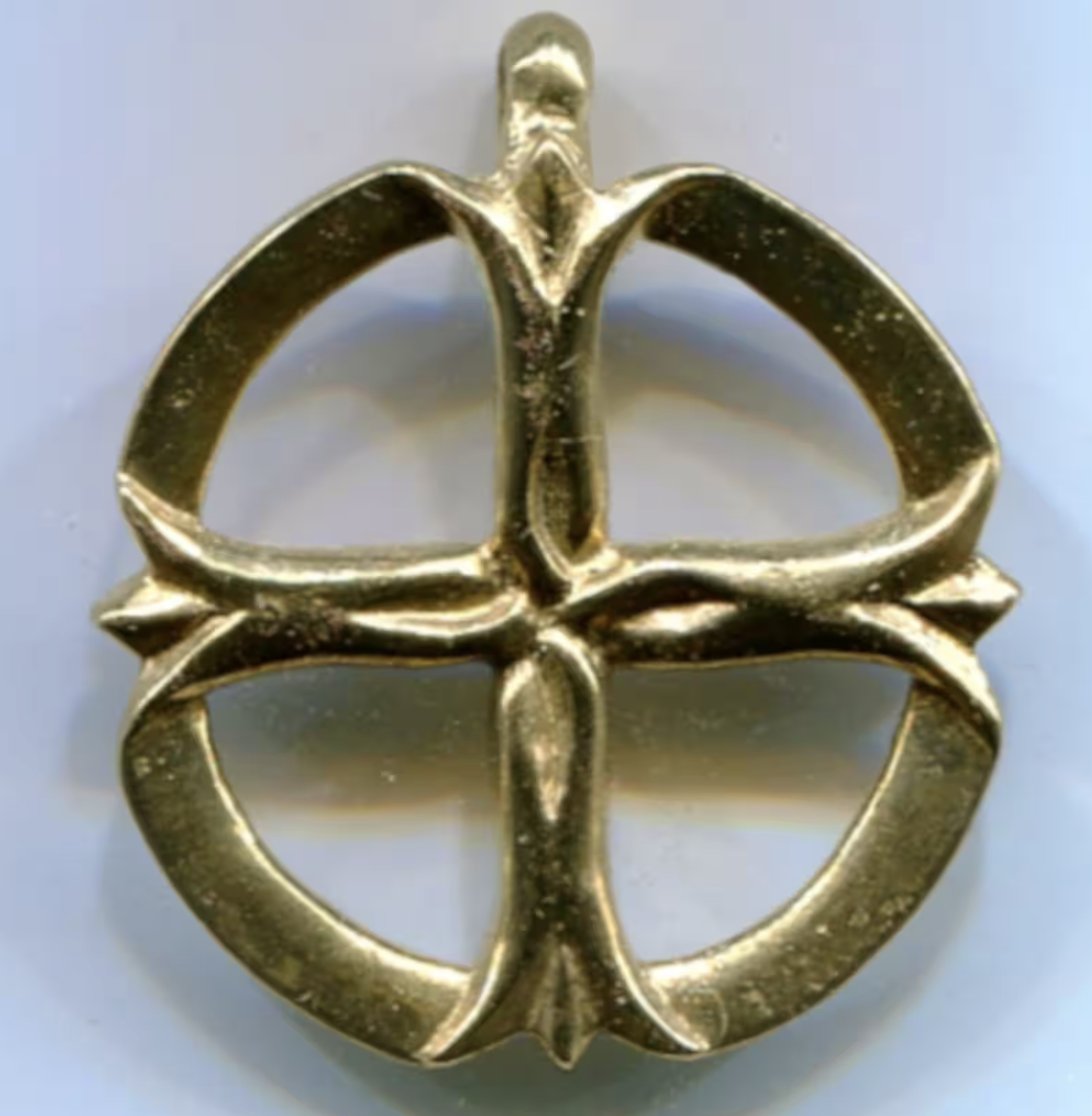
At 4 in the morning following the opening, I woke suddenly, knowing it was exactly 4, with the image of the form I explored in my previous blogs in this series, an equilateral cross in a circle, shining brilliantly on my inner eye.
À 4 heures du matin, au lendemain du vernissage, je me suis réveillé en sursaut, sachant qu’il était exactement 4 heures, tandis que l’image de la forme que j’avais explorée dans mes précédents articles de cette série – une croix équilatérale inscrite dans un cercle – brillait de mille feux dans mon œil intérieur.
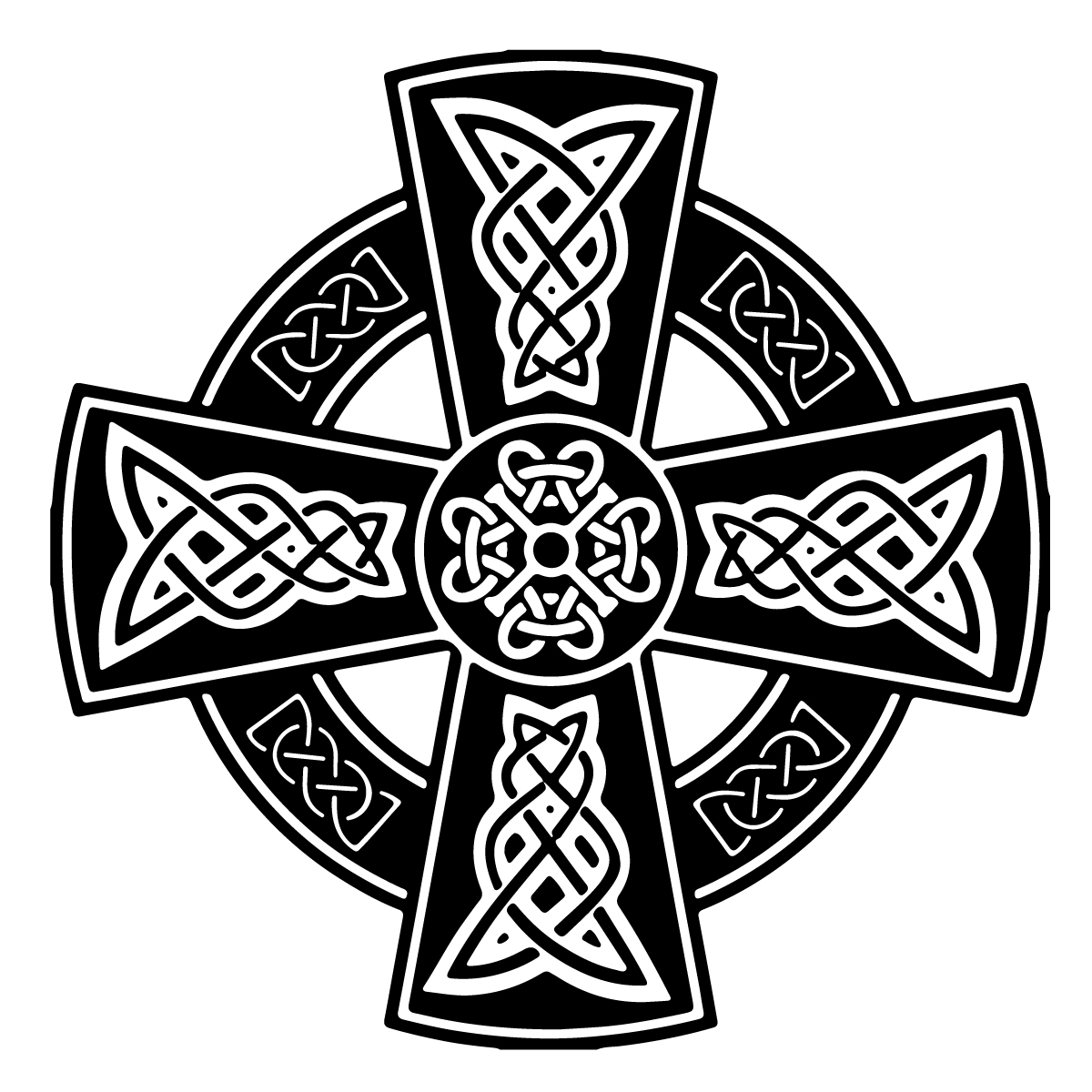
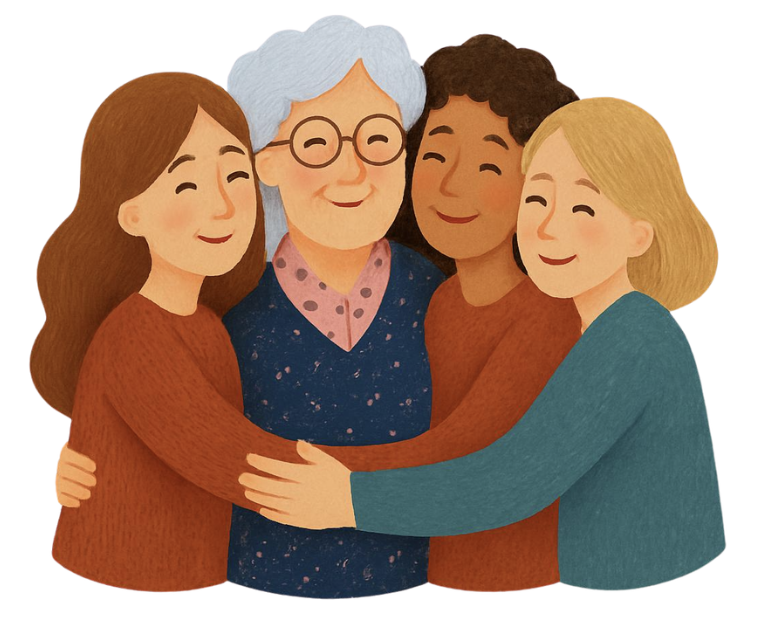
The version of the image below represents four figures in a circle, feet touching, arms open to the outside. It’s my souvenir of February 20, when three woman friends and I were in a Japanese hot tub at the exact moment the Saturn-Neptune conjunction perfected at 1° Aries.
La version de l’image ci-dessous représente quatre personnages formant un cercle, les pieds joints, les bras ouverts vers l’extérieur. C’est mon souvenir du 20 février, jour où trois amies et moi-même étions dans un bain japonais au moment précis où la conjonction Saturne-Neptune s’est réalisée à 1° du Bélier.
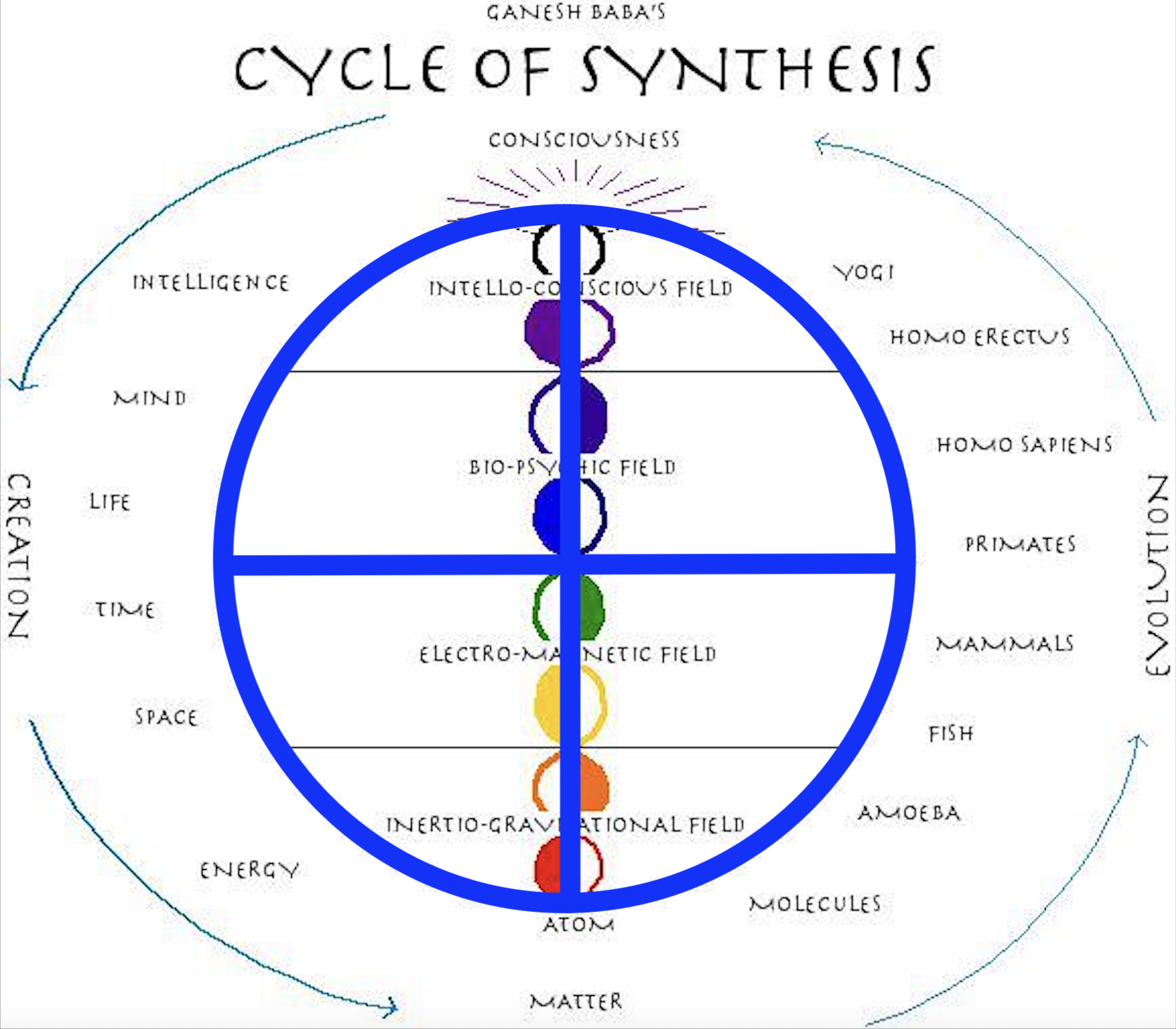
In my previous post in this series, I explore some traditional meanings associated with the cross within a circle. The straight line can represent the masculine, the circle the feminine, or the vertical line could the Masculine, the horizontal the Feminine. The center, the point of connection, is the heart. You can see the horizontal line as time, the vertical as space. The six directions, north, south, east, west, above and below are encompassed within it. It is central to my teacher Ganesh Baba’s theory of everything, Cycle of Synthesis.
Dans mon précédent article de cette série, j’ai exploré certaines significations traditionnelles associées à la croix inscrite dans un cercle. La ligne droite peut représenter le masculin, le cercle le féminin, ou bien la ligne verticale pourrait symboliser le masculin et la ligne horizontale le féminin. Le centre, le point de connexion, est le cœur. On peut considérer la ligne horizontale comme le temps, et la verticale comme l’espace. Les six directions – nord, sud, est, ouest, haut et bas – y sont englobées. Ce concept est au cœur de la théorie du tout de mon maître Ganesh Baba, le « Cycle de la synthèse ».
But I’d thought about all these things before. What came to me at 4 in the morning was the difference between the symbol of the cross in the circle and the symbolism in Jean-Gabriel Jonin’s work.
Mais j’avais déjà réfléchi à tout cela auparavant. Ce qui m’est venu à l’esprit à 4 heures du matin, c’était la différence entre le symbole de la croix dans le cercle et la symbolique présente dans l’œuvre de Jean-Gabriel Jonin.
Both represent the coming together of the Sacred Feminine and Sacred Masculine. In most traditional esoteric understandings, and in Jonin’s work, the Feminine is seen as the physical, the earth, the body, matter, and the masculine is the spirit, the unseeable, the unknowable. A single, tiny, nearly invisible sperm enters the egg. The active man shoots his life-force into the receptive woman, who holds and carries and nurtures their creation into adulthood. In Jonin’s work the Feminine Principle is depicted as the female body. The Masculine is a ray of light. His work is luminous, delightfully geometric, and rich with symbolism. The curves of the Feminine play with the lines of the Masculine.
Ces deux éléments représentent l’union du Féminin sacré et du Masculin sacré. Dans la plupart des conceptions ésotériques traditionnelles, ainsi que dans l’œuvre de Jonin, le Féminin est considéré comme le physique, la terre, le corps, la matière, tandis que le Masculin incarne l’esprit, l’invisible, l’inconnaissable. Un seul spermatozoïde, minuscule et presque invisible, pénètre dans l’ovule. L’homme actif projette sa force vitale dans la femme réceptive, qui accueille, porte et nourrit leur création jusqu’à l’âge adulte. Dans l’œuvre de Jonin, le principe féminin est représenté par le corps féminin. Le principe masculin est un rayon de lumière. Son œuvre est lumineuse, délicieusement géométrique et riche en symbolisme. Les courbes du féminin jouent avec les lignes du masculin.
The unencumbered cross in a circle offers a different interpretation of the same idea.
La croix libre, inscrite dans un cercle, propose une interprétation différente de cette même idée.
The lines are the Masculine, and the circle the Feminine. In this powerful image that has gripped my imagination for months, the Feminine is holding the Masculine.
Les lignes représentent le Masculin, et le cercle, le Féminin. Dans cette image puissante qui occupe mon imagination depuis des mois, le Féminin tient le Masculin dans ses bras.
And, at the heart of the image is the heart, the point of connection, and the doorway to other dimensions. It’s where fertilization and creation take place, where the new is born and where the old dies. It’s the ultimate möbius twist, the coming together of the opposites, the looking glass, the black hole and the newborn star.
Et, au cœur de l’image, se trouve le cœur, le point de connexion et la porte vers d’autres dimensions. C’est là que s’opèrent la fécondation et la création, là où le nouveau naît et où l’ancien meurt. C’est la torsion de Möbius par excellence, la réunion des contraires, le miroir, le trou noir et l’étoile naissante.
No wonder it’s called the Sun Cross.
Pas étonnant qu’on l’appelle la « Croix du Soleil ».
The astrological symbol for the sun is a circle with a dot at the center.
Le symbole astrologique du Soleil est un cercle avec un point au centre.
I began this piece three days before the solar eclipse, when the shadow of the moon crosses the sun.
J’ai commencé cet article trois jours avant l’éclipse solaire, lorsque l’ombre de la Lune passe devant le Soleil.
The eclipse was 92.3% complete in Cordes À Cordes, l’éclipse a atteint un taux de couverture de 92,3 %.
May the Feminine and Masculine Principles, manifest as the women and men on earth now, connect, hold each other, and work together to create a better balanced, more just, and more loving new world.
Puissent les principes féminin et masculin, qui se manifestent aujourd’hui sur Terre sous la forme des femmes et des hommes, se rapprocher, se soutenir mutuellement et œuvrer ensemble pour créer un monde nouveau, plus équilibré, plus juste et plus aimant.
I’m walking up a high hill with a group of friends, all of us carrying baskets. When the path spirals round to the top, I can see that the hill is a volcano, but it’s an inactive one, its crater a gentle dip soft with grass. More people are coming up the path and joining those already spreading blankets and tablecloths on the ground along the rim of the crater.
Je gravis une haute colline avec un groupe d’amis, et nous portons tous des paniers. Lorsque le sentier serpente jusqu’au sommet, je constate que la colline est un volcan, mais inactif : son cratère forme un léger creux recouvert d’herbe. D’autres personnes remontent le sentier et rejoignent celles qui sont déjà en train d’étaler des couvertures et des nappes sur le sol, le long du bord du cratère.
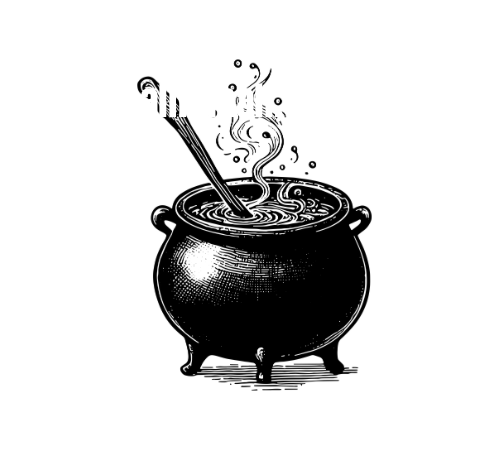
It’s my job to feed them all. There is a huge cauldron filled with something warm. I supervise some women friends who are ladling the soup (or stew?) into smaller cauldrons, which we then take around the circle to fill each of the picnickers’ bowls.
C’est à moi de les nourrir tous. Il y a un immense chaudron rempli d’un plat chaud. Je supervise quelques amies qui servent la soupe (ou le ragoût ?) à la louche dans des chaudrons plus petits, que nous faisons ensuite circuler pour remplir les bols de chacun des pique-niqueurs.
The mood is benign, cheerful, almost ebullient, though we’re all aware that it’s a volcano we’re sitting around.
L’ambiance est sereine, joyeuse, presque exubérante, même si nous sommes tous conscients que nous sommes assis au pied d’un volcan.
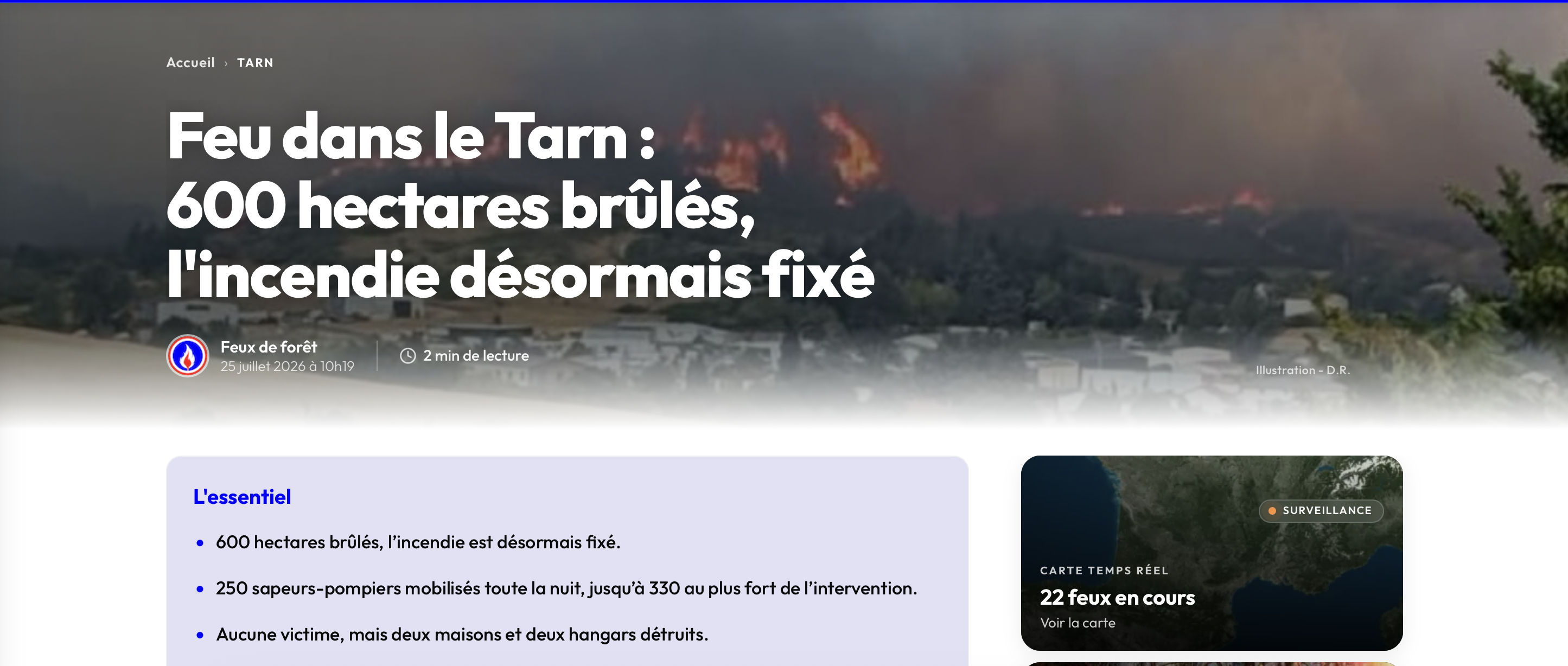
When I wake up, the sky is yellow gray with smoke from the wildfires all over southern Europe, savage wildfires as close as an hour’s drive from our little haven on a hill, Cordes-sur-Ciel. Tom is coughing. We barely glance at the news—it’s too apocalyptic.
À mon réveil, le ciel est d’un gris jaunâtre, chargé de la fumée des incendies qui ravagent tout le sud de l’Europe, des incendies dévastateurs qui font rage à peine à une heure de route de notre petit havre de paix perché sur une colline, à Cordes-sur-Ciel. Tom tousse. Nous jetons à peine un coup d’œil aux informations : c’est trop apocalyptique.
The waking world is falling into chaos. It’s fortunate that the fire nearest our place is contained, but the sister of a friend’s family has been evacuated from a much worse fire a four hour drive from here. Climate change is everywhere, we are in our sixth week of relentless heat, the wars in the Middle East and in Ukraine continue, and there are more earthquakes and erupting volcanoes along the Ring of Fire every day. Not to mention the political situation.
Le monde réel sombre dans le chaos. Heureusement, l’incendie le plus proche de chez nous est maîtrisé, mais la sœur d’un ami a dû être évacuée en raison d’un incendie bien plus grave, à quatre heures de route d’ici. Le changement climatique est omniprésent : nous en sommes à notre sixième semaine de chaleur accablante, les guerres au Moyen-Orient et en Ukraine se poursuivent, et les tremblements de terre et les éruptions volcaniques se multiplient chaque jour le long de la Ceinture de feu. Sans parler de la situation politique.
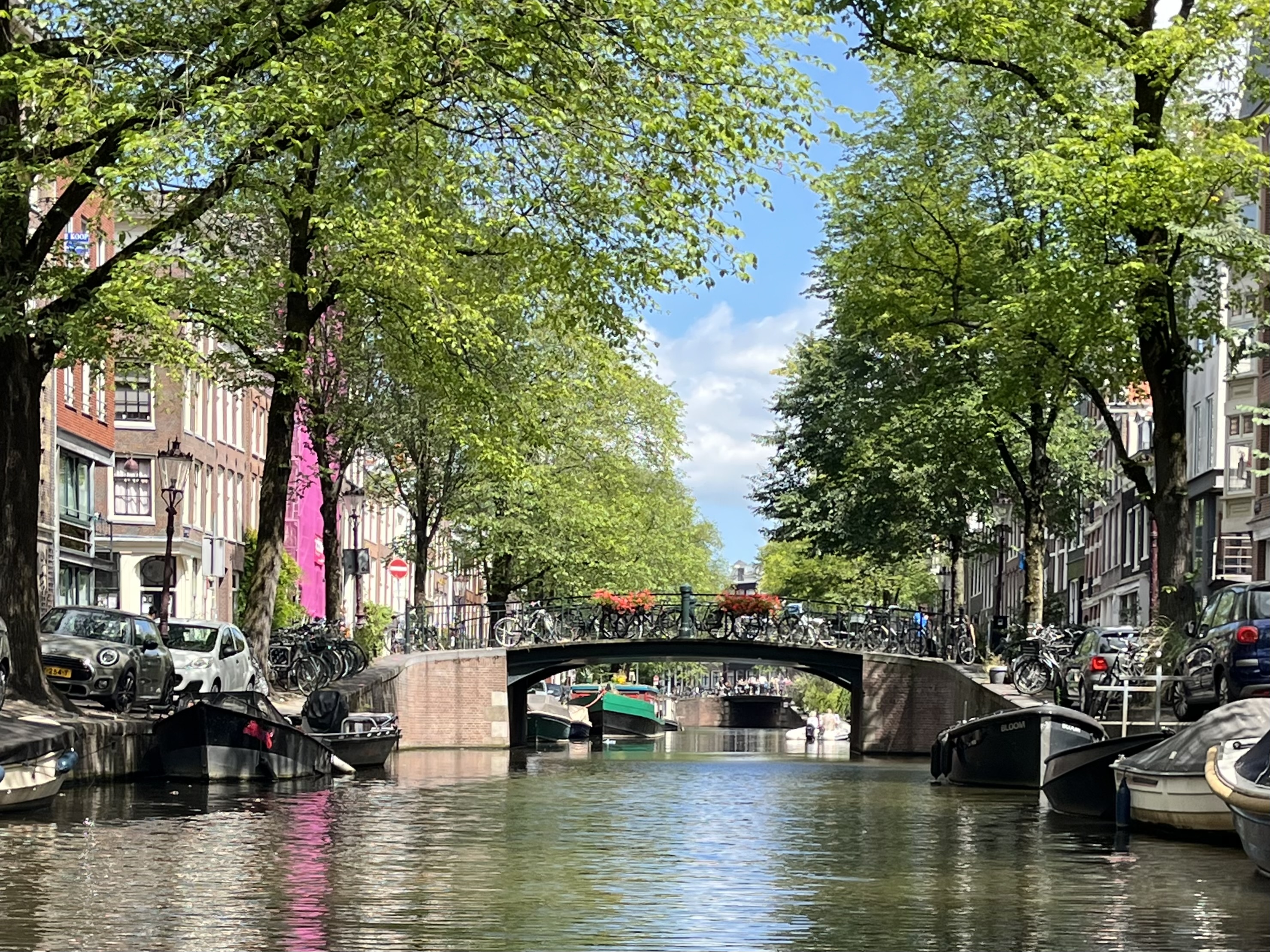
Yet Tom and I just returned from a few idyllic days in Amsterdam with family. The skies were blue and temperatures were well below the searing ones we’re enduring here.
Pourtant, Tom et moi venons tout juste de rentrer d’un séjour idyllique de quelques jours à Amsterdam en famille. Le ciel était bleu et les températures bien inférieures à celles, caniculaires, que nous subissons ici.
We were indeed picnicking on the rim of the volcano.
Nous étions effectivement en train de pique-niquer au bord du cratère du volcan.
The geometry of the dream bears further examination. There is the hill, the same one I’ve been climbing in my dreams for as long as I can remember. (I write about the series in another blog Spiral dream: Redemption, written a few years ago). At the top of the hill, there is a round indentation, grassy, but similar in form to the spring at the center of the women in white I saw in the vision which I describe in the blog called A Drop of Love, and like the spring, it is surrounded by people. In the vision, the other women and I are meditating while a battle goes on around us. In this dream, both men and women are sitting on the volcano’s rim, and the battle going on around us isn’t evident, though it’s glaring in the waking world.
La géométrie de ce rêve mérite d’être examinée de plus près. Il y a cette colline, celle-là même que je gravis dans mes rêves depuis aussi longtemps que je me souvienne. (J’ai évoqué cette série dans un autre blog intitulé « Spiral Dream: Redemption », rédigé il y a quelques années). Au sommet de la colline, il y a un creux arrondi, recouvert d’herbe, mais dont la forme rappelle celle de la source au centre des femmes en blanc que j’ai vues dans la vision que je décris dans le blog intitulé « Une goutte d’amour » ; et tout comme la source, ce creux est entouré de gens. Dans cette vision, les autres femmes et moi-même méditons tandis qu’une bataille fait rage autour de nous. Dans ce rêve, hommes et femmes sont assis sur le bord du volcan, et la bataille qui fait rage autour de nous n’est pas évidente, bien qu’elle soit flagrante dans le monde éveillé.
Symbols of the Feminine abound: the crater, the cauldrons, the bowls. We women are providing nourishment to the community.
Les symboles du féminin abondent : le cratère, les chaudrons, les bols. Nous, les femmes, nourrissons la communauté.
If the message of the vision, which I refer to fondly as “my dickhead vision,” is that women need to hold the center during period of chaos by remaining calm and focused on the deeper world, the message of this dream is that we also need to be of service by providing sustenance.
Si le message de cette vision, que j’appelle affectueusement « ma vision de con », est que les femmes doivent garder leur équilibre en période de chaos en restant calmes et concentrées sur le monde intérieur, le message de ce rêve est quant à lui que nous devons également nous mettre au service des autres en leur apportant le réconfort nécessaire.
That volcano doesn’t look like it’s about to erupt in my personal dream world, but I’d be a fool to think it’s just a hill.
Dans l’univers onirique qui m’est propre, ce volcan ne semble pas sur le point d’entrer en éruption, mais je serais bien bête de croire qu’il ne s’agit que d’une simple colline.
Get your cauldrons ready, my women friends. There will be work to do.
Préparez vos chaudrons, mes amies. Il y aura du travail à faire.
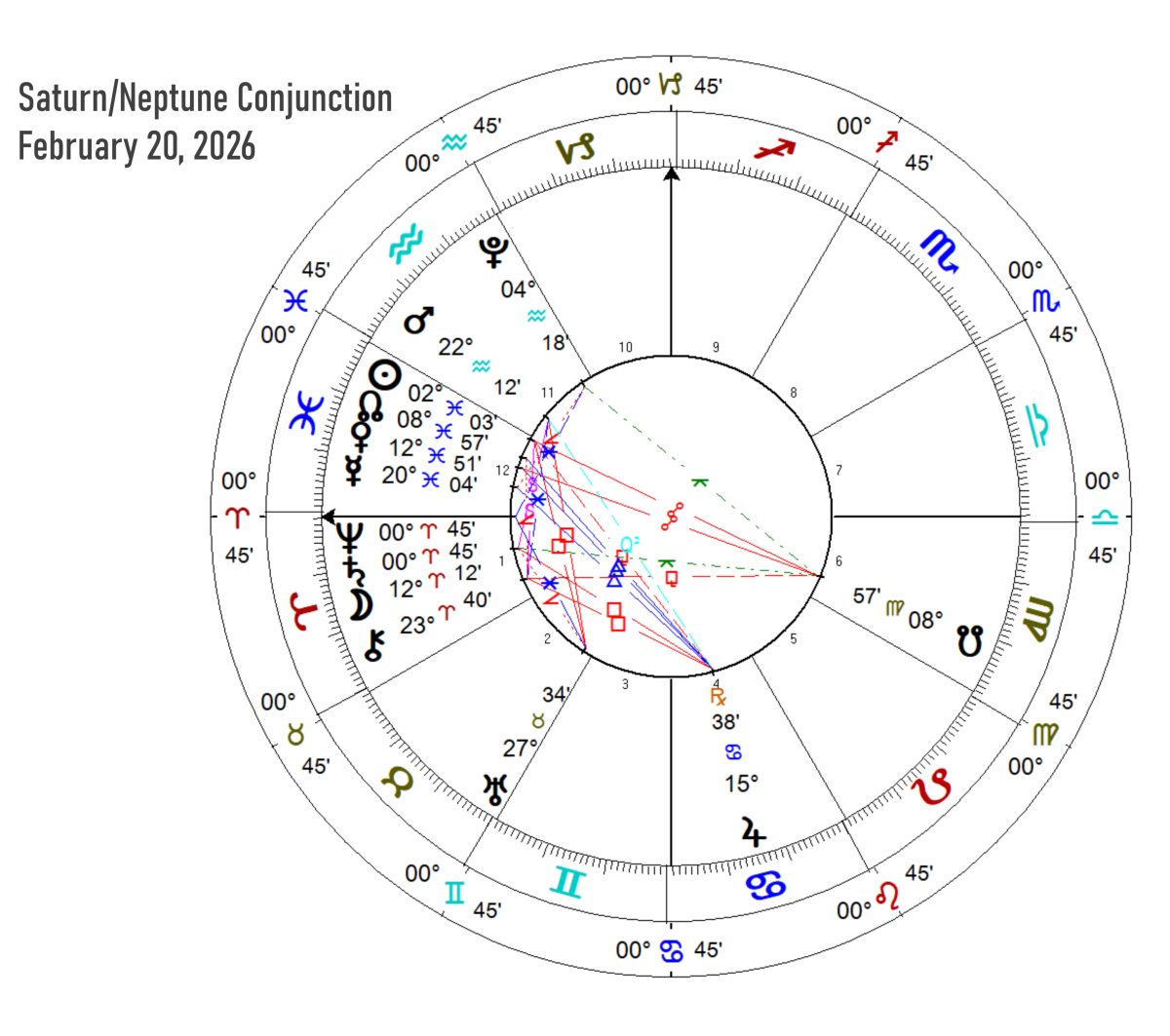
At just before six in the evening on February 20, 2026, I was immersed in a Japanese-style hot tub, perfectly round and not too hot, with three dear women friends. With our legs bobbing in the warm water in front of us, the four of us formed a Celtic cross.
It was a seminal moment. We all knew it.
At just that time, the conjunction of Neptune and Saturn was exact. Not only was it exact, which happens every 36 years, but it was exact at 0° Aries, which only happens every 6000 years.
And, not only was it exact, but it fell exactly on the north node of the moon in my birth chart. And we were at that spa at that moment to celebrate the birthday of one of the other women.
That’s a lot of astrology to unpack, and I’ll do it, but first, take a look the Sabian symbol for 0° Aries:
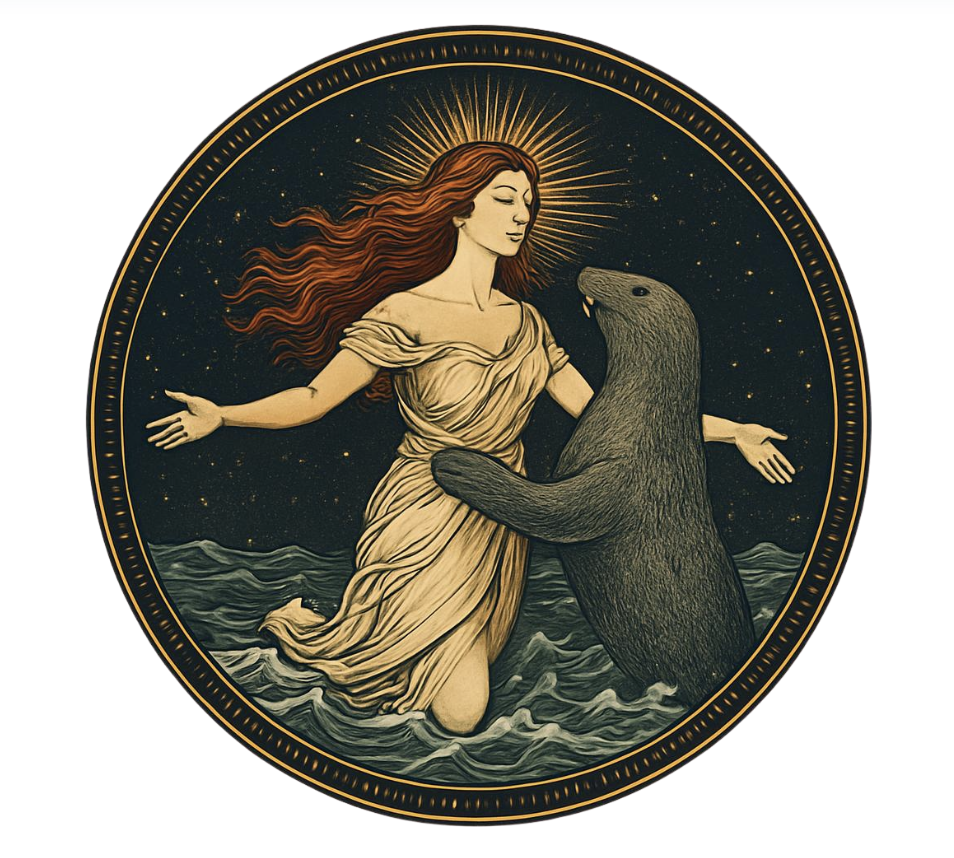
A Woman Just Risen From The Sea; A Seal Is Embracing Her
I hoped the four of us would take that moment to rise from the water and embrace, but, sadly, the water wasn’t welcoming enough for any of us to feel like submerging.
So we meditated and emerged from there to embrace.
What’s the significance of all this?
Last night I dreamed that I was deep in a forest with a group of people. We’d had to escape from somewhere and there was a question about whether we had brought the right stuff with us and whether there was enough food. It was a fairly large group of people, maybe twenty or thirty. I was at the back of the group, walking slowly with a companion. When we caught up with the others, they were cooking and eating. I was happy to see that they had roasted some chicken and that I had a choice of either a leg or a breast piece—I didn’t want them both because it seemed like too much.
Our whole civilization is entering the deep woods of uncertainty, and the question of whether we’re bringing the right things with us matters. The dream is reassuring—there’s enough chicken for us to have a choice, even if we’re the last to be served. Yet it would be a mistake to take it literally. Most of us won’t have to carry chickens along as we navigate the deep woods. We have to take some form of symbolic sustenance.
In the fall, while preparing a presentation for the Seeker’s Compass (watch it here: https://youtu.be/iQIEb5dbF9w), I remembered the profound importance of living symbolically. I’ve appreciated the idea since I was fourteen or so, when the marvelous creative writing teacher at my summer camp introduced us to the power of myth through the work of CG Jung and Joseph Campbell. (My eternal thanks go to Joe Beatty at Lighthouse Art and Music Camp). Ever since, I’ve attended to the metaphors behind details of daily life. I even studied myth at Pacifica and, in my work with Alice O. Howell, focused on seeing the sacred on the commonplace as well as on astrology—but when I used those words “living a symbolic life” in that talk, something powerful reawakened in me.
In the talk I said something like, “In these liminal times, living a symbolic life is surely one of the ways through to the next world.” It wasn’t a phrase I intended to put into that talk, which I gave several times, live and on camera, with and without notes. It wasn’t in my notes.
After the talk, I thought, huh, good thing nobody asked me a question about that—I wouldn’t have known what to say, or who to attribute it to for certain. I thought I remembered hearing it first in a talk by James Hillman at Pacifica, and had assumed it was his. It actually comes from Jung himself. InThe Symbolic Life: a collection of miscellaneous writings, he says,
You see, man is in need of a symbolic life – badly in need. We only live banal, ordinary, rational, or irrational things . . . but we have no symbolic life. Where do we live symbolically? Nowhere except where we participate in the ritual of life. . . .
Have you got a corner somewhere in your house where you perform the rites, as you can see in India? Even the very simple houses there have at least a curtained corner where the members of the household can perform the symbolic life, where they can make their new vows or their meditation. We don’t have it; we have no such corner. We have our own room, of course, – but there is a telephone that can ring us up at any time, and we always must be ready. We have no time, no place.
We have no symbolic life, and we are all badly in need of the symbolic life. Only the symbolic life can express the need of the soul – the daily need of the soul, mind you! And because people have no such thing, they can never step out of this mill – this awful, banal, grinding life in which they are “nothing but.” . . .
Everything is banal; everything is “nothing but,” and that is the reason why people are neurotic. They are simply sick of the whole thing, sick of that banal life, and therefore they want sensation. They even want a war; they all want a war; they are all glad when there is a war; they say, “Thank heaven, now something is going to happen – something bigger than ourselves!”
These things go pretty deep, and no wonder people get neurotic. Life is too rational; there is no symbolic existence in which I am something else, in which I am fulfilling my role, my role as one of the actors in the divine drama of life.
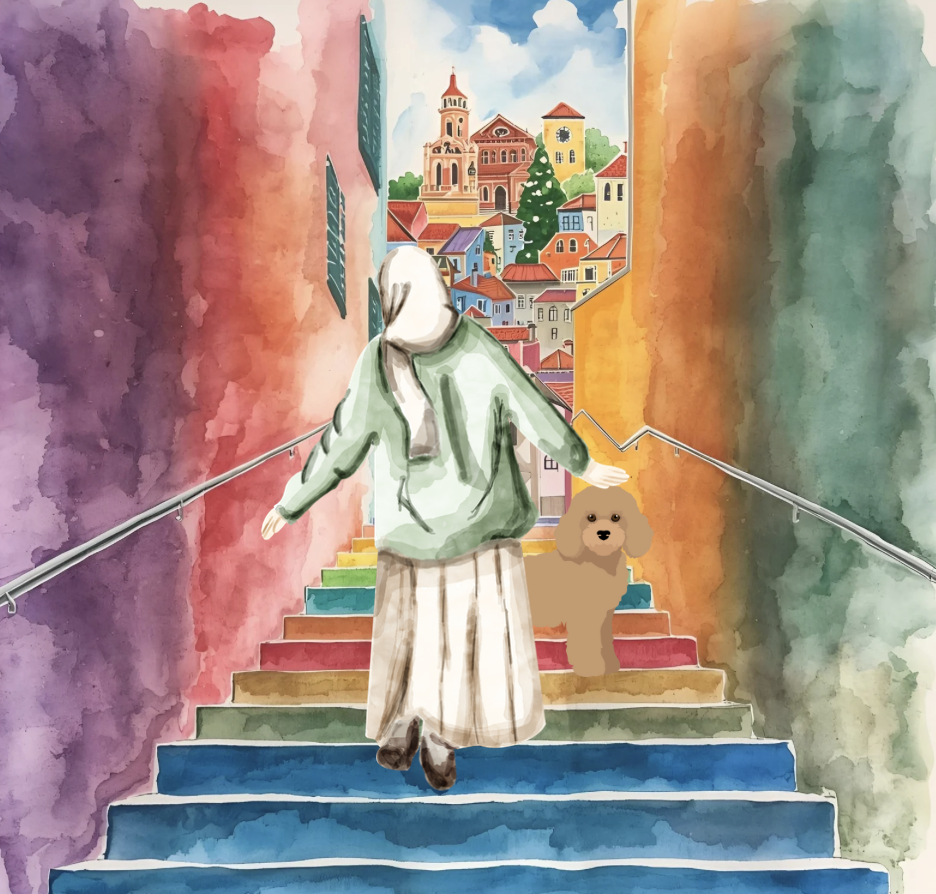
After I copied and pasted the above text into this essay, I thought I’d look for an image to illustrate the concept, maybe something from Jung’s The Red Book. The very first image that came up in my search was this one:
Over the top synchronicity.
But to return to the astrology that marked the moment: when the woods get deep and all the trees look alike, I often look up at the stars. Astrology provides a symbolic map for understanding changes in our personal and civilizational lives.
Astrology divides the celestial sphere into 12 sections or signs of 30 degrees each, for a total of 360 degrees. 0° Aries is considered the first degree of the zodiac, the threshold of a new level in the upward spiral of change. The exact passage, or conjunction, of two planets that appear to be moving slowly through the heavens, occurring at 0° Aries begs exploration.
Saturn is the furthest away of the seven “planets,” which in astrology include the sun and the moon, which are visible to the naked eye. Thus, it’s what holds the “world” together, the outer boundary, the structure.
Neptune, discovered using a telescope in 1846, was assigned the farthest out concepts of the time: imagination, illusions, dreams, the abstract, the mysterious.
The conjunction of Saturn and Neptune indicates a merger of structure with dreams.
In a birth chart, the planets are laid out on the zodiac in the position they were in at a person’s birth, each planet at a certain degree in one of the twelve segments, or signs.
In 1925, an astrologer, Marc Edmund Jones, and a clairvoyant, Elsie Wheeler, created a series of 360 images, one for each of the degrees of the zodiac. They called them the Sabian symbols. Each one is completely unique. For example, the woman rising from the sea embraced by the seal is followed by a man entertaining a group of people, and a few degrees later, by a triangle with wings.
In addition to the planets, there are other markers that are assigned meaning, among them the lunar nodes, which mark the moon’s orbit as it intersects the apparent path of the sun. The south node is said to show what a person comes into life with, and the north node what their purpose is.
One of the basic things astrologers do is to compare the position of the planets in the sky at present, or at any given time, to their positions at the time of one’s birth. Thus, I knew that the rare conjunction of Saturn and Neptune at 0° Aries coincided with the position of the north node in my birth chart at 0° Aries. When I looked up the significance of that, Astrology.com said, “When planetary transits touch your north node directly, you’ll find significant, destined events and meetings take place. The north node is uncharted terrain and unlocks the key to your life’s purpose.”
So, there I was, creating one of the four limbs of that cross in a circle at the exact moment of the structure/dream collaboration, at the exact point in time when I am supposed to come into whatever I came into this life to do. And with three dear friends, one of whose birthday was at the same time.
It’s taken too many words and too much time to get to this point in the story, so I’ll explore where the experience took me in my next post.
Today I woke up in a different world than I lived in yesterday. Granted it’s two weeks that I’ve been suffering from the terrible flu that’s going around this year, but I do feel much better. Almost myself. Yet today something new is happening. Beyond the lingering cough and minor aches and pains, there’s a delicate sense of vibrancy. My first thought was that I was feeling spring coming, that the seeds and roots, asleep underground for the winter, were waking up. Hope rekindling.
Aujourd’hui, je me suis réveillé dans un monde différent de celui dans lequel je vivais hier. Certes, cela fait deux semaines que je souffre de cette terrible grippe qui sévit cette année, mais je me sens beaucoup mieux. Je suis presque redevenu moi-même. Pourtant, aujourd’hui, quelque chose de nouveau se produit. Au-delà de la toux persistante et des douleurs mineures, je ressens une délicate sensation de vitalité. Ma première pensée a été que je sentais le printemps arriver, que les graines et les racines, endormies sous terre pendant l’hiver, se réveillaient. L’espoir renaissait.
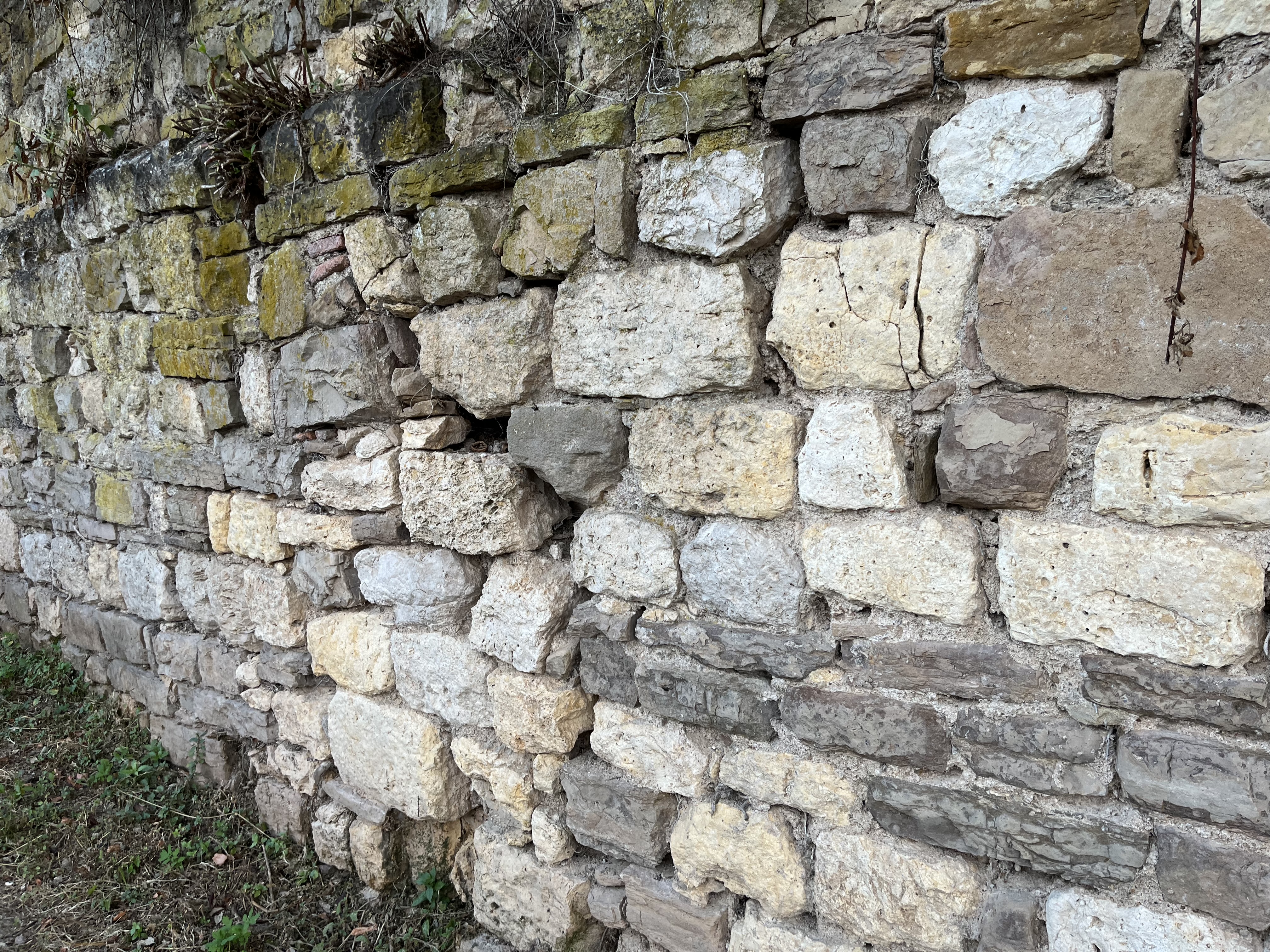
When I went out into the village to take the dog for her morning walk, the sensation expanded. “Good morning,” I said to the stones in the ancient wall as I always do. Immeasurably slowly, in a voice too deep for my ears to hear, one of the stones replied. “Good morning.”
Lorsque je suis sortie dans le village pour promener mon chien, cette sensation s’est amplifiée. « Bonjour », ai-je dit aux pierres du mur ancien, comme je le fais toujours. D’une lenteur infinie, d’une voix trop grave pour que mes oreilles puissent l’entendre, l’une des pierres m’a répondu : « Bonjour ».
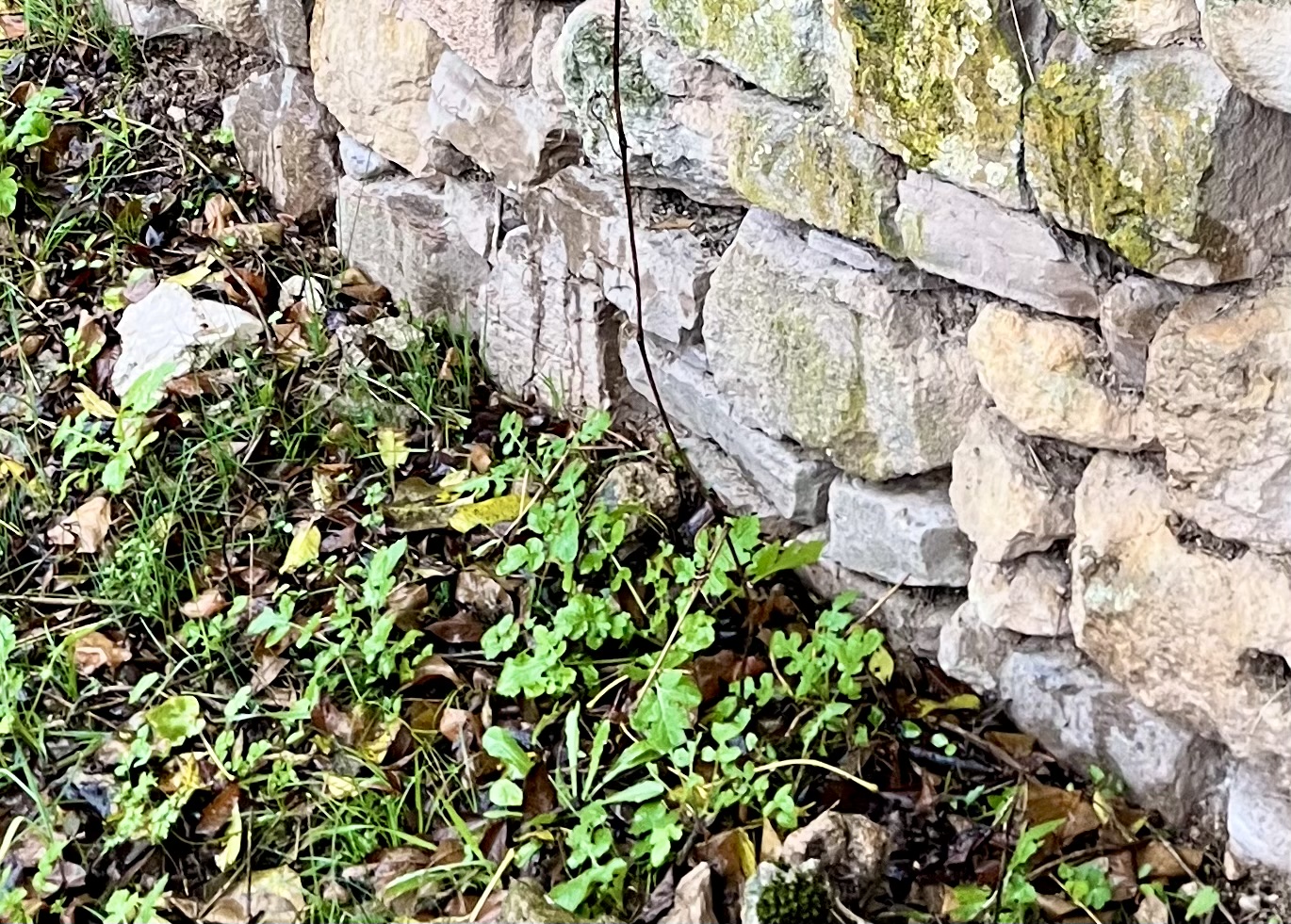
“Hello! Hello! Hello” I felt the leaves of little plants at the foot of the wall tinkle. “Hello!” I answered, tickled by the vibration.
« Bonjour ! Bonjour ! Bonjour ! » Je sentais les feuilles des petites plantes au pied du mur vibrer. « Bonjour ! » répondis-je, chatouillé par la vibration.
Over the next few moments, everything around me reached out to greet me. I barely have words to describe it. Rich, orchestral, multi-layered, subtle, vibrant, exciting, joyous. I couldn’t get enough. It lasted through our whole walk. I felt embraced, engulfed, held, welcomed by an enchanted world.
Au cours des instants qui ont suivi, tout ce qui m’entourait s’est mis à m’accueillir. Je n’ai pas vraiment les mots pour décrire ça. C’était riche, orchestral, complexe, subtil, vibrant, exaltant, joyeux. Je n’en avais jamais assez. Ça a duré tout le long de notre balade. Je me sentais enlacé, enveloppé, soutenu, accueilli par un monde enchanté.
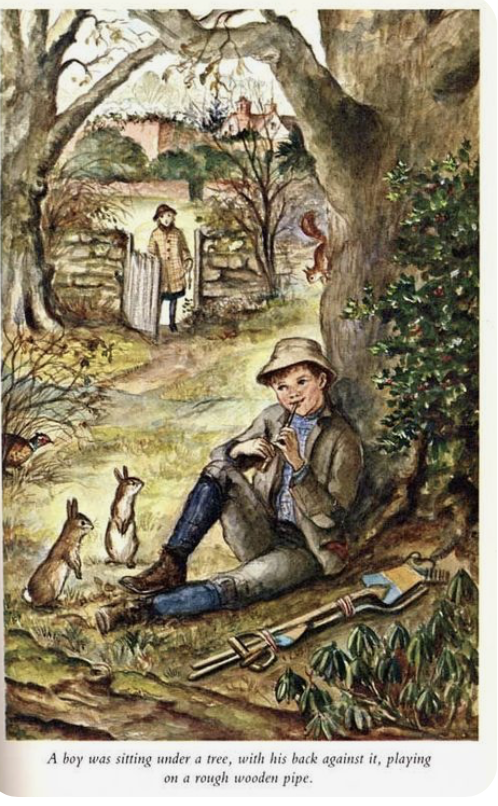
It’s something I’ve wished for as long as I can remember, the world of make-believe I lived in as a solitary child surrounded by dolls, stuffed animals, and toys who all talked. When I outgrew that world, I longed to be like Dickon in The Secret Garden who talked with the animals.
C’est quelque chose que j’ai toujours souhaité, depuis aussi longtemps que je me souvienne : le monde imaginaire dans lequel je vivais quand j’étais une enfant solitaire, entourée de poupées, d’animaux en peluche et de jouets qui parlaient tous. Quand j’ai dépassé cet âge, j’ai rêvé d’être comme Dickon dans Le Jardin Secret, qui parlait avec les animaux.
The Secret Garden, illustration by Tasha Tudor
One of the best parts of visiting Alice O. Howell in her handsome Victorian home in Monterey, Massachusetts, was seeing in person the hand-decorated signs on objects everywhere with their names on them. The names were very clever, often delightfully metaphorical, always charming, sometimes so funny you’d laugh every time you remembered them. Which, unfortunately, I don’t. My favorite of Alice’s books has always been been The Dove in the Stone, which I find speaks to the re-enchantment of the world in more comprehensible language than much of the post-Jungian work on the same subject.
L’un des meilleurs moments de ma visite chez Alice O. Howell, dans sa magnifique maison victorienne de Monterey, dans le Massachusetts, a été de voir de mes propres yeux les étiquettes décorées à la main apposées sur tous les objets, avec leur nom inscrit dessus. Les noms étaient très ingénieux, souvent délicieusement métaphoriques, toujours charmants, parfois si drôles qu’on ne pouvait s’empêcher de rire chaque fois qu’on s’en souvenait. Ce qui, malheureusement, n’est pas mon cas. Mon livre préféré d’Alice a toujours été The Dove in the Stone, qui, selon moi, parle du réenchantement du monde dans un langage plus compréhensible que la plupart des ouvrages post-jungiens sur le même sujet.
Since Mocha and I have been home, the sensation of all-encompassing aliveness has barely abated. “Have a glass of water,” called the faucet as I was taking off my shoes. And I did, greeting and thanking the glass that held the sparkling. living liquid. feeling the water’s aliveness as it traveled through my body.
Depuis que Mocha et moi sommes rentrés à la maison, cette sensation de vitalité omniprésente ne s’est pratiquement pas atténuée. « Bois un verre d’eau », m’a invité le robinet alors que j’enlevais mes chaussures. C’est ce que j’ai fait, en saluant et en remerciant le verre qui contenait ce liquide vivant et pétillant, tout en ressentant la vitalité de l’eau qui parcourait mon corps.
Iain McGilchrist would say that such a sense of connectedness, of amity, of being part of the family of everything, resides in the right brain. It is endemic to the top half of the Cycle of Synthesis, which I’ve been exploring in a recent series of talks.
Iain McGilchrist dirait qu’un tel sentiment d’appartenance, d’amitié, de faire partie de la famille de tout, réside dans le cerveau droit. Il est endémique à la moitié supérieure du Cycle de Synthèse, que j’ai exploré dans une récente série de conférences.
As I write, the feeling is fading a bit, becoming background to a more ordinary foreground.
Au moment où j’écris, ce sentiment s’estompe quelque peu, passant à l’arrière-plan pour laisser place à un premier plan plus ordinaire.
I hope. I believe, I trust, it will come back.
J’espère. Je crois, j’ai confiance, cela reviendra.