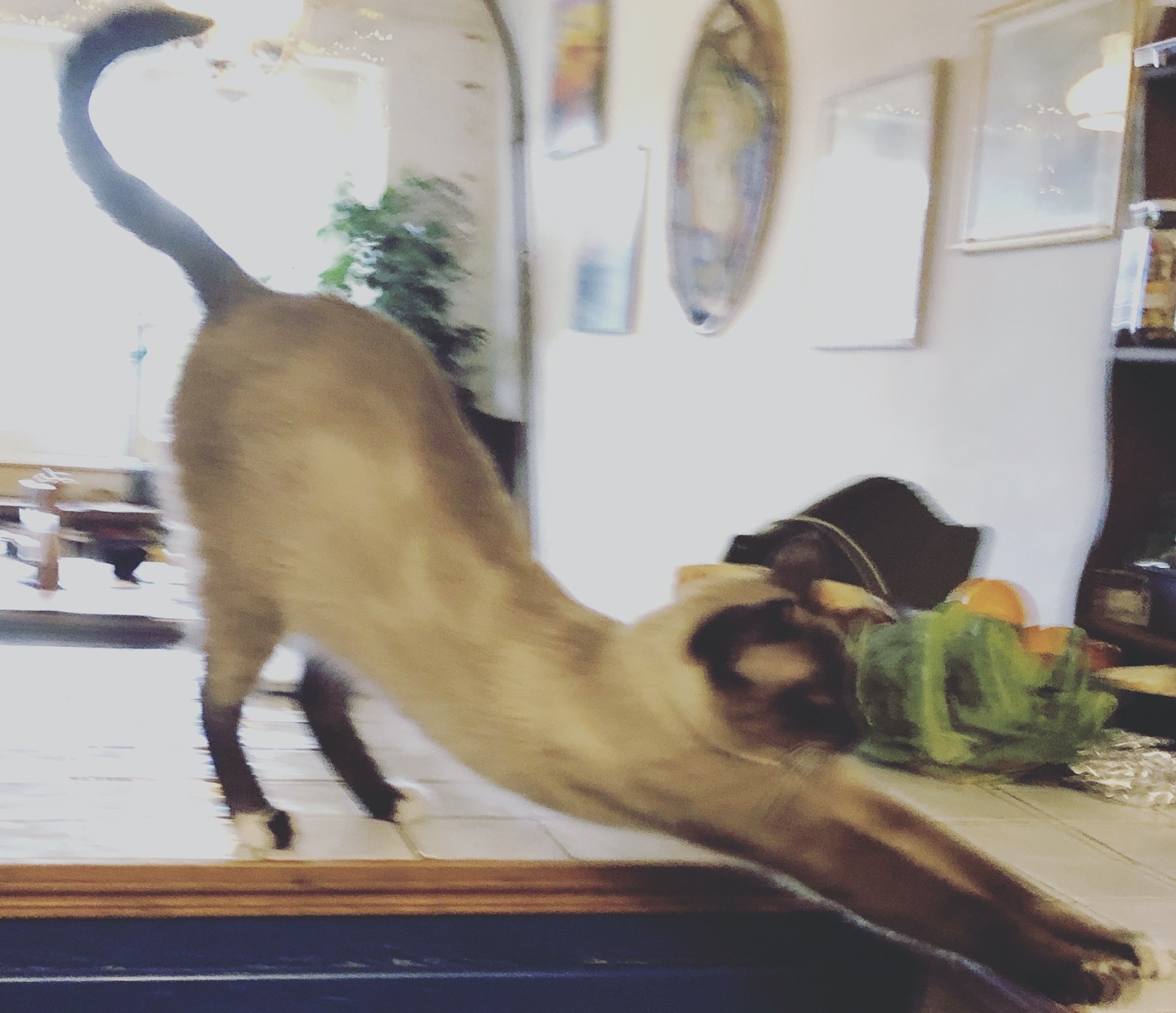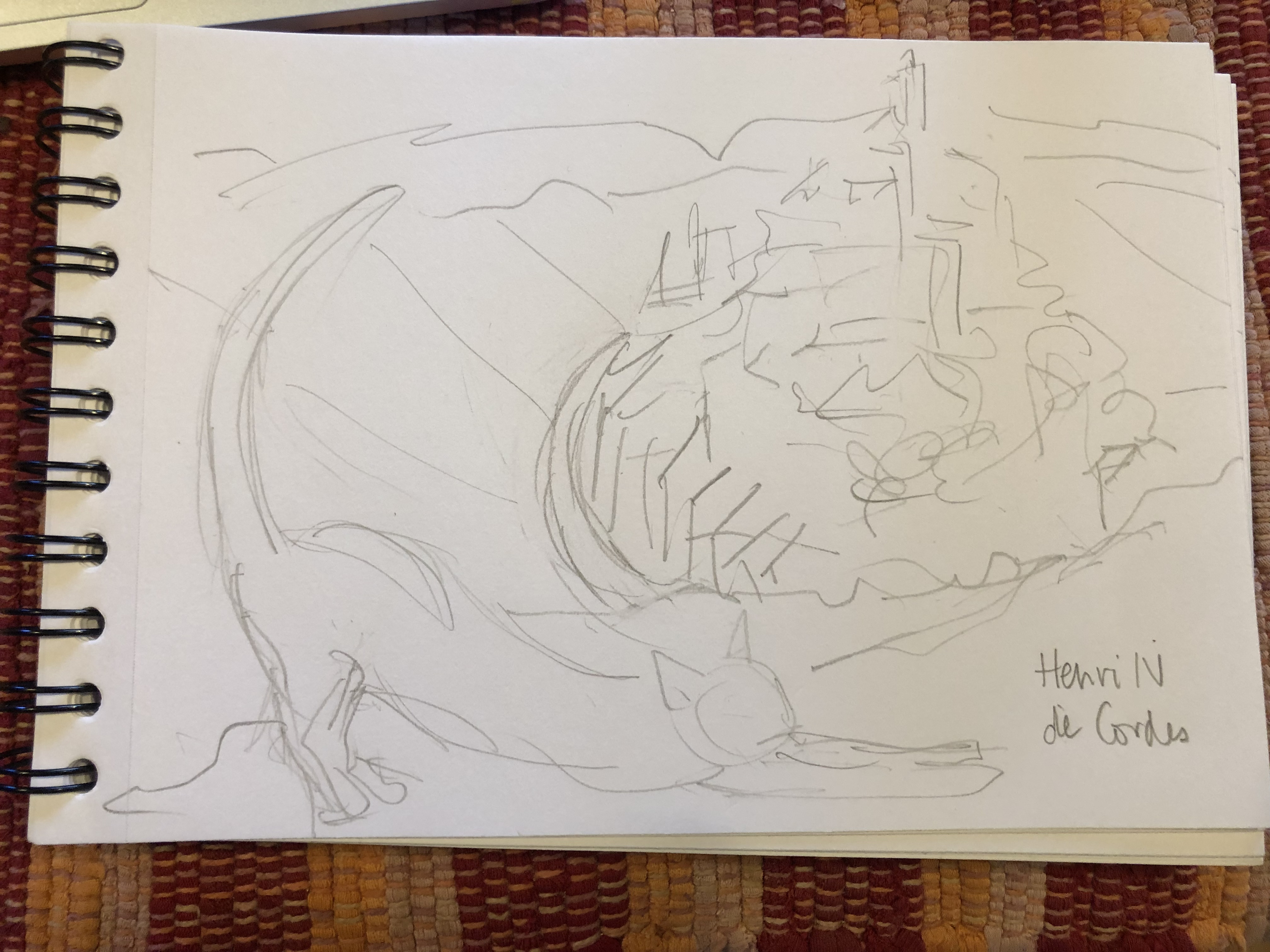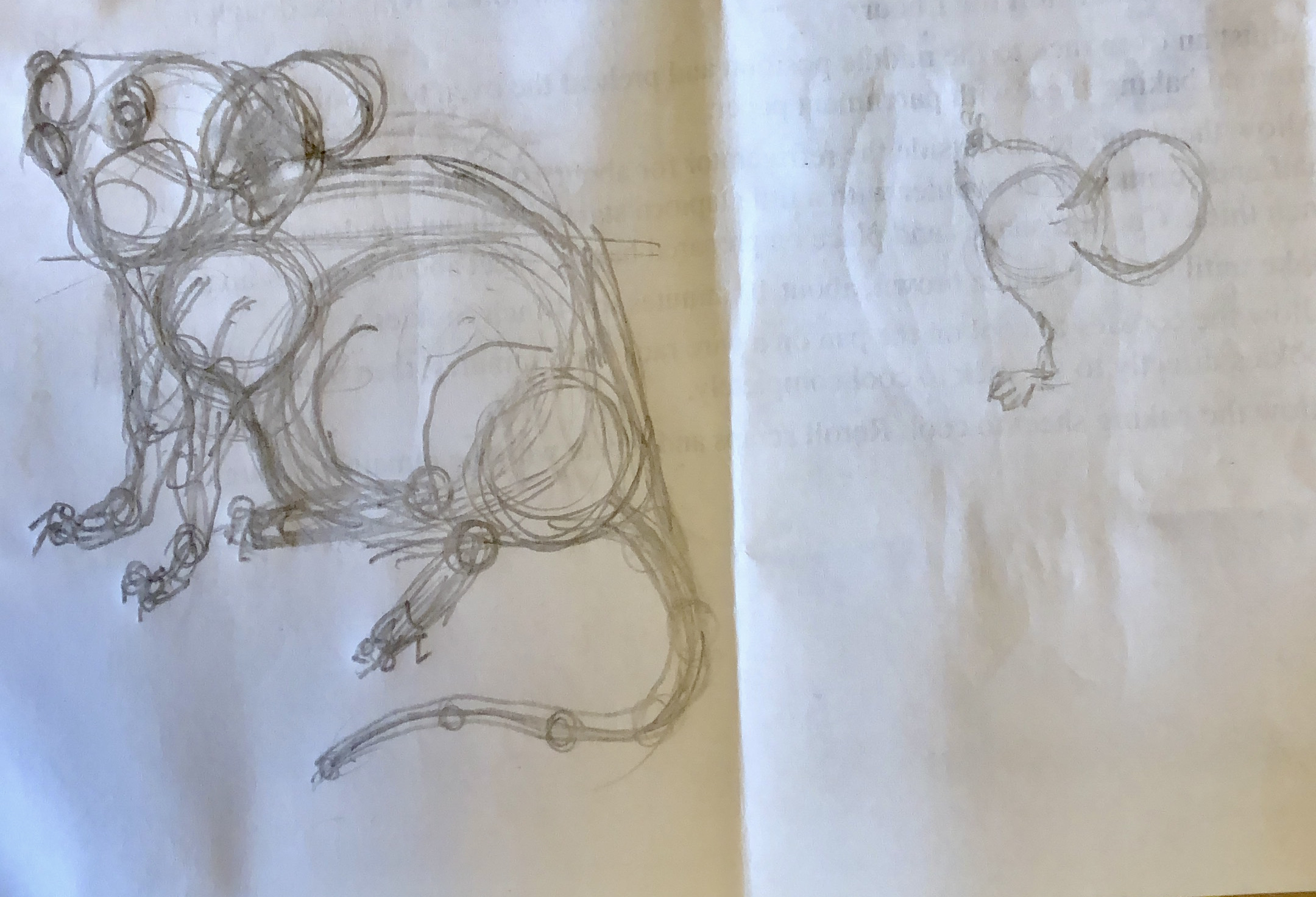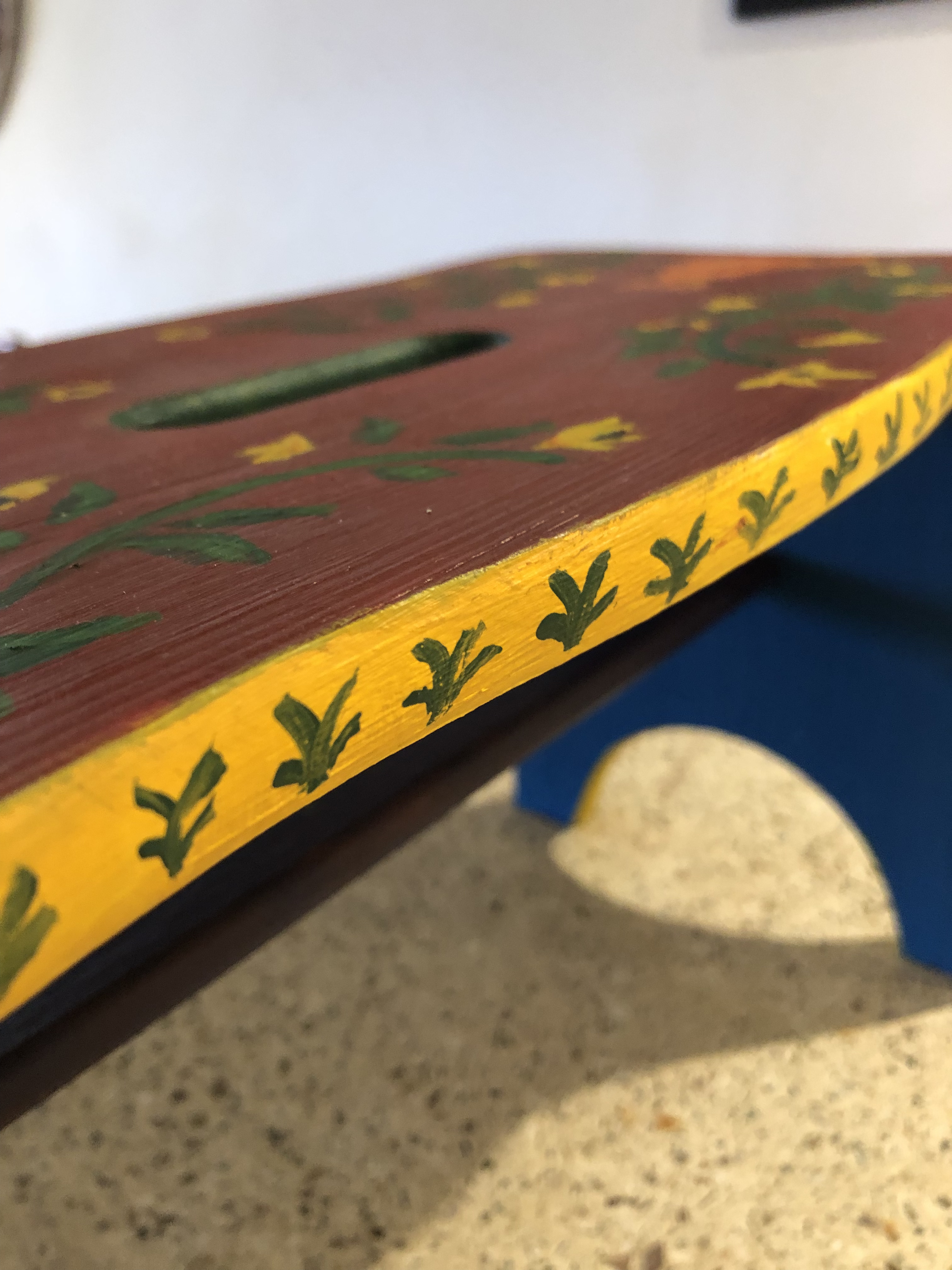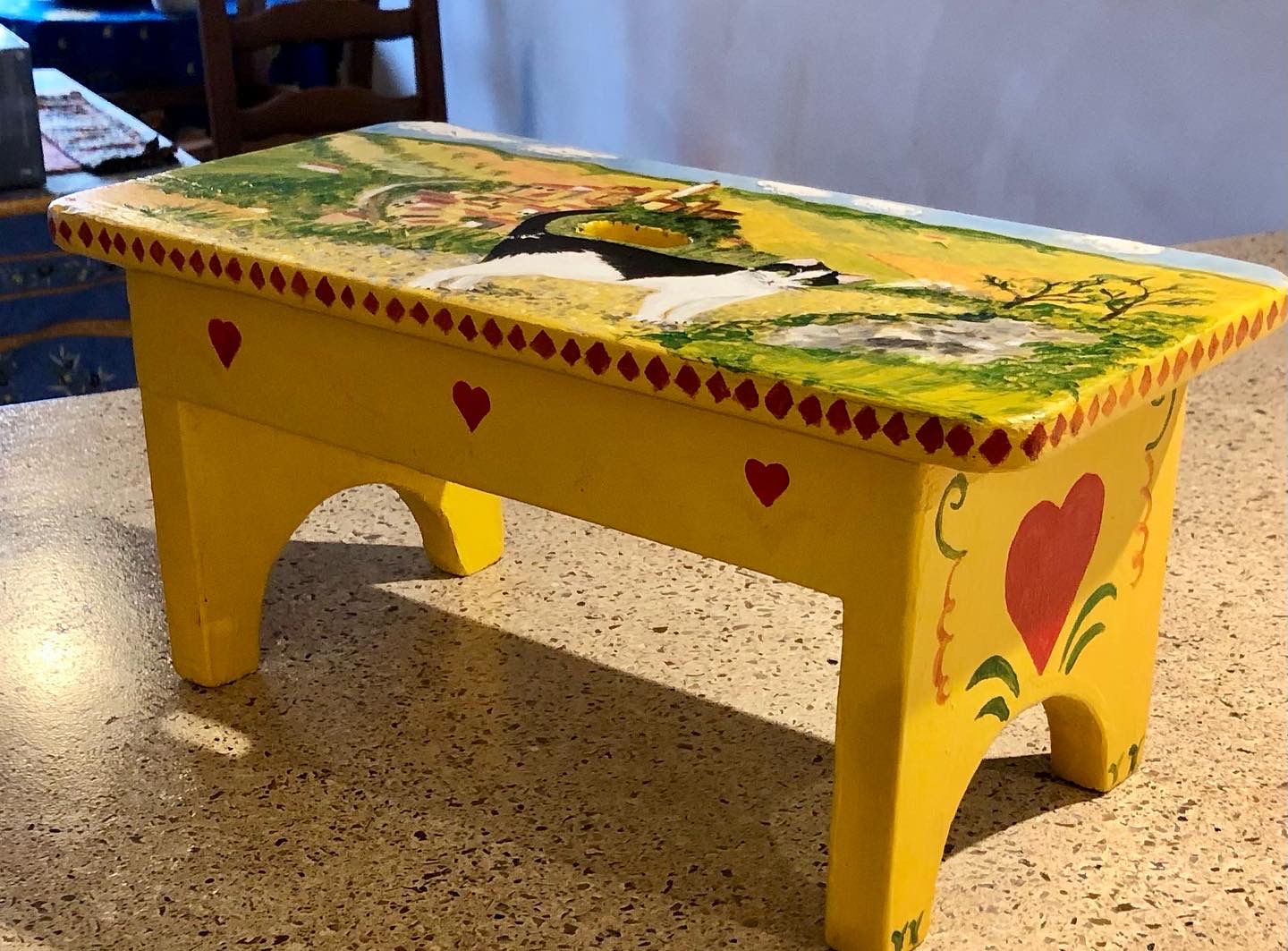
I’ve recently begun a series of painted footstools featuring cats. This is the first one.After choosing which stool I want to paint – I have a few on hand, some new, some old – I practice drawing the images I’ll put on it, and I start a search for the right quotation or poem for the bottom.
Then I paint the stool using acrylics. If I’m working on a stool for someone, I try to choose the right colors. Once the color is dry I begin on the design, usually on paper first and then on the stool.
Usually I add folk art designs at the end.
The second one in the series is in spring colors.
And now I’m beginning the sketches for the third one.
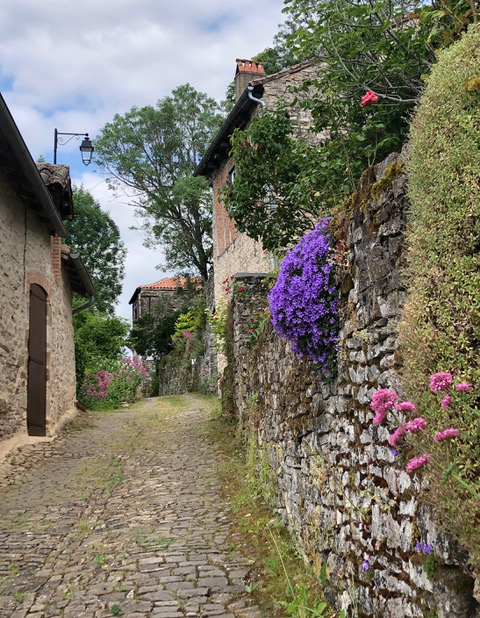
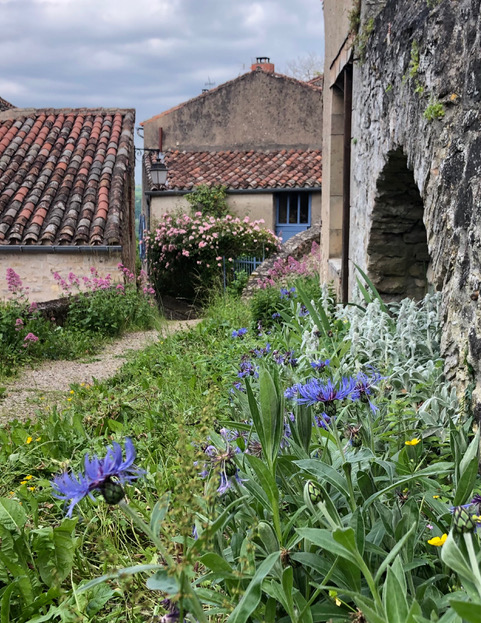
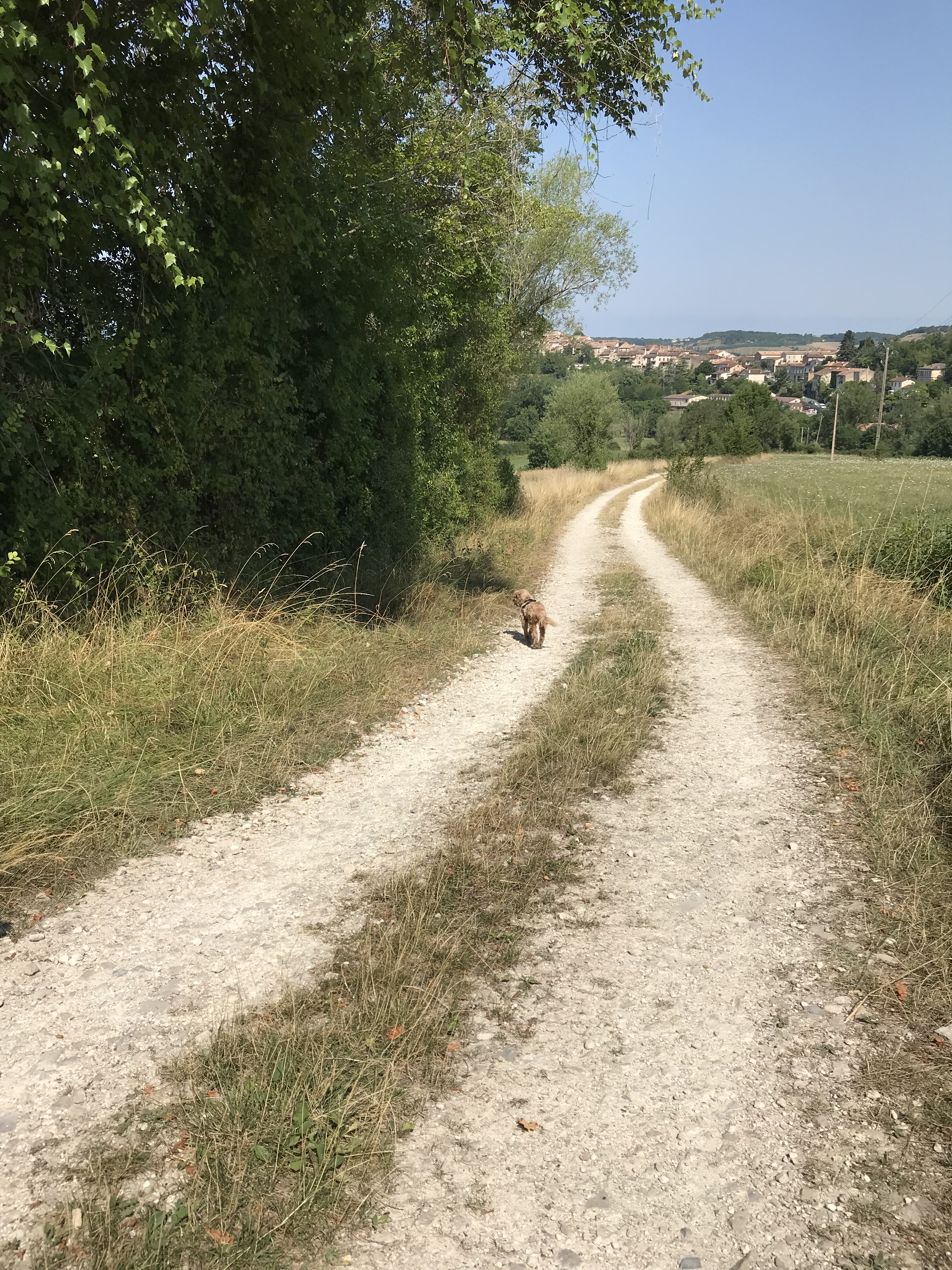
Please join me and Mocha on our walk around the village this afternoon.
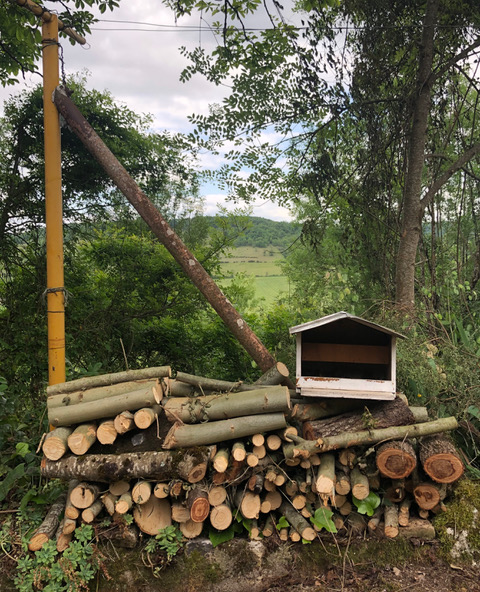
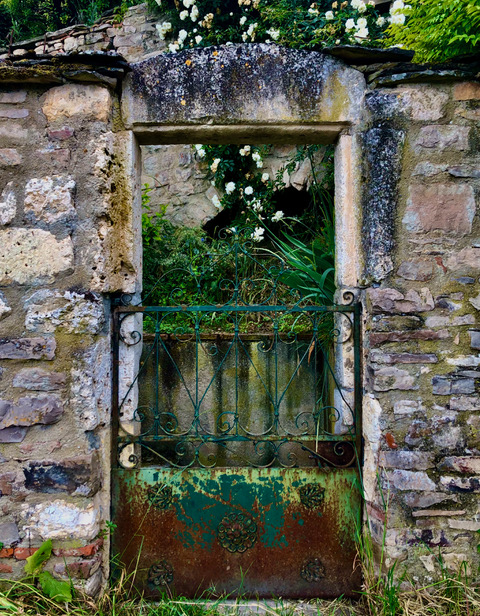
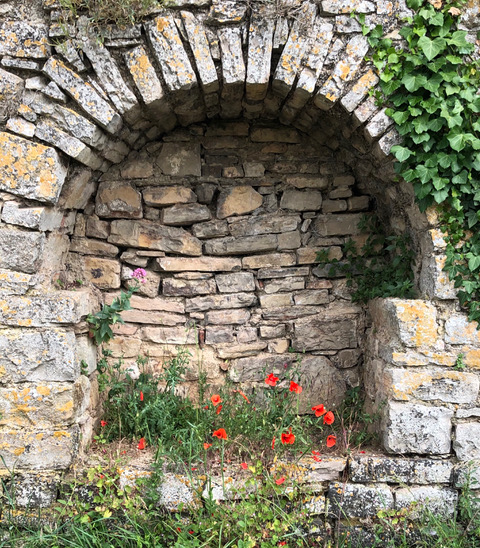
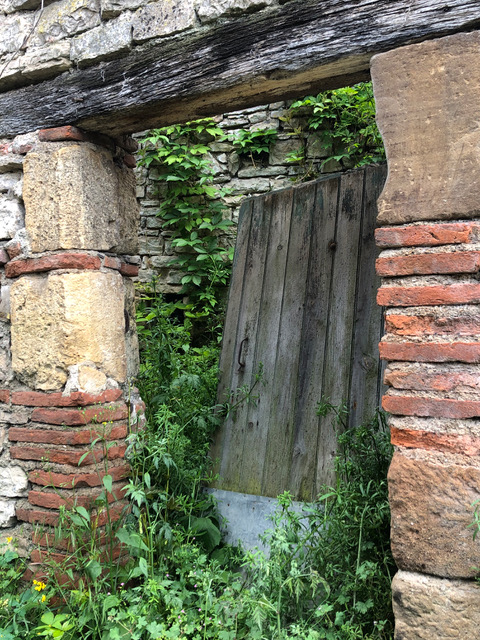
Along the footpath between le Barri and le Bouysset. C D B ?The new owners have cleaned up the area behind a house along the path.This is part of a ruin that now has a sign on it saying it will soon be renovated.A lovely old garden gate in le BouyssetI know this valerian is an invasive plant but it’s so beautiful!Poppies root anywhere. The walls in Cordes have lots of these arches built into them.
Now I’ve come round the west end of the village. This is the guardian of a garage, I think.
Abandoned gardens like this one aren’t uncommon.
Heading down the north side now.
I’m walking on footpaths mostly.
It’s high rose season now.
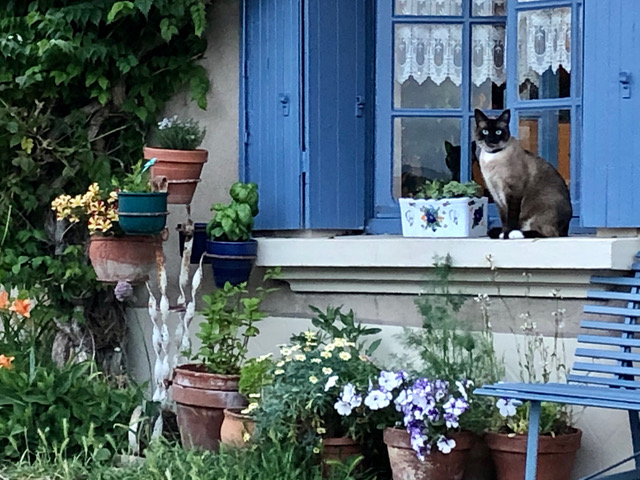
Almost home now. The cat disappeared when he sensed Mocha coming.
And look! Henri IV is in his place waiting for us again.
Our house in Cordes has two windows, one up and one down. Well, that’s not exactly true. There’s also the front door, which has a panel of obscure glass, (just learned that kind of mottled glass is called “obscure”), two bathroom windows, also obscure glass, and a skylight, obscured mostly by dirt since cleaning requires climbing on the roof.
The point is, there are only two windows where you can see out.
For obvious reasons, I started taking pictures out of them the day we moved in. Sometimes I take more than one, sometimes I miss a few days or even weeks because we’re traveling, or it’s dark when I get up, or it’s raining and the view is less inviting.
I don’t keep every picture I take, either. (I probably should have done that, but it’s too late now.)
Most of the time I face directly south, looking out of the windows.
Cordes is shaped like a fish, and we are on its belly, letting us see both the sunrise and the sunset. Sometimes I lean out to catch the sun.
I like the fog that rises from the creek, l’Aurausse.
It’s green in the winter here, but we get hard frosts and once in a while a dusting of snow.
Occasionally it rains enough for the valley to flood.
The trees change color and lose their leaves in the fall.
Rainbows aren’t uncommon.
And the clouds are spectacular!
In the late spring hot air balloons start to come over Cordes.
Our cats appreciate the window sills as much as I do.
Sometimes you get incredible clouds and fog at the same time.
I took screenshots of all these pictures to post them here, so you can’t click on them individually to enlarge them. Too bad.
Maybe I’ll put them all upon Flickr so they’re more accessible.
Or maybe I won’t.
In any case, I’ll keep taking more of them.
Because the extraordinary beauty right out the window never stops amazing me.
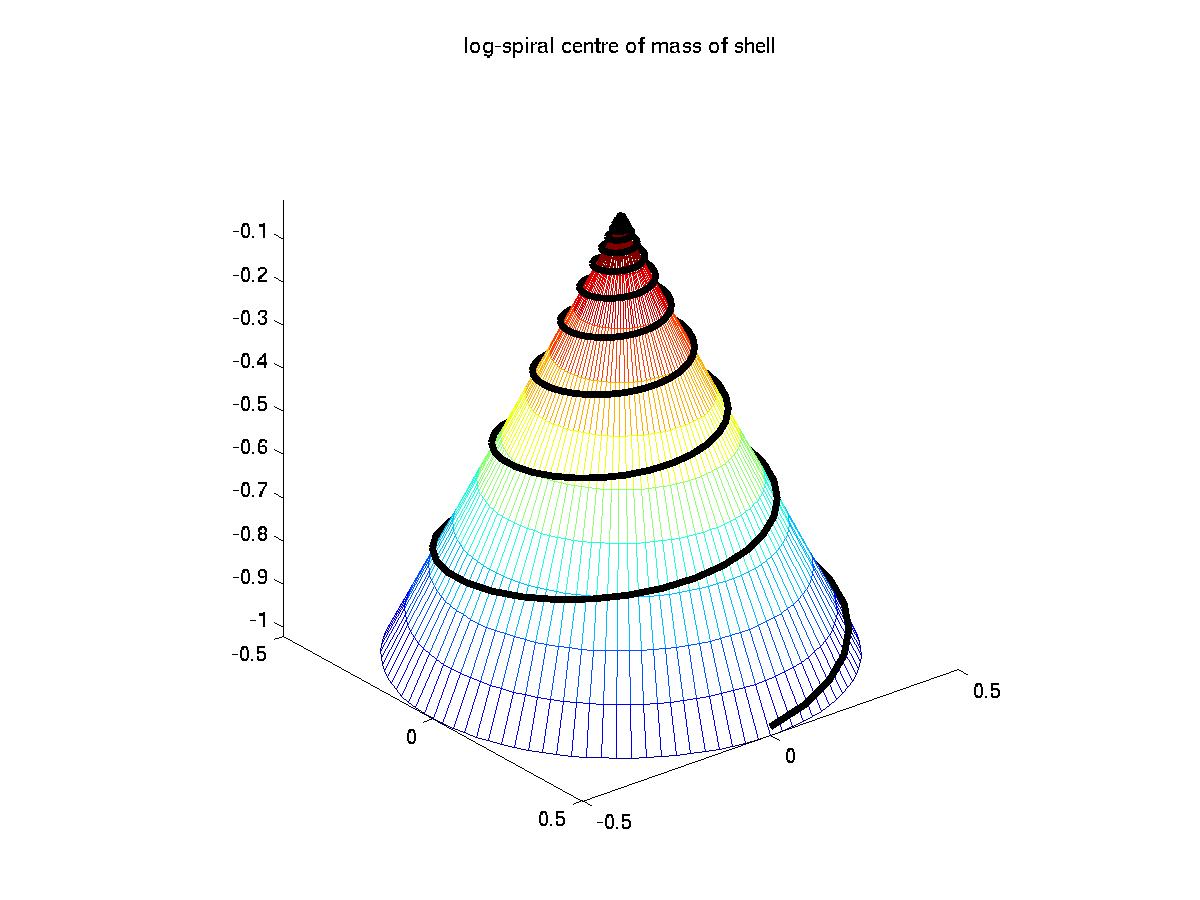
Ever since I was a very young child, I’ve had dreams that center on a conical spiral in one manifestation or another. William Butler Yeats called it a gyre.
The earliest ones I remember are nightmares. I’m with my mother on a path up a hill, mountain, or a pyramid, and the ground falls out from under me. She cannot save me.
Later I’m on my own on the path, always spiraling upward, never easy. But sometimes when the path collapses or the land slides, I can save myself.
When I was in my late 20’s and Ganesh Baba was part of my daily life, I reached the top of the mountain for the first time. In that dream, the path near the top is so steep and narrow that I can pull myself directly up by using it as a foothold. Still the mountain is steeper and steeper. When I’m sure I can’t go on and that I’m about to slide down that precipitous cliff, I see that my mother is at the top. She reaches down for my hand like Michelangelo’s God in the Sistine Chapel and pulls me up.
I imagined, at that time of my life, that the series would end – but I was wrong. The dreams continue to this day. Sometimes I reach the top, sometimes I am in the middle or at the bottom. Sometimes the mountain is wooded, sometimes I’m climbing a tower, sometimes I’m in the desert. Sometimes the conical spiral takes the form of a Christmas tree or a seashell.
When I began my studies at Pacifica Graduate Institute, I dreamed that I was slogging through a stream at the bottom of the mountain carrying my suitcases. I couldn’t even get to the first level until Tom came by above me, took the suitcases and pulled me up to the first level.
Last night this dream came to me:
In a post-apocalyptic urban setting I am tutoring two little girls, one about eight or nine years old and the other about six. The older one is not receptive to what I am trying do with her, so I take the younger one with me when I go for a walk.
We discover a nearly intact church and go inside. The enormous space is empty. Light enters in shafts through broken windows set high on the walls. There is nothing in the nave. We turn toward the back of the church to leave and I see that a wrought iron spiral staircase, maybe four meters high, has been pushed into the middle of the floor.
From our left, a line of green and gold robed figures files into the room. The first of them climbs up the stairs and stops at the top, the next stops a few steps down, the next a step or two lower, until the stairs are full. The rest of the group stands in a neat line below.
The man at the top begins to sing Bob Marley’s “Redemption Song.” One by one the others join in until they are all singing in glorious harmony.
The child and I are moved to tears.
Wanting to share the experience with the older child, the little one and I leave the church and walk back the way we came. We pass a ragged man in a wheelchair made out of a wooden cart and we tell him about the song. The child sings.
Recently, most of my days have been taken up with writing query letters to literary agents and tweaking Red Vienna, the first volume of Two Suitcases. I even added a short new section. Today Henri IV thought it was time to take a break from it.
Moving to the desktop worked for a short time.
But he was determined. I gave up.
And he decided to take a nap in the kitchen.
A short time later, while waking from a second nap on the kitchen counter, the idea to open his own Instagram account occurred to Henri. I reopened my laptop. He agreed to stay off the keyboard temporarily so we could choose some pictures to share to get it started.
But first he wanted to wash up.
And adjust a few things.
After that, we set up his new site, @henriquatredecordes. Naturally he wanted a simpler name, but some other Henri IVs had already claimed them. Thus, he is forced to go by most of his whole name, which is Henry IV de Cordes.
Satisfied with his day’s work, he sat on his throne to wait for dinner,
Quite a few of the queries I’m sending out to literary agents ask for a one sentence pitch for the book.
Which of these do you like the best? Do you have a better idea?
1. Can young love and a passionate commitment to high ideals survive the forces of fascism, populism and propaganda in Red Vienna on the eve of World War II?
2. In Red Vienna, idealistic young lovers Gisi and Max watch their dream city fall to the forces of fascism as the second world war looms
3. In Red Vienna, young idealists Gisi and Max fall in love at the 1929 International Socialist Youth Congress and set to work creating a more caring world, but can they hold onto their vision when their beloved utopia is destroyed by racism, nationalism and civil war?
4. With shocking parallels to recent events in the United States and Europe, this book – based on a true story – tells of an idealistic young couple confronting the forces of rising fascism and civil war in Vienna on the eve of World War II.
As those of you who follow this blog know, Two Suitcases, my book project, grew to three volumes some time ago. There was just too much material. My plan was to break the characters’ journey into their years in Vienna, their years in Paris, and their years in the south of France.
Though it’s five years since I began the project, and much of that time I was working on the project with a sense of great urgency – I even dreamed that my mother was telling me “work faster!” once – I stopped for two years when Mama Ganache needed me. And then there was the move to France which caused further delay. In retrospect, though, I think the gaps improved the book. Sorry, Mom.
Recently, as I was researching and writing about the period leading to the 1934 February Uprising (or Austrian Civil War), the parallels to what’s happening in the United States now became unmistakable. I posted an excerpt last year about how Austria became a Fascist dictatorship when Englebert Dollfuss dissolved the parliament and adopted martial law.
I continued writing until I reached 1936, all the while following the news of Trump’s America. Then that sense of urgency returned, and it pushed me to change my plans. The first volume, Red Vienna, would end after the February Uprising. The period when the characters are forced underground in Vienna, 1934-38, would be the second volume, and their period in France, 1938-1940, will be the third.
At that point, I went back and revised and rewrote the first book, which is now called Red Vienna, to prepare it for publication. I’m pleased to say that I’ve begun the process of seeking representation for it.
My real reason for this blog, though, is that I read this morning that Michael Caputo, one of Trump’s toadies, was warning people of armed uprisings, and that sense of urgency returned. I’ve posted an excerpt from Red Vienna below. It was hard to choose a piece because the events happen over a period of years, but this one is a pretty pointed parallel. It takes place immediately after the uprising.
At four in the morning on February 18, Max, stinking, hungry, and thirsty, furtively unlocked the door to his family’s apartment, slipped in, and immediately locked it behind him. He had climbed out of the sewer at Karl-Marx-Hof just two hours earlier, and managed to make his way home flattened against the walls of buildings, deep in the shadows, through the darkest alleys and streets of the city.
Leaving his mud-caked boots in the hall, he skirted past his sleeping father and went into the kitchen where he threw some bits of coal onto the embers in the stove, and drank down every drop of the boiled water left in the pot. Then he refilled the pot and set it on top of the stove again.
He shivered as he took off his clothes and put on his threadbare bathrobe. It would have been a good thing if he could have thrown those clothes away, but that was out of the question. Instead, he pulled the big galvanized tub out from under the sink and began to fill it, pot by pot, with water heated on the stove. As he waited for the water to heat up, he ate whatever he could find: some dry bread and most of a can of pickled herring. An hour later, when the tub was full enough, he stepped in, sighing deeply as the steaming water surrounded him and slowly warmed him. He washed himself thoroughly and then lay back and relaxed until the water was almost cold. Later, dry from the heat of the fire and wearing his nightshirt, he added another pot of boiling water to the washtub and dropped his filthy clothes into it.
It was after six in the morning when he lay down on the settee. He slept for the next twelve hours, barely stirring when his father came into the room and pulled a blanket over him.
* * *
After covering his son, Seppe left quietly to go to his cafe, where he found Dolf and Fredl sitting in a booth in the back room.
“Quick, sit,” said Dolf.
“It’s safe?” asked Seppe.
“I haven’t seen anything to make me think it’s not. But who knows anymore?” said Fredl. “They’re picking up more of us every day. We’re taking a big risk being here, but being at home could be an even bigger risk. Who knows anything anymore.”
“Max is back,” Seppe told them.
“Thank god!” said Dolf. “Did he tell you where he was?”
“He’s still sleeping.”
“At least he’s home. The news is all very bad.”
“Yes, Dollfuss is telling the world the housing complexes were built as fortresses to store weapons for an armed takeover, and that they stopped it from happening just in time,” Fredl said.
“And they’re putting out that we were in league with the Soviets,” finished Dolf. “The headline on the Fatherland Front paper says ‘Armed Insurrection Averted.’
Fredl said, “They claim only two hundred died, but I’ve heard it’s in the thousands.”
“And they’re hanging more as we speak,” said Seppe.
I usually don’t post other people’s blogs on mine, but Thanissara’s vision is powerful, her thinking so aligned with my own, and her message so clear, that I felt compelled to publish it here.
It’s only eight months since we passed Mama Ganache on to Ben Taylor and his family. In some ways that feels like an eternity; in others, the blink of an eye. It was harder than I expected to review my pictures from all those years. Assembling them for this blog brings a lump to my throat, an ache in my heart, and even some tears.
Mama Ganache began her life in the basement of the Vets Hall in San Luis. We rented the kitchen there on Sunday afternoons to create some ridiculously labor-intensive, ridiculously delicious chocolate bars: layers of chocolate, crispy rice and peanut butter. Tom sold them at local churches to fund his fledgling NGO, Project Hope and Fairness.
When his sister Joanne opened Splash Cafe in San Luis, our newly named Sweet Earth Chocolates were made in the second floor kitchen.
Our chocolate at Splash in 2006
Our first truffle collection
In 2009, we moved down the street to 1445 Monterey.
Our chocolates grew more and more beautiful and delicious, especially when Rebecca Wamsley came to work for us.
We held art shows, wine tastings and parties.
In 2012, we changed our name to Mama Ganache.
Valentine’s Day was always fun.
As was Easter:
Halloween:
And Christmas:
In 2013, we started to make our own chocolate from beans sourced from around the world.
Truffle critters were always popular.
We gave tours, hosted birthday parties and meetings, and raffled off huge bunnies and turkeys.
Raising a Reader
Girl Scouts
Birthday party
The Adventure Club
Our artists were amazing.
Jo Jackson
Susan Lara
John Landon
Susan Lara, Rochelle Niemerow, Lin Mercer
As was their art.
Susan Lara
Chloe White
Lee Lawson
Rebecca Wamsley
And our customers.
Tom and I will be forever grateful to all the incredible people who worked for us over the years. Apologies to those of you – and there are many – who aren’t included here because I don’t have pictures of you.
Kelly
Rebecca and Talina
Lena and Bruce
Isabelle
Sophia
Cindy
Jane
Ashley
Theresa
Terryl, Allison, and Lenny
Larry, Tom, and Josefina
Tom and I (and Joanne) had Mama Ganache for thirteen years. I went through close to 6000 pictures to choose these, and the ones I picked in the end don’t cover a fraction of the love, life, and laughter that we shared in those years.