Two Suitcases: A Window into my Work

Here’s a look into the process of writing Two Suitcases:

timeline

This is one of several timelines I’m using to structure the book. This one was meant to have historical events at the bottom, events and pictures from my parents’ and their friends’ lives in the middle, and trends at the top, but it’s pretty mixed already. It was a good plan anyhow.

herd of pipe cleaner animals

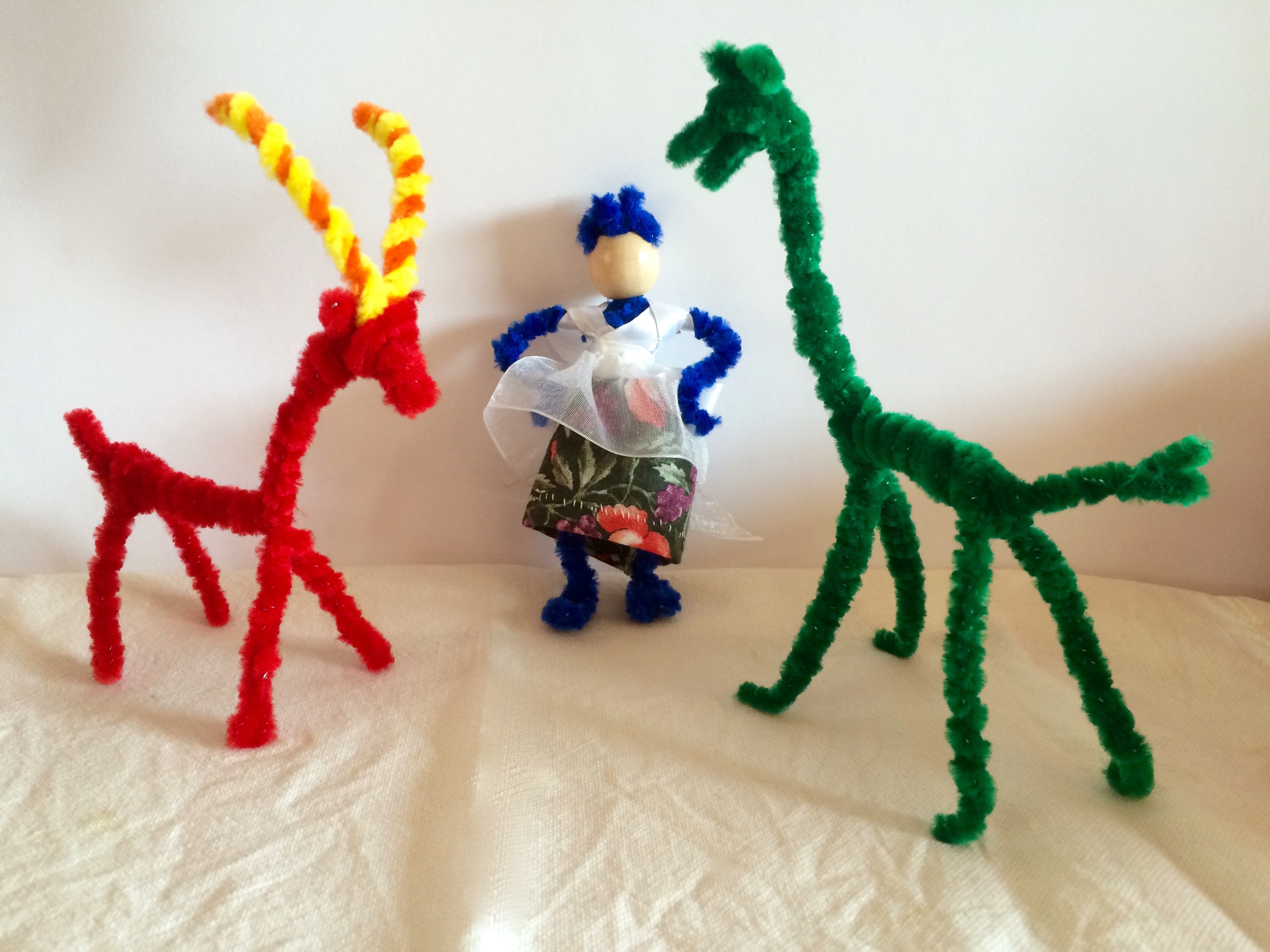
A small herd of pipe cleaner animals has invaded my chapter chart.

Fritz, Trudy and three pipe cleaner friends

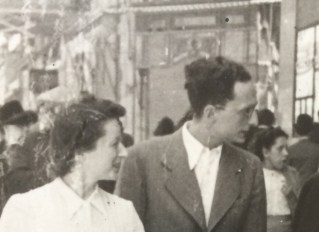
My favorite pictures of my parents and the first of the pipe cleaner friends.

Ida's passport picture      Ida's passort front page

These are pages from my aunt’s passport, issued in German-occupied Vienna in 1938.

And here are a couple of less distressing shots:

blue lady sunbathing

A blue lady sunbathing.

blue lady dancing

And one dancing.

And, as promised, a snippet of what I’m working on now. This is yesterday’s work, in more or less first draft.

April 22, 1929

The University of Vienna, Ringstrasse

Anna hurries out of her first afternoon class, Dr. Charlotte Buhler on Child Development. After experimenting with sitting on three different benches, she settles on the second, and, with her book bag on her lap, she looks first to the right, and then to the left, and then to the right again. It’s her intention to keep an eye on the door she expects Emil to emerge from momentarily, while simultaneously watching the route he is likely to take to the Konditorei where they’d first met, in case she misses him coming out. 

She doesn’t have to wait long. Emil’s mop of wild hair is obvious above the group pouring out of the Mathematics building.  He’s walking with someone and gesturing animatedly. What next? Should she stand up and go to him? Or hope that he notices her there on the bench? The courtyard is crowded and noisy now. 

Anna decides she shouldn’t chance sitting, so she stands up and makes her way toward Emil across the current of chatting students, glad of her own height. Should she call out? She’ll miss him if she doesn’t. She raises her arm and is about to wave, about to call out his name, when he turns, spots her, and grins. He says something to his companion and makes his way, cross-current, to where she is. 

“Hello!” he says, genuinely glad to see her. “I was hoping we’d run into each other again!”

“And I you!” she says. He’s very handsome despite the pockmarks all over his face. She hadn’t noticed them before, but it’s not such an uncommon sight. Lots of children get smallpox and most of them die. He is lucky to have survived, she thinks. Money and good doctors, that’s always a help.

“Join me for Jause, will you? I’m going to Sluka.” 

“I’d love to,” says Anna, and she lets herself be drawn into the outward flow of the crowd with Emil at her side. Sluka! Not the little bakery where they met! What have I done? What kind of fool must I be to have accepted?

Konditorei Sluka is one of the best bakeries in the city. It is elegant, luxurious, and outrageously expensive, a place inhabited by tourists and the wealthy, even the very wealthy. The Empress Elisabeth was a regular customer! Ida knows where it is, of course, but she has never been inside – though she has looked into the window longingly many times. Frantically, she searches her mind for a reason to back out now, to decline Erich’s offer, walk away and never see him again. They are too different; they’ll never get past their class differences. She is poor. He is rich.

Before she can decide on an excuse, he turns to her and asks how she likes her coffee. With whipped cream? One teaspoon of sugar or two?

By the time they reach the Konditorei, Emil and Anna have discussed their mutual enjoyment of good coffee, pastry, and the cinema, as well as establishing the comforting fact that they are both Jews. 

Once in the bakery, however, her problems begin. Ida has no money. She could allow Emil pay for a small cup of coffee, but it’s much too soon in their acquaintance to let him buy her pastry. 

Anna turns and looks around the Konditorei. High windows draped in sheer curtains fill the dining area with light. Glistening chandeliers in several sizes hang from the lofty ceiling. The walls are deep yellow with gold trim and pale green panels framed in rich brown. Elegantly dressed ladies and gentlemen sit at highly polished round tables cutting their pastries with forks and knives. The chairs have graceful bent wood backs and legs so delicate Ida wonders how people dare to sit on them.

She takes a deep breath.

The pastry case in front of them radiates golden light. Ornately decorated pastries and cakes satisfy every visceral sense: moist cream fillings, bright fruit slices shimmering in fruity glazes atop voluminous cakes, crispy puff pastry layers surrounding vanilla scented creams, soft nut tortes offering only a fleetingly crunchy resistance to the bite while rewarding one’s every nutty desire, unctuously melt-in-the mouth coffee butter creams topped with crunch.    

“So,” asks Emil, “What is your favorite?”

Two Suitcases – progress and a little taste of what’s to come

Today, even though I had most of the day to work on my new book, I only added a few lines and revised a short section. Instead, I worked on a crowd-sourcing site I’m planning to put up to help pay for the increasingly necessary research trip to the settings of the novel next spring. You can see the opening image of the site above. The day turned out to be more fun than I anticipated because, as incentives for people who are willing to support the project, I’m making and sending out pipe cleaner animals. Today I practiced making some to be sure I really could do what I’m promising.

IMG_7009

Some of you, I’m sure, are shaking your heads and asking, pipe cleaner animals? Here’s the reason. When I was a child, I had a collection of pipe cleaner animals made by one of the people in my parents’ circle. Unexpectedly, they turned up in Two Suitcases, playing a sort of Jiminy Cricket or Rosenkrantz and Guildenstern role. Here’s the beginning of the book in its current draft:

Chapter 1

Meeting

December 31, 1954

Brooklyn, New York

I lift the green pipe cleaner giraffe with the toothbrush neck from the shelf under the window and turn him toward the rising voices. “I doubt it,” he says. “Not anytime soon.”

The red antelope with wishbone horns snorts. Her attention is mostly absorbed in remaining upright. A powerful breeze rushes through the window, open an inch or so to mitigate the heat and cigarette smoke in the room. It hits the antelope’s oversized horns directly. She staggers but doesn’t topple. 

“It won’t be over till after bedtime,” she says grumpily. “Once they start to shout, we should make ourselves comfortable.” 

The blue pipe cleaner lady with the red plastic dress is upside down at the moment. The antelope is already packing their belongings—two acorn caps, a hard candy wrapped in foil and two carefully folded pieces of foil from candies eaten earlier—into her dress, which until recently topped a canister of whipped cream. They’d already chosen which of their things to leave behind and which to take. The ashtray is too heavy and they didn’t think they should touch the lovely china cigarette box. Anyway, they only have the lady’s whipped cream top dress to carry things in. Too bad the third acorn cap doesn’t fit. They’ll have to share plates at their next place, wherever that is.

“I’m so sorry I can’t help you with the packing,” the giraffe says. “But I’ve got a stiff neck.” He bobs the toothbrush to see if anybody gets the joke. “I’m very good at seeing over things, though.” Bravely, he hops up onto the windowsill and, bracing himself against the woodwork so as not to blow away, he peers out into the Brooklyn night. “It’s still raining, and the lights are on,” he reports. “Even in the park.”

I move all three of them to the bookshelf below the window and rearrange the pillows I took from the sofa on the floor around me. I am usually in bed by dark, but tonight I am in New York with my parents, visiting their friends. As always, I chose the most beautiful pillows, the ones with the multi-colored covers Fanny weaves. To my right, a heavy cast-iron radiator chuffs out heat relentlessly. I like sitting near the radiator, but the apartment is so warm, it makes me sleepy even when I don’t want to fall asleep.

Turning back toward the toys, my eye is caught by the bold, black calligraphy on the spine of one of the books. Die Sozialdemokratie und die Nationalitätenfrage it says, though at four, I couldn’t have read nor understood it even if it was in English: Social Democracy and the Nationality Question. There are a great number of beautiful books, some hand-printed and neatly bound with string. Some have pictures, black and white prints made from woodcuts. I’ve studied these closely. One picture fills a whole page. It’s a big tree with its trunk breaking in a thunderstorm. There are only four words on that page: O schwanken! O taumel! – my mother says they mean something like “Oh, sway! Oh, tremble!”

I’ve asked to hear the stories that go with the pictures, but everyone says I wouldn’t understand, so I make up my own stories to go with the pictures and look at the shapes of the words and letters. I especially like the books with the clean, tall, squared-off letters. The invitation to the evening’s gathering of my parents’ friends was hand-lettered in the same elegant style.

That’s as much as I’m willing to give away now, but to be honest, I’m not very good at keeping my own secrets, so more of the book is likely to show up here. In the meantime, watch for the crowd-sourcing site, which I hope to have in order within a week or two. This is so much fun!

Two Suitcases – project, process and progress

Tom and I are getting ready to sell our house next spring or summer.

Big decision!

We’ve been in San Luis Obispo for seventeen years, longer than we lived in Trumansburg, longer than Tom ever lived anywhere and pretty close to that for me. We’re not planning to leave San Luis, just this big house, which has been feeling more and more burdensome over the last year.

Here’s a short-lived glimpse into our home: this is one of my Airbnb listings. I’m taking all three listings down after Labor Day to give us time to get the house ready to be shown and to give me time to write. (The pictures on the Airbnb site were taken a year or so ago.)

I imagine us moving to a beautiful two or three bedroom place with enough room for Tom’s piano and for my new project, the work-in-progress that my next series of blogs will follow.

I’m working on a new book, historical fiction based on my parents’ story. I call it Two Suitcases because my parents left Vienna in 1938 with two suitcases, Paris in 1940 with two suitcases, and a village in the south of France in 1942 again with only two suitcases. It’s an extraordinary escape story, a re-examination of social democracy in the Red Vienna years, and an exploration of values. How do you choose what goes into two suitcases?

Nothing I’ve done for a long time has excited me as much as doing the research for the book and beginning to write it.

The story follows a group of friends and family who work for the Social Democratic Party in Vienna during the 1930’s and remain friends for the rest of their lives.

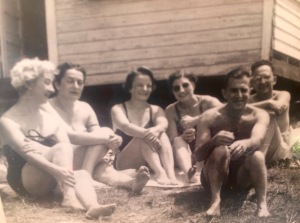
group at McCorkels'Here they are relaxing at a cabin in the Catskills right after the Second World War.

There are four main characters.

My mother:

Trudy's passportThis is her passport picture from 1942

My father:

Fritz 1940's

in the late 1940’s

My Aunt Ida:

Ida 1940's

also in the 1940’s

And my Uncle Eric, of whom I only have a picture taken many years later, in the 1970’s:

Eric

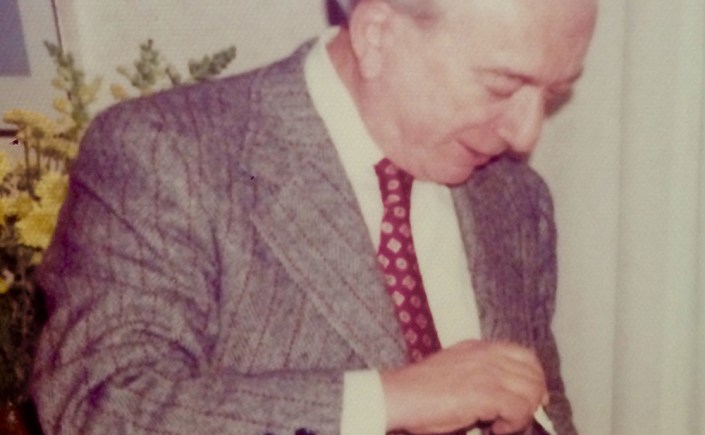
a gracious man with an elegance still evident when he was 93.

 As I write, I’ll share snippets of the text here and reflect on my writing process. Stay in touch!

Aberduffy Day

2927847289_c0ecabe4bb_zAlice O. Howell celebrated Aberduffy Day on Tuesday, October 28, about three weeks before what would have been her 92nd birthday. She left easily, surrounded by family.

At yesterday’s Samhain ritual, when Kathy and Barbara encouraged us to visit with our loved ones and bring back memories, messages and perhaps a gesture, Alice’s image and words came to me instantly. She floated in, full of grace, expressing immense joy in her release from that cumbersome body and in her reunion with Walter. Then came the gesture: raise a dram! So, after lunch, we got out the brandy and toasted her. On this day of special liminality, perhaps you might like to join me at sunset, wherever you are, in raising a dram. Get out the best scotch, face the sun, invoke Sophia, and raise a dram to Alice, Mercy Muchmore, IonaDove. She taught me so much. In bittersweet joy, Eve
holy-spirit-dove-st-peters
Invocation
O Holy Sophia, Holy Wisdom, Holy Joy hidden for so long come forth and reveal yourself in the world and in our souls!
Help us to see with a loving eye Help us to hear with in wit and intuition
Show us how to be natural and kind Show us how to find ourselves in one another
Lead us from who we think we are to who we really are
Let us learn from the flowers that we need not strive so hard
Teach us to allow that Light from within to unfold us as a gift like your Rose.
a. o. howell

Carpet Magic

When you clean house as much as I do, vacuum cleaners matter.

My old Oreck had always been too heavy and I’d been checking out possibilities at the store when my son’s girlfriend showed me her new cordless Dyson a couple weeks ago. Decision made, 20% off coupon in my bag, I went back to the store to make the purchase.

There it was, up on a shelf, and it was on sale, $100 off – except there weren’t any among the boxes under the display. An employee was right there though, and after some searching, told me there should be four left on another display at the front of the store. By the time we wound through the aisles to the front, there was one left.

They let me use my coupon AND the $100 discount.

The new vacuum cleaner is amazing.Dyson

How fortunate is that!

A few days later, while admiring my wonderfully dust-free carpets, I realized how much they needed a good deep steam-cleaning. I thought about renting a carpet-cleaner at the supermarket.

But, walking the dog this morning, I discovered that one of my neighbors had put just such a carpet-cleaner in front of his house with FREE sign on it. Obviously, it was for me – I took it home.

IMG_5029
It’s a Eureka and not old – I don’t know whether it works yet – but it’s got a sticker on the front saying CLEANS CARPETS BETTER THAN DYSON.

IMG_5034

I’ll try it out tomorrow.

Amazing grace.

Sacred Geography in San Luis Obispo

This is more or less the text of a 2007 talk I gave at Tridosha, the yoga center where Smiling Dog Yoga is now,  where Marsh and Higuera Streets meet, just south of downtown. Roxanne’s Cafe, one of my favorite places for lunch, is in the courtyard where the talk was part of a new moon ritual. I’ve updated it a little.

pbaab013_shiva_meditation_kailash_mountain

Long, long ago, before the world was as we know it today, the People knew that the shape of the land around them reflected the Cosmic Order.

In India, Shiva meditates on Mount Kailash, physical manifestation of Mount Meru, the axis mundi  that pierces the center of the earth.

Native Americans knew the land held the stories. Aboriginal peoples everywhere recognize the myths and metaphors that surround them in the form of geography: sacred earth, sacred stories.

When people traveled by foot, and lived in one place for generations, they knew the hills and valleys with their bodies and their souls. They knew where the springs were; they knew the seasons of the tides; they knew the power of the rocks, and they knew the patterns of the planets.

As time passed, places grew stories, as trees grow fruit, and the stories were passed from one generation to the next. The stories that connected heaven and earth, the ones that resonated in the soul, the live ones, gave meaning to life in ways that we barely remember today. They provided deep connections to our physical environment that opened the heart to a kind of peace that most of us only long for.

Recently, I’ve become more aware of the intertwined geography and history of this place, San Luis Obispo, of the stories this land tells. I’d like to share a couple of those stories, beginning with one about the piece of land below our feet.

IMG_2677

The Mission from across San Luis Obispo Creek

Mission San Luis Obispo de Tolosa sits in the shelter of Cerro San Luis Obispo, the mountain with the big M on it, on a low mound between two year-round creeks, San Luis Creek and Stenner Creek. In wet months, a third creek, Brizzolari, joins Stenner a little way up. San Luis and Stenner Creeks come closer and closer to each other as they wind toward the sea.

They join across the street from Tridosha (now Smiling Dog). San Luis Creek meanders in from northeast of town, down the grade near the 101. It goes through Cuesta Park and between Monterey and Marsh Streets, crosses to Higuera near Black Horse uptown, runs underground for a while and emerges near the Mission to become the heart of the downtown.

IMG_4578

San Luis Creek running through the center of the city

Stenner Creek comes down from the northwest, near highway 1, with Brizzolari joining it at the southwest corner of Cal Poly’s campus. San Luis and Stenner form a Y behind that new red building, 444 Higuera Street, across from Tridosha/Smiling Dog, and a little to the north, just south of the end of Dana Street.

In India Triveni Sangam, the confluence of three streams, one of which is invisible, indicates the holiest of places. Feng Shui teaches that rivers and creeks are channels for qi; how auspicious then, that a yoga studio should sit just at the point where the creeks meet. Tridosha, three forms of subtle energy, channelled into one, as reflected by geography! An apt name and place for a yoga center.

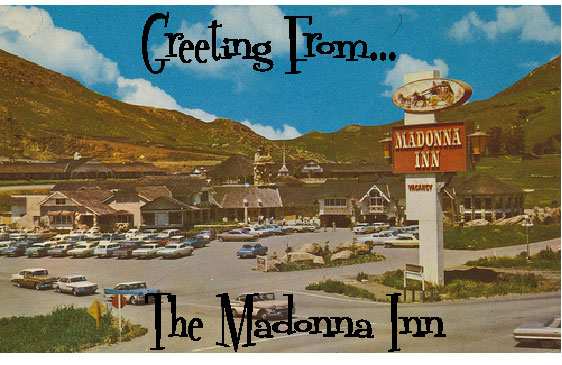
madonnainn

The second of my stories is about two men who had a tremendous impact on the lay of the land of this area: Alex Madonna and Harold Miossi.

So interesting archetypally. Consider the places we associate with them.

Remember Alex Madonna?  Of the Madonna Inn?  “A fantasy-theme hotel of outrageous excess and enduring California charm,” the New York Times calls the inn in Madonna’s obituary.

Another obituary, this one in the English paper, the Telegraph, quotes Umberto Eco:

The Inn was immortalised in Umberto Eco’s collection of essays Travels in Hyperreality (1991), in which the Italian scholar analysed the American love of grotesque fakery.

“The poor words with which natural human speech is provided,” wrote Eco, “cannot suffice to describe the Madonna Inn . . . Let’s say that Albert Speer, while leafing through a book on Gaudi, swallowed an overgenerous dose of LSD and began to build a nuptial catacomb for Liza Minnelli.” But that, he reiterated, could not convey its true ghastliness. In fact, the Inn’s architect was Madonna himself, who, in the mid-1950s, had spotted the perfect location for a motel at San Luis Obispo, on the highway running between San Francisco and Los Angeles.

Alex_Madonna6930_100404Madonna and his wife Phyllis built the inn in 1958. He designed the outside, she the interiors. It took on its present uniquely kitschy look after a 1966 fire. Today their daughter runs it. To much of the world, San Luis Obispo is the Madonna Inn.

Madonna, larger-than-life, magnanimous, was a huge presence in SLO when Tom and I moved here in 1998. He partnered with John Wayne to raise the beef for the steak house. He was friends with Ronald Reagan. There’s a piece of the freeway and a shopping center named after him. And still he took the time to dance with every one of the little girls at my daughter’s friend’s birthday party at the Inn.  

And Harold Miossi? Oh, you don’t know where he lived? If you’re local, you know his name, but you aren’t quite sure who he is?

Alex Madonna and Harold Miossi graduated from San Luis High two years apart, Madonna in ‘37, Miossi in ‘39, and they died two years apart, Madonna in April, 2004, and Miossi in November of 2006. Their grandparents came from the same region in Switzerland, near the Italian border, and their families spoke the same Swiss-Italian dialect at home. Both lost their fathers when they were young. But their personalities and their lives were as different as the terrain they inhabited.

6 - alex phyllis madonna  paintings portraits madonna in lobby

Alex and Phyllis Madonna’s portraits are in the inn

Alex Madonna, in addition to gaining world renown for building the one and only Madonna Inn and local renown for several environmental disasters, was the owner of the construction company (started when he was in high school!) that built the freeway from Buellton to Salinas.

image.php

Harold Miossi and Pecas

Harold Miossi, as the Tribune’s headline said at the time of his death, is the “Man Who Saved Cuesta’s Hills.” He saved the hills from being chopped down and tossed into the Cuesta Valley so that eight lanes of the freeway could go straight through to Santa Margarita.

Madonna wanted to bulldoze right through and Miossi opposed him. As a result, freeway winds through the hills in broad curves; the grapevine prevails.

Local environmentalists remember Harold Miossi well; he was a stellar conservationist of the old mold. A leader of the local Sierra Club, Miossi fought valiantly against the Diablo Canyon nuclear power plant, he wrote the master plan that is still keeping Montana de Oro and the Santa Lucia wilderness wild, and much, much more.

Miossi was born, lived, and died in a little house down a dirt drive lined with neatly planted native live oaks that follows a tributary of San Luis Creek. It’s in a canyon off a concrete piece of the old highway near Cuesta Park, the extension of Loomis Street called Miossi Road. The piece of the old highway is a tribute to Harold Miossi’s victory over the straight road Alex Madoona wanted to build through Cuesta Grade.

Miossi driveway

The red arrow points to the Miossis’ driveway

Alex Madonna was warm, generous, and also cantankerous, fiery, and very, very pro-development. The fight against the legacy of his pro-development views is still as dominant in local politics as Cerro San Luis is in our topography.

Harold Miossi was a stubborn man, too, but he was known for his ability to bring people together. The wonderful introduction to the Miossi archives at Cal Poly says his tactics in winning the battle to save the grade could “well serve as a syllabus for coalition-building.” A 1980 article in California Today titled ”How to Beat Mr. Big” reads in part:

When Miossi undertook his fight, it was a lonely one against what seemed great odds. But he had faith in the justice of his stand, and in the democratic process, in his friends and neighbors, and in their good sense and love of the land, If faith can move mountains, it can also sometimes keep them where they are.

So we have Alex Madonna in his cowboy outfit on the mountain: a masculine symbol on a masculine symbol; and we have Harold Miossi, a gentle soul, living in the valley, doing good works for the city, the county, the state, the people, the land and all those who live on it—living in the valley, a feminine symbol.

Madonna lived as large as a mountain. His funeral procession was led by his riderless horse, his empty boots backwards in the stirrups. A team of horses pulled his casket down Higuera Street.

Harold Miossi took care of his mother at home till she died at 97. She was Vera Gnesa Miossi, the same Vera Miossi, who, with other women in her family, donated the land at the top of Bishop’s Peak to the city. The plaque on that property reads,
a
This Peak is given to the People of this community by Lena Negranti, Vera Miossi, Hilda Giacomazzi and Josephine Johnson, in memory of and in tribute to their parents, James and Sofia Giorgi-Gnesa, who in 1870 as youths emigrated from Canton Ticino, Switzerland, settled in this County, raised a family, prospered, and contributed to the betterment of this Community.
b
And the legacy of each man to the community?
c
Harold Miossi made provisions for his 1700 acre ranch—all that open land northeast of the city along the freeway before the grade—to be preserved in its current state in perpetuity. He established the Miossi Trust, which funds efforts to improve the quality of life in our area.
k

Southwest of town, Alex Madonna left us the Home Depot and acres and acres of other big box stores.

What can I say?

As the Upanishads say, man is the mean between the macrocosm and the microcosm. These men lived out the stories of the land, and the land is living out their stories.
e
We both create and are created by our environment. The physical world reflects the patterns of the world of ideas, and the world of ideas reflects the physical world. Plato knew it; Pythagoras knew it. Native people worldwide know it.
f
There is meaning in the landscape. We are not alone in a meaningless universe! We are all connected in ways that we cannot imagine!
g

What a profound, profound relief.

This is how Black Elk puts it:

The first peace, which is the most important, is that which comes within the souls of people when they realize their relationship, their oneness with the universe and all its powers.

Slowing down in SLO redux

Guests enjoy themselves in the dining room.

Recent pictures of the Airbnb part of my life

all three rooms and Lily Bear too
Lily Bear is finished inspecting Juliet’s room. Trudy’s room is on the left, Linnea’s on the right.
IMG_4334
I just moved Meg Johnson’s pretty little table into Juliet’s room.
IMG_4536
The sun pours in Trudy’s room in the afternoon. The print above the bed is new.
Linnea's roomLinnea’s room is ready for tomorrow’s arrivals.
Aras's girlsSome guests play in the dollhouse
Monday Night Dinnerand others join us for Monday night dinner, a potluck Tom and I host once a month.
Pillowcases on the linePillowcases dry on the deck
IMG_4396where sweet peas bloom.
Easter tableGuests from Vienna join us for Easter dinner. Tom makes a spectacular meal: fresh local pastured leg of lamb, ratatouille and pommes dauphine.
ClafoutisFor dessert there is clafoutis with raspberries and apples and gently sweetened whipped cream on the side – as delicious as it is beautiful.

 My cup overflows.

Neighborhood magic: Elisabeth Abrahams (Part 2)

282_2116

Allegra Fuller Snyder

Here at last is the second part of an interview with my neighbor, Elisabeth Abrahams, now in her mid-80’s. Still full of fire, elegance and jaunty humor, Elisabeth and her 97-year-old husband Joe are passionately involved in local politics – and continue to host lively parties full of dancing and singing for each of their birthdays.

I’d asked Elisabeth to share an experience that dramatically shifted her world-view. “That’s an easy one,” she smiles. It was at UCLA,  where she studied Dance Therapy with Allegra Fuller Snyder, Buckminster Fuller’s daughter.

Elisabeth was in her 40’s and divorced. In England, she’d been “a solid Churchillian Conservative” but by the time she came to California in the 1970’s, she “was ready to hear Allegra.”

You must understand your body and experience as a way of knowing. In a functional way the ideas need to be embodied in your own thinking /experiencing. —Allegra Fuller Snyder

Elisabeth’s first marriage was to a man who later realized he was gay, “so physically it was a disaster.” Then her Tai Chi teacher, a Norwegian woman who’d studied Tai Chi in China and been analyzed by a Reichian, introduced Elisabeth to Wilhelm Reich’s books. Reich (1897-1947) was briefly considered heir to Freud and played an important part in shaping psychoanalysis.

With Reich, the defenses—narcissism, passive aggression, and the rest—moved to the fore. Psychoanalysis has adopted other interests (notably, empathy), but Freudian therapy as conducted today is closer to Reich than to Freud. — Slate.com

Reich’s status as heir didn’t last, however. His passion for his own ideas consumed him: he believed that proper orgasms could save the world. He named the energy in orgasms orgone and invented a special box, the orgone accumulator, to concentrate it – Woody Allen called it the orgasmatron in his 1972 film, Sleeper. Melding Freud with Marx, Reich was father to the Sexual Revolution. The counterculture, Esalen, the New Left, Fritz Perls, Henry Miller, Norman Mailer and William Burroughs, and many more are all indebted to Reich. His influence was huge, but hardly anyone remembers him.

An excellent retelling of Reich’s story can be heard on Pacifica Radio in a 2010 interview with Christopher Turner, author of Adventures in the Orgasmatron: How the Sexual Revolution Came to America.  Listen here.

There’s lots of interesting history in the broadcast and I’m eager to read the book. Reich is part of my life story: not only did I play with his great-niece as a child – his niece and her husband were friends of the family – but years later, my first husband, a fan of Reich’s ideas, built an orgone box in our house!

wilhelm.reich2

Wilhelm Reich

The pleasure of living and the pleasure of the orgasm are identical. Extreme orgasm anxiety forms the basis of the general fear of life.” 
― Wilhelm Reich

It is sexual energy which governs the structure of human feeling and thinking. —Wilhelm Reich

I tell you: “Only you yourself can be your liberator!”—Wilhelm Reich

Elisabeth decided that she was going to use Reich’s work, somehow, in her thesis.

At UCLA, Alma Hawkins was founder and chair of the Dance Therapy program.

I was not teaching technique and composition, but rather using movement as a personal means of experiencing and expressing. It was through my work with patients that I discovered the true meaning of organic movement as a vital force in the living process. —Alma Hawkins

Elisabeth remembers, “Alma was a lovely woman who had all the right ideas, a very forward-thinking woman, but definitely a spinster.

donorshawkins

Alma Hawkins

“I go into my first interview with her and she asks what I want to write about. I say I’d like to do something on tension and relaxation. What books do I intend to use, she asks, and I say I’d like to include Reich.”

Silence.

“‘You don’t like Reich, dearie, do you?’

“‘Well, yes, I do.’

“‘I think we shall have to think about that. I’m not sure that we can accept…’  In great distress, I went to Allegra.

“‘Don’t worry,’ she says. ‘I’ll take care of Alma.’ And she did!

“It was not a very good thesis, but it could have, it could have been really something,” Elisabeth says.

She pauses. “You know, he was onto the right thing. Prana! Chi! Kundalini! And Hahnemann was onto it too. It was just too soon.”

Elisabeth glances at her watch. “There, I mustn’t desert my husband!”

“But I have one more question,” I say – but that will have to wait for the third part of the interview.


Neighborhood magic: community

The city of San Luis Obispo from Monterey Heights

A thing is right when it tends to preserve the integrity, stability and beauty of the biotic community. It is wrong when it tends otherwise.  Aldo Leopold

The greatest lack in contemporary society is community,” someone at the SLO Soiree last Sunday said, and it struck me as true.

FileItem-57643-SteynbergGallery_fullThe setting in which the statement was made completely belied it: the guests at that gathering form a deliciously civilized community. At its heart is a group of friends who’ve been coming to soirees facilitated by Dr. David Hafemeister, physics professor and expert in nuclear policy and foreign relations, for many, many years. Now held at the Steynberg Gallery on Sundays from 7 – 9, participants enjoy wine and cheese before sitting down to a presentation of some sort and a lively Q&A session. Last Sunday a couple of retired lawyers debated whether America is in decline. They were wise and erudite and the discussion was both profound and very much fun.

0421test_ban_treaty_hafemeisterThe sense of community one finds in a group like the SLO Soiree is rare; it takes a rare human being like Dave Hafemeister to draw it together.

To like many people spontaneously and without effort is perhaps the greatest of all sources of personal happiness.   Bertrand Russell

Not so long ago, every neighborhood was a community. Small businesses served the neighborhood and kids went to the neighborhood school. A neighborhood was an ecology, a complex set of relationships, that took up the greatest part of our time, energy and attention.

Neighborhoods, small towns, villages, tribes, and families are all ecologies, for better or for worse, and more or less sufficient unto themselves. Cities are made of neighborhoods – fortunately, or they’d be cold places indeed – but all neighborhoods are not communities.

David Spangler says,

Some people think they are in community, but they are only in proximity. True community requires commitment and openness. It is a willingness to extend yourself to encounter and know the other.

Today, though there are impressive exceptions like the cohousing movement, communities built on proximity are increasingly short supply all over the world. The oil industry, all those cars and roads to drive them on, is largely responsible.

RQNIn Monterey Heights, my neighborhood, community is on the increase. Neighbors are coming together the way they do when facing a disaster – or the potential of a disaster, as many of us view the new freshmen dorms being built on our doorstep. A clear indicator of community is how long it takes to walk the dog – everyone I meet wants to talk.

Together, we imagine seven four-to-five story buildings looming over our mostly one-story neighborhood. We agree on how hard it is to cross Grand Avenue already. “Can you believe the Environmental Impact Report didn’t take the intersection of Slack and Grand into consideration?!” We visualize roving gangs of 18-year-olds looking for parties on our already student-rental-ridden blocks. A series of meetings is being held, and neighbors, armed with a common cause, are getting to know one another.

Equality comes in realizing that we are all doing different jobs for a common purpose. That is the aim behind any community. The very name community means let’s come together to recognize the unity. Come … unity. – Swami Satchidananda

As climate change, continuing economic instability, shifting values and lack of a common belief system bring more chaos into our lives, finding commonality with others around us is more and more essential.

As Ganesh Baba says,

We must shed our fear of one another, not for some medieval ideal, but as the only practical course to continue as a species.

Let’s make survival of the human race our common goal and take responsibility – individually and together – for our part in preserving the integrity, stability and beauty of the planetary community by preserving the integrity, stability and beauty of our own small part of it, the neighborhood.

Creating harmony amidst diversity is a fundamental issue of the twenty-first century. While celebrating the unique characteristics of different peoples and cultures, we have to create solidarity on the level of our common humanity, our common life. Without such solidarity, there will be no future for the human race. Diversity should not beget conflict in the world, but richness. Daisaku Ikeda

Thanks go to IdeaArchitects and Moon Magazine for many of the quotes.


Radiance

Who can resist the radiance of a smile?

IMG_3202

Or the sun’s rays?

IMG_4170

Or the sun in a flower

or a flower in the sun?

Radiance is both round and rayed,

Radiance is both round and rayed.

IMG_2498

It is our sun: its presence, presentation and representation in the world.

lines streaming outward from a center. common in Islamic art

Islamic art is full of centered circles with rays.

IMG_4245

Radiance is basic to life.

2013-09-23 15.16.04

It’s in the ceiling of this African house

And in this plant bursting through a crack in the concrete

and in this plant bursting through a crack in the concrete

IMG_2339

but my favorite is the radiance of my daughter’s smile on Mother’s Day.

Seeing the small is called Clarity.
Keeping flexible is called Strength.
Using the shining Radiance,
You enter the Light,
Where no harm can come to you.
This is called Enlightenment.

Lao Tzu