

For years I’ve watching the slow disintegration of the door of an abandoned house on rue de la Bouteillerie. Once in a while I take a picture of it, or of some part of it.
Yesterday I took a few pictures. Here’s the first one:

It wasn’t till I got home and took a look at the pictures, though, that I realized that some magic is taking place behind that door.

I wonder if very small people use those stairs?
Next time I pass I guess I’ll have to lie down on my stomach to get a better look.
Three days ago a friend suggested I join a Facebook group I’d never heard of, the Dull Women’s Club, so I could read some of the wonderful stories ordinary women from all over the world have posted. After about half an hour of reading, I dashed off an introduction to myself and my quiet world here in rural France. Who knew that a couple days later that post would have so many likes (12.5k this morning) and that it would lead to having contact with so many remarkable women? What an incredible experience.
I spent most of the next two days responding to the comments. I wanted to respond to every single one—so many of them touched my heart so deeply. What’s amazing about the stories is their ordinariness.
My teacher Alice O. Howell‘s book The Dove in the Stone is subtitled Finding the Sacred in the Commonplace, and that’s been my path ever since I first read it. I even facilitated a long-running discussion group about the book at my dining room table on Thursday mornings. But even though I was exploring the book every week and had a reasonable understanding of it, I can remember the exact moment that its importance sank into my bones.
We had a huge house in California then, very different from the little one we live in now. One or two of our five kids were always in college then, causing a major drain on our finances, so I cleaned the house myself. One day I’d climbed up to dust a high shelf and I was thinking about how to present the next chapter in The Dove and the Stone the next day. I picked up a small vase and was turning it in my hand to get the dust out of the cracks when it struck me.
Our big house
The understanding hit me in the heart like an electric shock and then rippled through my body. This is it. This is what I’m here for, to see the sacred in the commonplace. I had to climb down and make a cup of tea.

Our little house in France
So, when I came across the Facebook group filled with introductions to ordinary women my heart filled with joy. For the second time in my life I felt that I’d truly met my tribe. (The first was when I was 12 and went to an art and music camp for the first time.) But this time the tribe is hundreds of thousands of women.
Suddenly, as a result of the opportunity of meeting so many people through the facebook group, Red Vienna, is selling well, and lots of people are reading my blog.
On top of that, I found an outstanding narrator to for the audiobook version and her first sample arrived in my mailbox this morning.
I cannot express my gratitude. It’s over the top.


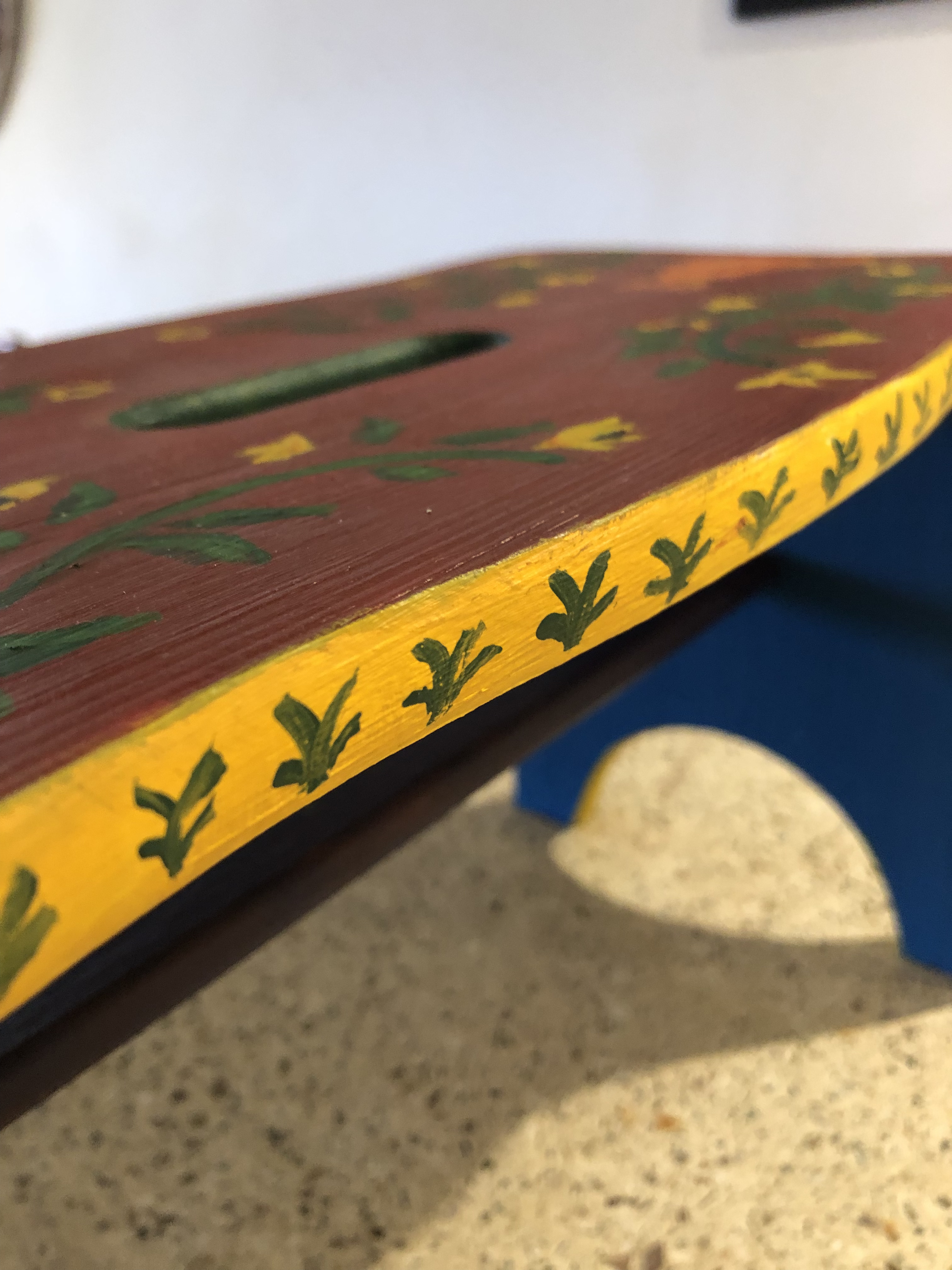
Then I paint the stool using acrylics. If I’m working on a stool for someone, I try to choose the right colors. Once the color is dry I begin on the design, usually on paper first and then on the stool.


Usually I add folk art designs at the end.
The second one in the series is in spring colors.


I haven’t had this much fun in a while!
OURIKA


ESSAOUIRA


When I consider the lessons of our divestment over the past several years, the house on McCollum Street, the house on Park Street, Mama Ganache, a lifetime of acquisitions – I find I always return to the center: what I am, I take with me.
What I am has nothing to do with the things and stories that surround me. It doesn’t need even one suitcase to contain it, much less two. When nostalgia for what I had begins to fill me, wherever I am, I can go to my heart and feel at home with who I am, and that is enough.

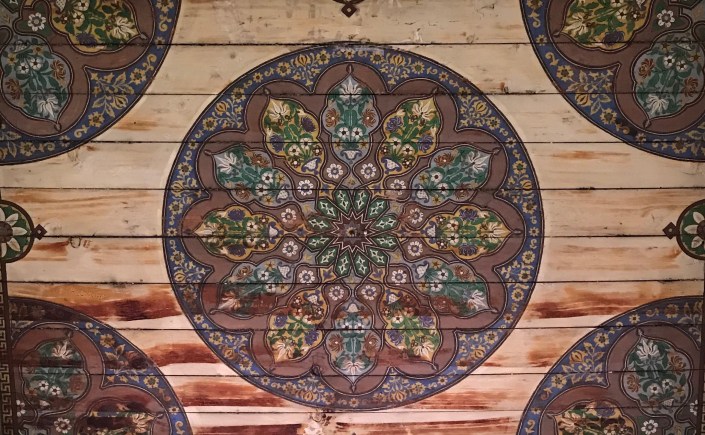
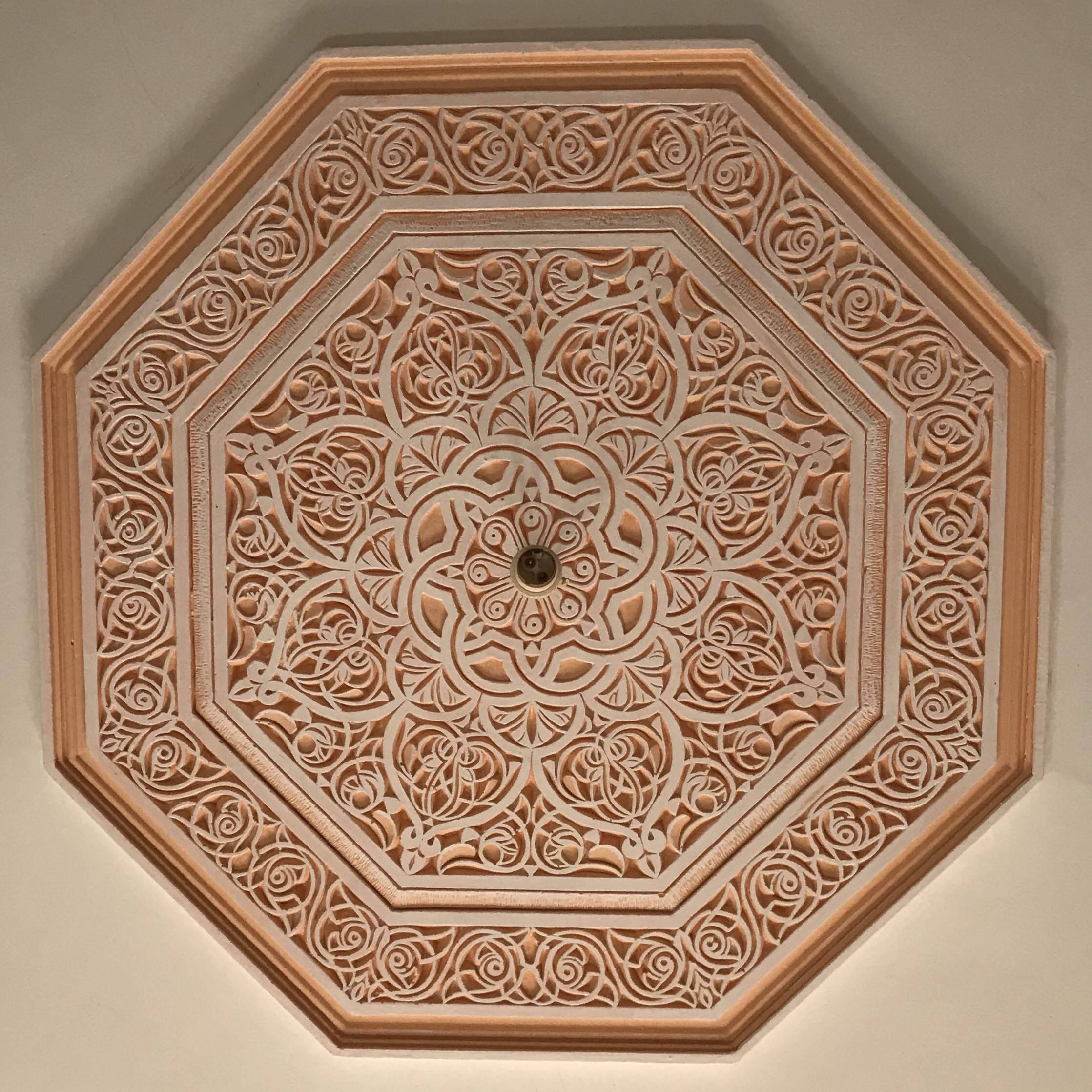
Ceiling tile for sale on a street in Morocco
It’s where I find hope, where I can recover that sense of eager anticipation the Hathors recommend in these times of failing expectations and beliefs, the loss of story, and crumbling perceptual boundaries.
One of the seminal books of my hippie years was a typewritten channeled teaching called Season of Changes. I’ve forgotten the details of the predictions, but I’m sure they’ve been borne out or will be soon enough. It was a dark view of the future, full of cataclysm and apocalypse. Written in question and answer format, the last responses concern how to respond to the changes. As I recall, the advice most forcefully given was to practice meditation.
It’s comforting to imagine that more people than ever are doing that, at least in my own bubble. It’s less comforting to remember how tiny a percentage of the world’s population my bubble contains.
But it’s sound advice. When the now threatening storm of storms is full upon us, when that moment of personal and collective apocalypse that we all feel coming finally arrives, it’s the meditators who will be able to hold the rudder.

Storm coming in at our house in Cordes
Meditation takes you to your center, to the center, the one we all have in common. It takes you out of the chaotic whirl of stories to the place of no story, where energy is conserved instead of fueling the miasma of outer experience.
It takes you beyond imagination, beyond the limits of space and time, and beyond the singular focus of our culture on the physical: on acquisition (growth vs. maintenance), on hierarchy (dominion vs. sharing), beyond your own little bit of the apocryphal elephant.
Letting go of the world as we know it, the world of perception, this particular consensus reality, is necessarily heart-breaking. It’s painful to separate from the things and people and stories we love, and love is, after all, what it’s all about.
The tricky part is to connect love to the universal rather than the particular.
And that’s where meditation can take you.
It was in the Nejjarine Museum of Wood Arts in Fès that the thought struck me. The chaos of the crumbling medina, the vibrancy of the souks, the noise, the pollution, the exploding energy of the colors, and the sheer quantity of stuff –

Souk, medina, Marrakech
– is beautifully balanced by prevalence of the purposeful geometry, sacred geometry, everywhere.
That’s why Morocco is so enchanting.

Souk, medina, Fès, Morocco

Doorway, Marrakech Musèe

Wall, Palais el Mokri
Islam takes the prohibition of worshipping graven images seriously, and discourages figurative art. Like all of life, art should be dedicated to God, and God is only describable as essence. Geometry is essence.

Fountain, Palais Glaoui, Fès
Who can resist being centered by such design?
All my years of studying sacred geometry, beginning even before my Ganesh Baba days, and then Dan Winter and most deeply with Alice O. Howell, peaked at that moment in the museum. I stood at the center of a ideally proportioned room surrounded by mandalas, exquisite symmetry, perfect curves, rhythmic repetition, and profoundly satisfying rectangles and squares.
I wanted to take dozens of pictures, but photography was not allowed, so I was forced to confront the serene beauty of that room face on. It was transformative.
Since then I’ve consciously attuned myself to noticing and letting the geometry take me in.

Palais el Mokri

Medina, Marrakech

Palais el Mokri, Fes

Pastry, souk, medina, Fès
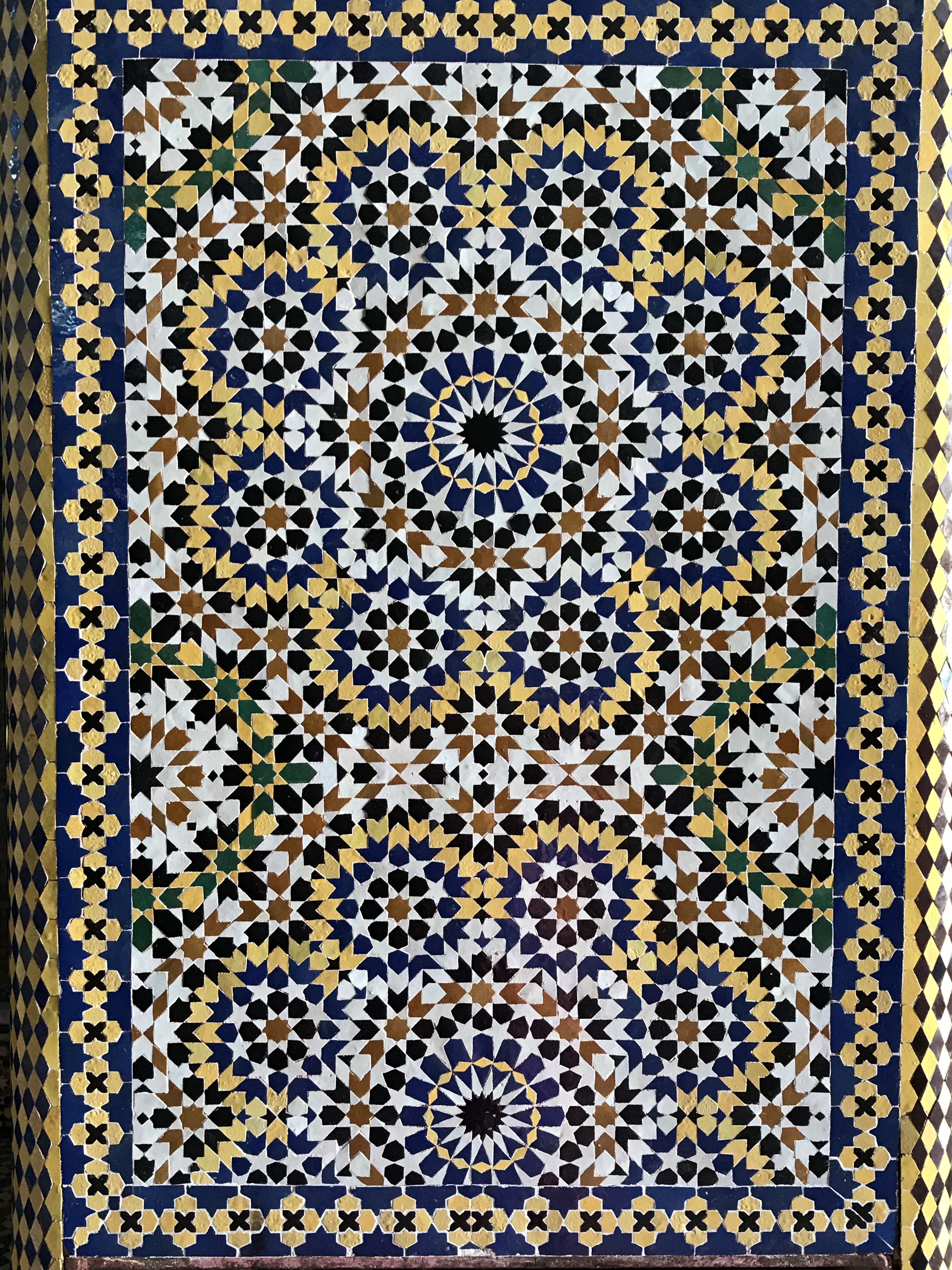
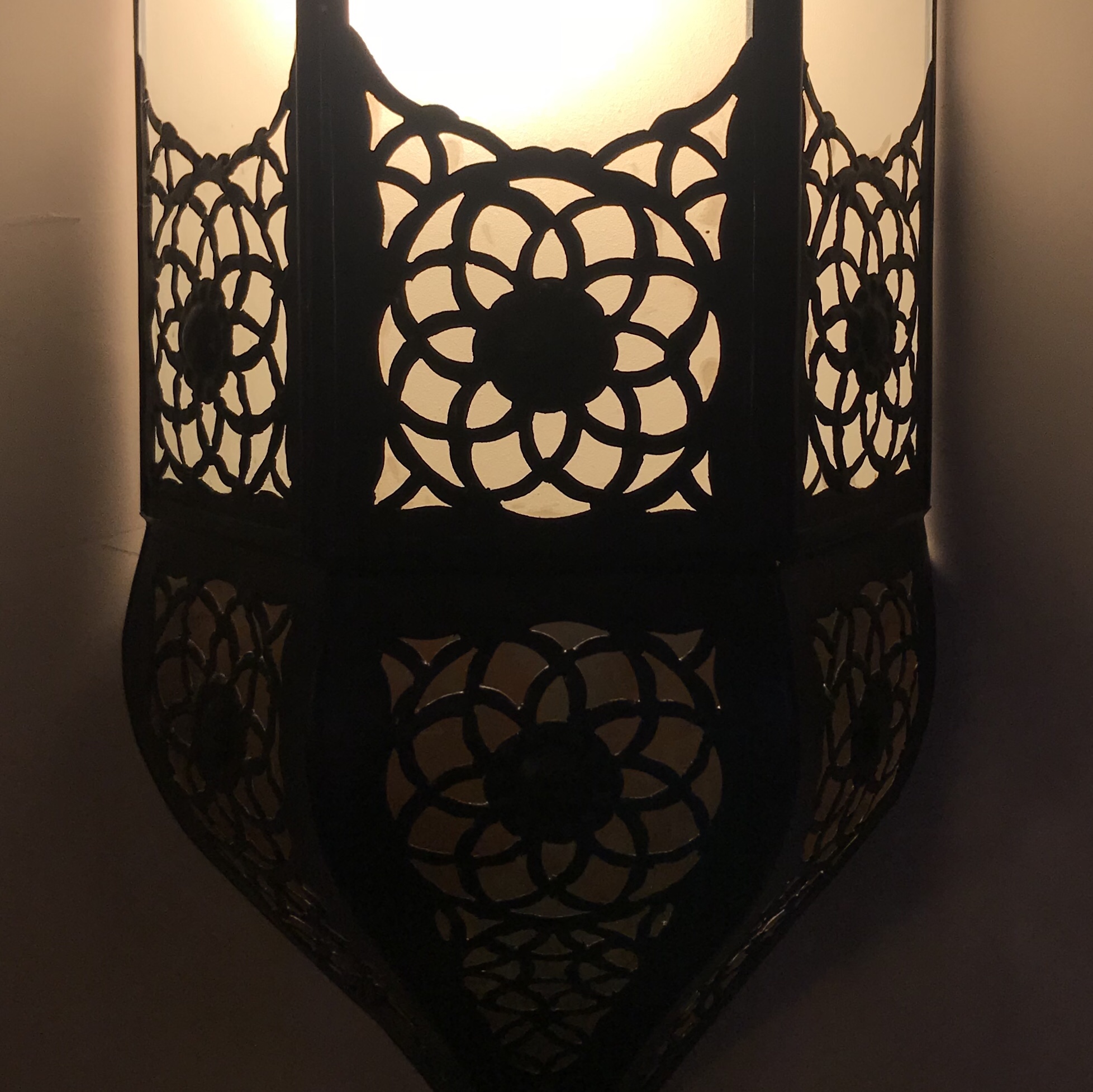
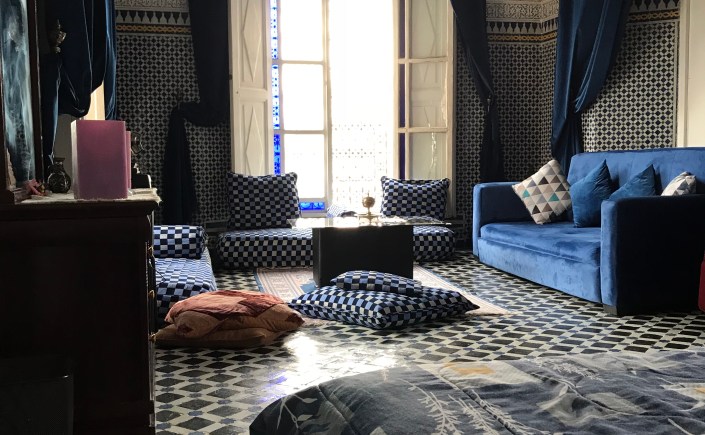
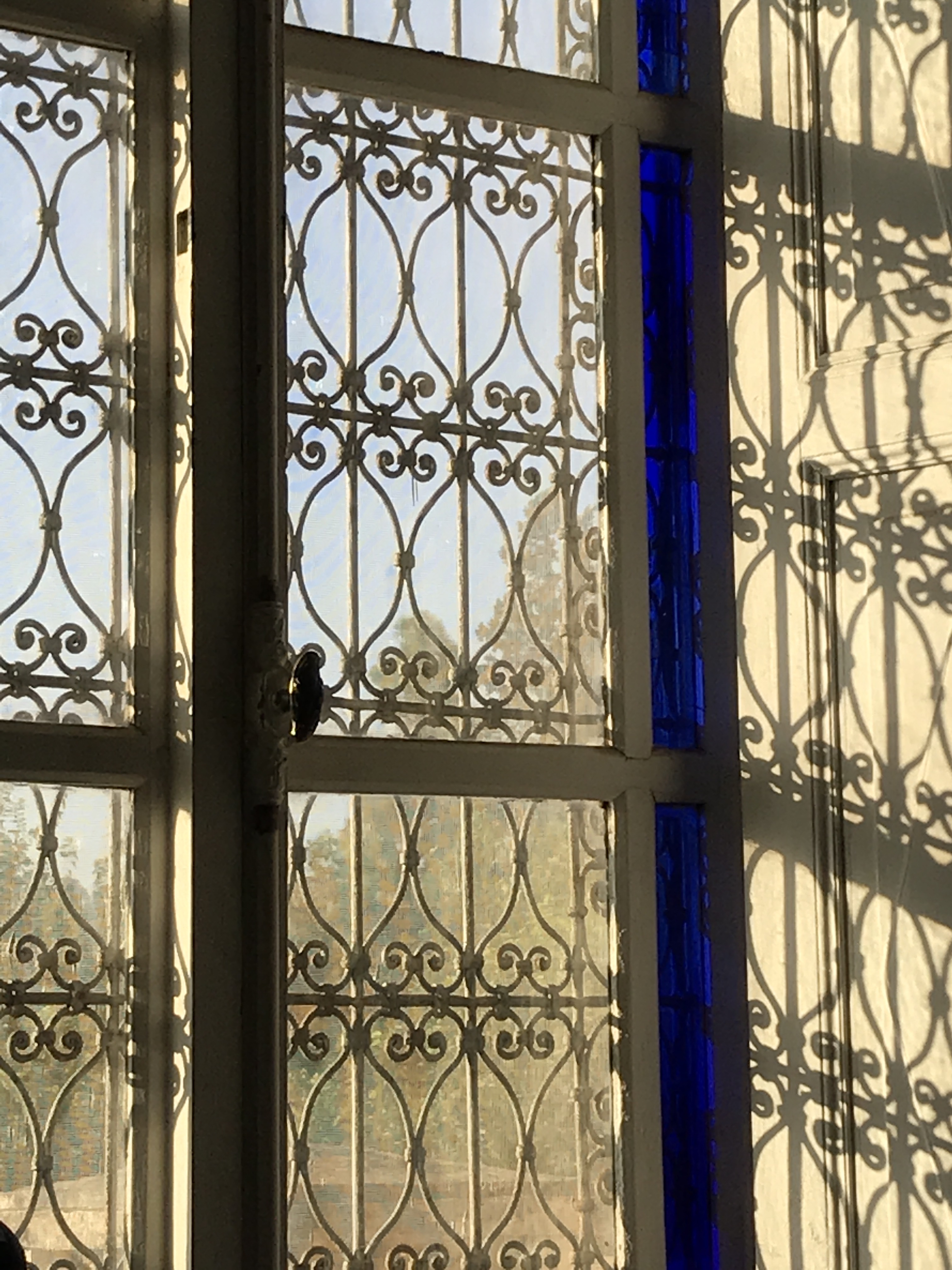
Even contemporary Moroccan design uses the elements of sacred geometry to create beautiful calm spaces, as exemplified by our current Airbnb in the new part of Marrakech.
Magical!

Detail, lamp, Marrakech apartment

Detail, lamp, Marrakech apartment

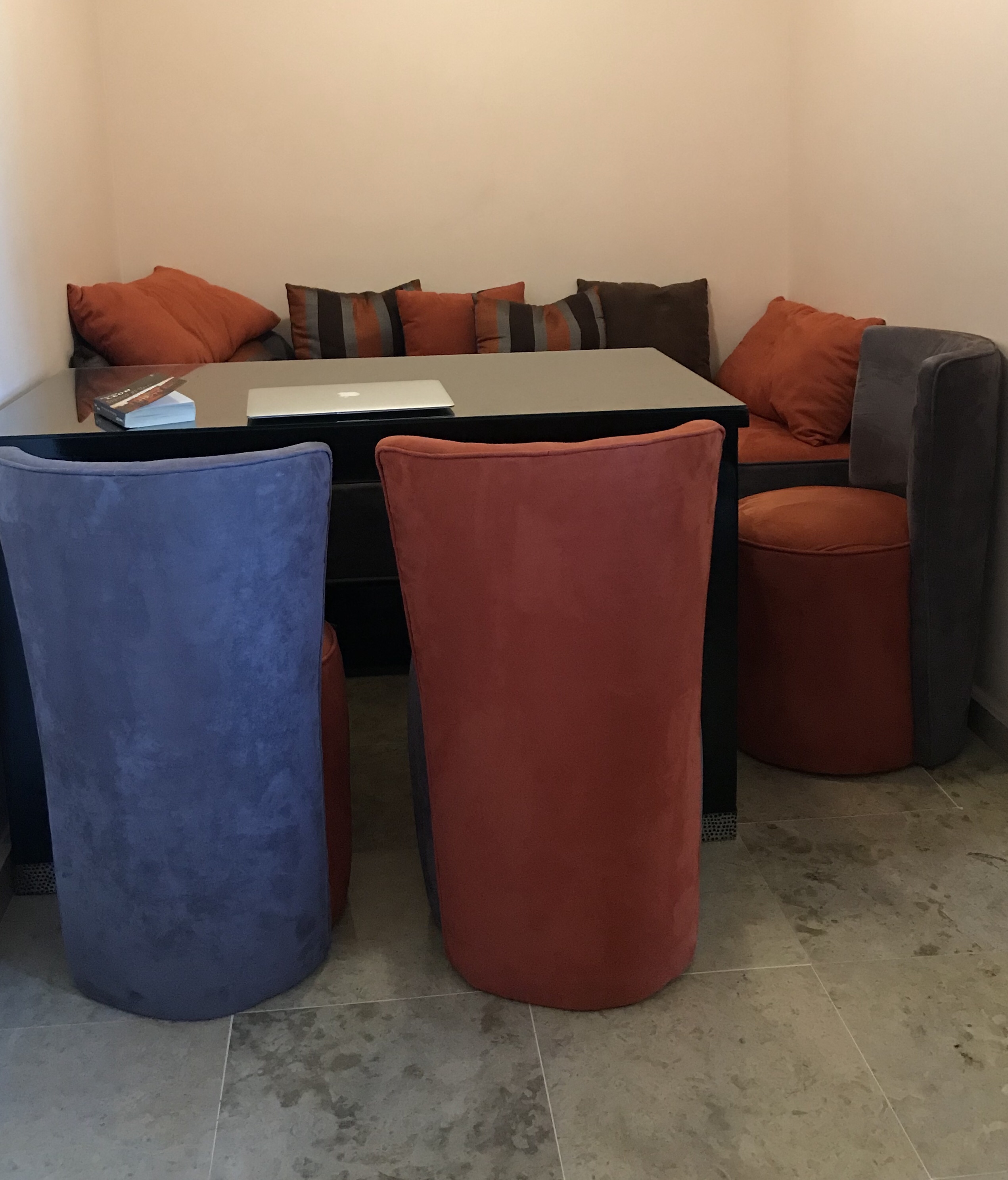
Dining room table and chairs

Dishes

Bedspread

Gate to new apartment building

Light fixture in our Airbnb apartment in Tnine, Ourika
For several days, Tom and I stayed in the Bird’s Nest, an upper room in Palais el Mokri, which is truly a palace, on a hilltop above the medina in Fès.

It was a little like staying at Miss Haversham’s place. Built in 1906 for the Pasha of Casablanca, his descendants are now restoring their magnificent inheritance, an enormous project, and renting out rooms on Airbnb. They’ll also cook for you, and bring very decent meals to your rooms.
The place is magnificent. Dilapidated, but magnificent – and worth every penny of the $23/night we spent to stay there!


Palais el Mokri is about a ten minute walk from the souks, museums, and restaurants of the medina, or old city, of Fès.
Here’s a peek into what we saw there:


By early September, it became clear that the papers necessary for me to acquire dual Austrian/American citizenship, and in turn an EU passport, were not going to arrive before our Schengen visas ran out. I’d diligently supplied the set of required documents to the Austrian consulate in Los Angeles but at each step the rules seemed to change, and there were more hoops to jump through. Our 90 out of every 180 days spent in the Schengen area would be up by mid-October.
The Schengen Area is a zone where 26 European countries abolished their internal borders. It covers most of the EU countries, except the UK, Ireland and the countries that are soon to be part of the EU: Romania, Bulgaria, Croatia and Cyprus. Although not members of the EU, Norway, Iceland, Switzerland and Lichtenstein are also part of the Schengen zone.
Our 180 days began when our visitor visas were stamped on our entry to France in May to explore the possibility of living there. Every time you go through passport control, your passport is scanned and a computer tells the border agent your Schengen status, so there’s no getting around obeying the rules.
We decided to apply for long term French visas, and we booked a trip to Morocco.

Ocean view from Salé
Casablanca is a noisy, dirty, sprawling, port city in the midst of major reconstruction. We rented an apartment between the port and the center city, a few blocks from the area along the ocean where many big hotels have been built and many more are coming. We could walk to the old medina where we enjoyed an outstanding meal at La Sqala, and sat at a lovely cafe on a small park.
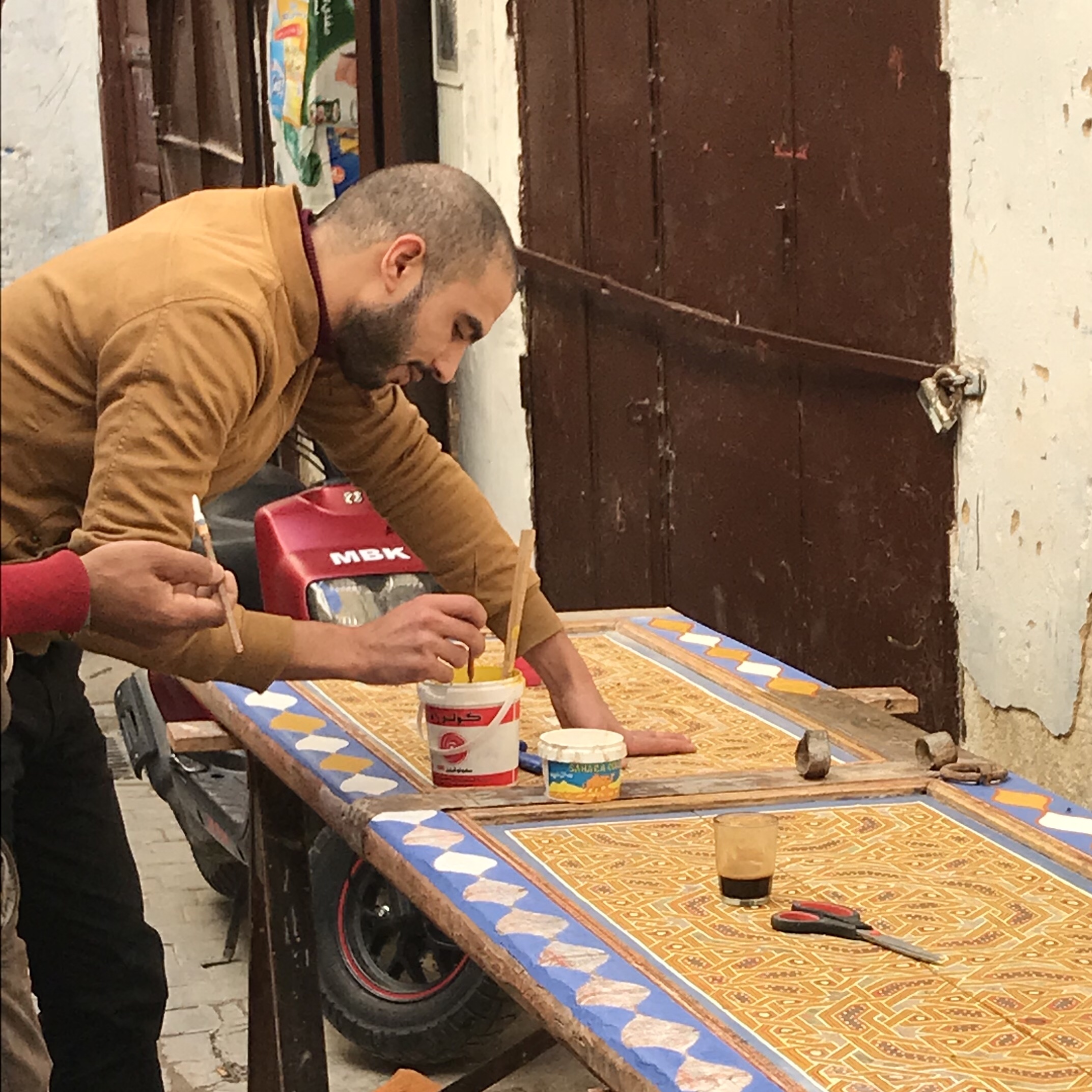
In front of Hotel Central in the old medina

La Sqala

La Sqala

Lunch at La Sqala

From cafe near Hotel Central, old medina
Though it rained a little, we walked for hours, checking out Rick’s Cafe, an elegant reconstruction of the movie set, and Le Cuisto Traditionel, an excellent traditional/modern fusion restaurant in the downtown area. We also visited the Hassan II mosque, which was incredibly enormous and struck me as soulless.

Rick’s Café

Le Cuisto Traditionel

Hassan II mosque

Mosaic tiling at the mosque
Next, we took the train to Rabat/Salé. Rabat is the capital of Morocco and Salé is the huge mostly residential city across the river from it, Oakland to San Francisco.
Our Airbnb apartment was in a middle class neighborhood in walking distance from the old medina, the ocean, and the tram to Rabat.

Tom relaxing in our spacious living room in Salé

Our street in Salé

Three flights up and down
Salé is clean, relaxed, and very friendly. The first afternoon we were there, we noticed some construction going on next door. From our fourth floor windows we could see a long tarp over the narrow street below.
That night – it was a Friday – a crowd gathered and a sound system was tested. It was a massive tent they’d set up. From 8 pm that night till long past midnight, our flat was filled with the voices of two men singing long, exquisitely beautiful prayers, interspersed with poetic speech. We fell eventually fell asleep, enchanted.

Morning view from our apartment
The next day was beautiful. We bought food at the neighborhood stalls and planned to stay at home, relaxing and cooking.

Vegetable stall around the corner
In the early afternoon, though, the tent filled up again, the sound system was turned up, and the celebration began. It was a wedding! The music was live and very loud. Western music would’ve been harder to take for such a long time, but still. In the late afternoon we took the tram into Rabat for a few hours. The routine noise of the busy city seemed wonderfully quiet to us.

Wedding tent
When we came back and Tom peeked into the back of the tent.
The wedding went on till just before midnight. Clearly, everyone had a great time – even without alcohol!
Over the next days, we made friends with the cashier at the local grocery store, visited the old medina, and sat at a fish restaurant across from the ocean enjoying an enormous meal.

Old medina, Salé

Cart near the old medina, Salé

Wall around Salé
We also explored the beautiful city of Rabat, a stunning combination of ancient and modern. Such an adventure! And now we’re off to Fes.

Almohad necropolis – 12th century

At the gas station near our place

Entrance to Chellah: Phoenician, Roman, and Marinide ruins

old mosque near Roman ruins

Cats are everywhere. These are waiting for the remains of eels near the mosque at Chellah

At the old medina in Rabat

Verveine

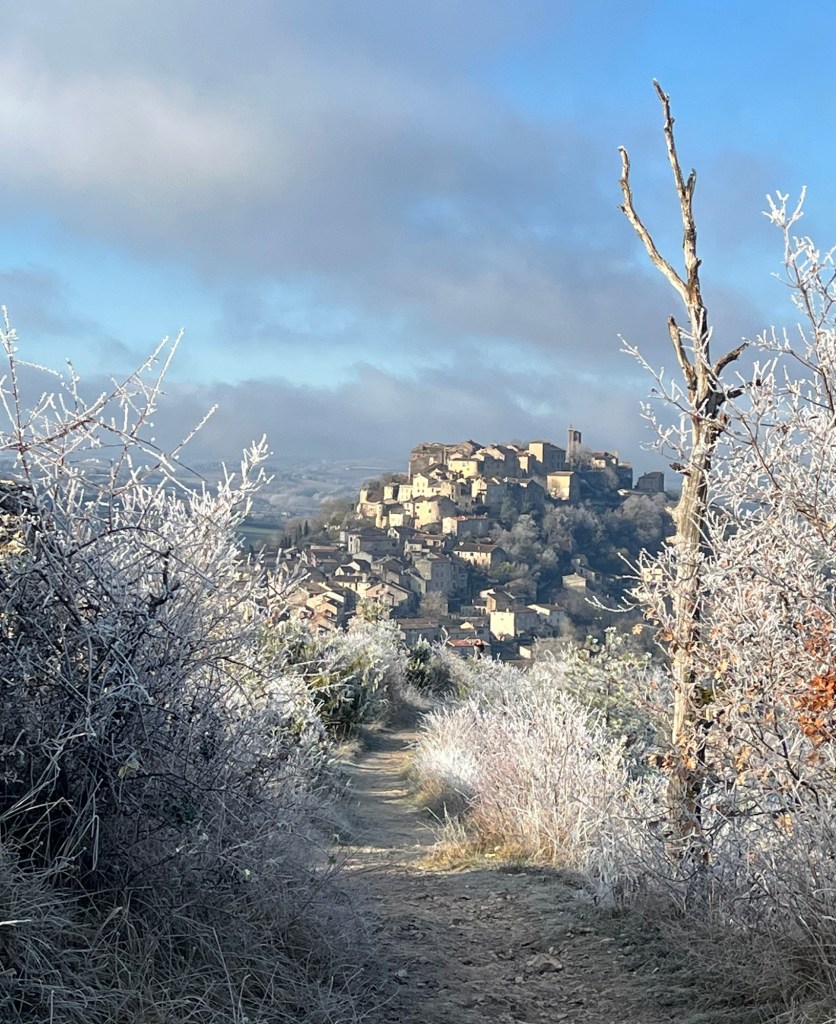
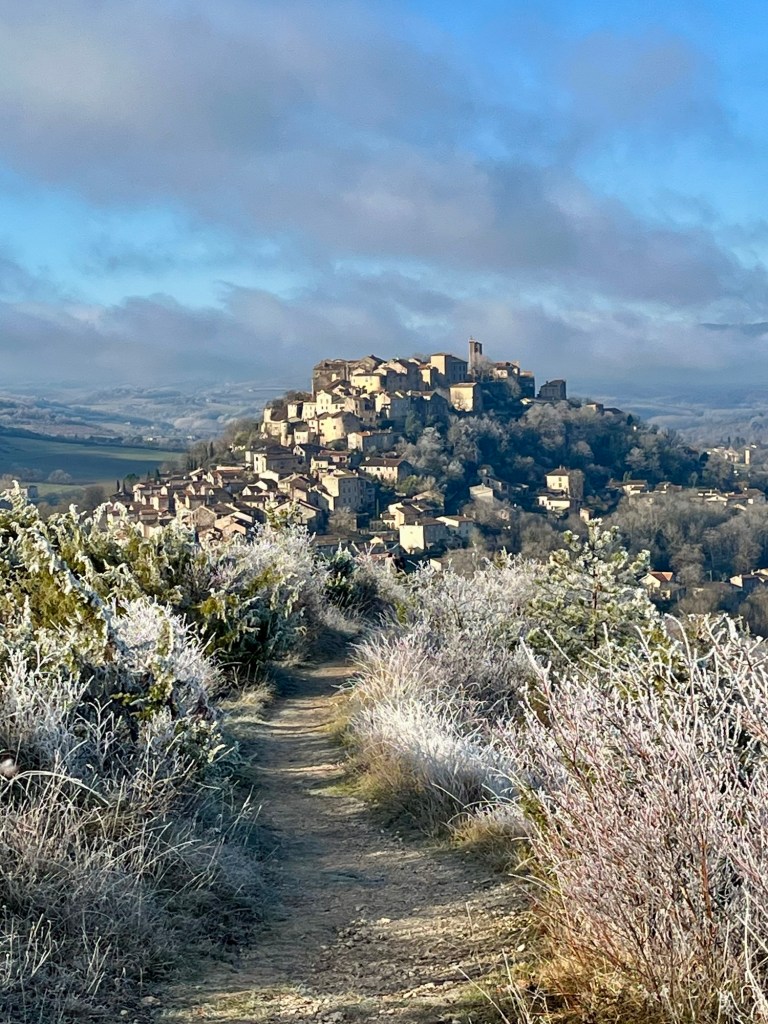
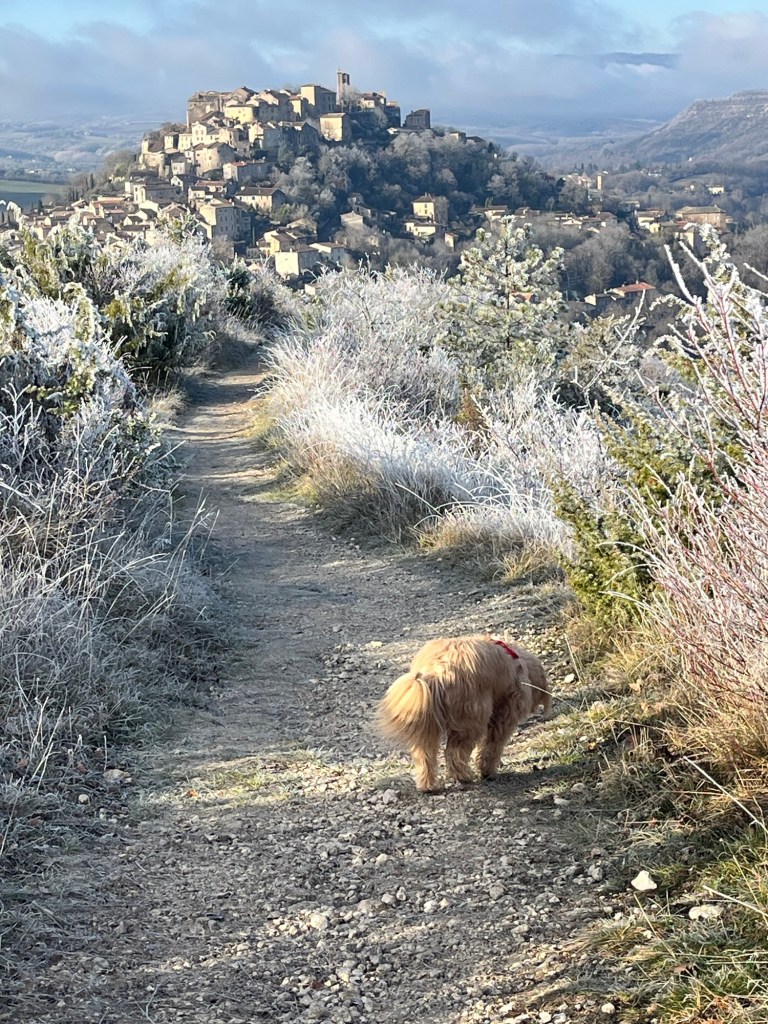
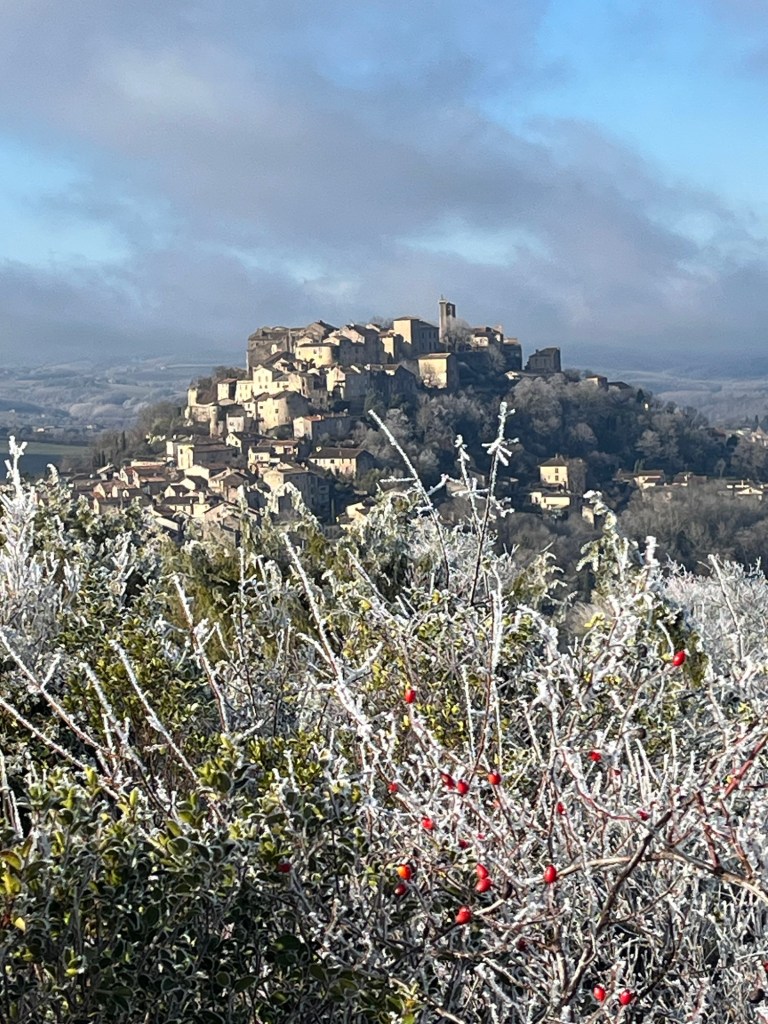
Most mornings I wake up before sunrise, open the shutters, roll out my rug and light a candle, and then do some stretches, breathe, and meditate for a while. When I open my eyes, the sun is up – or on its way up – and the view is so lovely, I try to save it in a photo.
These are some of the morning pictures I’ve taken. They begin in early August. The last one was taken this morning, the first day of fall.