Neighborhood magic: Elisabeth Abrahams (Part 1)

This is a warning: if you’re a neighbor of mine and you stop by in the afternoon for a cup of tea, you may well end up interviewed here. That’s what happened to Elisabeth Abrahams, dancer and dance therapist, playwright and yoga teacher, who lives just up the hill. Born and raised in England, Elisabeth is in her 80’s now. I’ve chosen to break my conversation with her into two parts; this is the first.

We sip black tea with milk on the deck and I ask her the same questions I asked Tom.

“On a routine day in your life, what makes you happiest?”

“What makes me happiest?” Elisabeth reflects for a moment. “Oh, when it gets to be around 3:30 or 4:00 in the afternoon, I like to sit down with a cup of tea – my latest tea taste is China Oolong tea – I don’t have milk in that – and some kind of a biscuit, a cookie.”  It is exactly 4:00 and I wish I had some cookies, biscuits, in the house, but no.
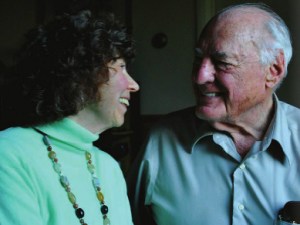
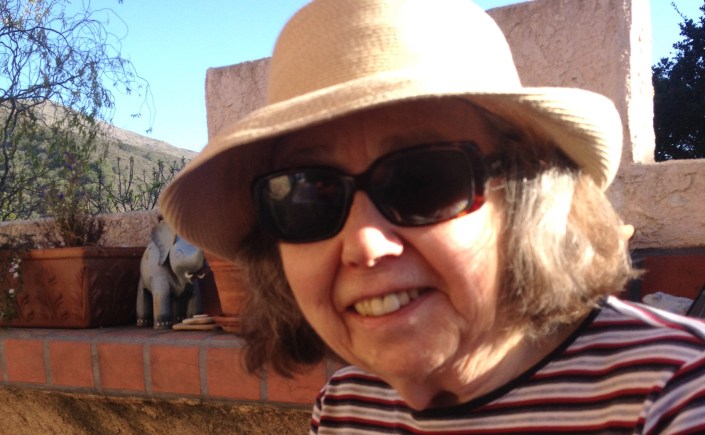
Elisabeth and Joe

photo credit: Susan Pyburn

She laughs to herself asking, “Should I say this?” before going on. “The other thing I really like to do – this is earlier in the day – the tea thing takes place at about, you know, tea time – the other thing is to draw a warm bath in the morning,”  she sighs contentedly, “and sink into it and plan the day.” She smiles. “But usually what’s happened is the telephone goes, and my husband walks in with the telephone in his hand, and I have to get out of the bath,” she laughs, “and answer the telephone.”

(Take note: avoid Elisabeth too early in the day.)

Joe is 97 and going strong. They met on a blind date in San Diego is 1978 and they’re still dancing. When I met them a few years ago they were both retired from Atascadero State Hospital where he’d been a psychiatrist and she a dance therapist.
1380427_10151685971023857_1230435072_n

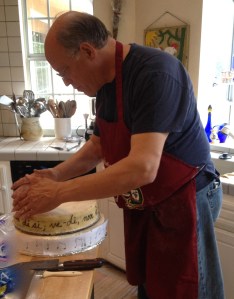
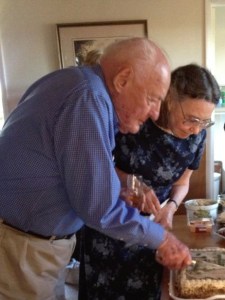
Elisabeth and Joe cutting the cake for his 97th birthday

I ask her, “In general, what activities give you the greatest joy?”

“Dancing,” she says right away. “Dancing of several kinds. I love to go to a ballet class, do the barre and do the moves to the music. I like to go the Madonna Inn and listen to music of the 30’s and 40’s and 50’s – and the 20’s! – and dance with Joe. I like to do a modern dance class if I can find one. That hasn’t happened for a while. And we love to dance around the house!

“I also like to read plays,” she smiles broadly, “and I should say, the best thing I’ve done in my life was to take the play I wrote to Edinburgh. I felt like a star.” Elisabeth is glowing. She takes a long sip of her tea and sets down the cup firmly. “I really enjoyed that.”

Elisabeth's play“Against the Tide  –  a portrait of a marriage” is a one-act play about Melanie Hahnemann, the Marquise Marie Melanie d’Hervilly Gohier Hahnemann, and her husband, Dr. Samuel Hahnemann, the founder of homeopathy.  It ran from August 26 to August 30, 2009, in the  Vault Theatre, a venue of the Edinburgh Festival.

“And I do like politics!” she says.  “If the truth be known, I like arguing.

“There’s a story from when I was working at ASH that illustrates it. They were looking for someone to be on a committee. They wanted somebody from each of the services and I’d recommended a young woman, a friend who’d come to work there recently. When she was turned down, I said I’d do it. I waited and waited to hear whether I was to go to this committee meeting but I was never called, so at last I went to my boss and asked what was happening. He shuffled his feet around and he said, ‘Um, you’d better go and ask Brenda.’

” So I go on to Brenda and she hems and haws and finally she comes out with it: ‘Well, you’re considered to be a little too argumentative.’

“And I grinned from ear to ear! She’d been sitting there, of course, so uncomfortable.

‘I am!’ I said, ‘I was brought up to be! That’s why they sent me off to study law!’ Brenda smiled and heaved a sigh of relief and said the other woman had been there long enough now and would I be satisfied if she sat on the committee. Of course I would, and that was the end of it.”

IMG_4186I ask Elisabeth, “What experiences in your life changed the way you see the world the most dramatically?”

“Well, that’s an easy one. In midlife, I went to UCLA to study Dance Therapy. I’d had a broken marriage, I was in my forties, and I was fortunate enough to meet Allegra Fuller Snyder, who is Buckminster Fuller’s daughter. I was a solid Churchillian Conservative in England, you know, didn’t believe in the National Health Scheme when it came in – I was most vocally against it. But I was ready to hear Allegra.”

The stories about that will have to wait, though. It’s time to walk the dog.

Neighborhood magic: an interview with Tom Neuhaus

Every now and then I’m planning to introduce you to some of the people who live in our neighborhood. My husband Tom kindly agreed to be my guinea pig for the project, so here he is!

I asked him a series of questions beginning with “On a routine day in your life, what give you the most pleasure?”

IMG_3841

He takes a sip of his wine and spreads some camembert from Fromagerie Sophie on his cracker.

“The most pleasure? Eating cheese and drinking red wine,” he says.

“And feeling the wind whistle past my ears when I ride my bike. I’m very fond of that. Just feeling the air. And I like the soft light of the evening.”

He eats some more cheese and considers.

“Just simple creature comforts give me the most pleasure.”

After enjoying some of the wine and cheese myself, I ask, “What activities in general give you the greatest joy?”

IMG_4060

“Diverting water,” he says without hesitation. (This is a guy who spent most of the last few weekends repairing a gray water system he built in our backyard. Lots of water to divert).

He continues, “Walking on the beach, eating great food, sex, GREAT music, oh, listening to great music like Rachmaninov’s 2nd and 3rd piano concertos, oh, I love that!

“All the sensory stuff. I’m not real big into thinking grand thoughts. I’m more emotionally driven than cognitively driven, more into senses than internal cognitive states.”

We finish off the cheese and wine. I ask, “What experiences in your life changed the way you see the world most dramatically?

He barely pauses. “Camping, being outdoors and realizing it doesn’t have to be thought of as God’s creation, but whatever it is, it’s damn beautiful. Canoeing across a lake in upper Minnesota or hiking up in the mountains in Colorado. You just can’t beat that.

IMG_3114

“That year in France, speaking foreign languages, meeting other people, eating their food, laughing at their jokes. Humans, I like humans a lot. That’s why I like teaching.

“Going to Africa, being in the villages.

“Reading great books. They open your mind, change how you look at things. It’s very important to read books from many different perspectives. That really opens your mind the most. I’ll read one book about how Europe underdeveloped Africa and then the next book is about the human body. I like that, I really like that.” He pours himself another glass of wine.

“What do you like about the way you make a living?” I ask.

“I love the variety. Running the chocolate business, Mama Ganache, you’re constantly running into all kinds of problems and challenges. Teaching, you’re always trying to be on the edge, trying to do a good job.

IMG_3987

“I remember buying some antiques from an old farmhouse in Texas and there was a sign that said Ich will streben nach dem Leben: I will strive to live. I like that Germanic idea of striving. I like trying to do as well as I possibly can. Without being a type A personality, just for the heck of it, just for the variety and the challenge. I like that, I like that.”

I continue, “What was your favorite job?”

“Huh. My favorite job? I liked them all. I liked playing the pipe organ because I like the challenge of making good sounds and the preachiness of organ music; collecting rat urine, well, I wouldn’t say that was my favorite job, but it was fun hanging around scientists. I liked baking, I liked working the line in a French kitchen, getting into arguments with the chef, running a restaurant, having a fun time with Puerto Ricans – the restaurant industry is full of Puerto Ricans in New York, great people, fun to josh around with, I learned a lot of Spanish. Ah, every job has so many good things about it – as long as you stay open-minded – stay curious about the world.”

We drink the last of the wine, a very nice cab from Vina Robles, as the sun goes down behind Bishop’s Peak. Am I fortunate or what?

Slowing down in SLO

Not long ago I changed the name of my Airbnb listings to Slow Down in SLO. It took a while for me to decide if SLO, San Luis Obispo, really is slow, but I concluded that it’s actually true. Located halfway between Los Angeles and San Francisco, SLO is a too far away to commute. Imagine: 44,000 people, virtually no traffic, everything you need a few minutes away, year-round access to an extraordinary outdoor environment, and a culture of kindness rooted in a Franciscan heritage and enhanced by a mild climate. I feel immensely grateful to find myself here – it is grace – but slowing down doesn’t happen from the outside. It’s internal.

Nature does not hurry.

Yet everything is accomplished.

– Lao Tzu

It was Lao Tzu’s poem that brought the deeper truth home to me a few years ago. Since then I’ve been reflecting on the virtues of slowing down, so it seemed like an obvious topic to write about  – except that the entire week I gave myself to put this together disappeared into a whirl of activity.

photo 8

Necessary activity. Did I consider slowing down in the midst of the hurly burly? I did – but only for the time it took to laugh at myself and at the lila, divine play, of life – and to refocus on slowing down.

Internal slowing down doesn’t mean doing less. It means doing whatever you’re doing more mindfully, more passionately, more fully, giving it the full focus of your attention. In the long run it’s more efficient – I’m sure your mother already told you this. Indeed, the benefits of being present to a task, whether it’s cleaning the wet leaves off the deck—which I’ve been doing in between paragraphs because a photographer is coming to take pictures of the exterior of our house, a sad mess because of the drought until this week when the rains came and now a much happier mess—or brushing your teeth or talking to your mother, are countless.

Hafiz says,

Time is a factory where everyone slaves away earning enough love to break their own chains.

The key that will let you out of slavery is to love what you are doing, whatever it is: catching your mind when it wanders into the future or the past, or to some place other than where you are, and bringing it home to the moment: celebrating the stillness of the center.

Tom and Lily Bear at the dog beach

Ganesh Baba talks about the four phases of our existence: the physical, the biological, the psychological and the spiritual. Slowing down involves all four: consciously releasing stress and tension in the body, slowing the breath and consequently the heartbeat, lowering the emotional pitch (“Don’t screw up the pitch!” he would scold), and using spiritual practices to find the still center within.

It’s the mind that’s moving too fast, rarely using the power of attention at its true worth, skimming the surface of experience instead to allowing it to be absorbed and processed at all four of the levels of our being. Unless we slow down we sacrifice the richness and beauty of life, of any life.

What we achieve inwardly will change outer reality. – Plutarch

For those of us who believe in physics, this separation between past, present and future is just an illusion. – Einstein

All life is fleeting. Cling to that understanding, and seek, then, within yourself that which alone endures. – Yogananda