Here’s the chapter of Underground that I just finished. Gisi and Max are planning to write a second article with information coded in it about the safest routes for refugees to take to leave Austria if it’s necessary. It’s 1937, less than a year before the Germans will annex Austria.
Two Conversations
April 16, 1937
a cafe near Max’s shop
A couple weeks later, on that first balmy day of the year when everything blooms at once and the air is full of rich fragrance, Gisi is rushing down the city street on her way to meet Max. When she arrives at the cafe near Max’s workshop the outdoor tables are already filling with spring revelers. It had been a long, hard winter for so many, in so many ways.
Gisi chooses an indoor table in a private corner, sits so she can watch the door, and pulls out a map from her bag. She unfolds it carefully and lays it flat on the table. Thoughtfully, she runs her finger along the routes from Austria to Italy that she and Max are considering. All of them are longer than the one they’d chosen for their first newspaper story. Even the shortest would require at least two overnight stays.
She has mixed feelings about going. Not only would all the proposed hikes take longer and require more preparation, but the story would take longer to tell and the article longer to write. And, it would take up more space in the newspaper, making it harder to sell. She sighs.
At the only other occupied table in the room, a couple in their forties is arguing. Though they’re trying to be quiet, Gisi can’t help hearing the woman’s adamant responses to her companion’s softer words.
“Don’t be a fool,” snaps the woman. “Mussolini will say whatever he wants Schuschnigg to hear.” A pause follows. “Of course he’s in league with Hitler! Why shouldn’t he be?” The pitch of her voice is rising. “Mussolini, Hitler, Franco, all the Fascists, they have nothing to lose by banding together.” Another pause. “Only we, the Jews, the immigrants, the travellers, the dark-skinned ones, all of us who are different, have something to lose!” A longer pause. Then she almost hisses, “But we have the money to get out, Fredl! And we have somewhere to go!” She listens for a moment and then says, “I don’t care if you don’t like my sister. It doesn’t matter. She’s offering to help us.” Another long pause.” And whose family has the means to do it? Yours?” She snorts.
Now Gisi can hear the man’s voice too. They’ve forgotten she’s there.
“It’s not a matter of the money, Lotte,” he says, slumping forward, elbows on the table. “You know that. You know it too well. But how can I leave my family, Lotte? What will happen to them?”
“You have a brother.”
“Yes, and you have a sister. Your sister has some good qualities and some less good ones—like my brother. No, I can’t leave. My life is built around caring for my family, and we’re rooted here. My life is in this city, in this country, no matter who is in power.”
“And my life isn’t here? You think I’m not leaving anything behind by emigrating? The issue isn’t what we have here now, Fredl. It’s what we won’t have when Germany takes over.” From the corner of her eye, Gisi sees the woman raising her hand to stop her husband from speaking. “Don’t talk about me how assimilated your family is. My cousin tells me how it is in Germany now. Jews have no rights. It doesn’t matter what kind of a Jew you are, rich or poor, practicing or not, we’re treated more and more like animals there. It’ll be the same here. Soon. Face it, Fredl. Is that what you want?”
“No. No, of course not.” He sits up and takes a sip of his coffee. “But we Viennese would never treat Jews the way the Germans have.” He puts down his cup. “We’re civilized here.” Even from across the room, Gisi can hear the doubt in his words. She realizes she hasn’t believed that for many years.
At that moment, Max enters the cafe bringing with him a rush of fresh air. He smiles at Gisi, who’s studying the map with a serious expression on her face. She looks up and smiles back at him, but the other couple’s argument is disturbing her, and her smile doesn’t reach her eyes.
He slips his jacket onto the back of the chair. “Well? Have you decided on which of the hikes we should take?”
“Oh, Max, I don’t know. Sit down and we’ll talk about them, but I have to tell you right away, I’m not sure I want to go on any of them.”
Max deflates as he sinks into his chair. “None of these particular hikes or none at all? Why not?” He can’t hide his disappointment. “I was so looking forward to it.”
Gisi lays out all her reasons: the time, the expense, the length of the article. It’s a strong argument and she becomes more convinced of it as she talks.
“So that’s it? Your mind is made up?” He stands up and begins to put on his jacket.
She relents. “I said we’d talk about the routes. You can still try to talk me into it. I just wanted you to know how I feel about it now.”
Max sits down again. “You’ve studied them? What did you find?”
“I read whatever I could find, and I talked to people. We were right about the routes we’ve been considering, but there are more. Smugglers have been using these trails for centuries. Now they’re in the business of smuggling people.”
“That makes sense,” he says. “It’s not too hard to find a smuggler to get you to Brno.”
“Although they’re not always reliable, as Hugo discovered.”
“You never know what to expect of people you meet along the way. I heard a story about a guy hiking and skiing into Switzerland who was picked up by some Heimwehr soldiers. It turned out they were more interested in what was in his rucksack than in turning him over to the authorities. Anyway, Switzerland was a kilometer away and it was many kilometers to their headquarters, so they escorted him to the border and left him there. Unfortunately, they’d robbed him, so he had nothing to show at the border, and guards turned him away. He walked back the three days it had taken him to get that far—without money, papers, skis, or even a winter coat.” Max shakes his head. “Poor guy.”
“At least he survived,” Gisi says.
“That’s true. People trying to escape from Germany wouldn’t be so lucky.”
Gisi looks down at the map. She doesn’t want to think about the horrors people are facing. “There at least a dozen well-used routes,” she says. “The shortest is the one we already tried, from Innsbruck to the Brenner Pass. Next is this one.” She points to the map. “You take the bus from Innsbruck to Naubers, which is a ski resort where strangers don’t stand out, and then it’s two and a half hours on foot to the border at Reschen Pass. It’s a much more rigorous hike than the one we took, but not as long or dangerous as most of the high mountain routes. I didn’t even study those. There are also, even at the very high altitudes, a handful of mostly flat routes that run along rivers, but they would take a very long time, days and days, even a week or more.”
“So the only reasonable one for us to explore is over the Reschen Pass. And we can do that! It’s only two and a half hours, you said?” Max is pleased.
“But they say some parts of the walk are challenging if you don’t have a head for heights. Do you have a head for heights?”
“Well…”
“And we’d need mountaineering equipment, trekking poles, warm, light-weight jackets, and better boots than either of us have.”
“Surely we can borrow what we need. Everyone in our circle supports this project.” He isn’t ready to give up.
She goes on, “It would be expensive, too. In addition to the train to Innsbruck, we’d have to pay for the bus to Naubers. Figuring out which of the hostel and restaurant owners would be willing to help refugees means we’d have to sleep and eat there, at least at some of them.”
Max has no response to that. “I don’t understand why you’re so negative about the project all of a sudden. Last time we talked about it you were all in favor. What happened?”
Gisi thinks. “I guess when I went into it more deeply, it didn’t seem so easy.”
“Nothing you’ve said has convinced me that it’s impossible though. Train, bus, and a two and a half hour trek—what’s so hard about that?”
“It’s everything together, but mostly, I find it frightening to imagine the two of us edging slowly along narrow path on a cliff with a thousand meter drop-off below us.”
“Come on, Gisi! You’ve skied so many times!”
“This is different.”
“It’s not. And everything else, we can manage easily.”
“No, Max. It would be much longer than our last trip—six hours on the train to Innsbruck and three more to Naubers, at least one night in Naubers, another six hours round-trip on foot to the border, and another night in Naubers, and then a full day to get home. And that doesn’t include all the time it’ll take to talk to people in order to write the article. Or the time it’ll take to write the article. It’s just too much.”
“So you’re giving up? You’re not interested in our project anymore?”
She sighs. “I just think it’s too much.”
He doesn’t argue. Instead, he takes his jacket and walks out the door.
At the other table, the couple who’d been arguing earlier have stopped. The wife is staring at her husband stonily as he slowly finishes his pastry.
Outdoors, clouds cover the sun and a cold wind cuts across the cafe. People are putting on their sweaters and coats.
In the part of Underground I wrote today, it’s April 4, 1937. Austria has had a Fascist government for several years, anti-Semitism is rising rapidly, and the possibility of Germany taking over Austria is becoming very real.
As they walk along a path in the Vienna Woods, Anna confides in Gisi that she recently wrote to their old acquaintance, Edith Suschitzky, now Edith Tudor-Hart. Anna is hoping that Edith can help her find an Englishman to marry, as Edith had found Alexander. For Anna it would be solely a marriage of convenience— it would get her a visa.
Edith is a secondary character in Red Vienna. She’s one of the real people scattered throughout the narrative. I have no idea if my parents, on whose story the books are based, ever knew the real Edith Suschitzky, though they may have. She was living—and taking the photographs described in the book— in Vienna at the time that I wrote her into my story. Her father did own the Social Democratic bookstore, her brother Wolf is real. It’s true that Edith married Alexander Tudor-Hart, that she was arrested, and that they moved to England.
Today, while checking the spelling of her name, I came across a documentary about Edith Tudor-Hart that hadn’t been released when I did the research for Red Vienna. It’s called Tracking Edith, and it’s available on Vimeo.
Wow. I knew I wanted to include Edith in my book the first time I read about her, and I knew much of what’s in the film, but there’s so much more. There are things I wish I’d known when I wrote about her, and things that I got wrong. And by no means have I told Edith’s whole story, just a tiny bit of what could have happened. Much of the really juicy part of her life hadn’t happened yet, or it was happening then, but there’s no way my characters could have known about it. I don’t want to spoil Red Vienna for those of you who haven’t read it, so all I’ll say here is that Edith’s story is probably the biggest of any of the characters in my books.
Do look her up, and watch the video. And read Red Vienna, too.
This one is from the second volume of Two Suitcases, which is called Underground. If you haven’t read the first volume Red Vienna yet, order it at your local bookstore or through Amazon.
February 2, 1937
a cafe not far from Max’s workshop
Gisi turns the pages of the new issue of the Kronen Zeitung she spread on the cafe table. She’d seen several copies on her way to the cafe. The paper’s populist touch allowed it to survive the Fascist takeover of Austria and keeps it on the newsstands in working class neighborhoods.
On the second to the last page, she finds what she’s looking for: From Innsbruck to Italy—Three Winter Hikes, by Wilhelm der Wandersmann. It’s Max’s and her first effort at hiding coded information about safe escape routes in the paper. She’s pleased to see it, of course, and she feels confident that no one who doesn’t know the code could possibly suspect anything, but it bothers her to think about the lies she had to tell to get it published .
The son of the publisher, a sweet but naive young man, now waits for her after lecture every week, or worse, he arrives early and saves her a good seat. Gisi puts on her spectacles to discourage him, but it hasn’t worked. She can’t tell him about Max so she told him that she’s helping a cousin in Tyrol to get a start in journalism instead.
“My cousin is more of an outdoorsman than a writer,” she’d said to him, “but he wants to write a series of articles like this about hikes all over the country. He’d like to make his love of hiking pay for itself. That’s why he’s using a catchy byline instead of his own name.”
What she feels worst about is that the day she gave the publisher’s son the article, she let him take her out for coffee and a pastry. Encouraging him even that much is so wrong.
Max rushes into the smoky cafe. “Sorry I’m late,” he says breathlessly. “I sold another radio and had to pack it up. I only have two left now.” They kiss lightly. “So, let’s have a look at our man Wilhelm der Wandersmann’s article!”
The code isn’t complicated. It involves starting certain sentences with letters that indicate the political bent of the proprietors of inns and restaurants along the way. Each time Gisi and Max succeed in publishing another article, a new code will be shared, again in code, in the ArbeiterZeitung.
“It’s fantastic!” he says, smiling broadly. “I can’t wait to take the next hike with you.” The next hike will be considerably longer with at least two overnight stays, quite possibly three.
Their conversation turns to how much fun they had hiking the trails for the article over the last six months, two of them more than once. In the end, they decided that only one of the three routes would be safe, and they’d written the article together, he injecting the humor into her fastidious accounts.
“We should go on the next hike as soon as the snow melts,” he tells her. “When’s your spring break?”
“It’s at Easter, but Easter is early this year, at the end of March. It could still be very cold.”
“Then we’ll have to keep each other warm,” he smiles. And the date is set.
“So,” he says, “that settled, let’s have a look at what else the paper has to tell us today.” He turns back to the front page and glances at the headlines. “Well, we knew the trade negotiations with Germany would fail, so that’s not news.” He fails to notice a piece of paper sliding from between the pages and falling to the floor.
Gisi picks it up. “Look at this, Max,” she says. “It’s a speech by Hitler. Someone seems to have printed out the whole thing and tucked it between the pages of the paper.”
“Hm. Somebody is getting ideas from us.”
“Shh. This speech was given a couple days ago, on the fourth anniversary of Hitler’s coming to power. Listen what he says here.”
Max leans in and she reads aloud.
“And I can prophesy here that, just as the knowledge that the earth moves around the sun led to a revolutionary alternation in the general world-picture, so the blood-and-race doctrine of the National Socialist Movement will bring about a revolutionary change in our knowledge and therewith a radical reconstruction of the picture which human history gives us of the past and will also change the course of that history in the future.”
“The blood-and-race doctrine of the National Socialist Movement,” repeats Max. “Horrifying words. On top of the blood-and-race problem, he uses the full name of his wretched party, which dares to co-opt our name, Socialist.”
Gisi wrinkles her nose. “Well, I don’t feel so proprietary about that, to be honest. If they want to call themselves Socialists, let them be socialistic. Populists like to make promises like income equality, so let the state take care of all its people, not just those with the right blood. It’s not the Socialist part of the National Socialist Movement that bothers me. It’s the Nationalist part. Now, listen to what he says next:
‘And this will not lead to an estrangement between nations; but on the contrary, it will bring about for the first time a real understanding of one another. At the same time, however, it will prevent the Jewish people from intruding themselves among all the other nations as elements of internal disruption, under the mask of honest world-citizens, and thus gaining power over these nations.’”
“Well, there it is” says Max. “He doesn’t mince words, our countryman.”
Gisi is still reading. “His defense of the Nazi takeover as a bloodless revolution is pure propaganda, too,” she points out. “He says there wasn’t even one window broken, but his compatriots here in Austria don’t seem to feel such reticence.”
Max says, “What bothers me is how he returns again and again to the way conditions have improved in Germany over the last four years. Here he says:
‘Within a few weeks the political debris and the social prejudices which had been accumulating through a thousand years of German history were removed and cleared away.
May we not speak of a revolution when the chaotic conditions brought about by parliamentary-democracy disappear in less than three months and a regime of order and discipline takes their place, and a new energy springs forth from a firmly welded unity and a comprehensive authoritative power such as Germany never before had?’”
Gisi agrees. “Yes, those are the parts of the speech that will resonate with readers of the Kronen Zeitung in particular. Most of this speech is too high-flown for the ‘folk community’ he refers to but the message is clear.”
“Yes. Get rid of the vermin Jews, destroy democracy, and everyone will live happily ever after.”
“I’m so glad we got Wilhelm der Wandersmann’s article printed. Herr Wandersmann has plenty of work to do.”
‘And we should have our suitcases packed,” Max says.
It’s the reddest day of the year—Valentine’s Day. Last night, Tom and I, together 35 years now, went out to eat at the very beautiful Au Jardin des Saveurs. It was a delightful evening in every way. When we got home, I checked my email and discovered that, though I was still patiently waiting to hear from the publisher, Red Vienna is already available through Amazon, in the US in hard or soft cover, overseas as an ebook.
An anticlimactic launch, to be sure! Nonetheless, I’m thrilled that you can buy it, in hard or soft cover in the US, or as an ebook there or overseas. And do have a look at its website.
I’ve been completely immersed in the second volume, Underground, which is more than halfway done now. It’s the end of 1936. I work on it as long as my neck and shoulders will let me type, go to sleep thinking about it and wake up the next morning thinking about it again. The characters are now back in Vienna, secretly working for the Social Democratic party in the face of continuing persecution and an unchecked rise in anti-semitism. I’m in a research phase, reviewing the history of Vienna in 1937 by rereading my parents’ copy of George Gedye’s book, Betrayal in Central Europe, and combing through the New York Times archives of that year. Next on my list is Bruno Kreisky’s The struggle for a democratic Austria. Lots of notes to take.
Now, I think I’ll have to take a break to get the word out that Red Vienna is available. Hurray!!
Currently, my characters Gisi and Max are traveling by train from Innsbruck to Venice over the Brenner Pass. In Venice, they’ll spend a couple nights in a youth hostel. It’s a much-needed short vacation for them, and a chance to try out Leo and Hugo’s recently forged Ausweis, or exit permit.
This is how may current writing process works. Once I’ve decided on a general framework for the next section I’m going to write, I do the research. I look at the history of the time and place in as close detail as I can—the Internet, for all its failings, is the most unbelievable library—as well as in the big picture. I fill pages and pages with cut and pasted images and text.
The archives of the New York Times are very useful, and I follow parallel stories in fiction and memoirs, and movies. I listen to music from the era. Currently, I reading Irene Wittig’s All that Lingers, which is set in the same time and place as Underground. The research for the particular section I’m writing now is taking me longer than usual because the characters are traveling to some places I’ve never been to.
When I’m feeling like I’ve done enough research, I start to imagine what my characters might do in the setting. Gisi and Max pass through Innsbruck on their way to Venice, so Gisi could see her cousin who lives there. The cousin’s husband is a Nazi; that could make for an interesting conversation. Maybe I’ll have Gisi and Max change trains in Innsbruck and give them a three hour wait, enough time to have meal with the cousins. Would Max be willing to do that?
Here’s how the piece I’ve written about that begins:
Chapter 21
Innsbruck
Vienna
September 2, 1936
When Gisi sees that other than by taking the night train, which would mean missing the views, the least expensive tickets she and Max can get to go to Venice includes a three-hour layover in Innsbruck. She suggests to Max that she write to her cousin Litzi to arrange to have lunch with her and her husband, Horst, who live there.
“I know he’s a Nazi,” she tells Max, “but I grew up with Litzi and I don’t want to lose her entirely. Surely we can steer the conversation away from hot topics.”
“You think so? Gisi, he hates me. He doesn’t even know me but he hates me. Why should I share a table with him?”
“Because you claim to be a pacifist? Because it takes two to tango?”
“I’m not sure I want to subject myself to that. I’m not sure I’m capable of it. I’m not Jesus Christ, Gisi.”
“He was perfectly well-mannered when I met him at Christmas a few years ago.”
“When he was pretending not to be a Nazi. Things have changed. He has no reason not to show his true colors now.”
“Then do it for me. If it gets ugly, we’ll stand up and leave.”
“Why don’t you and Litzi meet and I’ll spend the three hours in a bookstore or a cafe?”
“Maybe. But let me write and see what Litzi thinks. Then you can decide.”
Innsbruck
September 4, 1936
Litzi stands by the open window reading Gisi’s letter.
“Horst?” she calls into the hall. Her husband, returning from work with the daily paper tucked under his arm, hangs up his hat and comes into the sun-filled living room.
“My dear? You had a good day?”
“Yes, naturally. The boys haven’t come home yet, though, and I wanted to discuss this letter I received from Gisi today with you.”
Horst pats his thick blond hair into place and makes himself comfortable on the divan. “Alright,” he says. “What is it?”
“First, Gisi asks me not to discuss this with you, but how can I not? You’re my husband. I have to. But if what she is suggesting does come about, I would ask you not to let her know that we talked about her proposal so soon. You’re willing to do that?”
“Of course. What is she proposing?”
“Well, she and her friend Max will be in Innsbruck for a few hours on a stop between trains. They’re going to Venice for some reason. Since they’ll be here from eleven to two thirty, she suggests we have lunch together at a restaurant near the train station.”
“With Max? That sleazy Jew?”
“With Max. Though she says he isn’t eager to do it. He says he would rather wait at the station while she and I meet alone.”
“That sounds reasonable to me. Why not do that? I have no desire to share a table with a Jew, and a Socialist Jew at that.”
“I know he’s a Socialist Jew,” she tells Horst, “but I grew up with Gisi and I don’t want to lose her entirely. Surely we can steer the conversation away from hot topics.”
“You think so? Litzi, he hates me. He doesn’t even know me but he hates me. Why should I spend time with him?”
“Because you claim to be a Christian? Love your enemies? Blessed be the Peacemakers?”
“I’m not sure I’m capable of it. I’m not Jesus Christ, Litzi.”
“Then do it for me. If it gets ugly, we’ll stand up and leave.”
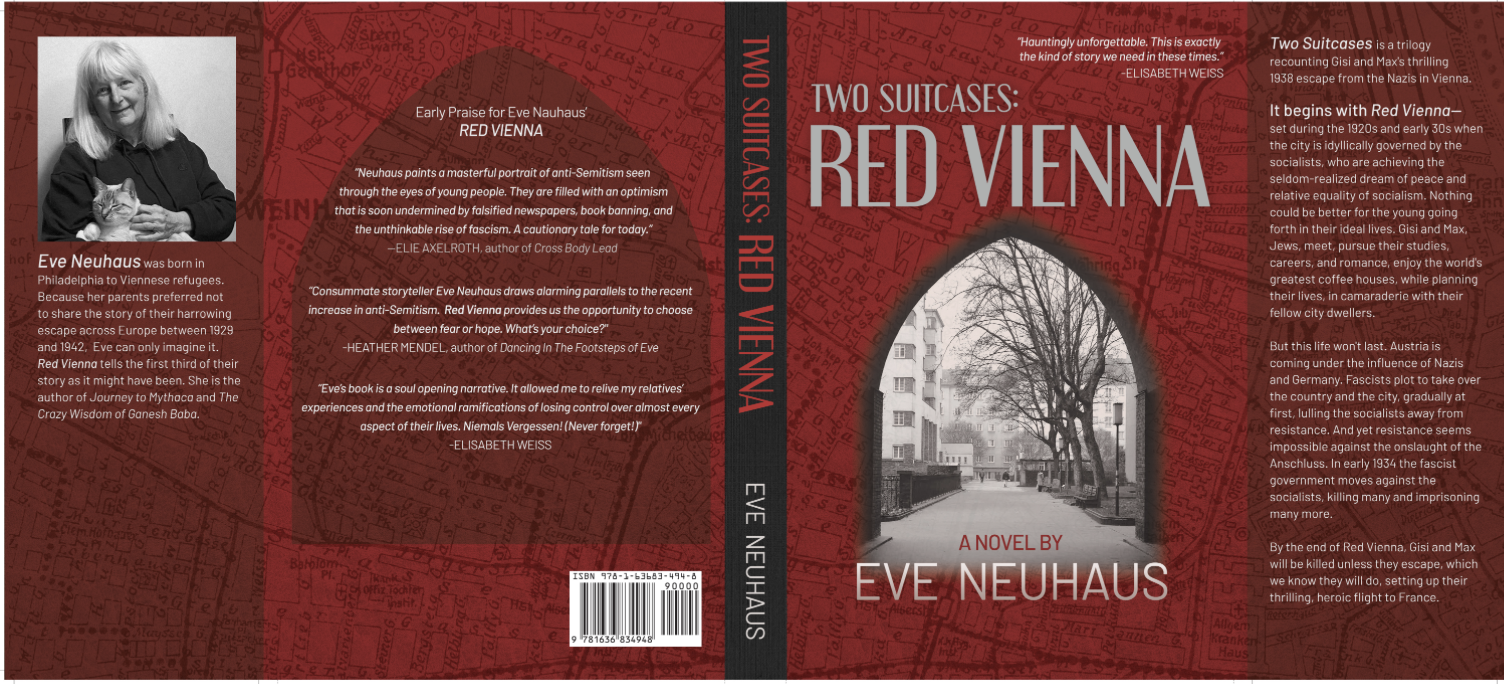
Draft of the cover for the hardback version of Red Vienna
Red Vienna is coming, I promise you. But, as anyone who has published a book will tell you, it always takes longer than you hoped.
While I wait I’ve been working on Underground, the second volume of Two Suitcases. After the fascist government of Austria banned the Social Democratic party, its activist members went underground, hence the title of the volume. In the outer world Leo works as a printer, and Hugo grinds lenses for an optician, but their real work takes place very discretely in a basement room in one of the social housing complexes.
Here’s the part I wrote today.
Chapter 19
Hijinks
April 20, 1935
a hidden room in the basement of Goethe-hof, a social housing complex
Leo and Hugo lean over a heavily crossed out and written over text, the harsh light above them creating a circle on the old table. Next to them is a stack of the official stationery of the President of the Police, Dr. Skubl. The pages even have his rubber-stamped signature at the bottom.
“No,” says Leo, pointing to the text. “Change it to make Skubl say, ‘As our noble police are currently occupied with arresting Socialists, Communists, and other anti-Fascists, the duty falls upon the public to keep down common crime.’ Add the word ‘noble.’”
“Right, right, that works better,” Hugo answers, looking up a moment and cleaning his glasses. “And the next part is good too, but let’s also make him assure the people that their taxes are being well-spent. Huh. Why don’t we invite people to inspect the police headquarters so they can see with their own eyes the absurd sums of money our government is spending on armaments to deploy against political opponents?”
Leo laughs. “Great idea!”
Hugo thinks. “How about advertising an Open House at police headquarters every Sunday morning? The invitation would specifically say it’s to see the vast armory of tanks, machine guns, rifles, gas weapons, etc., etc., ready to kill their neighbors and co-workers, all funded by their taxes. Let Skubl say it’ll start in May.”
“That’s it, perfect. Write down what you want it to say. I’ll get the type set.”
“We have a dozen sheets of this stationery, more than enough to get it out to the state newspaper, the radio, and the foreign press.”
“I can do some posters and flyers announcing the Sunday Open Houses, too.” Leo smiles at the thought of the police headquarters being overrun with people demanding to see the armory.
“Excellent. Make sure they give the reason for the Open House clearly: to see the weaponry meant to control the opposition.”
“It’ll have to be very carefully worded.”
“Of course. I trust you,” Hugo says, putting on his jacket. “Show me the first drafts when they’re ready.”
At just the same time in another neighborhood
Frau Selma Schmid of Habbichergasse is looking out of the window of her small apartment. The weather is changing. Soon it’ll be raining again, she thinks, and it’s so cold for April. I should start a fire. As she takes some old papers from the pile to throw into the cold coal stove, she glances at the program from an event she and her husband attended the week before. How proud she felt to see Major Fey, noble leader of the Heimwehr, as he was installed as Regent of Austria. Such an honor. Frau Schmid loves pageantry. Fondly, she recalls standing next to her father as the funeral procession of Emperor Franz Josef went by in 1916. Life was much better under the monarchy, even at the end, during that horrible war.
As she’s about the crumple the program up, she notices the words, “Free to the bearer of this program” and she looks more closely. What is free? Nothing is free anymore.
The door opens and Herr Schmid, disheveled after his afternoon nap, comes in. “What are you doing?” he asks grumpily. “We can’t afford a fire. It’s the middle of spring, what are you thinking?”
“But look, my dear! To think I almost threw this away! On the back of the program to Regent Fey’s installation is a generous donation by his supporters. It says that if we bring this program to any of the shops listed here, we’ll be offered our choice of goods worth 10 schillings! That’s three loaves of bread!”
“Now, why would anyone do that? It makes no sense at all to me,” mutters Herr Schmid, sitting down to look at the program.
“But that’s what it says,” his wife points out. “Look at the list. All these merchants are making the offer just to celebrate Regent Fey.”
“Well,” grunts her husband. “That’s what it says alright. Put on your coat. We’ll go to Oberhoffer’s—you see, he’s listed here—and see what’s left in his shop. Very little, I’m betting. He’s an old fool to have made such an offer.”
“Herr Oberhoffer is an honorable man, Richard. And a patriot. I’ll get my bag.”
Ten minutes later, the couple is entering the bakery while another couple opens an umbrella outside the shop.
“Georg! I told you it was a scam!” the woman is saying.
“But it was the official program. The guard at the gate was handing them out. I saw it myself,” her husband insists as they walk away.
“Ha,” says Herr Schmid to his wife Selma. “I told you so. You heard that. It’s a scam.”
“I’m going in anyway. I want to hear what Herr Oberhoffer has to say,” she replies, entering the shop.
“Nothing!” comes a shout from behind the counter. “I have nothing to say! Except that it’s not true, I’m not offering anybody anything for free!”
The Schmids stare at the baker.
“Nobody gets anything for free from me!” the baker goes on.
“What a miser!” says Herr Schmid to Selma as he turns and leaves. “He should have been generous and gone along with it even if it was a scam. That’s the last he’ll see of me!”
His wife hurries out after him.
In the hidden room in the basement of Goethe-hof
Leo says to Hugo, “Before you go, do you happen to have heard how the programs for Fey’s installation as Regent of Austria worked out? I printed a thousand of them even though they only expected a few hundred at the event. Franz said they’d be distributed at the event itself and that the rest would be left here and there all over the city.” He chuckles. “Halfway through the program we said Fey would be officially declaring himself Regent of the country he destroyed. That was the exact language. Of the country he destroyed. I wonder how many people read far enough to see that.”
“I’ll bet they read far enough on the back to see the list of shops in Vienna where they could get 10 schillings worth of free goods by presenting the program. I’ll have to ask around to see how that turned out.”
“It makes me laugh just to think of it,” Leo smiles.
“It’s incredibly frustrating, though, that our communication system is so limited. Without being able to use the post, telephone, or the telegraph, sometimes it takes weeks before I hear the results of something we planned and printed right here.”
“That’s true. Our illegal network is disrupted ridiculously often. Collection points can’t be accessed because a new neighbor moved onto the block, or worse, because one of our ‘postmasters’ has been arrested. All too frequently I send out a draft of something to someone who doesn’t dare come here in person to check it, and I get a reply days or weeks after the event I was printing the flyers for was supposed to have happened.”
Hugo opens the door to leave. “It feels like we’re in the middle ages, doesn’t it?” he says.
Much of my time last week went to proofreading the newly laid-out copy of Red Vienna. It’s amazing how many missed errors you find when you reread something in a different font and format. While I was working on it, the US House of Representatives was leaderless. Here’s an excerpt from my book that covers similar events that took place in Vienna’s parliament in 1933:
Cafe Rüdigerhof, Brigittenau
March 7, 1933
Max closes the shop early to meet with the others at the coffee house. The news that Chancellor Dollfuss had eliminated the parliament hit the press earlier that week, and on the same day, it had been announced that the Wartime Economy Authority Law, an emergency law passed in 1917, would be used as a basis to rule. It gave Dollfuss significantly broader powers than he had under the parliamentary system.
In fact, every day that week brought what seemed like earth-shattering news. Wednesday, the National Council couldn’t agree on how to settle the railway workers’ strike. When an agreement was finally reached, irregularities were found in the vote, and Karl Renner, leader of the SDAP, resigned as Chairman of the Council.
“You’ve all heard how it came about? It was apparently one of our people. He passed his voting card on to be handed in by someone else while he went to the lavatory,” Hugo says. “And they called it a voting irregularity.”
“Renner shouldn’t have resigned. He should have fought it,” says Leo.
Hugo shakes his head. “He took the high road, though, and he’s out now.”
“If it wasn’t true, it would be unbelievable,” says Max. “That one man responding to the call of nature could cause the cascade of events that led to the downfall of democracy in Austria.”
After Renner’s resignation, Rudolf Ramek, a Christian Social, had been named Chairman. He declared the previous vote invalid and called for a new vote. Another uproar followed. Ramek then resigned, and Sepp Straffner, leader of the Pan-Germans, became Chairman, but he also stepped down immediately. The resignations of Renner, Ramek, and Straffner left the house without a speaker, so the session couldn’t be closed and the National Council was incapable of acting. Not knowing what to do next, the members of the Parliament left the chamber..
In response, Chancellor Dollfuss had declared a constitutional crisis. The parliament, he said, had “eliminated itself,” a crisis not provided for in the constitution. Dollfuss then set up an authoritarian government without a parliament. The establishment of wartime rule gave him complete authority.
So far, the president of the United States hasn’t eliminated the House of Representatives and instituted martial law, but the parallels are striking.
Maybe even more than the desire to share a story based on my parents’ experiences, it’s echoes like this one that compelled me to finish the book.
Heinrich Schmidt’s iconic image of Austerlitz-hof in the late 1920’s
At last.
After—how many years is it? roughly ten?—I just submitted the first volume of Two Suitcases to the publisher, WingSpan Press, the same people who published my fantasy, Journey to Mythaca, in 2006.
Red Vienna will be available in paperback or ebook format in about six weeks. I’m working on a website for it, which can be seen in its incomplete state here. At this point, nothing will happen if you push the “buy the book” button because there isn’t a book to buy yet, but if you sign up for the email list, you’ll be among the first know when it becomes available.
The trilogy, Two Suitcases, will eventually cover 1929 to 1942, from when the main characters, Gisi and Max, meet until they leave for America. The first two volumes are set in Vienna and the third in France.
When I began the book, which I thought would be one book and not three, I intended it to be a work of non-fiction, telling the story of my parents’ escape from Nazi Austria as accurately as possible. Early on, though, the characters began to claim their independence, and I made the decision to let the story unfold as it wanted. So, though most of the main characters are based on real people and some of them are historical figures, it’s not only the dialogue that I added. What could I do? The characters fell in and out of love, they developed quirks, their lives followed trajectories that might have happened, given the setting, but probably didn’t. It’s fiction.
I tried much harder to keep the setting accurate, which I think it is. Writing historical fiction is entirely different from writing fantasy. It takes years of reading and researching, probably the main reason all this has taken this long.
If you’d like a look into my writing process, much of it is explored on this blog in posts tagged “Two Suitcases.” Some of the posts are linked below.
The second volume, tentatively called Underground, is about half written and now I’m eager to get back to it. I hope it takes less than ten years to finish.
Quite a few of the queries I’m sending out to literary agents ask for a one sentence pitch for the book.
Which of these do you like the best? Do you have a better idea?
1. Can young love and a passionate commitment to high ideals survive the forces of fascism, populism and propaganda in Red Vienna on the eve of World War II?
2. In Red Vienna, idealistic young lovers Gisi and Max watch their dream city fall to the forces of fascism as the second world war looms
3. In Red Vienna, young idealists Gisi and Max fall in love at the 1929 International Socialist Youth Congress and set to work creating a more caring world, but can they hold onto their vision when their beloved utopia is destroyed by racism, nationalism and civil war?
4. With shocking parallels to recent events in the United States and Europe, this book – based on a true story – tells of an idealistic young couple confronting the forces of rising fascism and civil war in Vienna on the eve of World War II.




 Eve Neuhaus