I added my interpretation of the big dream I had a couple nights ago. It makes so much sense now.
Uncategorized
Synchronicity: Tarot Cards, the Witches’ Market, and the Aurora Borealis


Sometimes I have extraordinary dreams—some of them are told in the links below—and sometimes my life is filled with extraordinary synchronicity. A few weeks ago I was graced with a series of delightful synchronicities.
That weekend, Tom was still in Africa so I had plenty of time to work on my book. There were no real meals to think about, minimal shopping to do, just the dog to walk, which is good for me and almost always a pleasure. I was on a roll.
The last three chapters that I’d written were all pretty dark— the excerpt I published here a few weeks ago is part of one of them—so I decided to add in a lighter one. I gathered my characters in Gert’s parents’ sitting room for New Year’s Eve, had Gert put on some popular music with funny lyrics—it was good fun to do that research—and pretty soon everyone was singing and dancing. They couldn’t dance for all the hours before midnight though, so I figured they could play games. More interesting research. No parlor games popped up, but card games were popular. The first card games from that time and place that came up in my search were played with tarot cards. Good idea. Let the characters play the game and afterwards draw a card. Or better, I’d draw a card for each of them.
The characters probably would have used an Industrie und Glück deck, but I used what I had on hand—I’ve accumulated a good number of tarot decks over the years. The first one I found was my well-worn Waite/Rider deck from the 1970’s.
An Industrie und Glück deck:

I divided out the major arcana cards from my deck, drew one for each of the characters, and then wrote them into my story:
Gert puts one of the decks into two piles. “Pull the chairs back into a circle with a table at the center while I sort the cards.” When the chairs are in place she explains, “I’m putting the major cards, the tarocks, in one pile and the minor cards in the other. Then we’ll each draw one of the tarocks, and I’ll explain what they mean. Or at least what I think they mean.”
“Ooh, she’s going to tell our fortunes!” says Toni. “How exciting!”
“Me first!” Gisi calls out. “I want to get it over with.”
“Okay.” Gert shuffles the smaller set of cards and fans them out so Gisi can choose one.
Gisi looks at the backs of the cards carefully. She runs a finger over them. “No,” she says. “I can’t do it. Someone else has to start. Sorry.” She sits back in her chair.
“I’ll do it!” volunteers Max. Gert shuffles the cards again and fans them out for Max. He doesn’t hesitate, immediately drawing a card from the center of the deck and turning it over.
“It’s Der Naar, the Fool. What does it mean?” he asks Toni.
“Well, that’s appropriate,” she laughs. “It’s the wild card in the deck. It symbolizes beginnings, innocence, spontaneity, and a free spirit.”
“Very appropriate!” Hugo agrees. “I’ll go next.” He runs his finger over the cards a few times before drawing Der Herrscher.
Gert smiles. “The Emperor. Another good fit. The Emperor represents authority, the establishment, structure, and a father figure. He’s the ultimate ruler of the world.”
“Good God,” says Hugo. “Is that how you all see me? I always wanted to be an artist. Isn’t there an artist card?”
“You are an artist,” says Anna, “but the card fits, Hugo. Accept your destiny.” Everyone laughs.
Leo volunteers next. He draws the Magician.
“Ah, my favorite,” says Gert. “Der Magier is the first of the Tarocks. It symbolizes manifestation and means that you can make your wishes come true.”
“Phew! A lucky one for me! What should I wish for?”
“That’s up to you,” Gert replies.
“Then I wish the power of Der Magier for all of us. May all our wishes come true.”
“Leo, generous as always! Thank you, my friend,” says Hugo.
The last rays of sun fill the room.
Everyone is smiling.
“Thanks!” says Anna. “I’ll go next, now that I have the power to make my wishes come true.” She takes only a moment to draw Die Sonne, the Sun.
Gert claps her hands. “I think Leo’s card worked. Die Sonne signifies enlightenment, joy, marriage, and happiness.” Anna looks at the card and grins.
“You are an excellent fortune teller, Gert,” says Gisi. “I guess I’ll risk taking a card now.”
Gert reshuffles and fans the deck out on the table. Gisi looks over the back of the cards several times, pauses, and then slowly draws out a card slowly. She studies closely, holding it up to see it better. “I have no idea what this means,” she says, turning it around so everyone can see.
“Oh, it’s der Gehenkte, the Hanged Man,” says Gert. “It’s a complicated card, but it generally points to pausing—voluntarily or involuntarily—in order to assess your situation. It can also mean that it’s time to shift your perspective. Sometimes it means you’ll have to make a sacrifice.”
“Aha!” says Max, rubbing his hands together. “I thought this would go a little deeper eventually. I think it’s an accurate reading of where you are in life, Gisi—of where we all are, no? Very interesting, Gert!”
“It is a good representation. All of our lives are held up right now, aren’t they. None of us knows where we’ll be in a year,” muses Gisi, tracing the form of the hanged man with her finger.
Hugo says, “I think all the cards have all been pretty good representations of who we are, or of who we could be.”
“I’ll go next,” Toni volunteers, and Gert lays out the cards again. Toni also takes her time to choose. Eventually she closes her eyes and stabs randomly at a card.
“The Hermit,” announces Gert. “Huh. Der Eremit isn’t a card I would have associated with you, Toni. The Hermit is a person who gains wisdom by being alone, through introspection. It also means the answer to your question will be found within.”
Toni is surprised too. “Soul-searching certainly isn’t something I’ve done much of so far in my life. All the other cards have seemed so exactly right though. Maybe I should take it up.”
“My turn now,” calls out Felix. “I’m so curious! Every one of these cards has been fascinating to consider.” Gert offers him the deck.
“Temperance. Die Mäßigkeit. Moderation,” she says when she see what he chooses. “Is that you, Felix? Or is the card advising you to be more balanced, more patient?”
“The latter,” says his brother. “Obviously.”
“I beg your pardon, Leo. I am the model of Patience. I ooze Balance from every pore.” Felix stands on one leg, extending his arms, wobbling a bit, but then holding the pose.
“Very good!” Anna claps and the rest of the group joins in.
“And now,’ Gert says. “I’ll pick one for myself.” She shuffles the cards three times and then riffles them. At last she chooses a card.
It’s Der Tod, the Death Card.
Everyone in the circle looks stricken.
“Wait, wait,” Gert cries. “It doesn’t mean death literally! None of the cards are meant to be understood literally. It symbolizes transformation or change, or an ending.”
Anna sighs audibly. “Of course, none of them is literal. Still, it’s shocking to draw it.”
Gert is shaken, but she hides it. “How about if we transition to Jause now? My parents will be home any minute. Come help me in the kitchen, ladies.”
When I had written that far, I took a break and walked the dog up the hill. It was surprisingly crowded in the village Saturday afternoon. Then I remembered that it was the day of the Witches’ Market!
There must have been half a dozen readers or sellers of Tarot readers there.
The second synchronicity occurred a week or so later. My chapter was dated January 25, 1938, so I followed my usual process of looking up what happened in Vienna at the time. It was a tense time then, six weeks before the Anschluss, when Austria merges into Germany.

In late January that year, the Northern Lights were visible in Vienna for the first time since 1805, just days before Napoleon marched into Vienna. Many Viennese saw their appearance in 1938 as an omen. Others were more hopeful—they thought it marked the birth of a princess in Holland.
I wrote the Aurora Borealis into my story by weaving together bits of whatever eyewitness reports I could find. The pictures were all in black and white, but the words were evocative. I went to bed imagining it.
In the morning, I saw that my social media was filled with pictures of the current Aurora Borealis.
A Marriage of Convenience – an excerpt from Underground
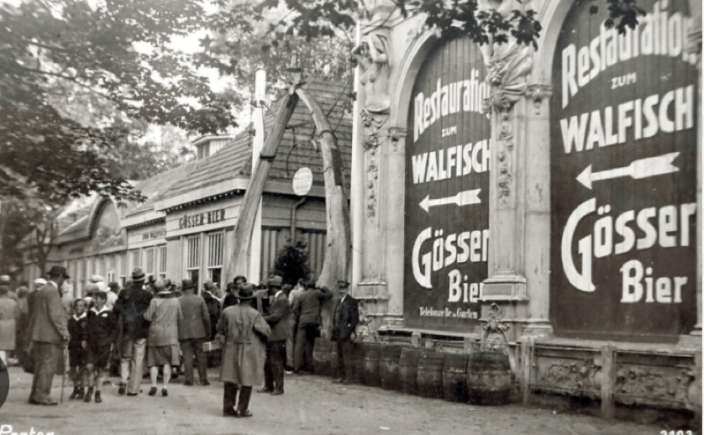
Underground is the second volume of Two Suitcases. This is an early draft of one of its chapters, including the photographs I used to write parts of it.
Chapter 39
Doctor Rudy Pollack
August 28, 1937
Westbahnhof station, Vienna
Dr. Pollack arrives by train. A tall man in his mid-fifties, portly but not overly so, he has a generous moustache and wears small rimless spectacles. In one hand, he carries an old leather suitcase, and in the other, a smaller bag, and his hat. Anna and Max, who’d been waiting at the station, recognize him immediately from the photograph he’d sent. Anna slips it back into her bag the moment they spot him.
“Dr. Pollack!” she calls out, and he turns toward her and smiles.
“Fräulein Baum! Call me Rudy, please.” He puts down his suitcase and offers her his hand. “I’m very glad to meet you at last,” he says slowly in German.
“And I you! Do call me me Anna,” she says, and then she introduces her brother. Max picks up the older man’s suitcase and leads them out of the station to the tram stop, where they stand and wait together.
Dr. Pollack makes a wry face. “My German is very poor. You will have to forgive me.” He has a gentle manner, Anna thinks, and his eyes are kind.
“And my English is very poor,” she answers in careful English. “We will have to forgive each other.”
“But we will manage!” they both say, he in German, she in English, and all three of them laugh.
Anna continues in English, hoping she’ll remember the words she’d copied into her little notebook that morning, and that she’ll pronounce them well enough to be understood. “We will take you first to your hotel, and then, if you are not too tired, we will go for something to eat at the Prater.”
He responds in English. “Well said! I am happy to go to my hotel and then eat at the Prater.”
On the tram, Max and Anna share a seat. “I think it will work out, Anna,” Max says. “You can tell right away that he’s a good man.“
A few hours later, Gisi, Max, Anna and Rudy emerge from another tram. In front of them, the Riesenrad, the tallest ferris wheel in the world, rises high above the trees and buildings, its thirty coaches carrying a dozen passengers each, swinging gently.

“Cor, Blimey!” says Rudy in English, looking amazed. “It’s enormous, indeed!”
“Cor, Blimey,” repeats Anna slowly. “It is en…nor…” but she can’t remember the rest. She sighs.
“You’ll learn, Anna,” Gisi says to her. “Don’t worry. It won’t take long.”
The conversation goes on like that, Rudy exclaiming over the park-like grounds, the rides and games, and the crowds, young and old, rich and poor. Between them, they piece together a basic understanding.
Eventually a grand plaza with a massive domed building at its end opens in front of them. Crowds fill the long, broad, tree-lined square, almost everyone moving in the direction of the ornate exposition complex, the Rotunde, at the end.

“It’s especially busy today because Die Messe Wien, the Vienna Fair, will only be at the Rotunde for one more week,” remarks a short man beside them in perfect English and then in German. He points toward the great gates of the exhibition center with his cane. Wearing a slightly floppy black hat and baggy trousers, he paces himself to seem like he’s part of their party, though no one noticed him before. “It’s the greatest exposition in the world in the most magnificent setting in the world. You are on your way to see it?” He switches between languages remarkably fluidly.

“No,” Max responds. “Not today.”
“But it is very much worth your time! There are hundreds of marvelous exhibits from every corner of Austria, all the latest and best products are on display for you to see or try. Please reconsider. I would be delighted to be your guide.” He tips his hat. “Let me introduce myself—I am Hans Wurstel.”
“We don’t need a guide, Herr Wurstel, thank you,” says Anna firmly, but the little man continues, first in German then in English.
“A translator, then. Forgive me for eavesdropping but I couldn’t help noticing your difficulties in communicating.”
“Okay, Herr Wurstel,” Rudy agrees. “I’m willing to pay you to translate for a short time.” He turns to the other two and says, “This will make it so much easier.”
Herr Wurstel translates his words and thanks Rudy. Turning to the German-speakers again, he tells them, “Your English friend is both wise and kind.” In both tongues, he goes on. “Let me tell you something about the Prater as we walk. Where did you say you were going?”
Anna, Max and Gisi look at each other in surprise. “We hadn’t said,” Max says. He smiles just a little as he continues, “but, in fact, we are on our way to a restaurant to eat some würstel .”
He isn’t sure that he trusts the fellow, especially with name like that, but having a translator is probably a good idea. Marriage is a serious thing.
Gisi doesn’t like the little man at all. She promises herself that she will keep a constant eye on him, and tucks her bag more securely under her arm.
Anna feels relieved. How fortunate, she thinks, that they should meet such a bright and funny man to provide just the service they need at the moment they need it. And more fortunate even, is that there is someone among them who’s willing and able to pay for it.
The little man laughs heartily. “Of course! You came for wurstel, the sausage, and you found Wurstel, the translator and guide. I am indeed the man of the moment. Not only is Wurstel my name—not an easy one to grow up with, you can imagine—but we have just passed through Der Wurstelprater, the world’s most amusing amusement park. The Prater itself is much larger, of course.” He indicates the enormity of the rest of the park with his stick, nearly hitting several passers-by.
The group spreads out to give their guide room.
“The Prater was originally Austria’s Imperial Hunting Ground, and only imperial guests could enjoy it. But in 1766, Emperor Josef II, a great reformer, donated part of his grounds to the city to be used as a park. He’s believed to have said, ‘If I only wanted to associate with people of my own kind, I could stay in the Imperial Crypt.’”
“He was ahead of his time,” comments Anna.
“It didn’t take long for inns, cafes, and Lebzelter, gingerbread, bakers to line its boundary. Many of the restaurants served the same delicious wurstel that you’ll be having this evening. When puppet theaters, seesaws, merry-go-rounds, and bowling alleys appeared behind the restaurants, the area became known as the Wurstelprater.”
“When was the Riesenrad built?” asks Rudy.
“In 1897. It was a great success at first, but during the Great War it was almost dismantled. By then it was badly run-down, and close to being sold for the value of the iron, which was much needed for the war. It would have happened, the great wheel might have met its demise, but oddly, not enough workers could be found to take it apart. Instead a rich business man came forward, bought it, and restored it. It’s still privately owned.”
“I could have told that story,” Max mutters to Gisi. “We didn’t have to pay for it.”
“You could have told it in English?” she asks softly.
Wurstel continues. “But the Rotunde, which you see before you now,was built in 1873 for the World’s Fair. Its dome is the largest in the world, larger, I’m proud to say, than even the Pantheon in Rome.” They pause to admire the massive structure. “It weighs 4000 metric tons. Can you imagine?”
Ten minutes later, they’re approaching Zum Walfisch.

“Can’t miss it!” cries Herr Wurstel, standing below the large signs pointing to the popular restaurant.
“Wait, let me take a picture of you there,” says Rudy, pulling a camera from his bag.
“Certainly,” agrees the little man. “If you will give me one moment.” He takes off his hat, blows on it to get rid of the dust, and, in a few deft movements, gives it more of a point at the top. Once the black hat is back on his head in a satisfactory position, he pulls a cigar from his pocket, lights it, and takes a couple of puffs. Thrusting one leg forward and holding the cigar up as if he’s about to take another puff, he says,
“There. I’ll hold this pose. Go ahead and take your picture. And then we’ll have the rest of you here with me for another shot. Good?”
Rudy is ready, and the shutter of his camera clicks.
Herr Wurstel releases his pose. “Now, another one with just Fraulein Baum and me.”
“Wait!” cries Gisi. “How much will these photos cost? Do you charge people to be in their pictures?” Herr Wurstel translates for Rudy.
Rudy replies to him in English and Wurstel says to the others, “He says the cost doesn’t matter—he just wants to remember this lovely day.”
“I want to talk to you privately,” Max says to Anna and Gisi as he leads them out of hearing distance. “It’s not the cost—though it takes some chutzpah to charge people to take your picture—it’s that we don’t know where the photos could end up. They could be lost or stolen and fall into the wrong hands. Then there would be proof of this encounter.”
Anna looks at him as if he’s crazy. “I’m marrying Rudy at the Rathaus tomorrow. What more proof could be needed?”
“I don’t know. You never know. These times are so uncertain.”
Gisi says, “Dr. Pollack’s reputation could be harmed, I imagine, if the photos got into the wrong hands.”
“I say it’s his decision.” Anna is clear. “If Rudy wants the photos, and he doesn’t care if Wurstel charges for his presence in them, he can do what he wants. I’ll smile. I owe it to him.”
Two suitcases full of books: Book and audiobook launch events in Cordes and on Zoom
Very heavy. You can imagine. They travelled home from California with me last week, and here they are on their way into our house:

And now, having some copies of Red Vienna to pass on, I’ve set up two events.
It was at the back of my mind to do a launch of some sort locally, maybe in my living room or in someone else’s living room, but when I saw the back room at La Théiere Folle, the new salon de thé in Cordes, I couldn’t resist asking the proprietors, Ricky and Axel, if they’d be willing to host it there.

So, here’s the plan:
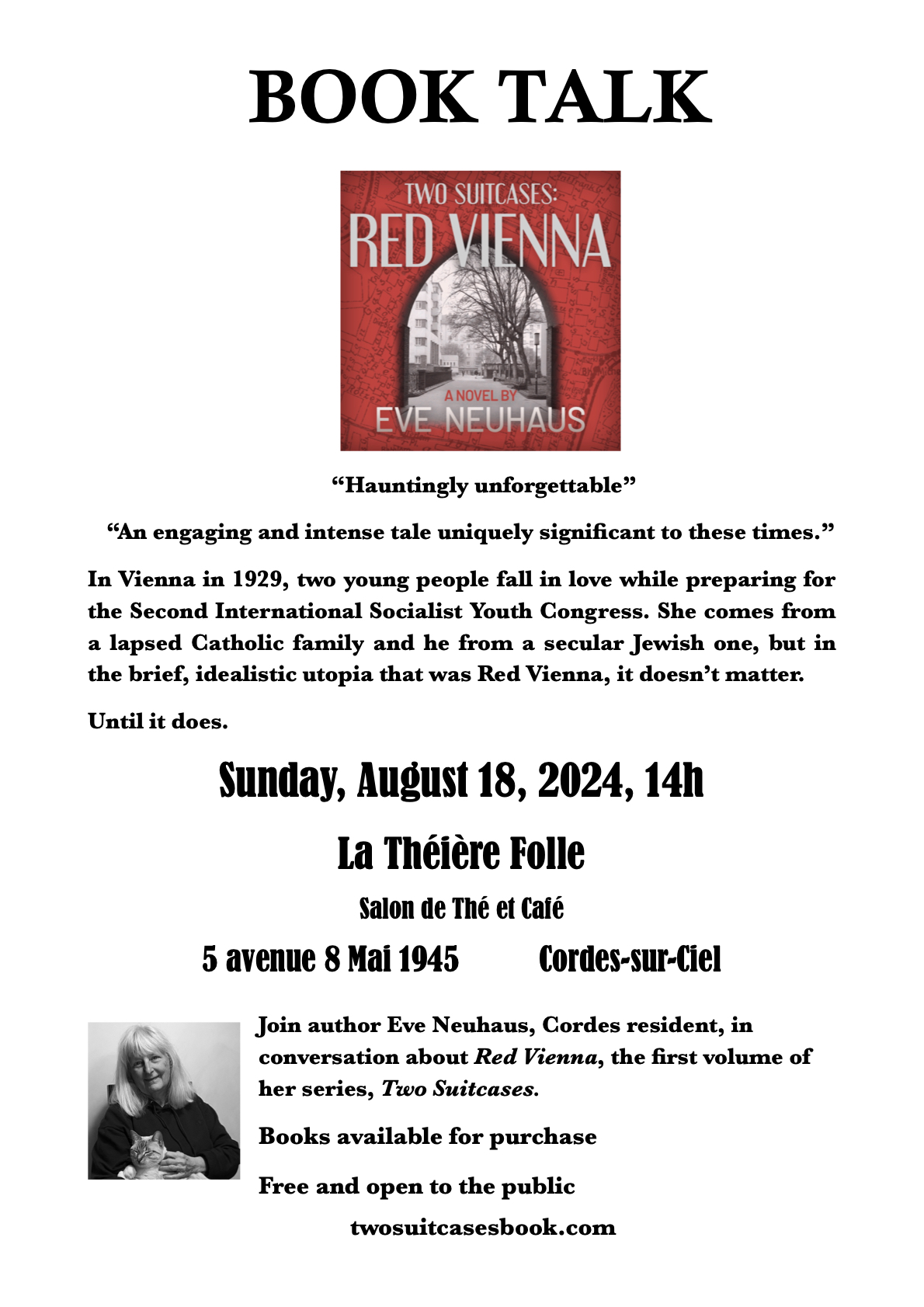
And then, for those farther away, the narrator of the audiobook version of Red Vienna and I are doing an audiobook launch on Zoom. I’ll add the details about it in my next post, but here are the basics. Join us if you can!

Learn more about Red Vienna, read excerpts, and reviews at twosuitcasesbook.com
Such a Dream
While I was staying at my daughter’s place in California, I woke up in the middle of the night and wrote down this dream.

July 12, 2024
I had such a dream.
In the dream, I owned a huge, rambling, falling down house, though some of the rooms were still good. A woman in her forties of North African or mixed-race descent—with light brown skin and beautiful curly black hair—came to the door with her teen-aged daughter. A group of other women and girls, all in long dresses, were with her. She explained to me that they could fix up my house, and I invited them in.
Room by room, they created a series of magical spaces full of color, filled with marvelously compelling furniture and objects, and cloths draped everywhere, each one unique. I went looking for my own room, and I found it, spacious, airy, comfortable, elegant. Oddly, I realized that the room was an illusion, even in the dream, but I loved it anyway. Next to it was Tom’s room, his piano in the middle of it. I knew he would be pleased.
I walked through room after room until I came to the end of the house. Through the window of the last room I could see a jumble of metal stairs and incomplete infrastructure, piled up, all in ruins. I realized it was part of my old house.
I set out to look for my own room again, but it wasn’t there. Instead I found a sort of throne room where all the women were sitting. When I entered, the head woman approached me, drew two longish sticks from a pot, and gave them to me. They were tipped with large cannabis buds.
I was happy but still looking for my room when I woke up. The place was vivid in my mind, rich and magical like Arabia of old or India of pre-colonial days.
I’m still feeling happy.
A few days after the dream, I had my best birthday ever, filled with family, friends, and food.
A few days after my birthday, Joe Biden stepped down, and Kamala Harris stepped up.
I hope dreams come true.
Eve Neuhaus Interview on NPR affiliate KCBX: A Day of Delights
I’m pleased to pass on the link to my most recent interview about Red Vienna, this one on the NPR affiliate in San Luis Obispo, KCBX.
The interview was aired on my best birthday ever. As my voice reached thousands of people, I was enjoying a lunch at Cafe Leila in Berkeley with two old and dear girlfriends. We opened the place and we closed it.

I’d already had a terrific meal out the night before with my son-and daughter-in-law, and a magnificent gluten-free breakfast with my Berkeley family. Mariposa Bakery is the best!
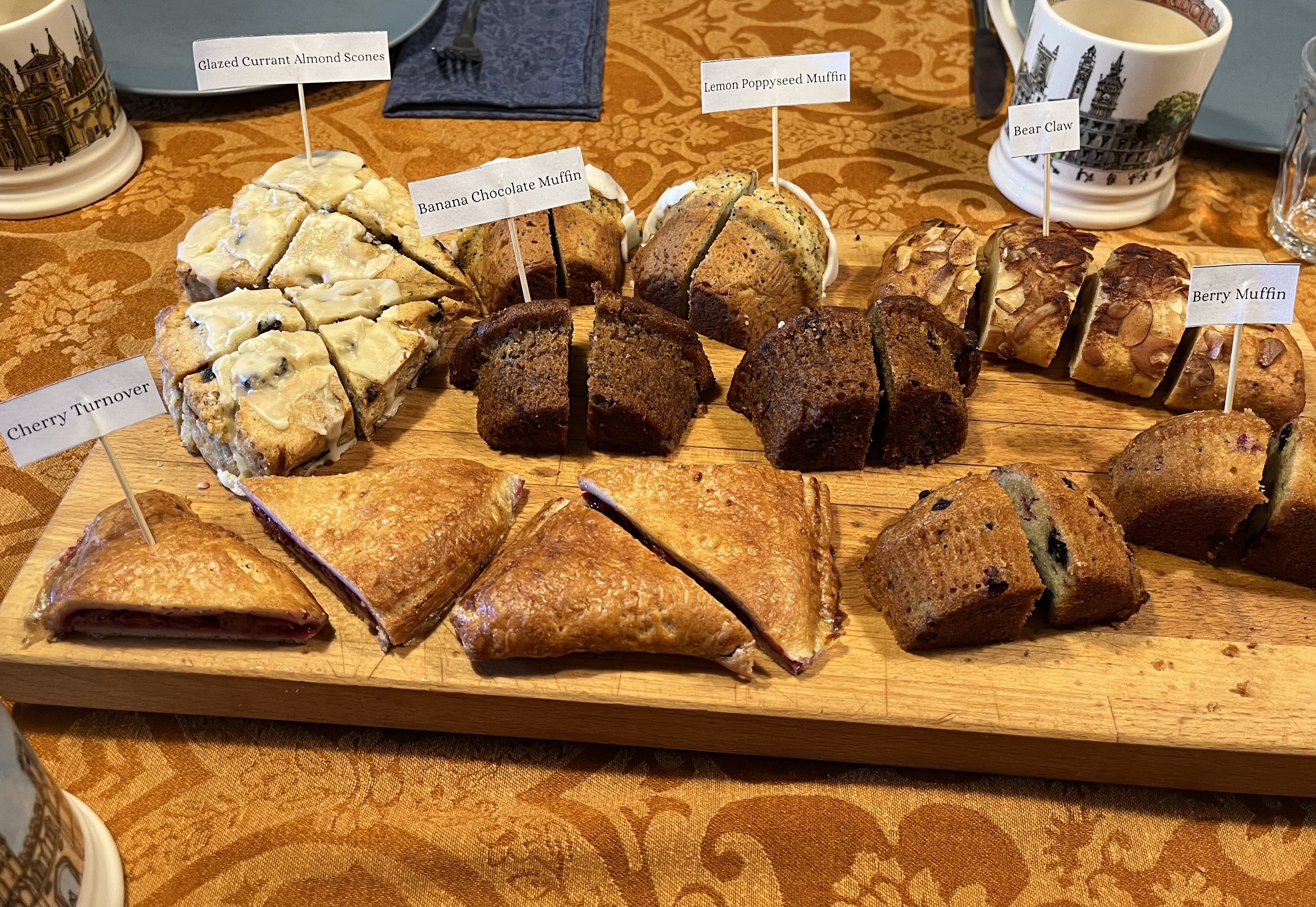
After lunch, we took BART back to Pleasanton, where I’ve been staying to help out with our daughter’s three-year old boy and newborn baby.
Imagine our surprise as this character came out of the station.


The day ended with a superb paella at my daughter’s place in Pleasanton.

It was over the top. I am grateful beyond words to my family and friends for making it all happen.
Listen to the interview: https://www.kcbx.org/podcast/central-coast-voices/2024-07-18/eve-neuhaus-author-of-red-vienna
Exploring Red Vienna’s Utopian Philosophy: The Legacy of Otto Bauer
Questions have been coming up at my book talks and interviews about the origins of the philosophy behind the utopian vision that is now called Red Vienna, which is also the title of the first volume of Two Suitcases. This article from Jacobin Magazine is the best one on the subject that I’ve come across:
Red Vienna in the news

Well, that title is a little deceptive on my part. Red Vienna is indeed in the news, but it’s the historical period, not my book.
Still, take a look at how much interest there is in that brief utopian experiment right now, especially in the social housing model that plays such a big role in my book.
And then read my book.
A couple days: a lecture
A week ago:
The February Uprising
https://www.msn.com/en-gb/news/world/the-february-uprising/ar-BB1iaDSR
Social Housing in Red Vienna
In the last few month or so:
https://jacobin.com/2023/11/otto-bauer-austro-marxism-nationalism-theory-history
https://businessdesk.co.nz/article/the-life/viennas-public-housing-is-a-paragon-for-the-world
https://delano.lu/article/red-vienna-a-model-for-lenert-
So much to read!
A long wait and a new excerpt
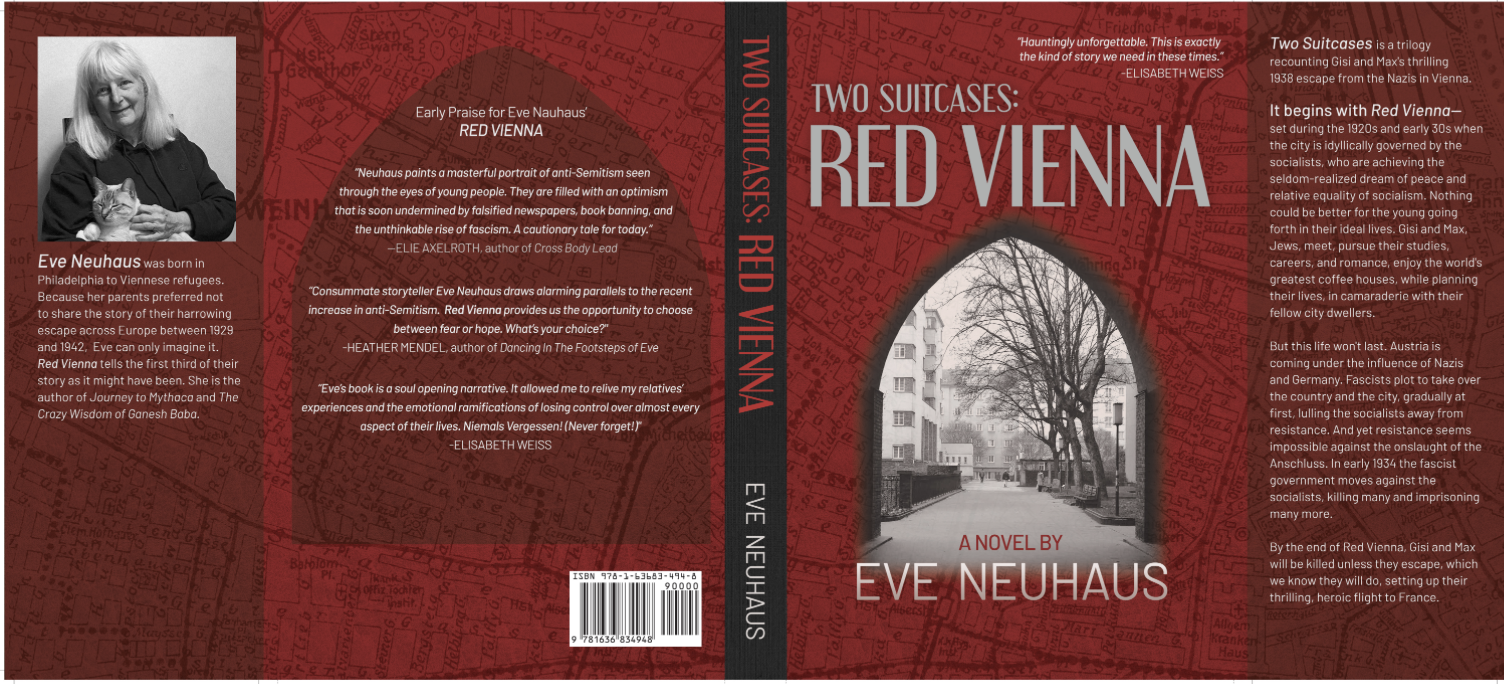
Red Vienna is coming, I promise you. But, as anyone who has published a book will tell you, it always takes longer than you hoped.
While I wait I’ve been working on Underground, the second volume of Two Suitcases. After the fascist government of Austria banned the Social Democratic party, its activist members went underground, hence the title of the volume. In the outer world Leo works as a printer, and Hugo grinds lenses for an optician, but their real work takes place very discretely in a basement room in one of the social housing complexes.
Here’s the part I wrote today.
Chapter 19
Hijinks
April 20, 1935
a hidden room in the basement of Goethe-hof, a social housing complex
Leo and Hugo lean over a heavily crossed out and written over text, the harsh light above them creating a circle on the old table. Next to them is a stack of the official stationery of the President of the Police, Dr. Skubl. The pages even have his rubber-stamped signature at the bottom.
“No,” says Leo, pointing to the text. “Change it to make Skubl say, ‘As our noble police are currently occupied with arresting Socialists, Communists, and other anti-Fascists, the duty falls upon the public to keep down common crime.’ Add the word ‘noble.’”
“Right, right, that works better,” Hugo answers, looking up a moment and cleaning his glasses. “And the next part is good too, but let’s also make him assure the people that their taxes are being well-spent. Huh. Why don’t we invite people to inspect the police headquarters so they can see with their own eyes the absurd sums of money our government is spending on armaments to deploy against political opponents?”
Leo laughs. “Great idea!”
Hugo thinks. “How about advertising an Open House at police headquarters every Sunday morning? The invitation would specifically say it’s to see the vast armory of tanks, machine guns, rifles, gas weapons, etc., etc., ready to kill their neighbors and co-workers, all funded by their taxes. Let Skubl say it’ll start in May.”
“That’s it, perfect. Write down what you want it to say. I’ll get the type set.”
“We have a dozen sheets of this stationery, more than enough to get it out to the state newspaper, the radio, and the foreign press.”
“I can do some posters and flyers announcing the Sunday Open Houses, too.” Leo smiles at the thought of the police headquarters being overrun with people demanding to see the armory.
“Excellent. Make sure they give the reason for the Open House clearly: to see the weaponry meant to control the opposition.”
“It’ll have to be very carefully worded.”
“Of course. I trust you,” Hugo says, putting on his jacket. “Show me the first drafts when they’re ready.”
At just the same time in another neighborhood
Frau Selma Schmid of Habbichergasse is looking out of the window of her small apartment. The weather is changing. Soon it’ll be raining again, she thinks, and it’s so cold for April. I should start a fire. As she takes some old papers from the pile to throw into the cold coal stove, she glances at the program from an event she and her husband attended the week before. How proud she felt to see Major Fey, noble leader of the Heimwehr, as he was installed as Regent of Austria. Such an honor. Frau Schmid loves pageantry. Fondly, she recalls standing next to her father as the funeral procession of Emperor Franz Josef went by in 1916. Life was much better under the monarchy, even at the end, during that horrible war.
As she’s about the crumple the program up, she notices the words, “Free to the bearer of this program” and she looks more closely. What is free? Nothing is free anymore.
The door opens and Herr Schmid, disheveled after his afternoon nap, comes in. “What are you doing?” he asks grumpily. “We can’t afford a fire. It’s the middle of spring, what are you thinking?”
“But look, my dear! To think I almost threw this away! On the back of the program to Regent Fey’s installation is a generous donation by his supporters. It says that if we bring this program to any of the shops listed here, we’ll be offered our choice of goods worth 10 schillings! That’s three loaves of bread!”
“Now, why would anyone do that? It makes no sense at all to me,” mutters Herr Schmid, sitting down to look at the program.
“But that’s what it says,” his wife points out. “Look at the list. All these merchants are making the offer just to celebrate Regent Fey.”
“Well,” grunts her husband. “That’s what it says alright. Put on your coat. We’ll go to Oberhoffer’s—you see, he’s listed here—and see what’s left in his shop. Very little, I’m betting. He’s an old fool to have made such an offer.”
“Herr Oberhoffer is an honorable man, Richard. And a patriot. I’ll get my bag.”
Ten minutes later, the couple is entering the bakery while another couple opens an umbrella outside the shop.
“Georg! I told you it was a scam!” the woman is saying.
“But it was the official program. The guard at the gate was handing them out. I saw it myself,” her husband insists as they walk away.
“Ha,” says Herr Schmid to his wife Selma. “I told you so. You heard that. It’s a scam.”
“I’m going in anyway. I want to hear what Herr Oberhoffer has to say,” she replies, entering the shop.
“Nothing!” comes a shout from behind the counter. “I have nothing to say! Except that it’s not true, I’m not offering anybody anything for free!”
The Schmids stare at the baker.
“Nobody gets anything for free from me!” the baker goes on.
“What a miser!” says Herr Schmid to Selma as he turns and leaves. “He should have been generous and gone along with it even if it was a scam. That’s the last he’ll see of me!”
His wife hurries out after him.
In the hidden room in the basement of Goethe-hof
Leo says to Hugo, “Before you go, do you happen to have heard how the programs for Fey’s installation as Regent of Austria worked out? I printed a thousand of them even though they only expected a few hundred at the event. Franz said they’d be distributed at the event itself and that the rest would be left here and there all over the city.” He chuckles. “Halfway through the program we said Fey would be officially declaring himself Regent of the country he destroyed. That was the exact language. Of the country he destroyed. I wonder how many people read far enough to see that.”
“I’ll bet they read far enough on the back to see the list of shops in Vienna where they could get 10 schillings worth of free goods by presenting the program. I’ll have to ask around to see how that turned out.”
“It makes me laugh just to think of it,” Leo smiles.
“It’s incredibly frustrating, though, that our communication system is so limited. Without being able to use the post, telephone, or the telegraph, sometimes it takes weeks before I hear the results of something we planned and printed right here.”
“That’s true. Our illegal network is disrupted ridiculously often. Collection points can’t be accessed because a new neighbor moved onto the block, or worse, because one of our ‘postmasters’ has been arrested. All too frequently I send out a draft of something to someone who doesn’t dare come here in person to check it, and I get a reply days or weeks after the event I was printing the flyers for was supposed to have happened.”
Hugo opens the door to leave. “It feels like we’re in the middle ages, doesn’t it?” he says.
Red Vienna – a novel
Heinrich Schmidt’s iconic image of Austerlitz-hof in the late 1920’s
At last.
After—how many years is it? roughly ten?—I just submitted the first volume of Two Suitcases to the publisher, WingSpan Press, the same people who published my fantasy, Journey to Mythaca, in 2006.
Red Vienna will be available in paperback or ebook format in about six weeks. I’m working on a website for it, which can be seen in its incomplete state here. At this point, nothing will happen if you push the “buy the book” button because there isn’t a book to buy yet, but if you sign up for the email list, you’ll be among the first know when it becomes available.
The trilogy, Two Suitcases, will eventually cover 1929 to 1942, from when the main characters, Gisi and Max, meet until they leave for America. The first two volumes are set in Vienna and the third in France.
When I began the book, which I thought would be one book and not three, I intended it to be a work of non-fiction, telling the story of my parents’ escape from Nazi Austria as accurately as possible. Early on, though, the characters began to claim their independence, and I made the decision to let the story unfold as it wanted. So, though most of the main characters are based on real people and some of them are historical figures, it’s not only the dialogue that I added. What could I do? The characters fell in and out of love, they developed quirks, their lives followed trajectories that might have happened, given the setting, but probably didn’t. It’s fiction.
I tried much harder to keep the setting accurate, which I think it is. Writing historical fiction is entirely different from writing fantasy. It takes years of reading and researching, probably the main reason all this has taken this long.
If you’d like a look into my writing process, much of it is explored on this blog in posts tagged “Two Suitcases.” Some of the posts are linked below.
The second volume, tentatively called Underground, is about half written and now I’m eager to get back to it. I hope it takes less than ten years to finish.
December 2018 “Two Suitcases- an update
January 2016 “Two Suitcases – in process”
January 2016 “Two Suitcases – an update and an excerpt”
January 2016 “Two Suitcases – an update and an excerpt”
August 2015 “Two Suitcases – progress and a little taste of what’s to come”
 Eve Neuhaus