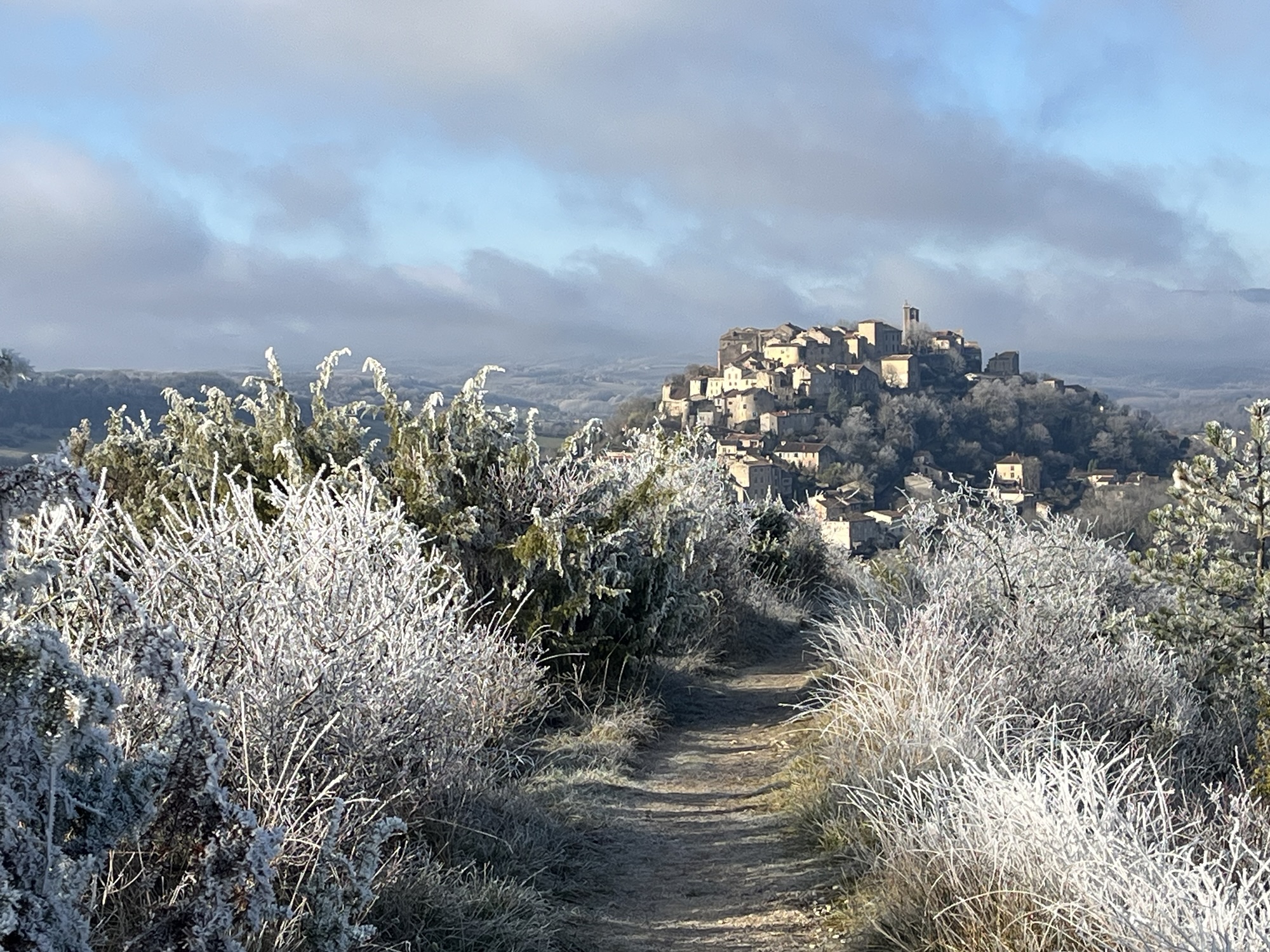
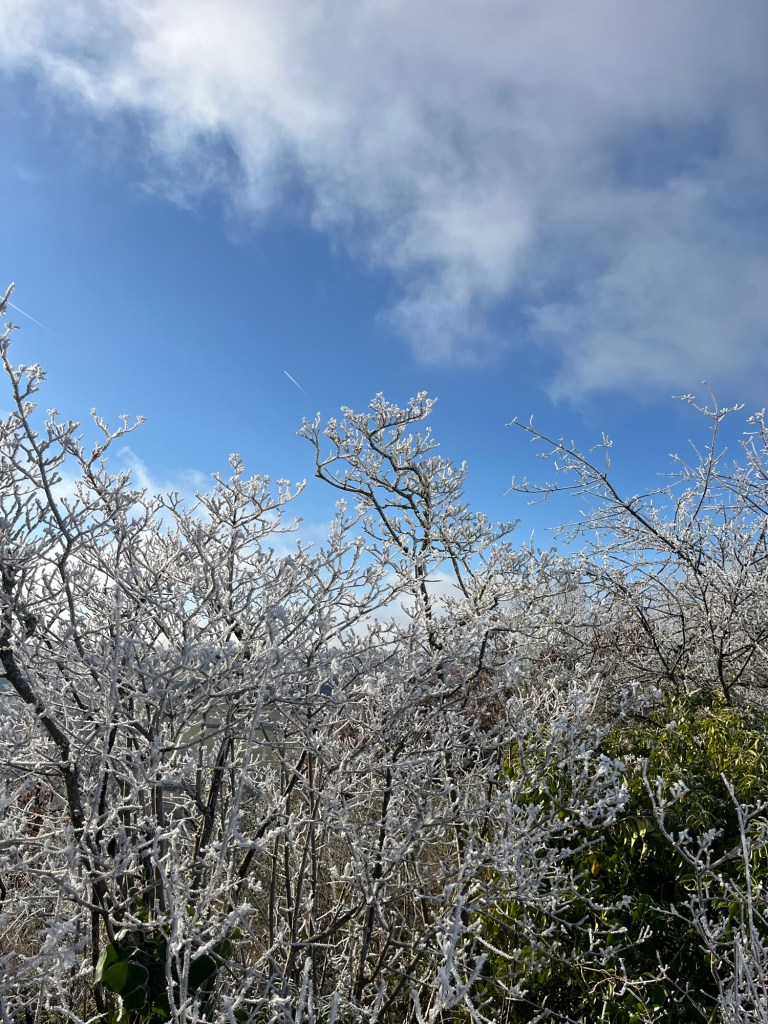
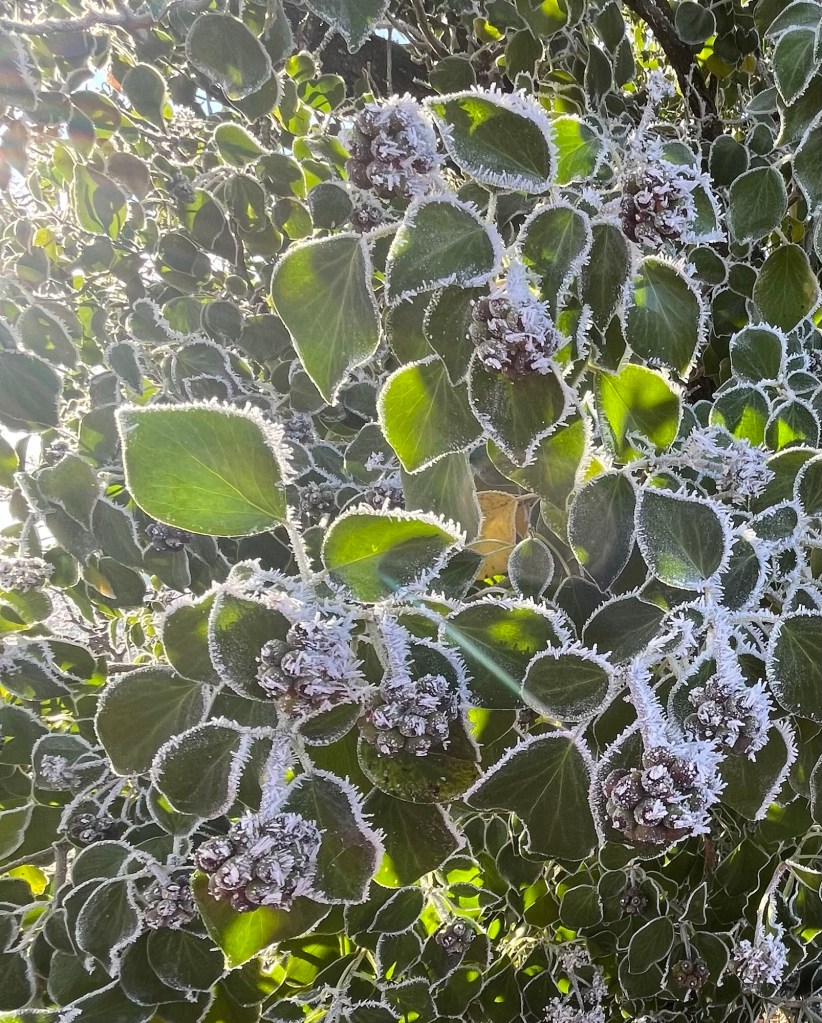
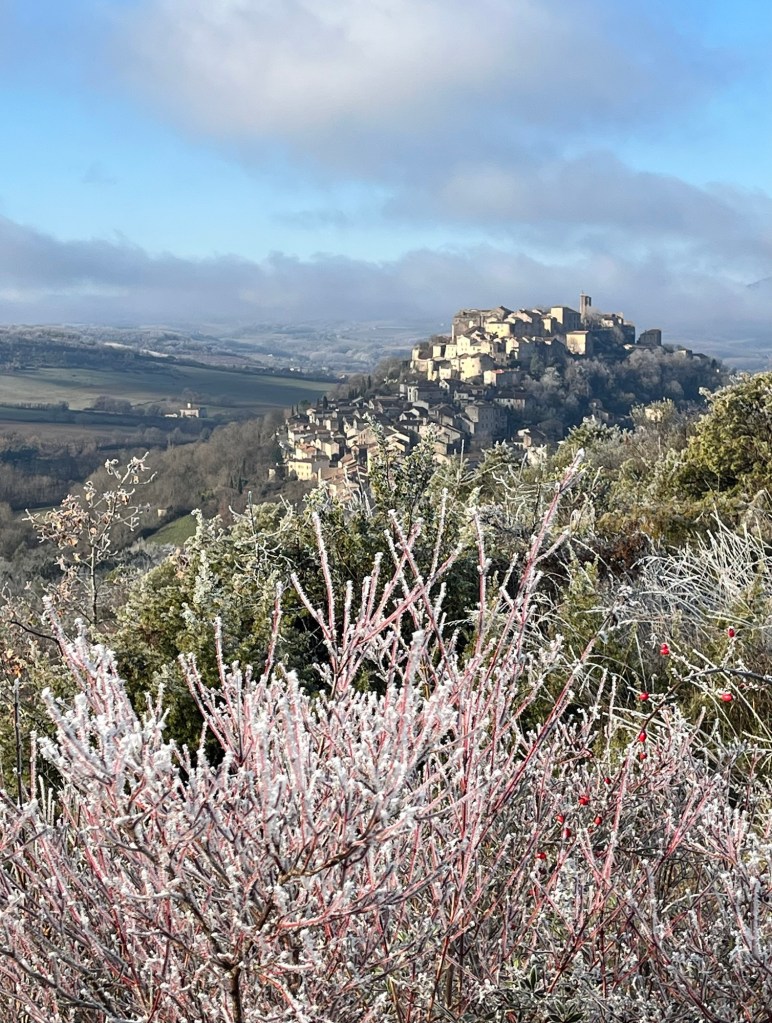
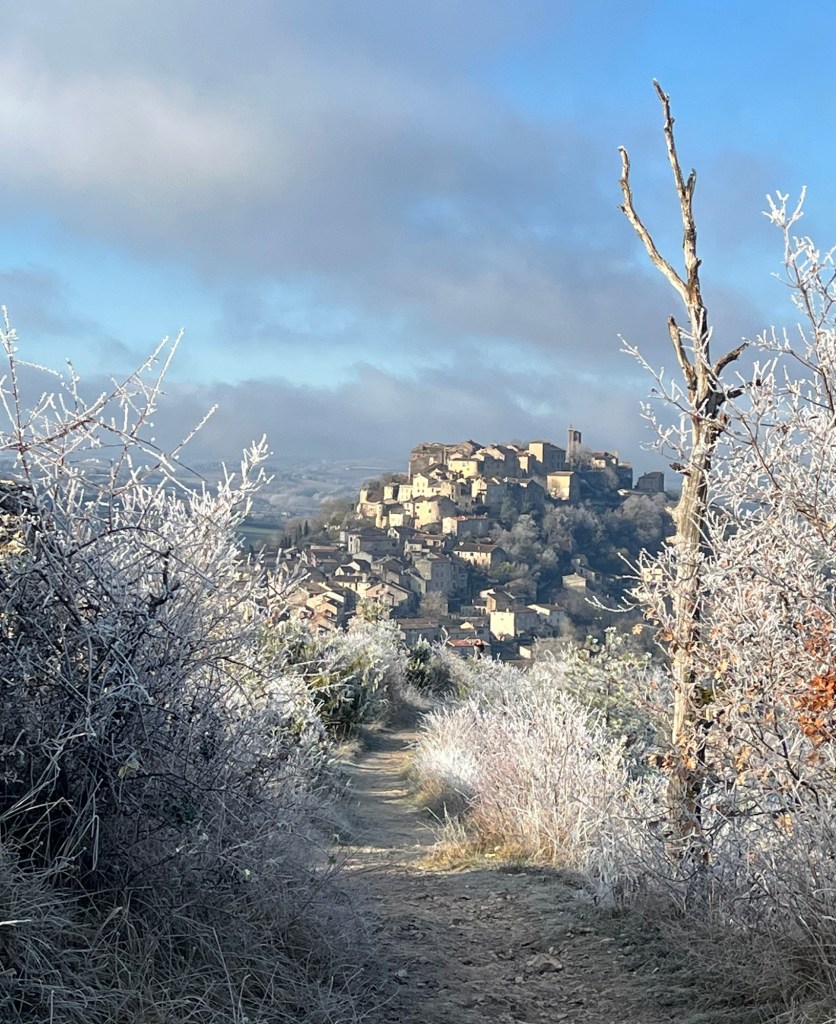
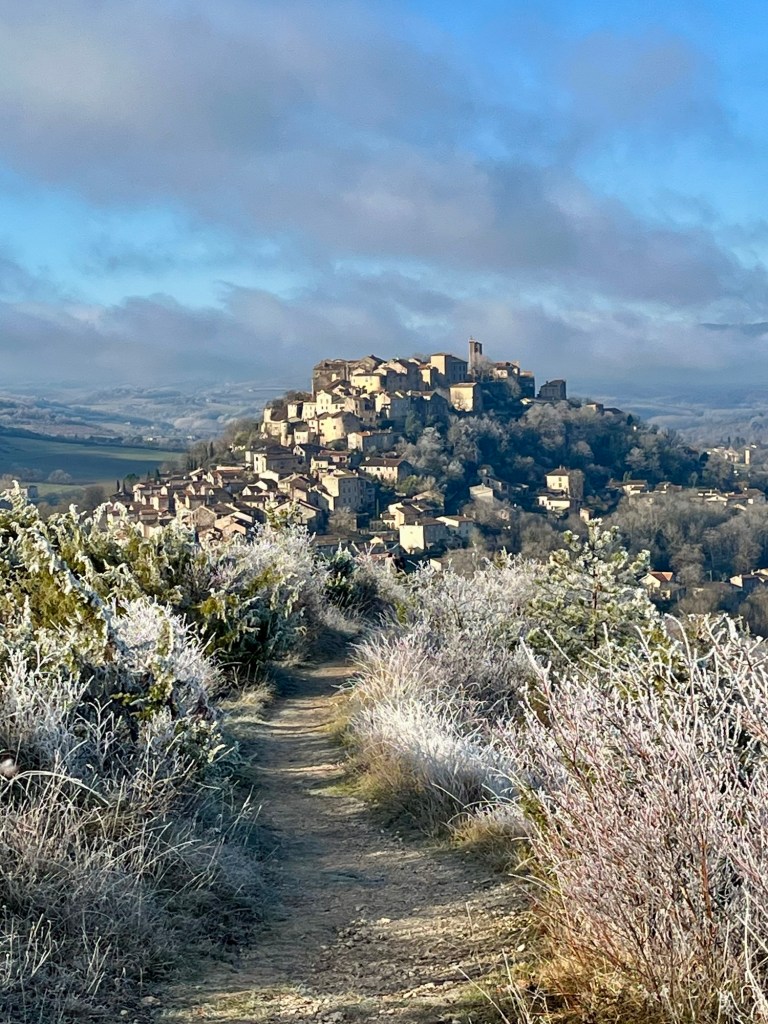
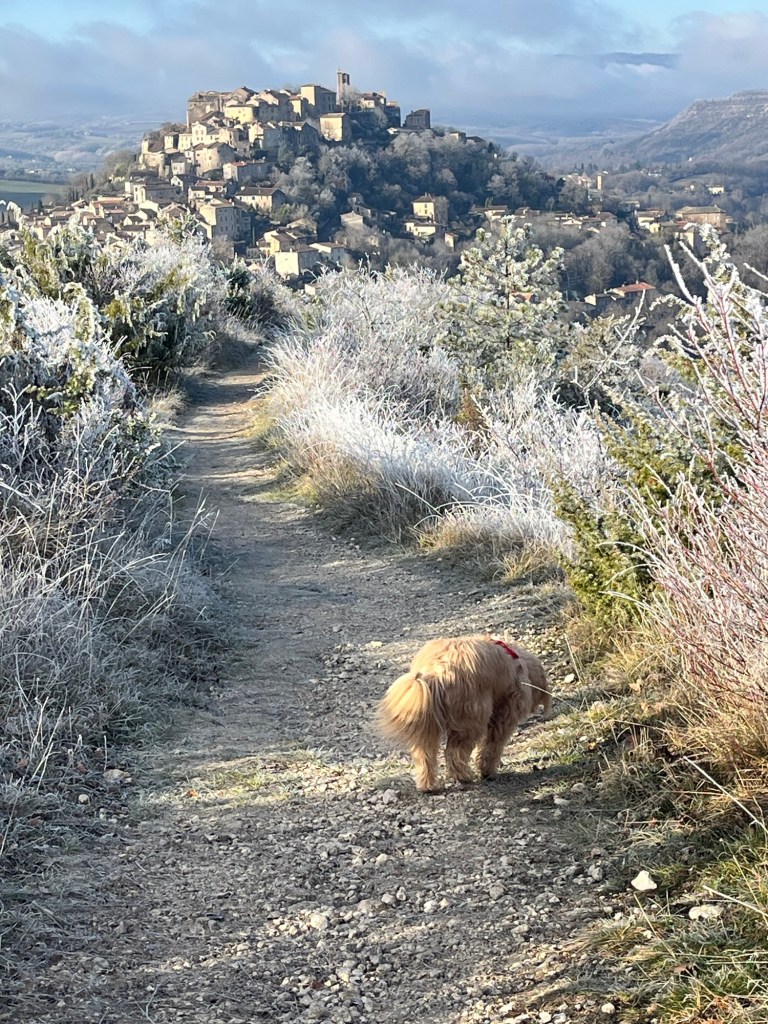
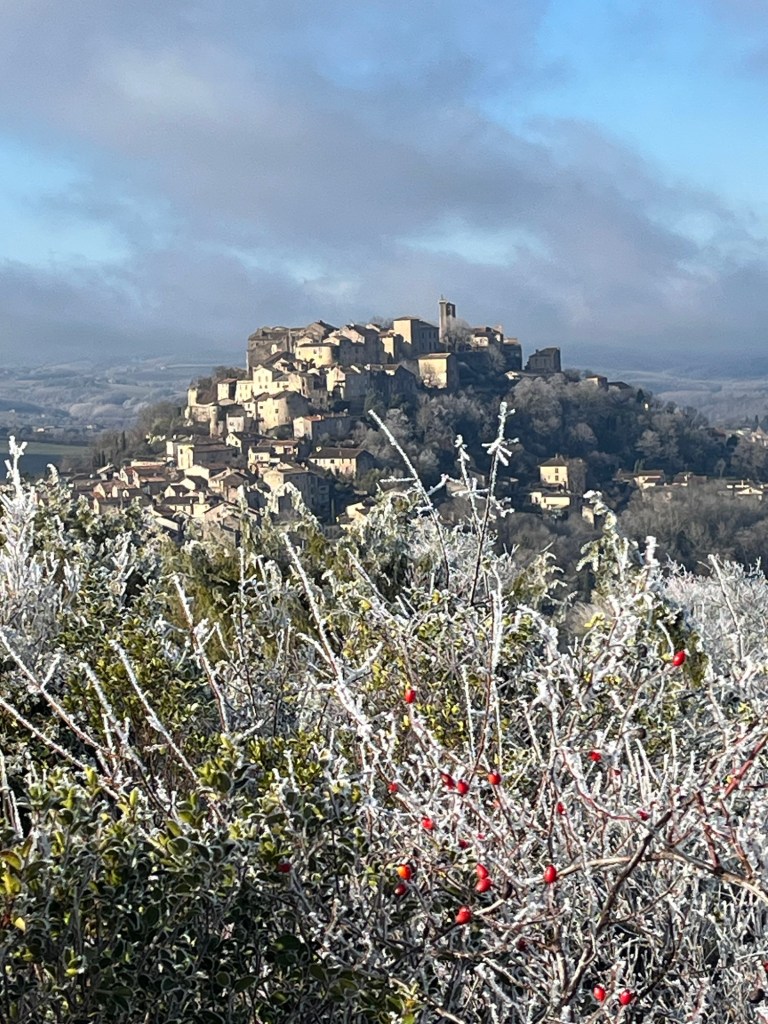
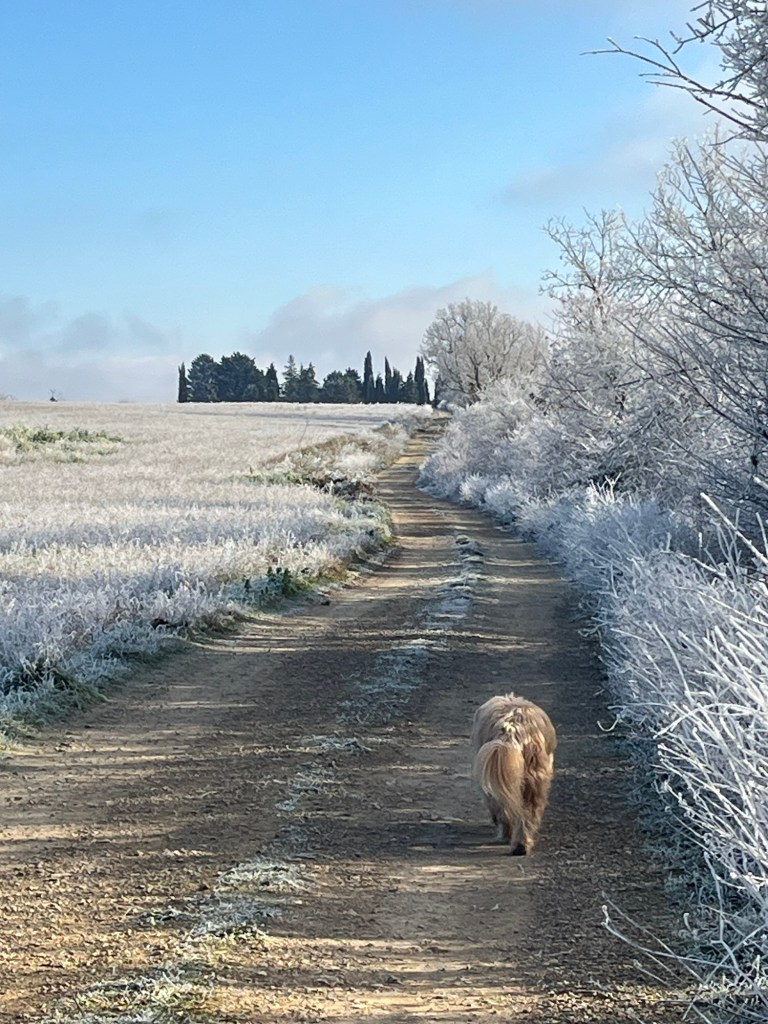
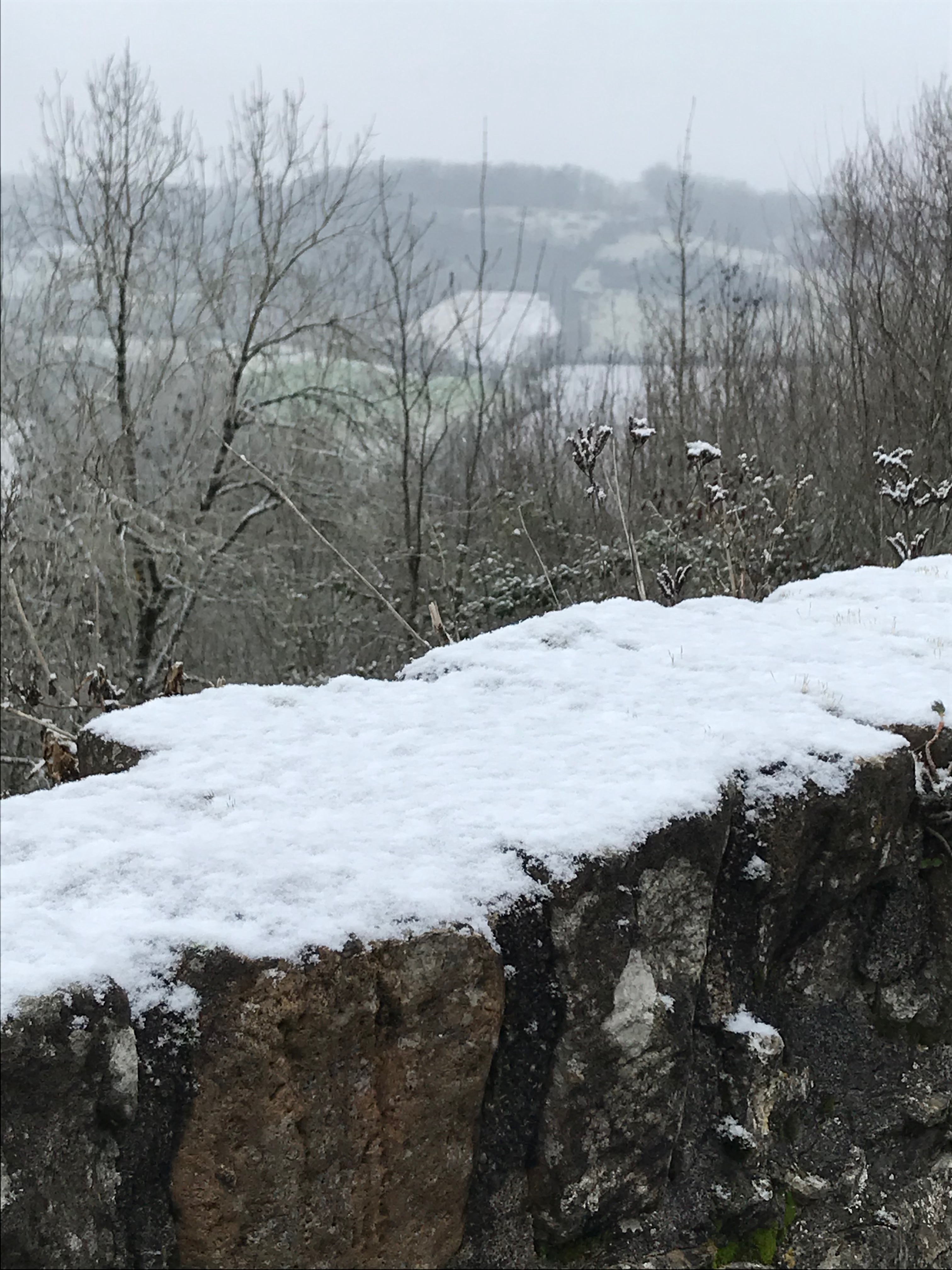
Once in a while, the fog that rises from the valleys surrounding Cordes-sur-Ciel freezes.
Overnight the dense cloud that made driving so difficult the night before becomes a delicate crystalline web, clinging to the edges of every leaf, every branch.
It’s magic.
This morning we walked to the le Grain de Sel, the chalky outcropping you can see from our street.
It’s a short but steep climb to walk there from our house, but you can drive up past it and take a flat path too.
Wishing you all a year filled with glimmers of hope, fresh insights, many moments of pure joy and raucous laughter, and at least a few of breathtaking awe.
Le vendredi suivant celui où les pierres noires étaient apparues puis avaient disparu, je suis retourné à Emmaüs pour voir si la personne qui les avait emportées chez elle par inadvertance les avait peut-être rapportées.
The day began well with a slow drive—our Ami only goes 45km (28mph)—through the hills, lush green with all the rain, while chatting with a friend, Anu, who’s only in Cordes a short time each year.
La journée a bien commencé par une balade tranquille en voiture – notre Ami ne roule qu’à 45 km/h – à travers les collines verdoyantes après la pluie, tout en discutant avec une amie, Anu, qui ne passe que peu de temps à Cordes chaque année.
It was on our walk to Emmaüs from the car that I made my first mistake. As I was telling Anu about the ephemeral black stones, we passed a woman talking to a couple as she bent over to arrange some white stones in a tray in front of her garage door. We laughed—white stones this week!—and I’m certain I heard the words, “la magie des pierres,” (the magic of stones) but we didn’t stop to hear more.
C’est lors de notre promenade entre Emmaüs et la voiture que j’ai commis ma première erreur. Alors que je parlais à Anu des pierres noires éphémères, nous avons croisé une femme qui discutait avec un couple, penchée pour ranger des pierres blanches dans un plateau devant la porte de son garage. Nous avons ri– des pierres blanches cette semaine !–et je suis certaine d’avoir entendu les mots « la magie des pierres », mais nous ne nous sommes pas arrêtées pour en savoir plus.
Did I pause to hear more? No.
Me suis-je arrêté pour en savoir plus ? Non.
The black stones had not been returned to the store. My round table wasn’t there, not was the small carpet for the upstairs landing.
Les pierres noires n’avaient pas été rapportées au magasin. Ma table ronde n’était pas là, pas plus que le petit tapis destiné au palier à l’étage.
But, in the same place in the kitchen section that I’d found the black stones on the glass candy dish the previous week, I found a brass monkey on a crocodile.
Mais, au même endroit dans la section cuisine où j’avais trouvé les pierres noires sur le plat à bonbons en verre la semaine précédente, j’ai trouvé un singe en laiton sur un crocodile.
“What a treasure!” said the guardian of the kitchen section as she wrapped my 1€ find in newspaper.
« Quel trésor ! » s’exclama la gardienne du rayon cuisine en emballant ma trouvaille à 1 € dans du papier journal.
On our way out of the store, I unwrapped it to show Anu, who, being Indian, immediately recognized that my treasure was from the Panchatantra teaching story, “The Monkey and the Crocodile.” We were talking about that as we passed the tray of white stones, still displayed in front of the garage door.
En sortant du magasin, je l’ai déballé pour le montrer à Anu qui, étant indienne, a immédiatement reconnu que mon trésor provenait du conte pédagogique du Panchatantra, « Le singe et le crocodile ». Nous en parlions en passant devant le plateau de pierres blanches, toujours exposé devant la porte du garage.
Did I stop to take a picture? No.
Est-ce que je me suis arrêté pour prendre une photo ? Non.
When I came home, I looked up the story. Here’s my favorite rendition of it:
Once upon a time, a monkey lived in a tree by a river. The monkey was alone as he had no friends or family but he was happy and content. The tree gave him plenty of sweet jamun fruit to eat. It also gave him shade from the sun and shelter from the rain.
One day, a crocodile was swimming up the river. He climbed on to the bank to rest under the monkey’s tree.
‘Hello,’ called the monkey, who was a friendly animal.
‘Hello,’ replied the crocodile, surprised. ‘Do you know where I can get some food?’ he asked. ‘I haven’t had anything to eat all day and I am hungry.’
Now you might think that the crocodile would want to eat the monkey, but this was a very kind and gentle crocodile and the thought never entered his head.
‘I have lots of fruit in my tree. Would you like to try some?’ said the monkey, who was also very kind.
He threw some jamun fruit down to the crocodile. The crocodile was so hungry that he ate up all the jamuns even though crocodiles don’t usually eat fruit. He loved the sweet tangy fruit and the pink flesh made his tongue turn purple.
‘Come back whenever you want more fruit,’ said the monkey, when the crocodile had eaten all he wanted.
Soon the crocodile was visiting the monkey every day. The two animals became good friends. They would talk, tell each other stories and eat lots of sweet jamuns together.
One day, the crocodile told the monkey about his wife and family.
‘Please take some fruit for your wife as well when you go back today,’ said the monkey.
The crocodile’s wife loved the jamuns. She had never eaten anything so sweet before but she was not as kind and gentle as her husband.
‘Imagine how sweet the monkey would taste as he eats these jamuns every day,’ she said to her husband.
The kind crocodile tried to explain to his wife that he could not possibly eat the monkey.
‘He is my best friend,’ he said.
The crocodile’s greedy wife would not listen. To get her husband to do what she wanted, she pretended to be ill.
‘I am dying and only a sweet monkey’s heart can cure me!’ she cried to her husband. ‘If you love me, you will catch your friend the monkey and let me eat his heart.’
The poor crocodile did not know what to do. He did not want to eat his friend but he could not let his wife die.
At last, he decided what he must do and the next time he visited the monkey he asked him to come to meet his wife as she wanted to thank him in person for the lovely jamun fruit.
The monkey was pleased but said he could not possibly go because he did not know how to swim.
‘Don’t worry about that,’ said the crocodile. ‘I’ll carry you on my back.’
The monkey agreed and jumped onto the crocodile’s back.
So the two friends moved out into the deep wide river.
When they were far away from the bank and the jamun tree, the crocodile said, ‘I am so sorry but my wife is very ill and says that the only cure is a monkey’s heart. I am afraid that I have to kill you, although I will miss our talks.’
The monkey thought quickly and said, ‘Dear friend, I am very sorry to hear of your wife’s illness. I am glad that I will be able to help her but I have left my heart behind in the jamun tree. Do you think we could go back so that I can fetch it?’
The crocodile believed the monkey. He turned and swam quickly to the jamun tree. The monkey jumped off his back and climbed into the safety of his tree.
‘I thought you were my friend,’ he called. ‘Don’t you know that we carry our hearts within us? I will never trust you again or give you fruit from my tree. Go away and don’t come back.’
The crocodile felt foolish. He had lost a friend and a supply of good sweet fruit. The monkey had saved himself because he had thought quickly. From that day on, he never trusted crocodiles again.
Quand je suis rentré chez moi, j’ai cherché cette histoire. Voici un lien vers le conte en français :
It took me about a week of asking my French neighbors to learn that putting white stones in front of your house for good luck or to make it welcoming is an old, local custom, and even longer to find an article about it.
Il m’a fallu environ une semaine pour apprendre, en interrogeant mes voisins français, que placer des pierres blanches devant sa maison pour porter chance ou la rendre accueillante est une ancienne coutume locale, et encore plus longtemps pour trouver un article à ce sujet.
“Healing stones in the French countryside: forgotten knowledge
Not so long ago, the French countryside was rich in ancestral knowledge passed down from generation to generation, whispered in hushed tones or through age-old gestures. Among these traditions, the art of healing with stones, known as lithotherapy, held a discreet but essential place in the daily lives of villagers.”
Since learning about the magic of white stones, I’ve noticed how often there’s one white cobblestone on the street in front of houses, or a white stone placed at the corner of a house. I got to know my neighbors better by asking my neighbors about the custom, and I put a couple white stones on my own windowsill, too.
Depuis que j’ai découvert la magie des pierres blanches, j’ai remarqué qu’il y avait souvent un pavé blanc devant les maisons ou une pierre blanche placée au coin d’une maison. J’ai adoré interroger mes voisins sur cette coutume et j’ai moi-même placé deux pierres blanches sur le rebord de ma fenêtre.
So, even though I missed the opportunity to learn the magic of the stones from the woman in Carmaux, and I missed the chance to take a picture there, I did get another good story.
Ainsi, même si j’ai raté l’occasion d’apprendre la magie des pierres auprès de la femme de Carmaux, et même si je n’ai pas pu prendre de photo là-bas, j’ai tout de même obtenu une autre belle histoire.
The moral of the Monkey and the Crocodile and of my own story is similar.
Even though bad things happen, good thinking and smart actions can lead to happy endings.
La morale de l’histoire du singe et du crocodile, et celle de ma propre histoire, est similaire..
Même lorsque des événements malheureux surviennent, une réflexion positive et des actions intelligentes peuvent mener à une issue heureuse.
La vraie magie : des pierres noires, trois verres à vin et une bonne histoire
For several weeks, I’ve been watching for magic in my life. An explanation is in my post from two weeks ago, Peace, Love, and Magic. The post that follows it, The Queen of Cordes, is an illustration. And since then, my life has been filled with ordinary magic. It seemed as if all I had to do was hear about a problem, and a solution would appear. I found the keys my neighbor lost. I found the right person to care for a friend’s gîte. In record time.
Depuis plusieurs semaines, je suis à l’affût de la magie dans ma vie. L’explication se trouve dans mon billet d’il y a deux semaines, Peace, Love, and Magic. Le billet qui suit, La reine de Cordes, en est l’illustration. Et depuis, ma vie est remplie de magie ordinaire. Il me semblait qu’il suffisait d’entendre parler d’un problème pour qu’une solution apparaisse. J’ai retrouvé les clés que mon voisin avait perdues. J’ai trouvé la bonne personne pour s’occuper du gîte d’un ami. En un temps record.
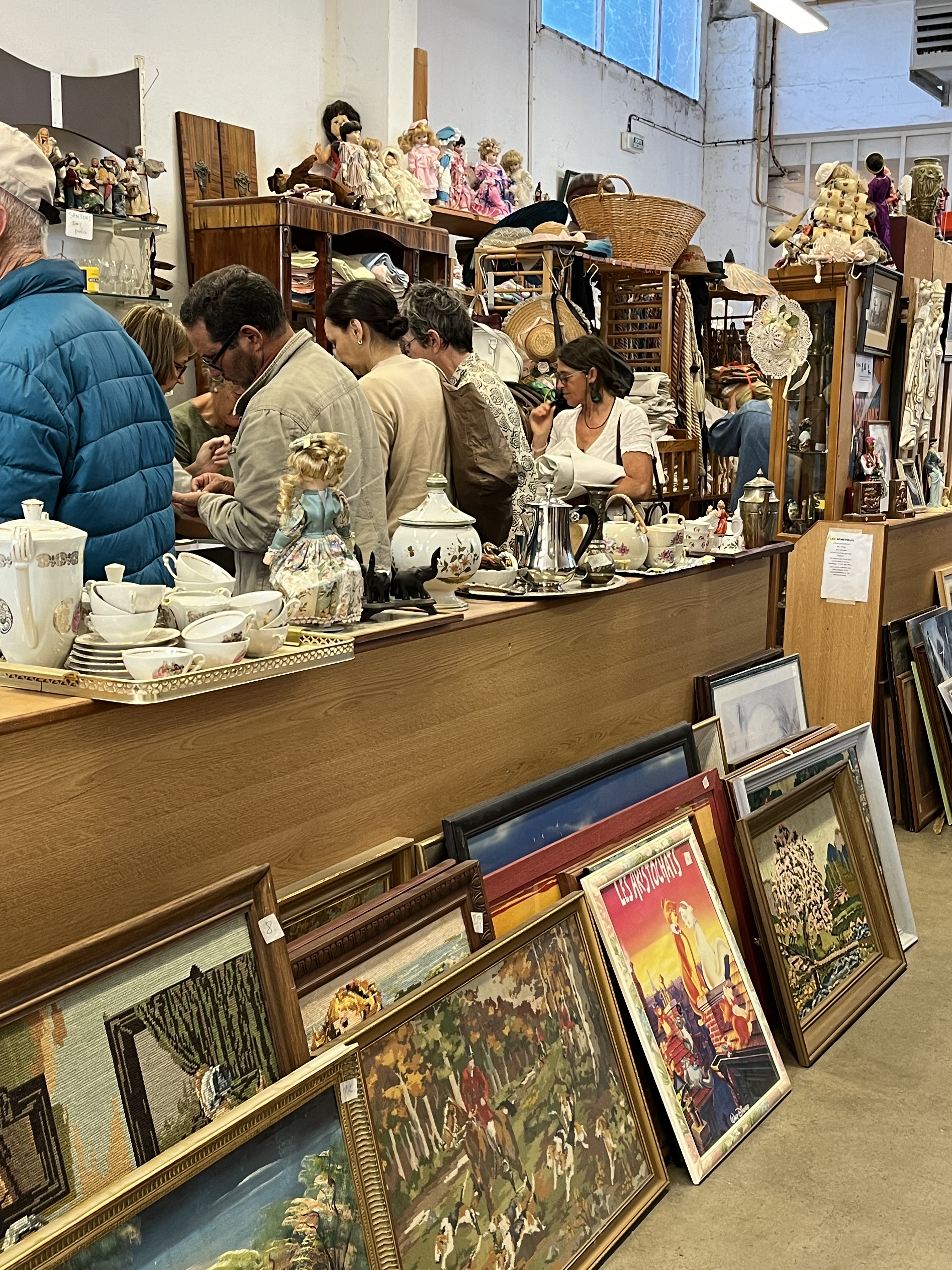
So naturally, I thought last Friday would be a good day to go to Emmaüs, the best thrift store in the world. (I wrote a story about that too, Emmaüs in Carmaux).
C’est donc tout naturellement que je me suis dit que vendredi dernier serait un bon jour pour aller chez Emmaüs, la meilleure friperie du monde. (J’ai d’ailleurs écrit un article à ce sujet, Emmaüs à Carmaux).
“I feel lucky today,” I told the friend with whom I went to Carmaux. And indeed I was!
« Je me sens chanceux aujourd’hui », ai-je dit à l’ami avec lequel je me suis rendu à Carmaux. Et c’est vrai que j’ai eu de la chance !
Neither the round table nor the small carpet that I’ve been on the lookout for months was there—you don’t go to Emmaüs for specific things in any case—but in the kitchen section, in a heavy glass candy dish, was a collection of polished black stones. There were about twenty of them, different kinds, some that you could hold up to see a glint of light, others opaque, different shapes and sizes but all beautifully polished, ranging from the size of a marble to that of a walnut.
Ni la table ronde ni le petit tapis que je cherchais depuis des mois n’étaient là – on ne va pas chez Emmaüs pour des choses précises de toute façon – mais dans le rayon cuisine, dans un lourd plat à bonbons en verre, se trouvait une collection de pierres noires polies. Il y en avait une vingtaine, de différentes sortes, certaines que l’on pouvait tenir pour voir un reflet de lumière, d’autres opaques, de différentes formes et tailles mais toutes magnifiquement polies, allant de la taille d’une bille à celle d’une noix.
(An AI generated picture of the stones. In real life the shapes were all organic, but I couldn’t figure out how to get rid the geometric ones in this picture. Une image des pierres générée par l’IA. Dans la réalité, les formes étaient toutes organiques, mais je n’ai pas réussi à me débarrasser des formes géométriques dans cette image.)
~
For years, I’ve been collecting black stones to give to people. Somewhere, a long time ago, I read that a black stone will absorb negative energy, particularly the negative energy you pick up from others. A useful tool, no? The trick is to state that you believe the stone can do it—black is absorptive after all—and then to hold the stone in the palm of your hand for a little while, concentrating on it. After a few seconds or minutes, the stone can be set aside. For a while, I was even sewing little sacks to keep the stones in.
Pendant des années, j’ai collectionné des pierres noires pour les offrir aux gens. Quelque part, il y a longtemps, j’ai lu qu’une pierre noire absorbait l’énergie négative, en particulier celle que l’on reçoit des autres. Un outil utile, non ? L’astuce consiste à dire que vous croyez que la pierre peut le faire – le noir est absorbant après tout – puis à tenir la pierre dans la paume de votre main pendant un petit moment, en vous concentrant sur elle. Après quelques secondes ou minutes, la pierre peut être mise de côté. Pendant un certain temps, j’ai même cousu de petits sacs pour y ranger les pierres.
It works. Maybe it works literally—who knows?— but it definitely works psychologically. The act of imagining negative energy being drained from you is enough to change your perspective from being “inside” of the negative state to being “outside” of it, and thus to disempower it.
Cela fonctionne. Peut-être que cela fonctionne littéralement – qui sait ? – mais cela fonctionne certainement sur le plan psychologique. Le fait d’imaginer que l’énergie négative se vide de vous suffit à modifier votre perspective, qui passe de « l’intérieur » de l’état négatif à « l’extérieur », et donc à lui ôter tout pouvoir.
~
When I found so many perfect stones at Emmaüs, I was overwhelmed. It was obvious that finding them was the reason I’d come.
Lorsque j’ai trouvé tant de pierres parfaites chez Emmaüs, j’ai été subjuguée. Il était évident que c’était pour les trouver que j’étais venue.
I took the glass bowl of stones, plus two wine glasses and two dessert plates—one with a cat on it, the other a pretty floral design—to two ladies who are the keepers of the kitchen section.
J’ai apporté le bol de pierres en verre, ainsi que deux verres à vin et deux assiettes à dessert – l’une ornée d’un chat, l’autre d’un joli motif floral – à deux dames qui sont les gardiennes du rayon cuisine.
“I don’t need the glass bowl,” I explained to them, so one of the women wrote up a chit for 1€ for the lot, and the other carefully wrapped the stones in a cone of newspaper. As I went out, the chit in my hand, I saw my wine glasses and plates being wrapped too.
“Je leur ai expliqué que je n’avais pas besoin du bol en verre. L’une des femmes a donc rédigé un bon de 1 euro pour le lot et l’autre a soigneusement emballé les pierres dans un cône de papier journal. En sortant, le chit à la main, j’ai vu que mes verres à vin et mes assiettes étaient également emballés.
Then I went to find my friend. As we walked toward the cashier’s office to pay, she remembered that another friend was looking for a washing machine, and there it was, clean, refurbished, just the right size for our friend’s apartment. After a flurry of texts, arrangements were made for the washer to be delivered on Tuesday.
Puis je suis allée retrouver mon amie. Alors que nous nous dirigions vers la caisse pour payer, elle s’est souvenue qu’une autre amie cherchait une machine à laver, et celle-ci était là, propre, remise à neuf, de la bonne taille pour l’appartement de notre amie. Après une avalanche de textos, des dispositions ont été prises pour que la machine à laver soit livrée le mardi.
I paid my euro and went back to the kitchen section with the receipt and the remaining part of the chit to retrieve my bag of goodies.
J’ai payé mon euro et je suis retourné au rayon cuisine avec le ticket de caisse et le reste du chit pour récupérer mon sac de friandises.
Alas, when the ladies looked, the bag with the other part of my chit stapled to it wasn’t there!
Hélas, lorsque les dames ont regardé, le sac avec l’autre partie de mon chit agrafé n’était pas là !
Apparently it had been given to someone else by mistake. The two women were most apologetic. But what could be done? The other customer was gone.
Apparemment, il avait été donné à quelqu’un d’autre par erreur. Les deux femmes se sont excusées. Mais que faire ? L’autre client était parti.
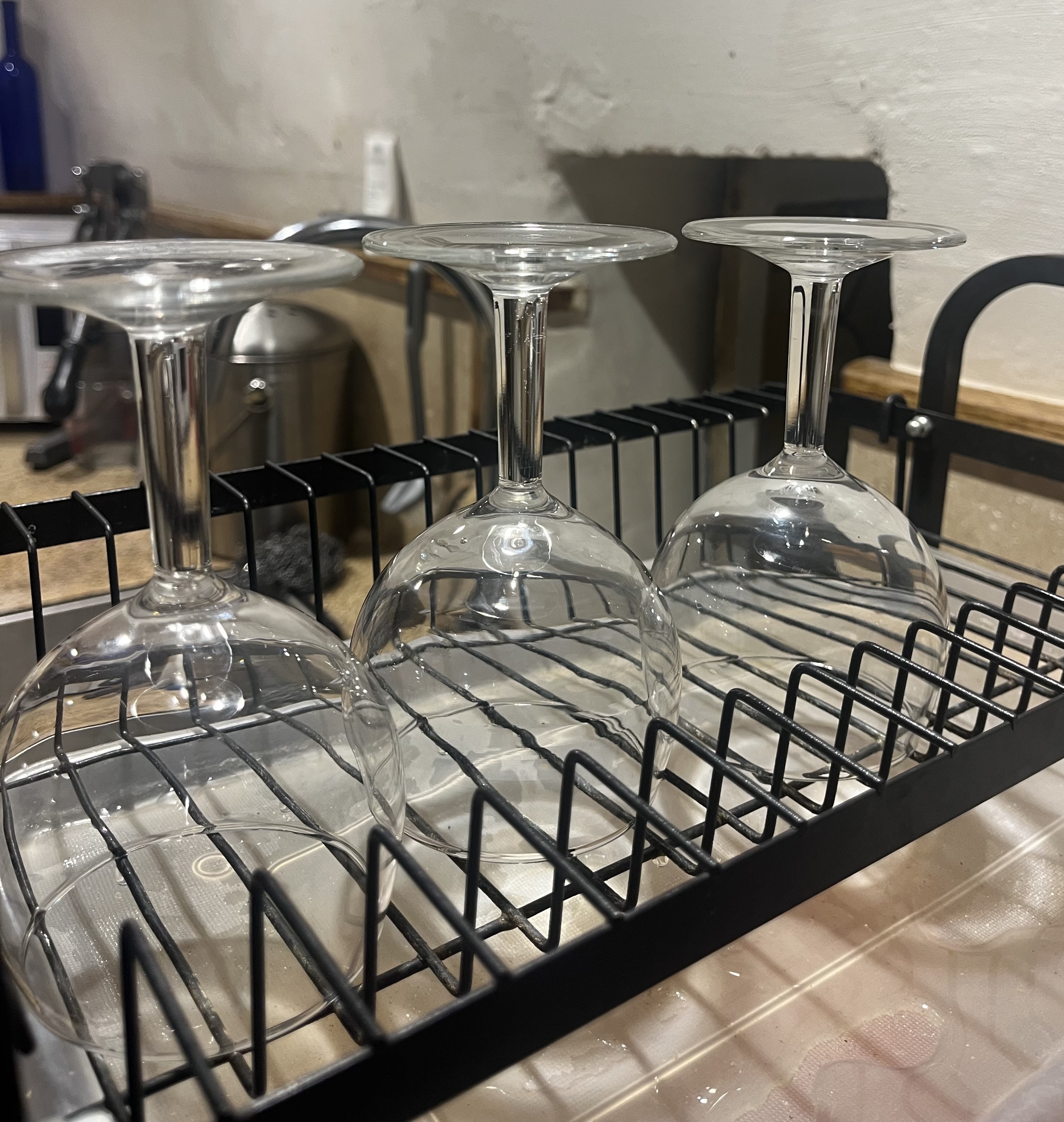
I chose something else worth a euro—three wine glasses.
J’ai choisi quelque chose d’autre qui valait un euro – trois verres de vin.
~
As magically as those beautiful black stones appeared in my life, they disappeared.
Aussi magiquement que ces belles pierres noires sont apparues dans ma vie, elles ont disparu.
It’s such a delicate thing, magic, so ephemeral. It exists in the liminal space between the world of the physical and literal, and the worlds of thought and imagination, where time and space are transcended. I held those stones in my hands. Now they only exist in my memory.
La magie est une chose si délicate, si éphémère. Elle existe dans l’espace liminaire entre le monde physique et littéral et les mondes de la pensée et de l’imagination, où le temps et l’espace sont transcendés. J’ai tenu ces pierres dans mes mains. Maintenant, elles n’existent plus que dans ma mémoire.
It seemed like my extraordinary streak of good luck was over—until I realized that we’d found a washing machine for our friend, and I’d come home with something, too: three wine glasses and a story.
Il semblait que ma chance extraordinaire était terminée – jusqu’à ce que je réalise que nous avions trouvé une machine à laver pour notre ami, et que j’étais rentré à la maison avec quelque chose, aussi : trois verres à vin et une histoire.
On my way home, I recounted the story to a neighbor who was feeling particularly exhausted. She got it, and I left her smiling.
En rentrant chez moi, je l’ai raconté à une voisine qui se sentait particulièrement épuisée. Elle a compris et je l’ai quittée en souriant.
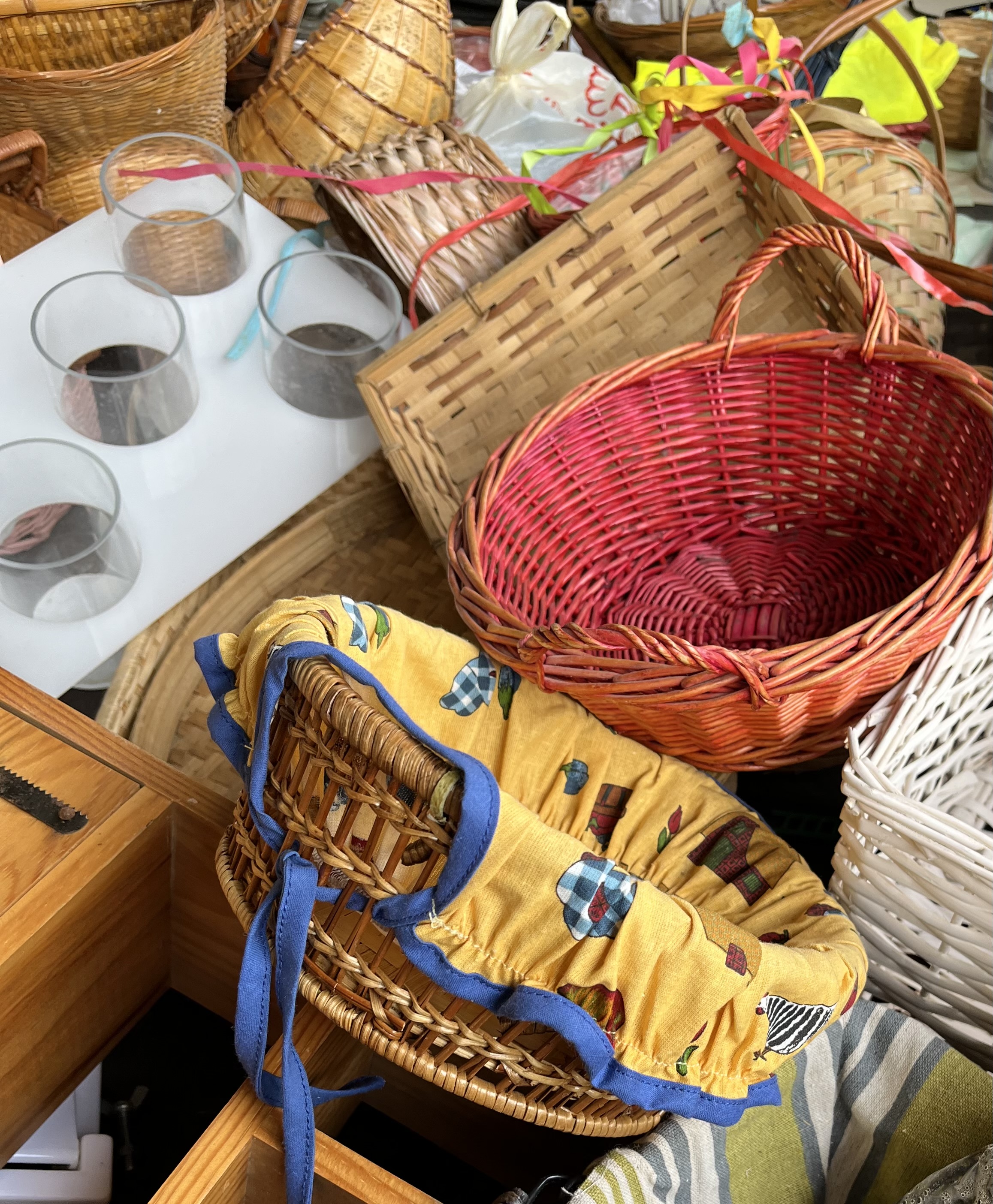
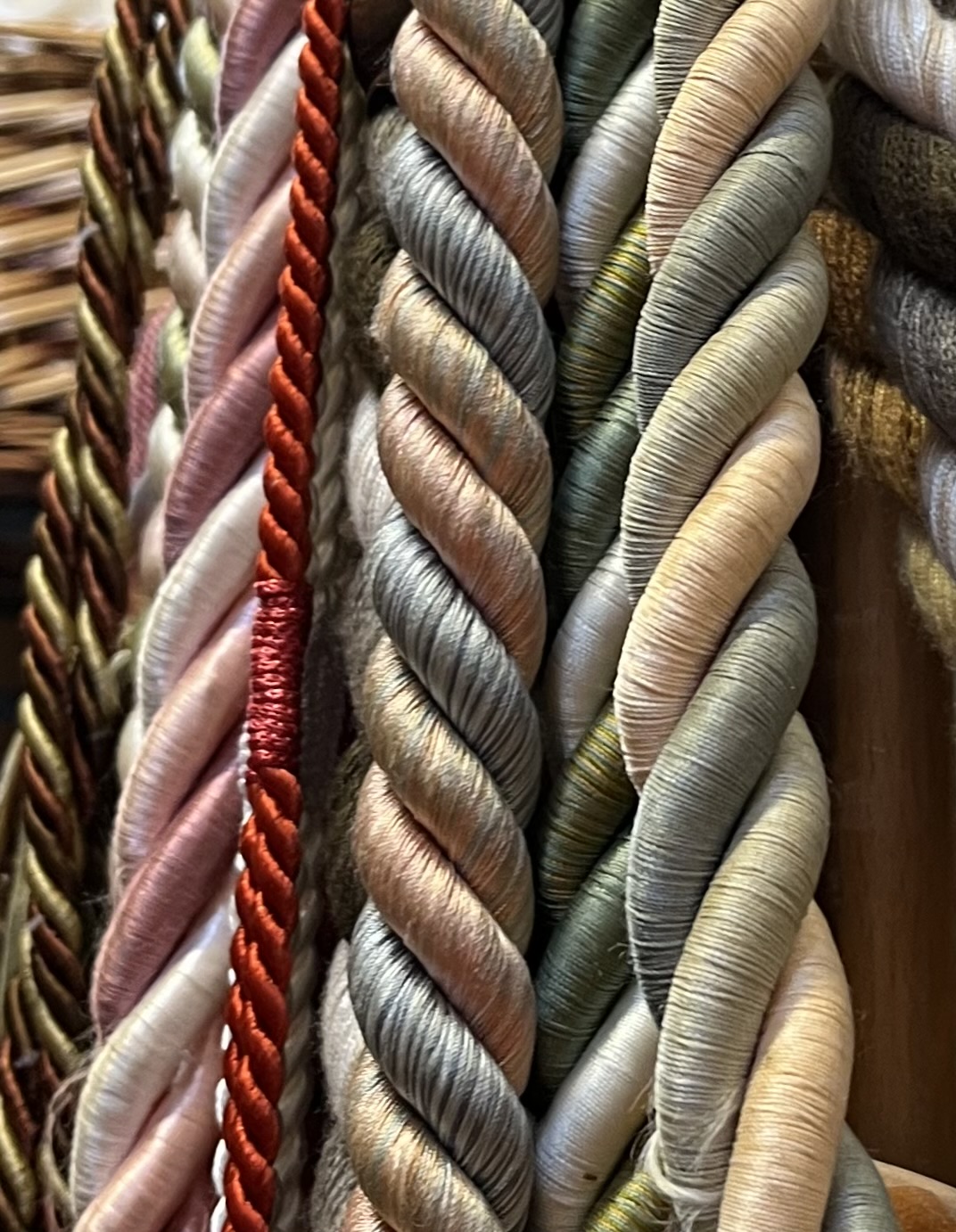
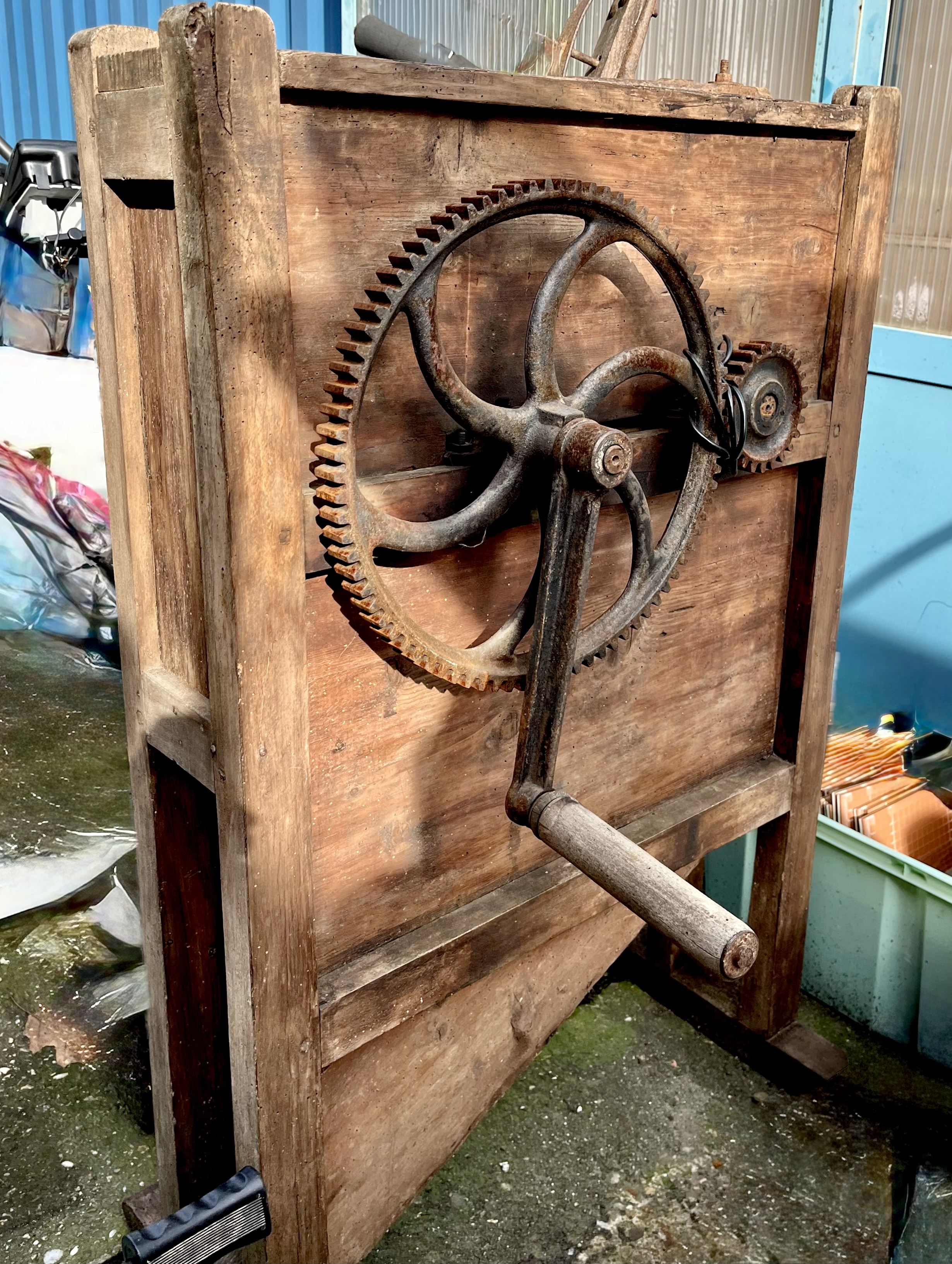
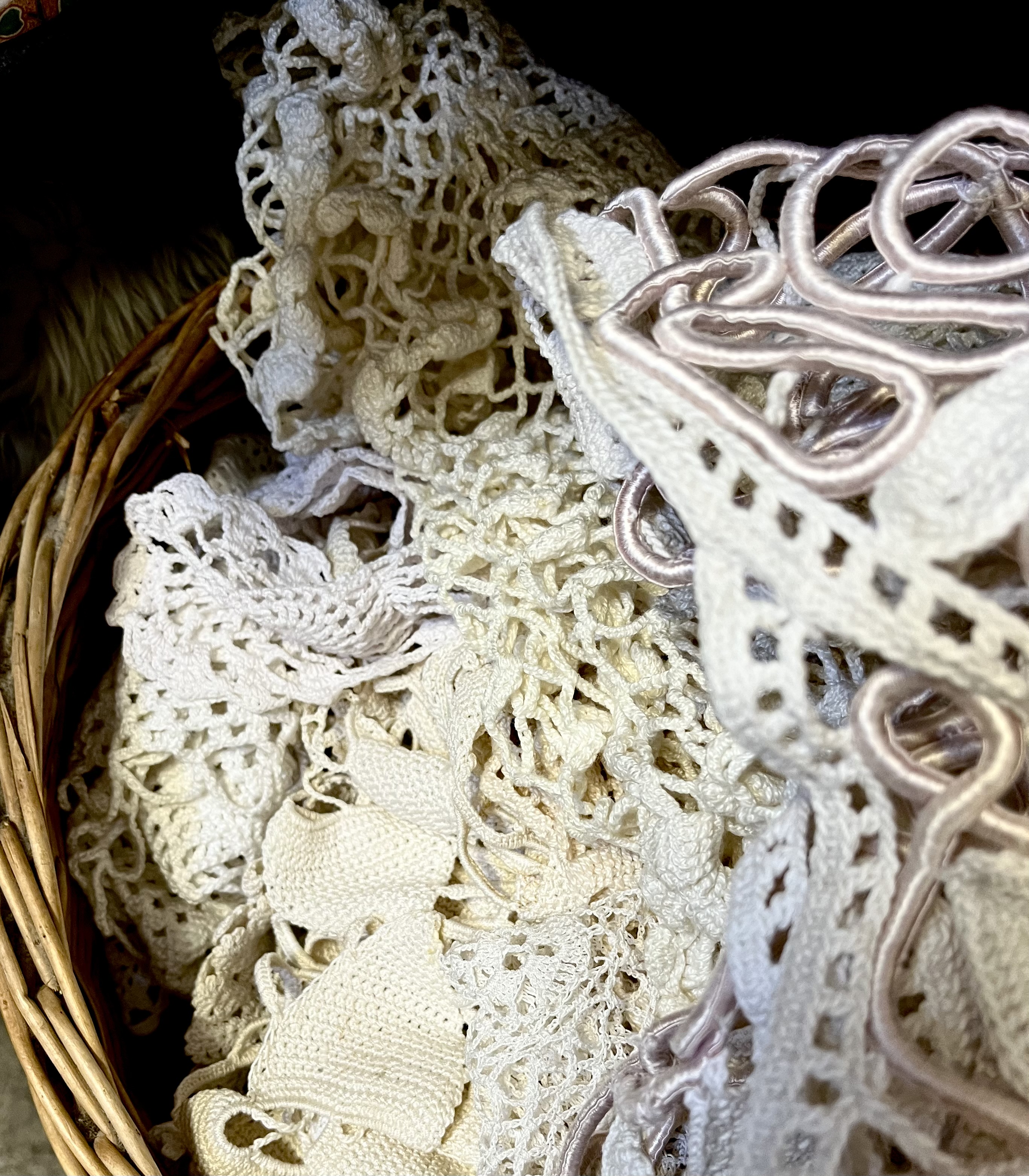
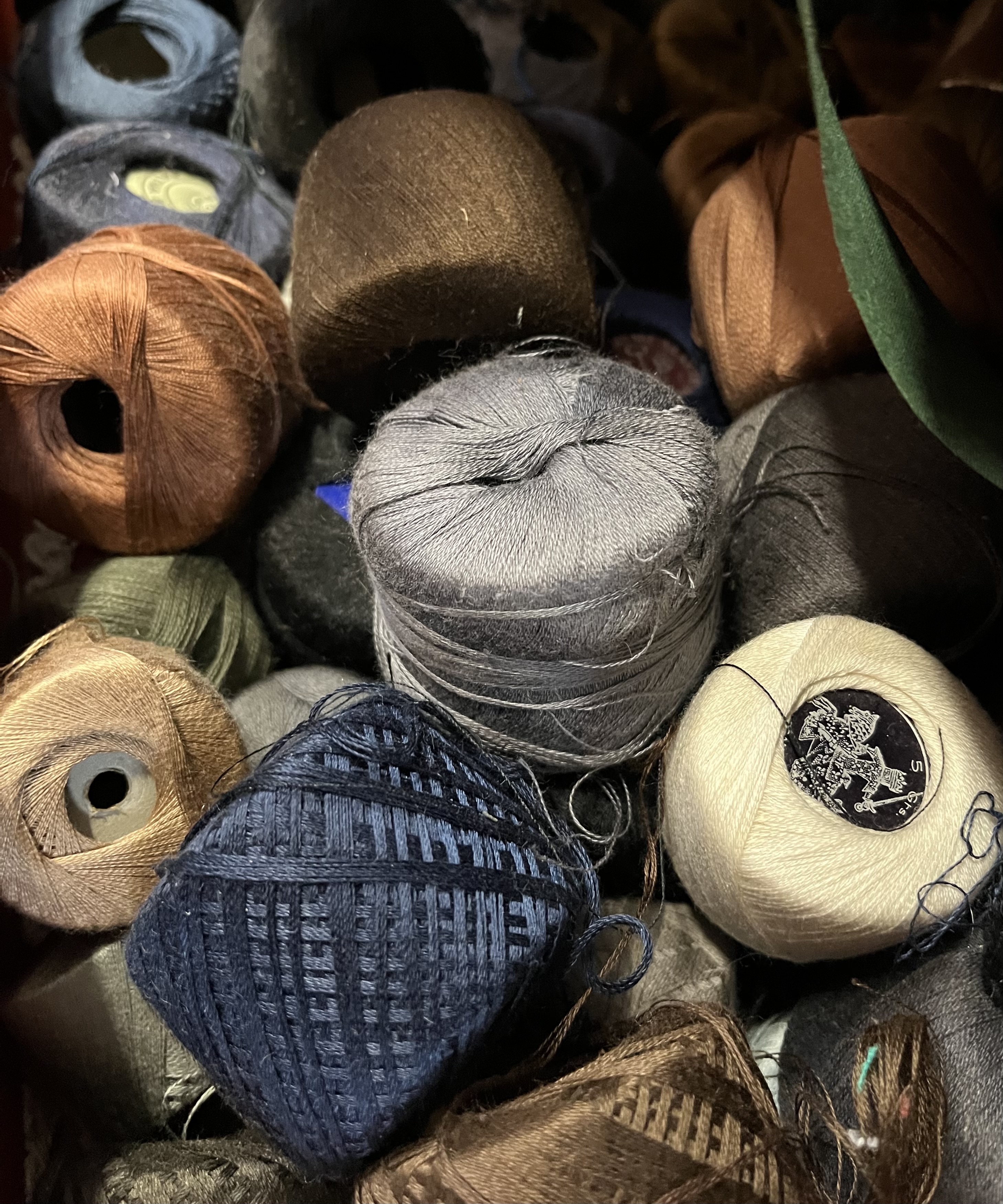
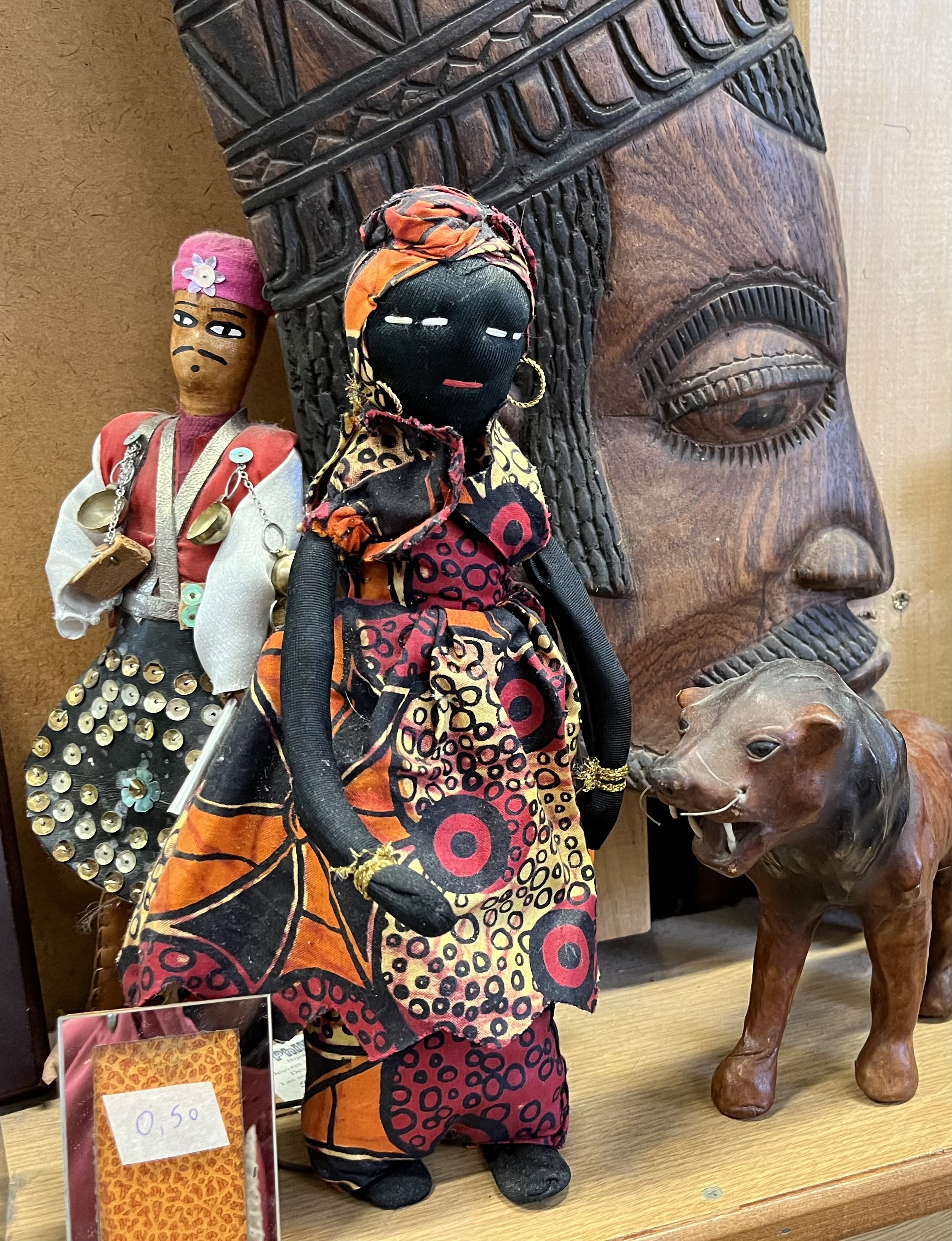
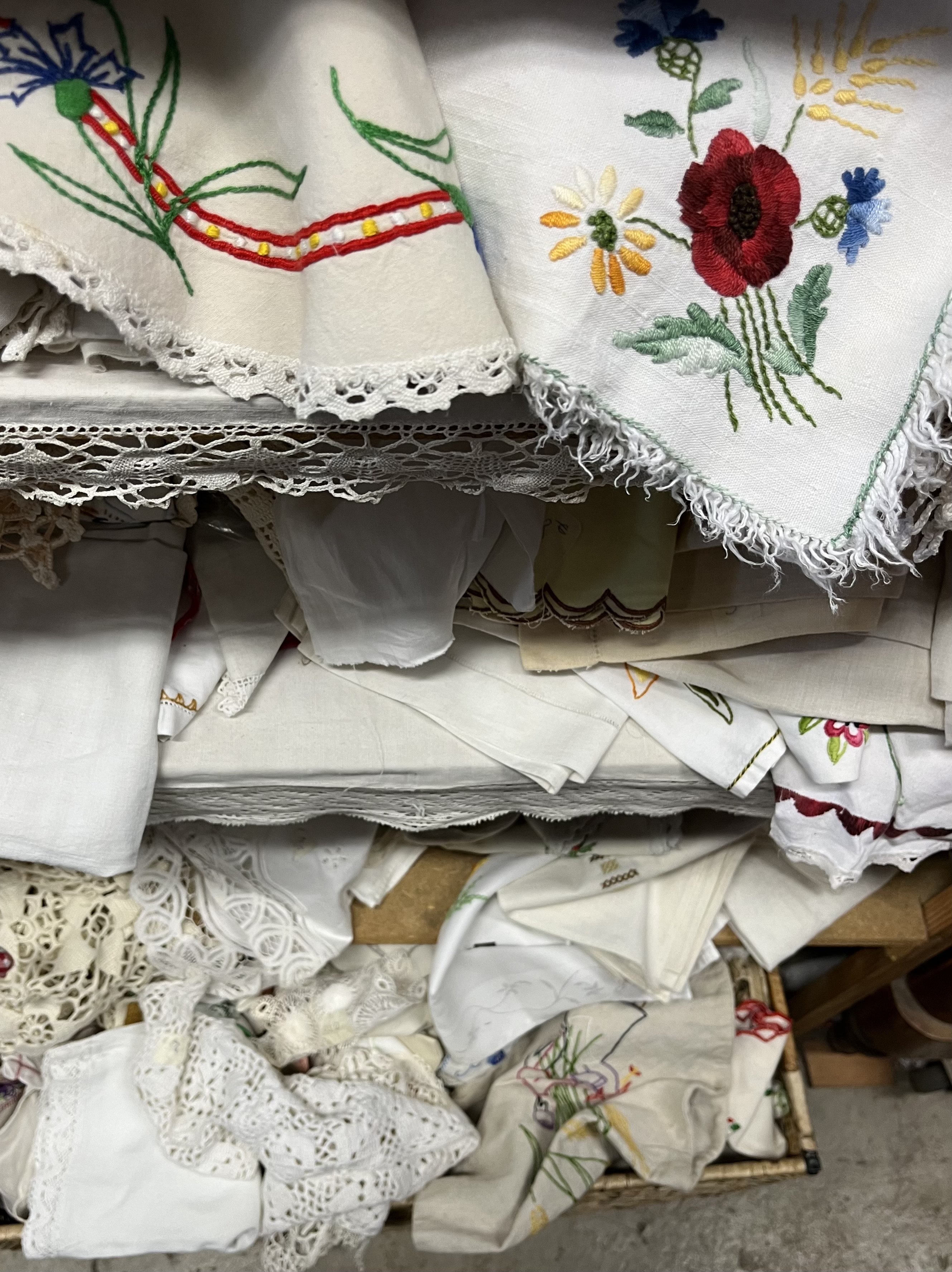
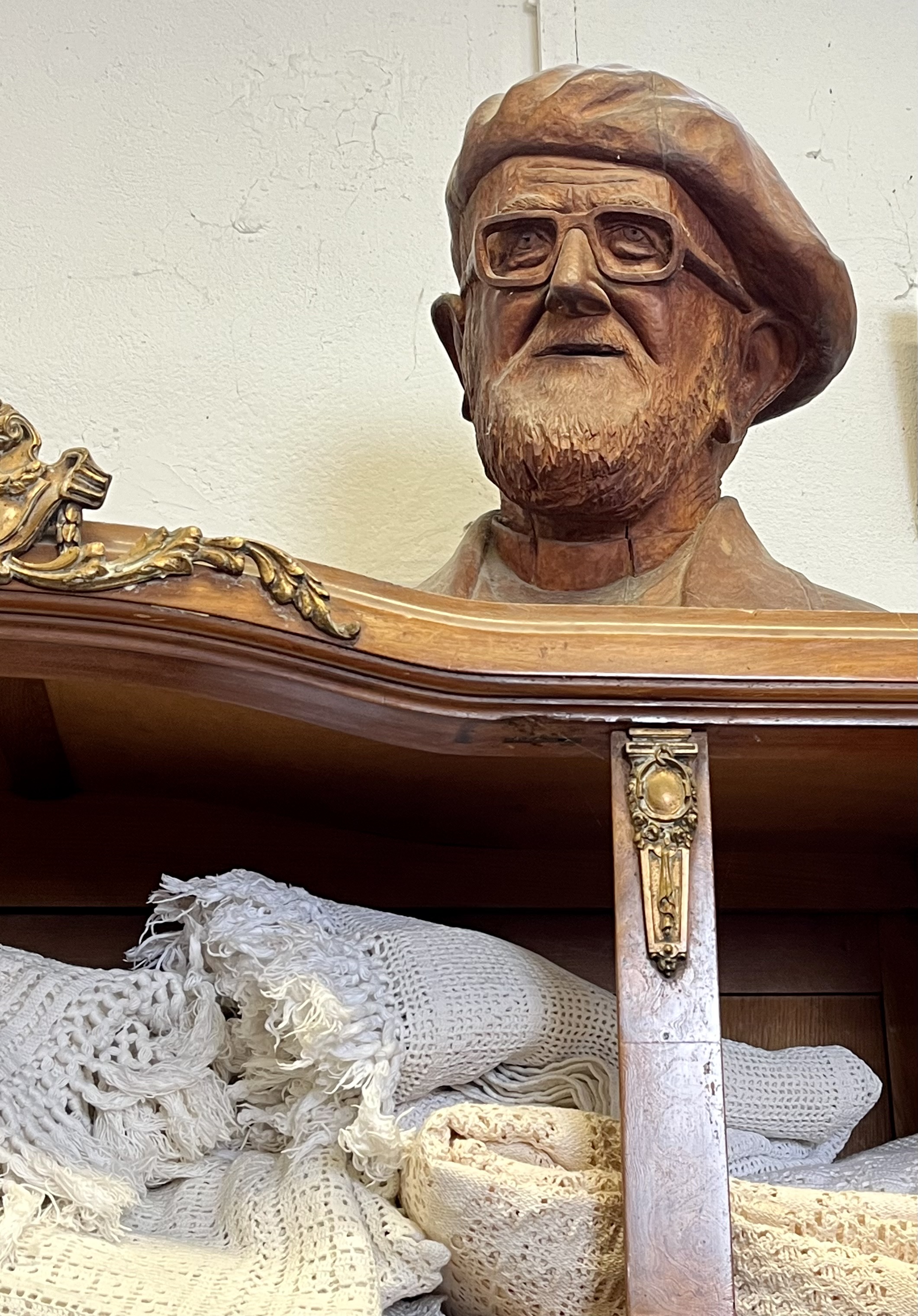
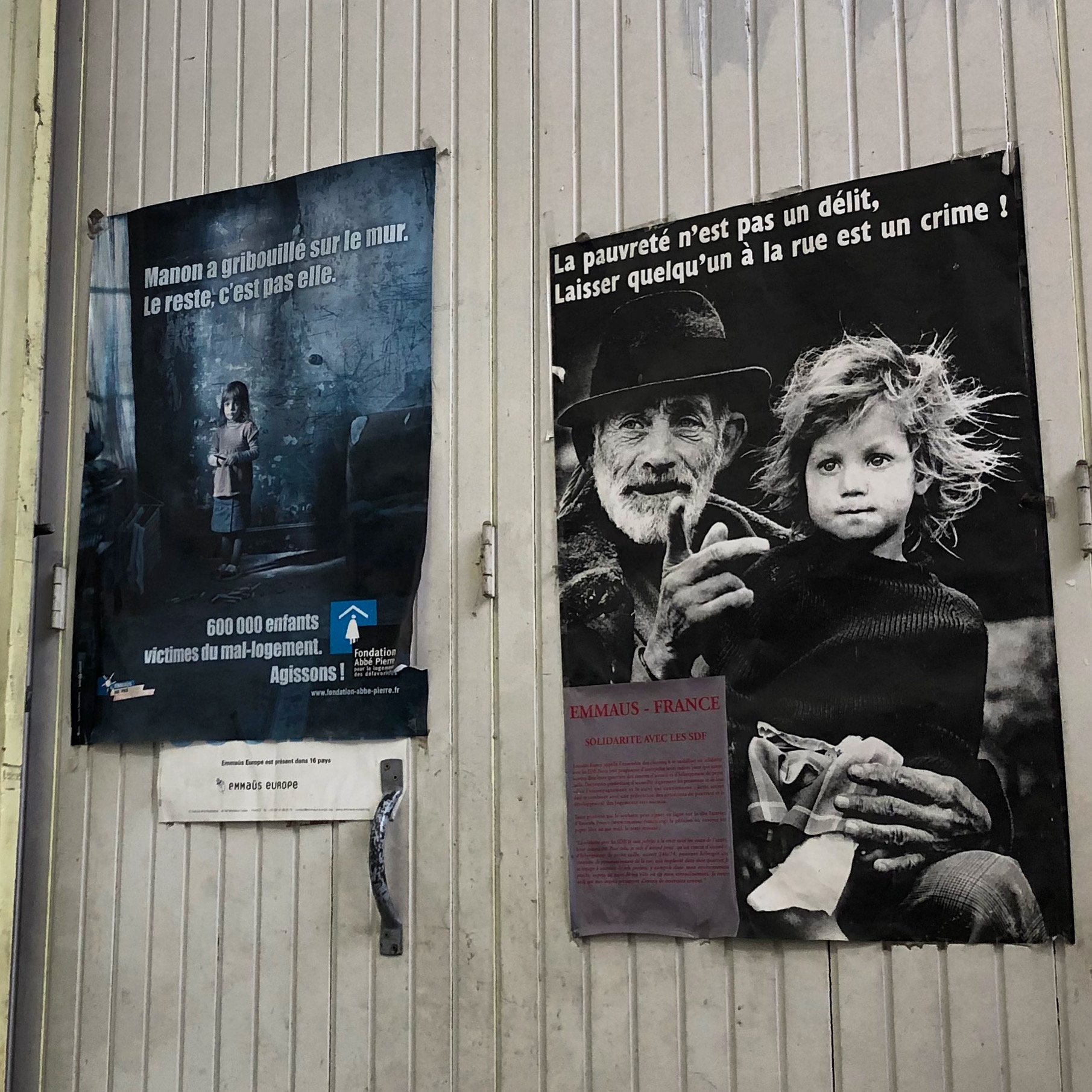
Emmaüs, the big thrift store in Carmaux, is only open on Fridays.Like all thrift stores, it’s a magical place.I thought I’d take a break from watching the sky fallto share some of the pictures I’ve taken there over the years.Lots of these are available in the vintage fabric sectionan old farm implementKnitting supplies have their own areaAmazing laceI want all the buttons, but what would I do with them?Emmaüs is my regular source for threadThe six interior spaces have employees who set aside your choices and give you a chit on a little piece of paper. You take the chits to the cashier who tears off half and gives you back the rest so you can retrieve your items.There are so many tempting things to take homeThe linens are exquisiteSometimes the line at the cashier takes a long time.Sadly, Emmaus founder Abbe Pierre was accused of sexual misconduct and his name was removed from the organization.His presence in the many Emmaus shops and charities was ubiquitous, but all the posters and busts are gone now.His good works go on, though, regardless of his offenses.
Three days ago a friend suggested I join a Facebook group I’d never heard of, the Dull Women’s Club, so I could read some of the wonderful stories ordinary women from all over the world have posted. After about half an hour of reading, I dashed off an introduction to myself and my quiet world here in rural France. Who knew that a couple days later that post would have so many likes (12.5k this morning) and that it would lead to having contact with so many remarkable women? What an incredible experience.
I spent most of the next two days responding to the comments. I wanted to respond to every single one—so many of them touched my heart so deeply. What’s amazing about the stories is their ordinariness.
My teacher Alice O. Howell‘s book The Dove in the Stone is subtitled Finding the Sacred in the Commonplace, and that’s been my path ever since I first read it. I even facilitated a long-running discussion group about the book at my dining room table on Thursday mornings. But even though I was exploring the book every week and had a reasonable understanding of it, I can remember the exact moment that its importance sank into my bones.
We had a huge house in California then, very different from the little one we live in now. One or two of our five kids were always in college then, causing a major drain on our finances, so I cleaned the house myself. One day I’d climbed up to dust a high shelf and I was thinking about how to present the next chapter in The Dove and the Stone the next day. I picked up a small vase and was turning it in my hand to get the dust out of the cracks when it struck me.
Our big house
The understanding hit me in the heart like an electric shock and then rippled through my body. This is it. This is what I’m here for, to see the sacred in the commonplace. I had to climb down and make a cup of tea.
Our little house in France
So, when I came across the Facebook group filled with introductions to ordinary women my heart filled with joy. For the second time in my life I felt that I’d truly met my tribe. (The first was when I was 12 and went to an art and music camp for the first time.) But this time the tribe is hundreds of thousands of women.
Suddenly, as a result of the opportunity of meeting so many people through the facebook group,Red Vienna, is selling well, and lots of people are reading my blog.
On top of that, I found an outstanding narrator to for the audiobook version and her first sample arrived in my mailbox this morning.
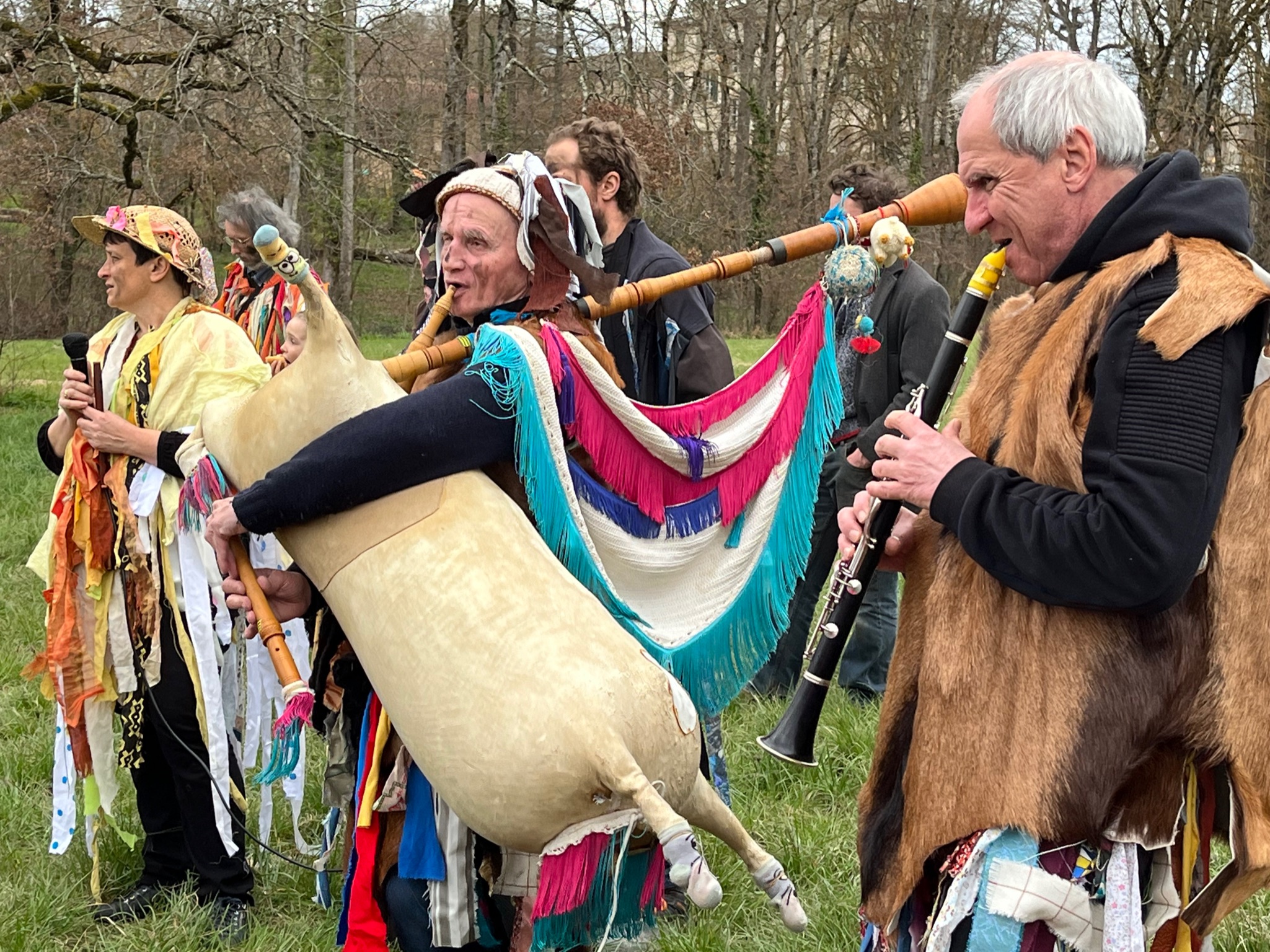
Carnaval de la Caitiviá took place in Cordes yesterday, after being postponed a week because of bad weather. It was, as good rituals should be, both festive and cathartic. School children in costume paraded through the villages of Cordes and Les Cabannes dancing and drumming to traditional Occitan music. They were led by a big cardboard effigy of Monsieur Carnaval, scapegoat for all the miseries of the participants, who was burned at the end.
The invitation to participate read (in Google translation):
“This Carnival will be that of the caitiviá (of the destitute), festive and demanding. Carnival-goers of all ages, disguised as destitute and excluded from all eras, will stroll through the streets of Cordes and Cabannes.
Loud and joyful, it will be accompanied by artists and musicians, including those from the music conservatory (Cordes and Carmaux branches), La Talvera and the Cantanha choir, themselves supported by children from surrounding schools who will have made their own instruments. The highlight of this Carnival will be the judgment and the cremation of Mr. Carnival, scapegoat for the miseries suffered by the carnival people who will judge him and celebrate his departure with a pantagruelic shared meal! So put on your most beautiful “petaçons” [pétassous] (destitute clothing made of pieces of patched fabric) or another disguise of your choice and join the procession!”
It was indeed loud and joyful!
La Talvera, the cultural association that organizes it, is dedicated to reviving the Occitan culture and language of the area. In addition to yesterday’s extraordinary event, they just published a new book of local legends.
It was a delight to follow the parade through the village and up the path to the meadow where the effigy would be burned.
I can imagine how much fun the participants, especially the children, had in preparing. The costumes were stunning.
Tom and I missed the judging, something we won’t do again, but when the parade reached the meadow, the dancing continued.
La Talvera, the band, lived up to its reputation as the best traditional Occitan band in France. We’re so fortunate to have them based here in Cordes.
The music and dancing paused as the wishes the participants had attached to the effigy were read aloud – let a cafe reopen at the center of the village, let me never be spanked, reduce the price of fuel – as M. Carnaval was wheeled to the pyre and installed.
Then it began again, the crowd swirling around the giant figure as the fire was started.
The fire grew and grew until it engulfed the figure.
A cheer went up as the head fell off!
This is the second year Carnival has been celebrated in Cordes. The revival of an ancient ritual like the Carnaval de la Caitiviá is just what this changing world needs.
We are so very fortunate to have it happening here in Cordes!
This morning we welcomed a new member to our French conversation class, Samaher Alqadi, whose documentary, “As I Want” is beginning the film festival circuit now. Here’s the trailer:
And here’s a short interview with Samaher:
Then, the end of our conversation, another participant shared this recently released music video, filmed in Cordes:
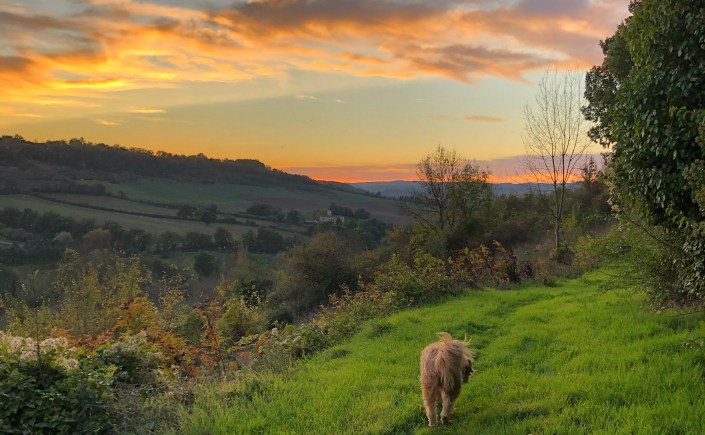
The name of the street on which Tom and I (and Mocha and Henri IV) live is called Rue de l’Acampadou, which we’ve been told means something like “between the fields and the town.” Our neighborhood is called Quartier du Barri. Opposite our house is a low wall and the stairs to our garden.
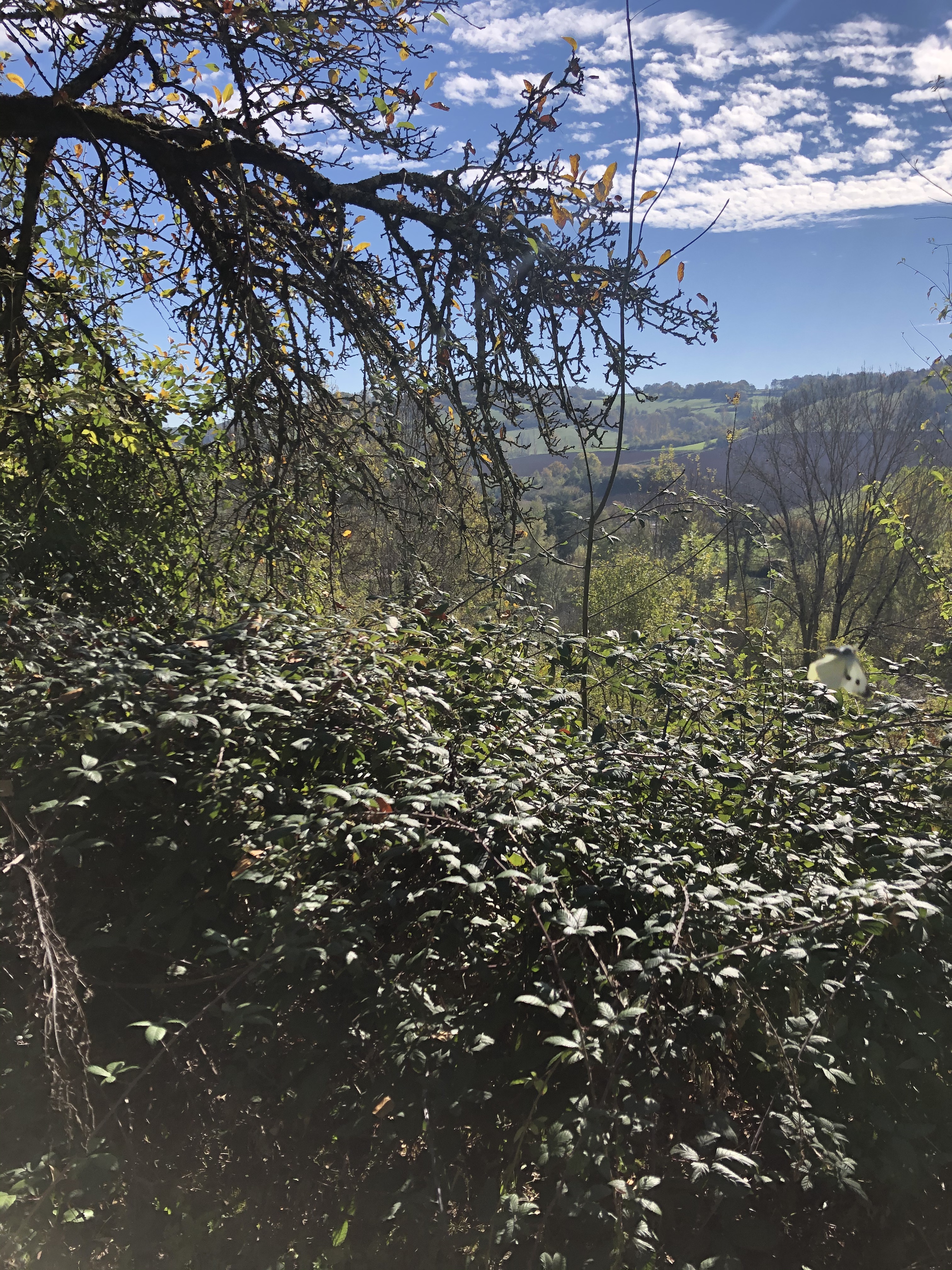
Below that, almost all the way down to the stream, L’Aurasse, is a wooded hillside.
Our house is blocked by trees in this picture, but you can see Simone’s house with the blue shutters next door.
When we first came to Cordes, we walked along the road below our house and tried to come up the hillside on some overgrown footpaths. Mocha was so covered in burrs and sticky seeds when we came home from that walk that we stuck to better maintained paths for a good year and a half after that.
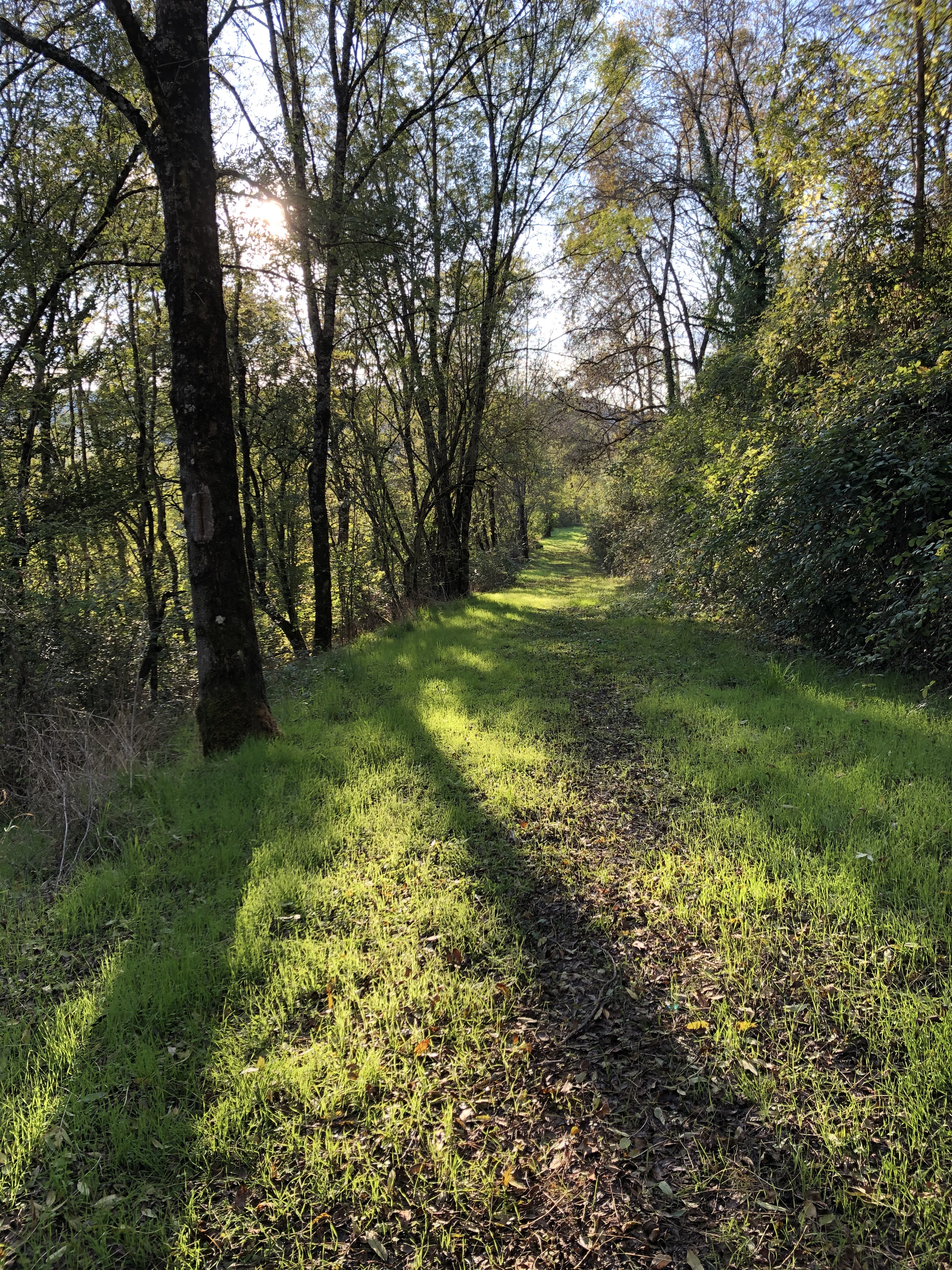
One day during last spring’s confinement, I discovered that the paths on our hillside had been cleared. I went down a set of formerly bramble-covered stone stairs just up from our house and found that there was a maze of cleared paths zigzagging up and down the hill in broad sloping swaths.
Some of the paths were left narrow. I preferred those to the wide ones at first.
Mocha and I began to explore the maze of paths. I was surprised at how wide most of them were, as wide as roads. Over the summer, you could hear the noise of brush cutters as the village cleared more and more.
It was a dry summer. The cut grass lay on the dusty pathways. I took Mocha along the paths but all I saw was the wildlife cover that was gone. The paths made me sad.
Then fall came and it began to rain, and the paths became beautiful grassy walkways. I read somewhere that they have a name, Les Terrasses du Barri, and I realized that they were indeed terraces, and no doubt very ancient.
Now that we’re in the second confinement, which limits walking for exercise to one kilometer from home, I’m realizing what an extraordinary treasure is across the street from our house.
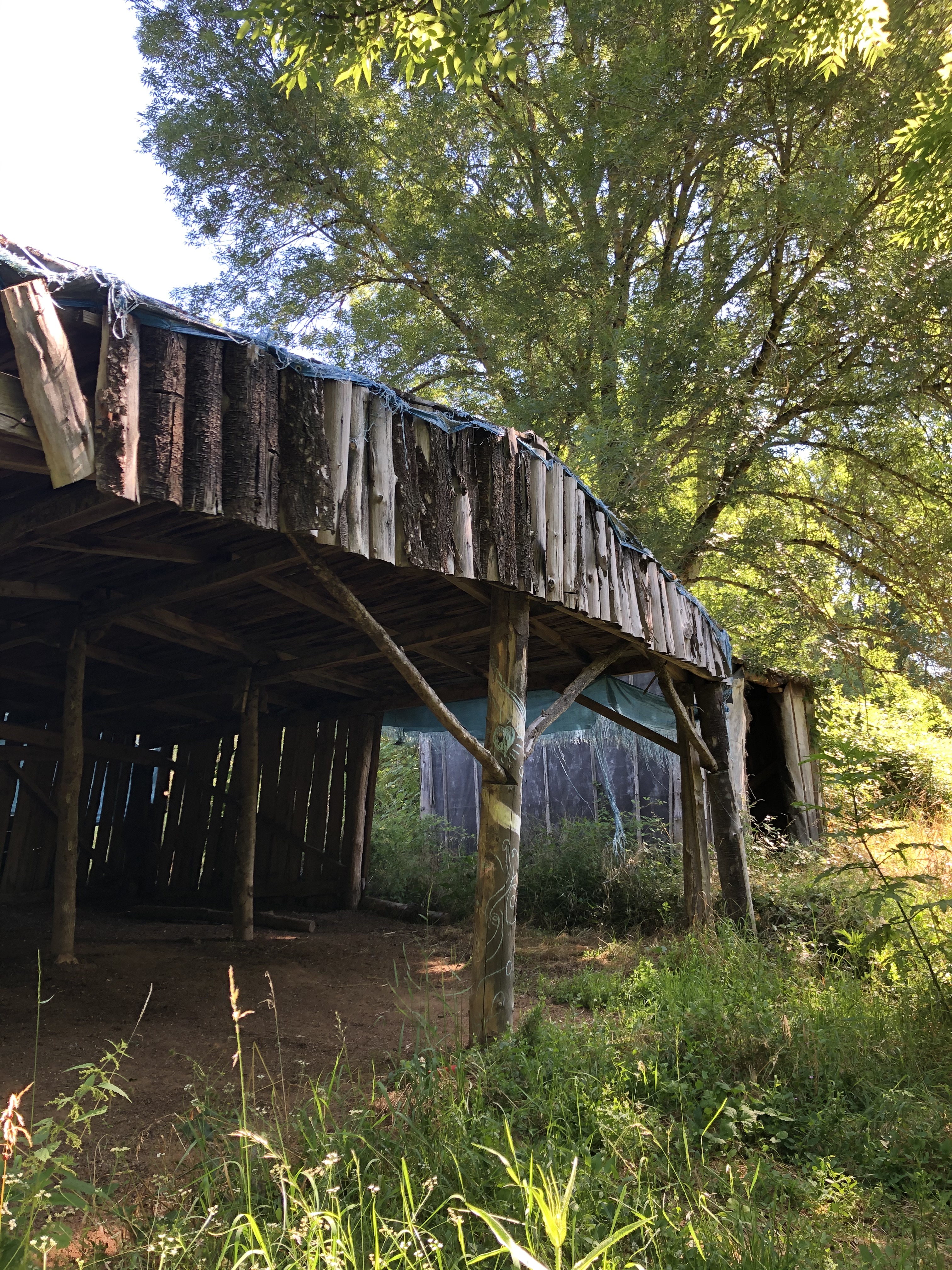
Mocha enjoys being off leash.Sunset is our favorite time to go You can see how they zigzag here. At the top a house on rue de l’Acampadou is peeking through.There are a few landmarks. This spring is running now. It’s just off a a small meadow with rock I like to sit on to meditate.There are a number of very big trees like this ash that I like to lean on and look up.This structure was part of the Medieval Festival a few years ago. Wood was stored in it and burned in the small building next to it to demonstrate how charcoal was traditionally made.
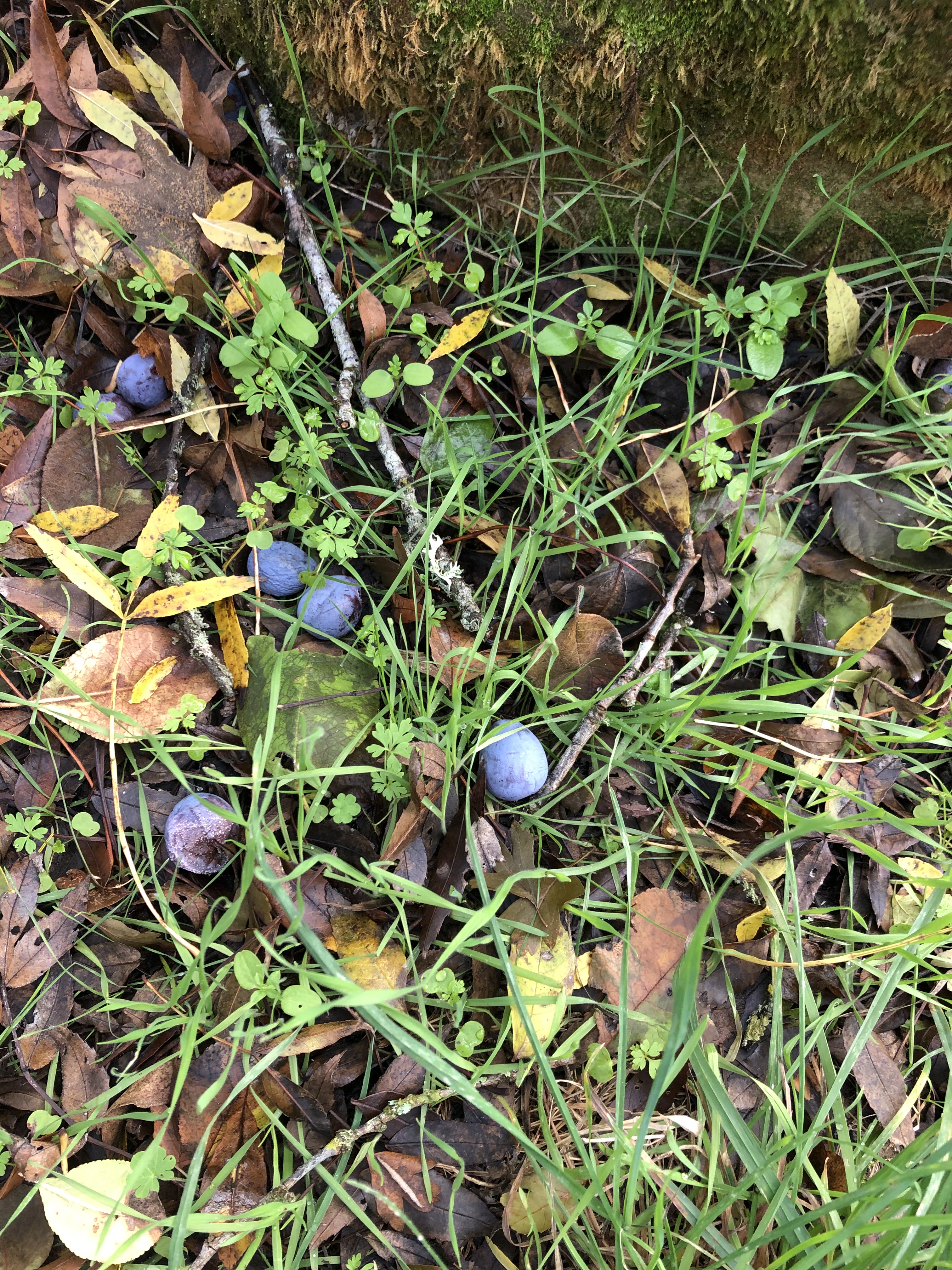
The woods are full of foods, like these wild plums, and medicinals waiting to be gathered.RosehipsFigsNettleAnd blackberries.It’s the end of our walk, but Mocha thinks there are still interesting things to see. Tomorrow, Mocha.
Recently, most of my days have been taken up with writing query letters to literary agents and tweaking Red Vienna, the first volume of Two Suitcases. I even added a short new section. Today Henri IV thought it was time to take a break from it.
Moving to the desktop worked for a short time.
But he was determined. I gave up.
And he decided to take a nap in the kitchen.
A short time later, while waking from a second nap on the kitchen counter, the idea to open his own Instagram account occurred to Henri. I reopened my laptop. He agreed to stay off the keyboard temporarily so we could choose some pictures to share to get it started.
But first he wanted to wash up.
And adjust a few things.
After that, we set up his new site, @henriquatredecordes. Naturally he wanted a simpler name, but some other Henri IVs had already claimed them. Thus, he is forced to go by most of his whole name, which is Henry IV de Cordes.
Satisfied with his day’s work, he sat on his throne to wait for dinner,
We’re told that this winter is not typical for Cordes-sur-Ciel, that it was unusually short, that, in fact, it may well not be over yet.
On nous dit que cet hiver n’est pas typique de Cordes-sur-Ciel, qu’il a été exceptionnellement court, qu’en fait, il se pourrait bien qu’il ne soit pas encore terminé.
After six weeks in California, we came back to our little house in Cordes on January 11. The skies were gray, but the fields were still green.
Après six semaines en Californie, nous sommes rentrés dans notre petite maison à Cordes le 11 janvier. Le ciel était gris, mais les champs étaient toujours verts.
January 11 11 janvier
It was cold that month, cold and damp and very gray.
Il faisait froid ce mois-ci, froid et humide et très gris.
January 17 17 janvier
It even snowed a little.
Il a même neigé un peu.
January 23 23 janvier
January 25 25 janvier
But it was cozy indoors and there were at least a couple sunny and clear days each week.
Mais c’était agréable à l’intérieur et il y avait au moins deux journées ensoleillées et claires chaque semaine.
My favorite chair for reading. Ma chaise préférée pour lire.
Tom is trying it out. Tom l’essaie.
It was a good time for making potimarron soup.
C’était un bon moment pour faire de la soupe au potimarron.
And poached pears.
Et des poires pochées.
I love seeing the trees and bushes without leaves.
J’aime voir les arbres et les buissons sans feuilles.
We took long walks with the dog. One day, I noticed hyacinths in bud in front of a neighbor’s house. It happens, our neighbor said, but then it gets very, very cold again, and the buds never bloom.
Nous avons fait de longues promenades avec le chien. Un jour, j’ai remarqué des jacinthes en boutons devant la maison d’un voisin. Cela arrive, a dit notre voisin, mais ensuite, il fait à nouveau très froid et les bourgeons ne fleurissent jamais.
January 19
It was about then that a fortunate thing happened. We’d wondered who the abandoned garden across the street from our house belonged to, and had asked around before we left for California. We could look over the wall and see that, though largely covered in brush, it looked like there there were fruit trees, a chicken coop, and maybe a well.
C’était à peu près alors qu’une chose chanceuse s’est produite. Nous nous étions demandés à qui appartenait le jardin abandonné situé de l’autre côté de la rue de notre maison et nous l’avions demandé avant notre départ pour la Californie. Nous pourrions regarder par-dessus le mur et voir que, bien que largement recouvert de broussailles, il semblait y avoir des arbres fruitiers, un poulailler et peut-être un puits.
Travelling for so long – we’d left Cordes in mid-October for Morocco, stayed four weeks, returning for only a couple, before our time in California – I was longing for roots. As I fell asleep in all those different beds, I’d imagine asking for permission to use that garden: cleaning it up, pruning the trees, digging over the beds and planting vegetables and flowers, and maybe even having a few chickens.
Voyager pendant si longtemps – nous avions quitté Cordes à la mi-octobre pour le Maroc, sommes restés quatre semaines et n’y étions revenus que deux semaines avant notre séjour en Californie – je rêvais de racines. Quand je me suis endormi dans tous ces différents lits, j’imagine que demander l’autorisation d’utiliser ce jardin: le nettoyer, tailler les arbres, creuser par-dessus les lits, planter des légumes et des fleurs et peut-être même avoir quelques poulets.
Our neighbors, Dominique and Lucie, were kind enough to keep Mocha for us while we were gone. A week or so after we came back, we invited them over for dinner. To our delight, Dominique told us the garden belonged to Lucette, who passed away three years ago, and whose house was maintained by her children, though they rarely use it. Coincidentally, they were there that weekend.
Nos voisins, Dominique et Lucie, ont eu la gentillesse de garder Mocha pour nous pendant notre absence. Environ une semaine après notre retour, nous les avons invités à dîner. À notre plus grand plaisir, Dominique nous a dit que le jardin appartenait à Lucette, décédée il y a trois ans et dont la maison était entretenue par ses enfants, bien qu’ils l’utilisent rarement. Par coïncidence, ils étaient là ce week-end.
The next morning, Tom went over, introduced himself, and minutes later, we had permission to use the garden.
Le lendemain matin, Tom est allé se présenter, et quelques minutes plus tard, nous avons eu la permission d’utiliser le jardin.
The chicken coop. I took this picture from an angle where the piles of trash and old building materials weren’t visible. Le poulailler. J’ai pris cette photo sous un angle où les piles de déchets et les vieux matériaux de construction n’étaient pas visibles.
I was pleased to discover a clothesline, partly covered in vines and brambles, but functional. Artichokes, planted randomly on the lawn and in the beds, were thriving. That’s the door to the chicken coop in the background. J’ai eu le plaisir de découvrir une corde à linge, partiellement recouverte de vignes et de ronces, mais fonctionnelle. Les artichauts, plantés au hasard sur la pelouse et dans les parterres, étaient en plein essor. C’est la porte du poulailler à l’arrière-plan.
It is a well! C’est un puits!
There’s an old pump that we haven’t got working yet. Il y a une vieille pompe avec laquelle nous n’avons pas encore travaillé.
And, even though it was January, there were irises blooming.
Et, même si c’était en janvier, des iris étaient en fleurs.
I think they are Iranian iris, Iris reticulata. Je pense que ce sont des iris iraniens, Iris reticulata.
We also found a peach tree already budding.
Nous avons également trouvé un pêcher en herbe.
So we began work in the garden, pruning, clearing brush, cleaning up in general.
Nous avons donc commencé à travailler dans le jardin: élagage, débroussaillage, nettoyage en général.
Shirtsleeve weather Assez chaud pour pas de manteau
I had no idea how much joy hanging the clothes to dry would bring me. Je n’avais aucune idée de la joie que j’avais à suspendre des vêtements.
A neighbor gave us a little table and chair. Un voisin nous a donné une petite table et une chaise.
Tom repaired the steps going down to the well. Tom a réparé les marches qui descendent au puits.
We found a small enamel bucket and began using the well to water the fruit trees. Nous avons trouvé un petit seau en émail et avons commencé à utiliser le puits pour arroser les arbres fruitiers.
We carried the water in a bigger bucket. Nous avons porté l’eau dans un plus grand seau.
One Saturday, we bought four little strawberry plants and set them in the ground in a neat row. Un samedi, nous avons acheté quatre petits plants de fraises et les avons placés dans le sol de manière ordonnée.
Every couple days I pick fresh irises for the table. They’re very delicate and don’t last long. Tous les deux jours, je choisis des iris frais pour la table. Ils sont très délicat et ne dure pas longtemps.
On February 10, M. Jazz de Rodez, a cat of great dignity and considerable curiosity, came to live with us.
Le 10 février, M. Jazz de Rodez, un chat d’une grande dignité et d’une grande curiosité, est venu vivre avec nous.
He took over the upper floor of the house immediately. Il a immédiatement pris possession de l’étage supérieur de la maison.
At this point, he owns every room except the one Mocha is in. À ce stade, il possède toutes les pièces, sauf celle de Mocha.
Mocha likes Jazz a lot more than Jazz likes her. If Mocha showed her considerable interest in the cat in some way other than barking, the process of integration would be going better. Mocha aime beaucoup Jazz beaucoup plus que Jazz ne l’aime bien. Si Mocha manifestait un intérêt considérable pour le chat autrement qu’en aboyant, le processus d’intégration se déroulerait mieux.
While the two of them make their peace, the garden keeps growing.
Alors que les deux font leur paix, le jardin ne cesse de croître.
Daffodils on our street February 20 Jonquilles dans notre rue.
Peach blossoms about to open. Fleurs de pêche sur le point de s’ouvrir. February 28
First peach blossom. Première fleur de pêche. March 3
Tree peony. Pivoine arbustive. February 28
Apricot blossom Fleur d’abricot March 3
Now there are trees in bloom everywhere.
Maintenant, il y a des arbres en fleurs partout.
Wild plum or maybe almond Prune sauvage ou peut-être d’amande March 5
Inside, Mocha waits a little impatiently to be taken for a walk.
A l’intérieur, Mocha attend un peu avec impatience de se promener.
And Jazz is sleeping on my lap.
Et Jazz dort sur mes genoux.
I don’t think winter will come back this year.
Je ne pense pas que l’hiver reviendra cette année.



































 Eve Neuhaus