Early this morning, at about 4:30, I was woken by a dream.
Someone is knocking at the door. I know it’s still night and at first I resist answering. The knocking persists, so at last I get up and go downstairs. At the door is the UPS man who shows up periodically in my dreams. He’s in this one, for example: https://eveneuhaus.com/2017/04/22/the-changing-room/) In the new dream, he hands me a soft package wrapped in white paper.
When I unwrap it, I see that it’s a fairy godmother dress, complete with folding wings. I am delighted.
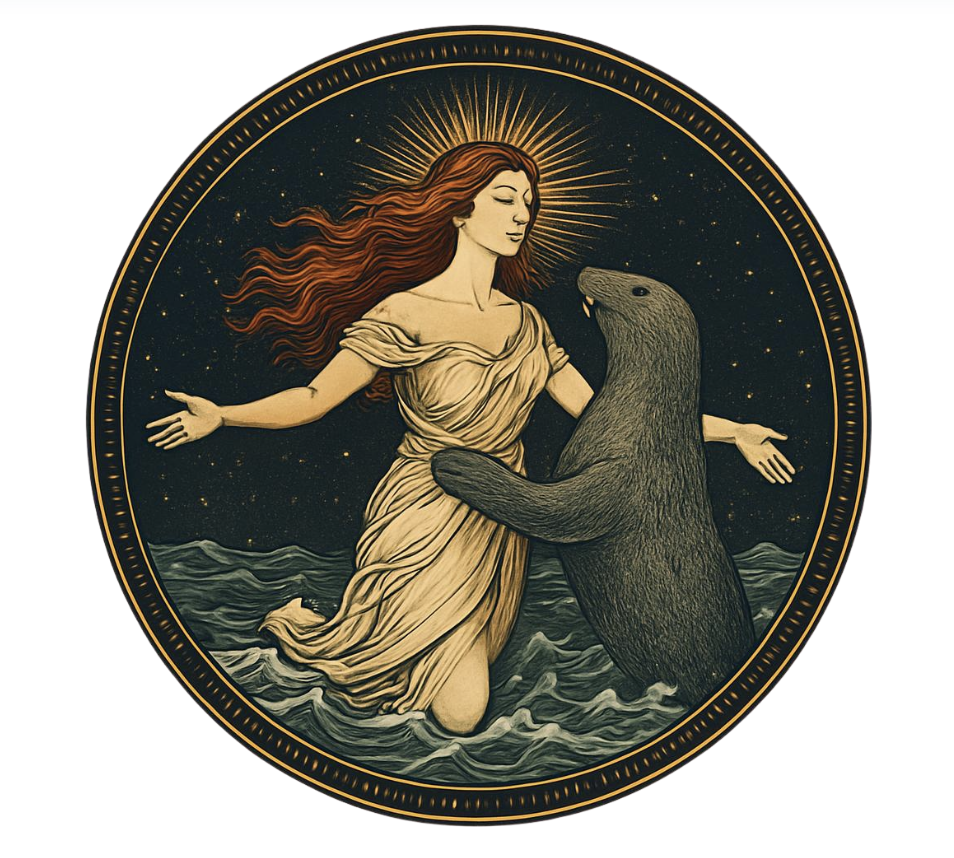
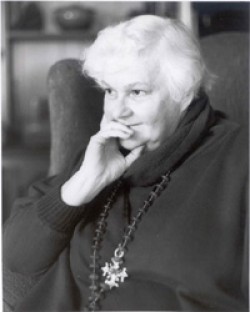
As I wake up, my inner eyes still on the sparkling costume, I realize that I’d been blessed with another gift from Alice O. Howell, the third powerful vision she’s blessed me with.
The first came in a dream too, the night before I had my first of our long interchange of e-mails, talks on Skype, and occasional visits. In that dream, the central image was a telescope or kaleidoscope that I found in my pocket unexpectedly. When I looked into it, my own eye looked back.
The second was a vision in a meditation a couple days after she passed. In it, she was flying back and forth past me merrily, calling out “Look! I’ve left that troublesome body!”
And now she sends me a fairy godmother costume right when I need one. Oh my goodness, I am grateful beyond words.
Over the last few weeks, I’ve been busy preparing my talk for the Seekers Compass on November 16. Deadlines suit me. I like to work intensively on a project, and I have been working very intensively on this one. Day and night.
The talk is titled “Everyday Magic- synchronicity, symbols, and in-sight.” I gave it the name before I had any real idea about what I’d be saying, but I trust my intuition in matters like this. I planned to began the research by looking up the word “synchronicity.” I wanted to now what people are saying about it now.
I was off. I spent at least a couple of weeks down that rabbit hole.
Somewhere along the way, an app for recording and analyzing dreams, Temenos, was recommended. I downloaded it and immediately began having a series of dreams related, not surprisingly, to my upcoming talk. Using the voice recorder is much easier than writing down dreams. And, as these things go, the more you pay attention to your dreams, the more you remember them.
Weeks pass. I begin an outline of my talk but it’s uninspired. I start over, this time using images. Since it’s an online presentation, I pull up Keynote, which I haven’t used for many years, and start to play with it. As those of you close to me know, I’ve always been drawn to computer technology. It runs in my family. Alice gave me permission to love it when she explained that the waves of the symbol of Aquarius are energy waves, not water waves. Aquarius is an air sign. She eagerly embraced electronic communication.
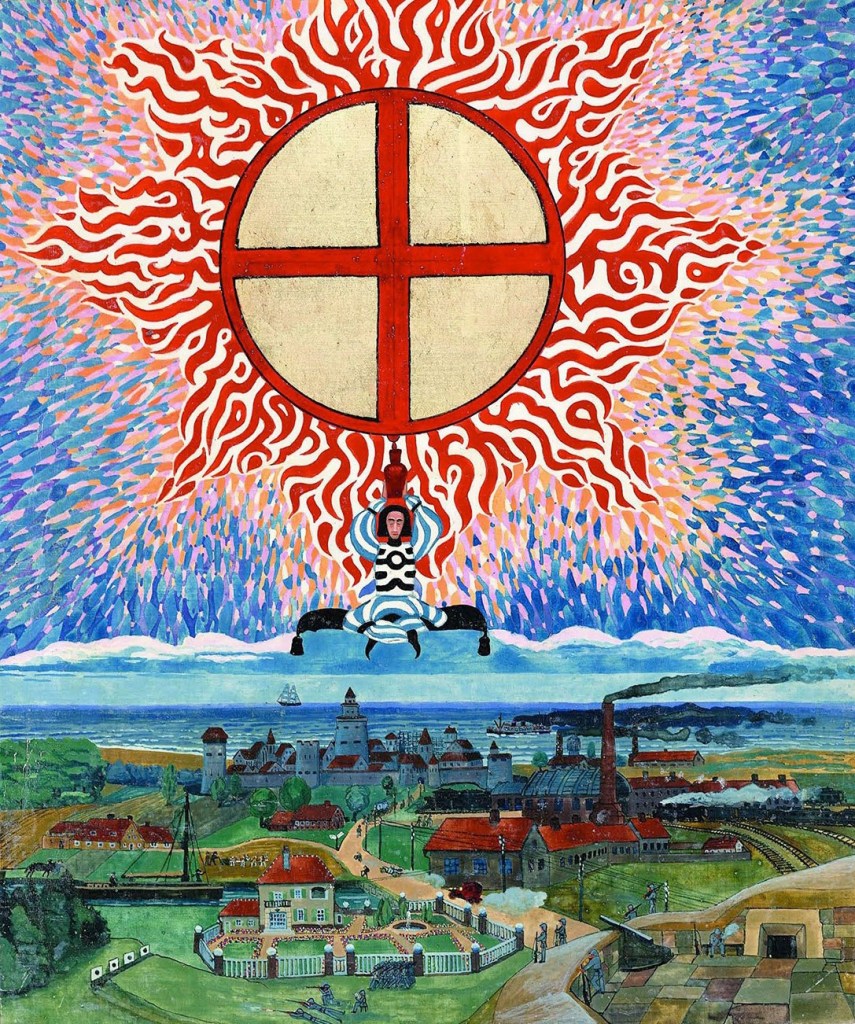
The images I came up with soon coalesced into a detailed breakdown of the diagram Ganesh Baba drew for me on a paper napkin in a diner in Watkins Glen, New York, in 1979, the first full day I spent with him. It’s a diagram of the cosmos. At the time that he drew it for me and pounded the numerology associated with it into my head, we thought we only had that time together, so there was a strong sense of urgency. “This is your work,” he told me. Study it, remember it, and pass it on.
Ganesh Baba the day we went to Watkins Glen
It took me about two weeks to get an explanation of his diagram into images and language that I hope will be intelligible. Yesterday afternoon I decided that part of my presentation was finished.
When I went to bed I asked for a dream to guide the rest of my presentation, which is, after all, about Everyday Magic: Synchronicity, Symbols, and In-Sight.
I got a Fairy Godmother costume from Alice.
To top it off, I had a related vision about it in my meditation this morning, but I think I’ll save that for the talk itself.
Now I’m off to work on that presentation again, feeling very grateful indeed.
Look! I’m doing an online presentation that you can sign up for using the link on the picture. It’s an extension of the ponderings I’ve been doing on my blog in recent months. See you there?
Type the word “magic” into the search on my blog to get an idea of what I’ll be talking about.
Use the link at the bottom of the description to sign up.
Le vendredi suivant celui où les pierres noires étaient apparues puis avaient disparu, je suis retourné à Emmaüs pour voir si la personne qui les avait emportées chez elle par inadvertance les avait peut-être rapportées.
The day began well with a slow drive—our Ami only goes 45km (28mph)—through the hills, lush green with all the rain, while chatting with a friend, Anu, who’s only in Cordes a short time each year.
La journée a bien commencé par une balade tranquille en voiture – notre Ami ne roule qu’à 45 km/h – à travers les collines verdoyantes après la pluie, tout en discutant avec une amie, Anu, qui ne passe que peu de temps à Cordes chaque année.
It was on our walk to Emmaüs from the car that I made my first mistake. As I was telling Anu about the ephemeral black stones, we passed a woman talking to a couple as she bent over to arrange some white stones in a tray in front of her garage door. We laughed—white stones this week!—and I’m certain I heard the words, “la magie des pierres,” (the magic of stones) but we didn’t stop to hear more.
C’est lors de notre promenade entre Emmaüs et la voiture que j’ai commis ma première erreur. Alors que je parlais à Anu des pierres noires éphémères, nous avons croisé une femme qui discutait avec un couple, penchée pour ranger des pierres blanches dans un plateau devant la porte de son garage. Nous avons ri– des pierres blanches cette semaine !–et je suis certaine d’avoir entendu les mots « la magie des pierres », mais nous ne nous sommes pas arrêtées pour en savoir plus.
Did I pause to hear more? No.
Me suis-je arrêté pour en savoir plus ? Non.
The black stones had not been returned to the store. My round table wasn’t there, not was the small carpet for the upstairs landing.
Les pierres noires n’avaient pas été rapportées au magasin. Ma table ronde n’était pas là, pas plus que le petit tapis destiné au palier à l’étage.
But, in the same place in the kitchen section that I’d found the black stones on the glass candy dish the previous week, I found a brass monkey on a crocodile.
Mais, au même endroit dans la section cuisine où j’avais trouvé les pierres noires sur le plat à bonbons en verre la semaine précédente, j’ai trouvé un singe en laiton sur un crocodile.
“What a treasure!” said the guardian of the kitchen section as she wrapped my 1€ find in newspaper.
« Quel trésor ! » s’exclama la gardienne du rayon cuisine en emballant ma trouvaille à 1 € dans du papier journal.
On our way out of the store, I unwrapped it to show Anu, who, being Indian, immediately recognized that my treasure was from the Panchatantra teaching story, “The Monkey and the Crocodile.” We were talking about that as we passed the tray of white stones, still displayed in front of the garage door.
En sortant du magasin, je l’ai déballé pour le montrer à Anu qui, étant indienne, a immédiatement reconnu que mon trésor provenait du conte pédagogique du Panchatantra, « Le singe et le crocodile ». Nous en parlions en passant devant le plateau de pierres blanches, toujours exposé devant la porte du garage.
Did I stop to take a picture? No.
Est-ce que je me suis arrêté pour prendre une photo ? Non.
When I came home, I looked up the story. Here’s my favorite rendition of it:
Once upon a time, a monkey lived in a tree by a river. The monkey was alone as he had no friends or family but he was happy and content. The tree gave him plenty of sweet jamun fruit to eat. It also gave him shade from the sun and shelter from the rain.
One day, a crocodile was swimming up the river. He climbed on to the bank to rest under the monkey’s tree.
‘Hello,’ called the monkey, who was a friendly animal.
‘Hello,’ replied the crocodile, surprised. ‘Do you know where I can get some food?’ he asked. ‘I haven’t had anything to eat all day and I am hungry.’
Now you might think that the crocodile would want to eat the monkey, but this was a very kind and gentle crocodile and the thought never entered his head.
‘I have lots of fruit in my tree. Would you like to try some?’ said the monkey, who was also very kind.
He threw some jamun fruit down to the crocodile. The crocodile was so hungry that he ate up all the jamuns even though crocodiles don’t usually eat fruit. He loved the sweet tangy fruit and the pink flesh made his tongue turn purple.
‘Come back whenever you want more fruit,’ said the monkey, when the crocodile had eaten all he wanted.
Soon the crocodile was visiting the monkey every day. The two animals became good friends. They would talk, tell each other stories and eat lots of sweet jamuns together.
One day, the crocodile told the monkey about his wife and family.
‘Please take some fruit for your wife as well when you go back today,’ said the monkey.
The crocodile’s wife loved the jamuns. She had never eaten anything so sweet before but she was not as kind and gentle as her husband.
‘Imagine how sweet the monkey would taste as he eats these jamuns every day,’ she said to her husband.
The kind crocodile tried to explain to his wife that he could not possibly eat the monkey.
‘He is my best friend,’ he said.
The crocodile’s greedy wife would not listen. To get her husband to do what she wanted, she pretended to be ill.
‘I am dying and only a sweet monkey’s heart can cure me!’ she cried to her husband. ‘If you love me, you will catch your friend the monkey and let me eat his heart.’
The poor crocodile did not know what to do. He did not want to eat his friend but he could not let his wife die.
At last, he decided what he must do and the next time he visited the monkey he asked him to come to meet his wife as she wanted to thank him in person for the lovely jamun fruit.
The monkey was pleased but said he could not possibly go because he did not know how to swim.
‘Don’t worry about that,’ said the crocodile. ‘I’ll carry you on my back.’
The monkey agreed and jumped onto the crocodile’s back.
So the two friends moved out into the deep wide river.
When they were far away from the bank and the jamun tree, the crocodile said, ‘I am so sorry but my wife is very ill and says that the only cure is a monkey’s heart. I am afraid that I have to kill you, although I will miss our talks.’
The monkey thought quickly and said, ‘Dear friend, I am very sorry to hear of your wife’s illness. I am glad that I will be able to help her but I have left my heart behind in the jamun tree. Do you think we could go back so that I can fetch it?’
The crocodile believed the monkey. He turned and swam quickly to the jamun tree. The monkey jumped off his back and climbed into the safety of his tree.
‘I thought you were my friend,’ he called. ‘Don’t you know that we carry our hearts within us? I will never trust you again or give you fruit from my tree. Go away and don’t come back.’
The crocodile felt foolish. He had lost a friend and a supply of good sweet fruit. The monkey had saved himself because he had thought quickly. From that day on, he never trusted crocodiles again.
Quand je suis rentré chez moi, j’ai cherché cette histoire. Voici un lien vers le conte en français :
It took me about a week of asking my French neighbors to learn that putting white stones in front of your house for good luck or to make it welcoming is an old, local custom, and even longer to find an article about it.
Il m’a fallu environ une semaine pour apprendre, en interrogeant mes voisins français, que placer des pierres blanches devant sa maison pour porter chance ou la rendre accueillante est une ancienne coutume locale, et encore plus longtemps pour trouver un article à ce sujet.
“Healing stones in the French countryside: forgotten knowledge
Not so long ago, the French countryside was rich in ancestral knowledge passed down from generation to generation, whispered in hushed tones or through age-old gestures. Among these traditions, the art of healing with stones, known as lithotherapy, held a discreet but essential place in the daily lives of villagers.”
Since learning about the magic of white stones, I’ve noticed how often there’s one white cobblestone on the street in front of houses, or a white stone placed at the corner of a house. I got to know my neighbors better by asking my neighbors about the custom, and I put a couple white stones on my own windowsill, too.
Depuis que j’ai découvert la magie des pierres blanches, j’ai remarqué qu’il y avait souvent un pavé blanc devant les maisons ou une pierre blanche placée au coin d’une maison. J’ai adoré interroger mes voisins sur cette coutume et j’ai moi-même placé deux pierres blanches sur le rebord de ma fenêtre.
So, even though I missed the opportunity to learn the magic of the stones from the woman in Carmaux, and I missed the chance to take a picture there, I did get another good story.
Ainsi, même si j’ai raté l’occasion d’apprendre la magie des pierres auprès de la femme de Carmaux, et même si je n’ai pas pu prendre de photo là-bas, j’ai tout de même obtenu une autre belle histoire.
The moral of the Monkey and the Crocodile and of my own story is similar.
Even though bad things happen, good thinking and smart actions can lead to happy endings.
La morale de l’histoire du singe et du crocodile, et celle de ma propre histoire, est similaire..
Même lorsque des événements malheureux surviennent, une réflexion positive et des actions intelligentes peuvent mener à une issue heureuse.
La vraie magie : des pierres noires, trois verres à vin et une bonne histoire
For several weeks, I’ve been watching for magic in my life. An explanation is in my post from two weeks ago, Peace, Love, and Magic. The post that follows it, The Queen of Cordes, is an illustration. And since then, my life has been filled with ordinary magic. It seemed as if all I had to do was hear about a problem, and a solution would appear. I found the keys my neighbor lost. I found the right person to care for a friend’s gîte. In record time.
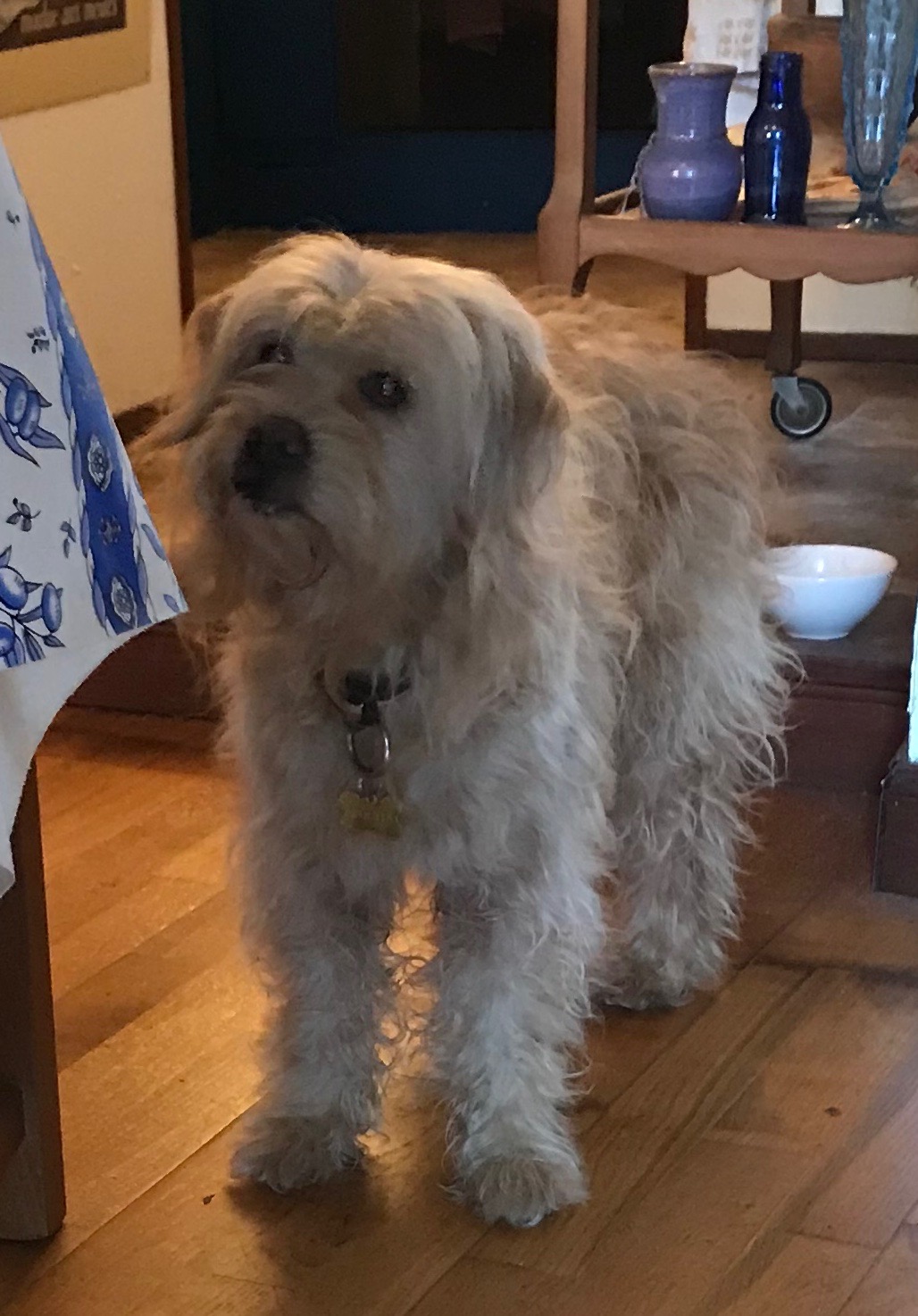
Depuis plusieurs semaines, je suis à l’affût de la magie dans ma vie. L’explication se trouve dans mon billet d’il y a deux semaines, Peace, Love, and Magic. Le billet qui suit, La reine de Cordes, en est l’illustration. Et depuis, ma vie est remplie de magie ordinaire. Il me semblait qu’il suffisait d’entendre parler d’un problème pour qu’une solution apparaisse. J’ai retrouvé les clés que mon voisin avait perdues. J’ai trouvé la bonne personne pour s’occuper du gîte d’un ami. En un temps record.
So naturally, I thought last Friday would be a good day to go to Emmaüs, the best thrift store in the world. (I wrote a story about that too, Emmaüs in Carmaux).
C’est donc tout naturellement que je me suis dit que vendredi dernier serait un bon jour pour aller chez Emmaüs, la meilleure friperie du monde. (J’ai d’ailleurs écrit un article à ce sujet, Emmaüs à Carmaux).
“I feel lucky today,” I told the friend with whom I went to Carmaux. And indeed I was!
« Je me sens chanceux aujourd’hui », ai-je dit à l’ami avec lequel je me suis rendu à Carmaux. Et c’est vrai que j’ai eu de la chance !
Neither the round table nor the small carpet that I’ve been on the lookout for months was there—you don’t go to Emmaüs for specific things in any case—but in the kitchen section, in a heavy glass candy dish, was a collection of polished black stones. There were about twenty of them, different kinds, some that you could hold up to see a glint of light, others opaque, different shapes and sizes but all beautifully polished, ranging from the size of a marble to that of a walnut.
Ni la table ronde ni le petit tapis que je cherchais depuis des mois n’étaient là – on ne va pas chez Emmaüs pour des choses précises de toute façon – mais dans le rayon cuisine, dans un lourd plat à bonbons en verre, se trouvait une collection de pierres noires polies. Il y en avait une vingtaine, de différentes sortes, certaines que l’on pouvait tenir pour voir un reflet de lumière, d’autres opaques, de différentes formes et tailles mais toutes magnifiquement polies, allant de la taille d’une bille à celle d’une noix.
(An AI generated picture of the stones. In real life the shapes were all organic, but I couldn’t figure out how to get rid the geometric ones in this picture. Une image des pierres générée par l’IA. Dans la réalité, les formes étaient toutes organiques, mais je n’ai pas réussi à me débarrasser des formes géométriques dans cette image.)
~
For years, I’ve been collecting black stones to give to people. Somewhere, a long time ago, I read that a black stone will absorb negative energy, particularly the negative energy you pick up from others. A useful tool, no? The trick is to state that you believe the stone can do it—black is absorptive after all—and then to hold the stone in the palm of your hand for a little while, concentrating on it. After a few seconds or minutes, the stone can be set aside. For a while, I was even sewing little sacks to keep the stones in.
Pendant des années, j’ai collectionné des pierres noires pour les offrir aux gens. Quelque part, il y a longtemps, j’ai lu qu’une pierre noire absorbait l’énergie négative, en particulier celle que l’on reçoit des autres. Un outil utile, non ? L’astuce consiste à dire que vous croyez que la pierre peut le faire – le noir est absorbant après tout – puis à tenir la pierre dans la paume de votre main pendant un petit moment, en vous concentrant sur elle. Après quelques secondes ou minutes, la pierre peut être mise de côté. Pendant un certain temps, j’ai même cousu de petits sacs pour y ranger les pierres.
It works. Maybe it works literally—who knows?— but it definitely works psychologically. The act of imagining negative energy being drained from you is enough to change your perspective from being “inside” of the negative state to being “outside” of it, and thus to disempower it.
Cela fonctionne. Peut-être que cela fonctionne littéralement – qui sait ? – mais cela fonctionne certainement sur le plan psychologique. Le fait d’imaginer que l’énergie négative se vide de vous suffit à modifier votre perspective, qui passe de « l’intérieur » de l’état négatif à « l’extérieur », et donc à lui ôter tout pouvoir.
~
When I found so many perfect stones at Emmaüs, I was overwhelmed. It was obvious that finding them was the reason I’d come.
Lorsque j’ai trouvé tant de pierres parfaites chez Emmaüs, j’ai été subjuguée. Il était évident que c’était pour les trouver que j’étais venue.
I took the glass bowl of stones, plus two wine glasses and two dessert plates—one with a cat on it, the other a pretty floral design—to two ladies who are the keepers of the kitchen section.
J’ai apporté le bol de pierres en verre, ainsi que deux verres à vin et deux assiettes à dessert – l’une ornée d’un chat, l’autre d’un joli motif floral – à deux dames qui sont les gardiennes du rayon cuisine.
“I don’t need the glass bowl,” I explained to them, so one of the women wrote up a chit for 1€ for the lot, and the other carefully wrapped the stones in a cone of newspaper. As I went out, the chit in my hand, I saw my wine glasses and plates being wrapped too.
“Je leur ai expliqué que je n’avais pas besoin du bol en verre. L’une des femmes a donc rédigé un bon de 1 euro pour le lot et l’autre a soigneusement emballé les pierres dans un cône de papier journal. En sortant, le chit à la main, j’ai vu que mes verres à vin et mes assiettes étaient également emballés.
Then I went to find my friend. As we walked toward the cashier’s office to pay, she remembered that another friend was looking for a washing machine, and there it was, clean, refurbished, just the right size for our friend’s apartment. After a flurry of texts, arrangements were made for the washer to be delivered on Tuesday.
Puis je suis allée retrouver mon amie. Alors que nous nous dirigions vers la caisse pour payer, elle s’est souvenue qu’une autre amie cherchait une machine à laver, et celle-ci était là, propre, remise à neuf, de la bonne taille pour l’appartement de notre amie. Après une avalanche de textos, des dispositions ont été prises pour que la machine à laver soit livrée le mardi.
I paid my euro and went back to the kitchen section with the receipt and the remaining part of the chit to retrieve my bag of goodies.
J’ai payé mon euro et je suis retourné au rayon cuisine avec le ticket de caisse et le reste du chit pour récupérer mon sac de friandises.
Alas, when the ladies looked, the bag with the other part of my chit stapled to it wasn’t there!
Hélas, lorsque les dames ont regardé, le sac avec l’autre partie de mon chit agrafé n’était pas là !
Apparently it had been given to someone else by mistake. The two women were most apologetic. But what could be done? The other customer was gone.
Apparemment, il avait été donné à quelqu’un d’autre par erreur. Les deux femmes se sont excusées. Mais que faire ? L’autre client était parti.
I chose something else worth a euro—three wine glasses.
J’ai choisi quelque chose d’autre qui valait un euro – trois verres de vin.
~
As magically as those beautiful black stones appeared in my life, they disappeared.
Aussi magiquement que ces belles pierres noires sont apparues dans ma vie, elles ont disparu.
It’s such a delicate thing, magic, so ephemeral. It exists in the liminal space between the world of the physical and literal, and the worlds of thought and imagination, where time and space are transcended. I held those stones in my hands. Now they only exist in my memory.
La magie est une chose si délicate, si éphémère. Elle existe dans l’espace liminaire entre le monde physique et littéral et les mondes de la pensée et de l’imagination, où le temps et l’espace sont transcendés. J’ai tenu ces pierres dans mes mains. Maintenant, elles n’existent plus que dans ma mémoire.
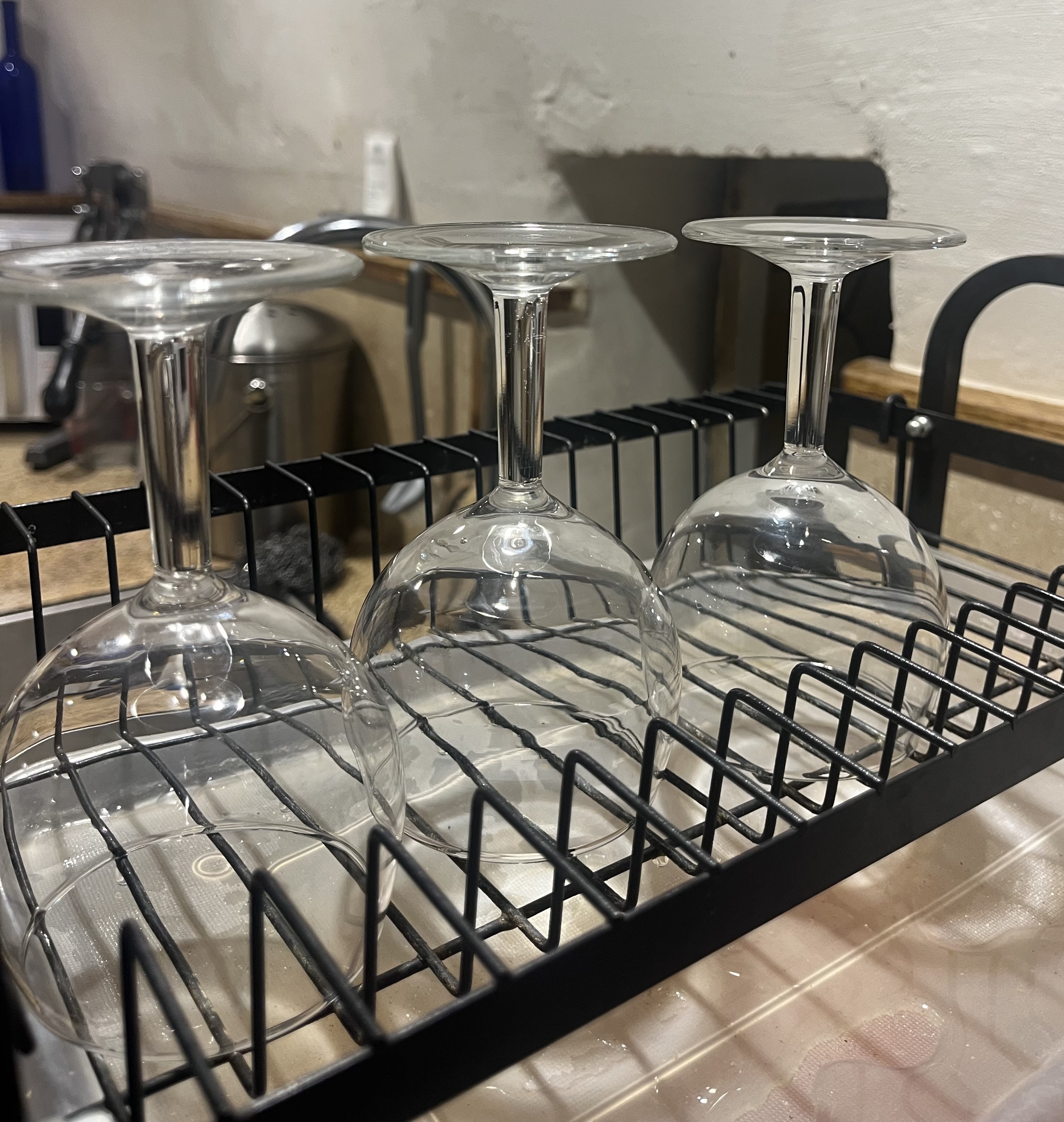
It seemed like my extraordinary streak of good luck was over—until I realized that we’d found a washing machine for our friend, and I’d come home with something, too: three wine glasses and a story.
Il semblait que ma chance extraordinaire était terminée – jusqu’à ce que je réalise que nous avions trouvé une machine à laver pour notre ami, et que j’étais rentré à la maison avec quelque chose, aussi : trois verres à vin et une histoire.
On my way home, I recounted the story to a neighbor who was feeling particularly exhausted. She got it, and I left her smiling.
En rentrant chez moi, je l’ai raconté à une voisine qui se sentait particulièrement épuisée. Elle a compris et je l’ai quittée en souriant.
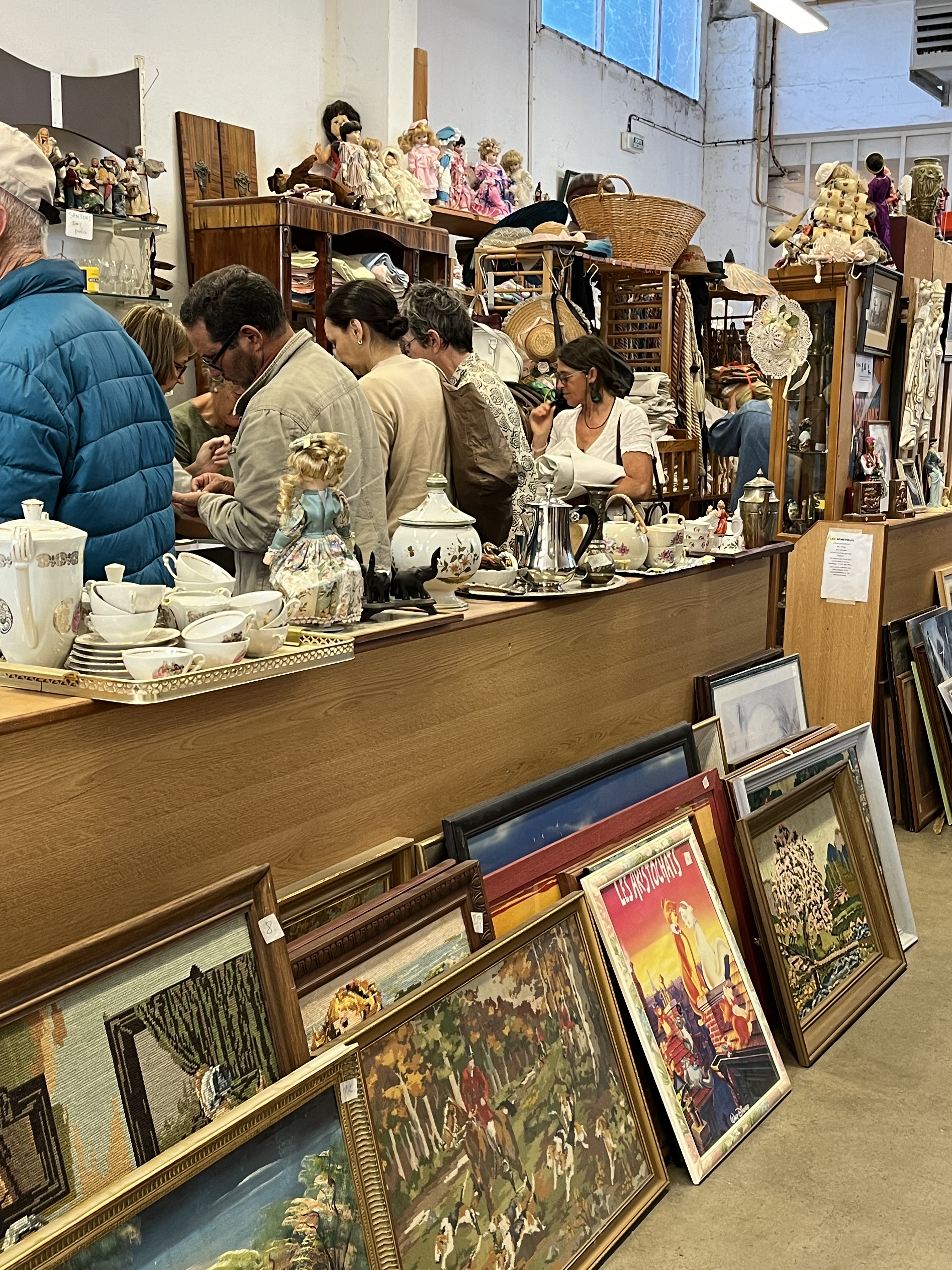
Last Friday a friend and I went Emmaüs, the big thrift store in Carmaux, an old mining town near here. All thrift stores are magical, but this one has a particularly good record.
I headed straight for the bins of old framed pictures. I was hoping to find something to hang in a niche in the bathroom. I found it, and I also found this:
It’s a framed, hand-painted postcard. The delightful Indian gentleman riding right out of the frame is Ganesh Baba, the scientific psychedelic kriya yoga guru. He appeared in my life late in 1979, intending to stay three days. Instead, he stayed in my orbit for three years, staying three days at a time, until the dream was over.
Now, he roared back into my life on a motorbike to remind me of his core message.
Ganesh Baba was the real thing. Look him up. The Wikipedia entry is good though outdated. There is a newer, much more explicit book on Ganesh Baba and his teachings available now. Written by another student of Baba’s, Keith Lowenstein, it’s called Kriya Yoga for Self-Discovery.
Baba’s essential teachings can be encapsulated into four actions. He reminded me in my meditation today is that practicing the four will get you through the hardest of times. The full system is more complex, at least eight steps if not twelve. But the first four are what’s needed today.
Posture
Hold your head high, your spine straight, rib cage open.
There’s a reason the military and the old aristocracy made the straight back essential. It changes your perspective, among many other benefits. Your spinal cord is your antenna.
Reconnect with the physical world.
Breath
Your breath is your connection to the life force. The more air you can breath in and out, the better you will feel.
Reconnect with the biological world.
Attention
Practice controlling your attention. Meditation does this particularly well, but any serious practice, spiritual, mental, or physical. can achieve it. Those who can direct their attention are better able to maneuver in worlds beyond the physical.
Reconnect with the mental/psychological world.
Mantra
Using a mantra, a sound or phrase repeated internally or aloud, is a time-tested method for changing one’s vibration. Now more than ever, the world needs humans to raise their vibration.
OM on the in breath, OM on the out breath is simple and potent.
Reconnect with the spiritual world.
That’s it, and it’s enough. Practice each one separately and do them in combination and all together. It’s efficient and effective.
Sometimes I have extraordinary dreams—some of them are told in the links below—and sometimes my life is filled with extraordinary synchronicity. A few weeks ago I was graced with a series of delightful synchronicities.
That weekend, Tom was still in Africa so I had plenty of time to work on my book. There were no real meals to think about, minimal shopping to do, just the dog to walk, which is good for me and almost always a pleasure. I was on a roll.
The last three chapters that I’d written were all pretty dark— the excerpt I published here a few weeks ago is part of one of them—so I decided to add in a lighter one. I gathered my characters in Gert’s parents’ sitting room for New Year’s Eve, had Gert put on some popular music with funny lyrics—it was good fun to do that research—and pretty soon everyone was singing and dancing. They couldn’t dance for all the hours before midnight though, so I figured they could play games. More interesting research. No parlor games popped up, but card games were popular. The first card games from that time and place that came up in my search were played with tarot cards. Good idea. Let the characters play the game and afterwards draw a card. Or better, I’d draw a card for each of them.
The characters probably would have used an Industrie und Glück deck, but I used what I had on hand—I’ve accumulated a good number of tarot decks over the years. The first one I found was my well-worn Waite/Rider deck from the 1970’s.
An Industrie und Glück deck:
I divided out the major arcana cards from my deck, drew one for each of the characters, and then wrote them into my story:
Gert puts one of the decks into two piles. “Pull the chairs back into a circle with a table at the center while I sort the cards.” When the chairs are in place she explains, “I’m putting the major cards, the tarocks, in one pile and the minor cards in the other. Then we’ll each draw one of the tarocks, and I’ll explain what they mean. Or at least what I think they mean.”
“Me first!” Gisi calls out. “I want to get it over with.”
“Okay.” Gert shuffles the smaller set of cards and fans them out so Gisi can choose one.
Gisi looks at the backs of the cards carefully. She runs a finger over them. “No,” she says. “I can’t do it. Someone else has to start. Sorry.” She sits back in her chair.
“I’ll do it!” volunteers Max. Gert shuffles the cards again and fans them out for Max. He doesn’t hesitate, immediately drawing a card from the center of the deck and turning it over.
“It’s Der Naar, the Fool. What does it mean?” he asks Toni.
“Well, that’s appropriate,” she laughs. “It’s the wild card in the deck. It symbolizes beginnings, innocence, spontaneity, and a free spirit.”
“Very appropriate!” Hugo agrees. “I’ll go next.” He runs his finger over the cards a few times before drawing Der Herrscher.
Gert smiles. “The Emperor. Another good fit. The Emperor represents authority, the establishment, structure, and a father figure. He’s the ultimate ruler of the world.”
“Good God,” says Hugo. “Is that how you all see me? I always wanted to be an artist. Isn’t there an artist card?”
“You are an artist,” says Anna, “but the card fits, Hugo. Accept your destiny.” Everyone laughs.
Leo volunteers next. He draws the Magician.
“Ah, my favorite,” says Gert. “Der Magier is the first of the Tarocks. It symbolizes manifestation and means that you can make your wishes come true.”
“Phew! A lucky one for me! What should I wish for?”
“That’s up to you,” Gert replies.
“Then I wish the power of Der Magier for all of us. May all our wishes come true.”
“Leo, generous as always! Thank you, my friend,” says Hugo.
The last rays of sun fill the room.
Everyone is smiling.
“Thanks!” says Anna. “I’ll go next, now that I have the power to make my wishes come true.” She takes only a moment to draw Die Sonne, the Sun.
Gert claps her hands. “I think Leo’s card worked. Die Sonne signifies enlightenment, joy, marriage, and happiness.” Anna looks at the card and grins.
“You are an excellent fortune teller, Gert,” says Gisi. “I guess I’ll risk taking a card now.”
Gert reshuffles and fans the deck out on the table. Gisi looks over the back of the cards several times, pauses, and then slowly draws out a card slowly. She studies closely, holding it up to see it better. “I have no idea what this means,” she says, turning it around so everyone can see.
“Oh, it’s der Gehenkte, the Hanged Man,” says Gert. “It’s a complicated card, but it generally points to pausing—voluntarily or involuntarily—in order to assess your situation. It can also mean that it’s time to shift your perspective. Sometimes it means you’ll have to make a sacrifice.”
“Aha!” says Max, rubbing his hands together. “I thought this would go a little deeper eventually. I think it’s an accurate reading of where you are in life, Gisi—of where we all are, no? Very interesting, Gert!”
“It is a good representation. All of our lives are held up right now, aren’t they. None of us knows where we’ll be in a year,” muses Gisi, tracing the form of the hanged man with her finger.
Hugo says, “I think all the cards have all been pretty good representations of who we are, or of who we could be.”
“I’ll go next,” Toni volunteers, and Gert lays out the cards again. Toni also takes her time to choose. Eventually she closes her eyes and stabs randomly at a card.
“The Hermit,” announces Gert. “Huh. Der Eremit isn’t a card I would have associated with you, Toni. The Hermit is a person who gains wisdom by being alone, through introspection. It also means the answer to your question will be found within.”
Toni is surprised too. “Soul-searching certainly isn’t something I’ve done much of so far in my life. All the other cards have seemed so exactly right though. Maybe I should take it up.”
“My turn now,” calls out Felix. “I’m so curious! Every one of these cards has been fascinating to consider.” Gert offers him the deck.
“Temperance. Die Mäßigkeit. Moderation,” she says when she see what he chooses. “Is that you, Felix? Or is the card advising you to be more balanced, more patient?”
“The latter,” says his brother. “Obviously.”
“I beg your pardon, Leo. I am the model of Patience. I ooze Balance from every pore.” Felix stands on one leg, extending his arms, wobbling a bit, but then holding the pose.
“Very good!” Anna claps and the rest of the group joins in.
“And now,’ Gert says. “I’ll pick one for myself.” She shuffles the cards three times and then riffles them. At last she chooses a card.
It’s Der Tod, the Death Card.
Everyone in the circle looks stricken.
“Wait, wait,” Gert cries. “It doesn’t mean death literally! None of the cards are meant to be understood literally. It symbolizes transformation or change, or an ending.”
Anna sighs audibly. “Of course, none of them is literal. Still, it’s shocking to draw it.”
Gert is shaken, but she hides it. “How about if we transition to Jause now? My parents will be home any minute. Come help me in the kitchen, ladies.”
When I had written that far, I took a break and walked the dog up the hill. It was surprisingly crowded in the village Saturday afternoon. Then I remembered that it was the day of the Witches’ Market!
There must have been half a dozen readers or sellers of Tarot readers there.
The second synchronicity occurred a week or so later. My chapter was dated January 25, 1938, so I followed my usual process of looking up what happened in Vienna at the time. It was a tense time then, six weeks before the Anschluss, when Austria merges into Germany.
In late January that year, the Northern Lights were visible in Vienna for the first time since 1805, just days before Napoleon marched into Vienna. Many Viennese saw their appearance in 1938 as an omen. Others were more hopeful—they thought it marked the birth of a princess in Holland.
I wrote the Aurora Borealis into my story by weaving together bits of whatever eyewitness reports I could find. The pictures were all in black and white, but the words were evocative. I went to bed imagining it.
In the morning, I saw that my social media was filled with pictures of the current Aurora Borealis.
After nearly three weeks in the big cities of Morocco, Tom and I headed to the mountains.
Atlas Mountains from the road from Marrakech to Ourika
Tom had visited the Ourika Valley in the foothills of the Atlas Mountains before, so we booked a room at in Tnine, the village he’d visited with a souk where the Berbers came by donkey. We planned to see that on Monday, the day of the week it happens. We arrived on Friday.
Our hosts in Morocco have been very hospitable, but Abdurrahman at the Secret Atlas is by far the most generous and friendly of them all. Using a translator on his phone because he speaks only Arabic, he served us delicious thyme tea on our arrival, told us about his family, and shared beautiful passages from the Koran that explained his exceptional hospitality. For 11€/night, we have a spacious bedroom, living room and kitchen. The extraordinary breakfasts Abdurrahman cooks for us each morning are a few euros more.
Tiles on the wall and floor of the Atlas Secret
Kitchen
The apartment is elegantly spare and spotless, the bed excellent, and views spectacular.
View from the Atlas Secret
We were a little surprised, however, to find that the Secret Atlas is in apartment building on the relatively busy street that connects the two parts of the village. On Airbnb, it’s listed as a “farm stay.”
On our first afternoon in Tnine, we explored the part of the village near the river. It was hot, the pollution from all the cars and motorcycles hung low, and other than offering a window into the lives of ordinary residents of the valley, there wasn’t much to see there.
Street scene, Tnine, Ourika
The next morning, we discovered that other than a couple nice places for tea or a meal, the other end of the village had little to offer either.
We looked on the internet to see what else we could do. Everything looked like it would require another expensive taxi ride. The taxis to and from Marrakech are a bargain because they’re shared by up to seven people, but to call one to go from point A to point B requires paying the fee for the distance traveled to where you are and to where you’re going at the full rate.
But wait. It looked like at least one destination was close by, and it was something neither of us had ever seen: a saffron farm!
Le Jardin du Safran is an easy walk from the Secret Atlas. We’d passed by the dirt road that leads to it the day before.
What an enchanted place! We found the front gate open.
Entrance to Jardin du Safran
A sign told us we were free to wander around but not to pick the fruit or flowers. Pretty soon the farm manager found us and took us on a tour that lasted a couple hours.
Pathways, Le Jardin du Safran
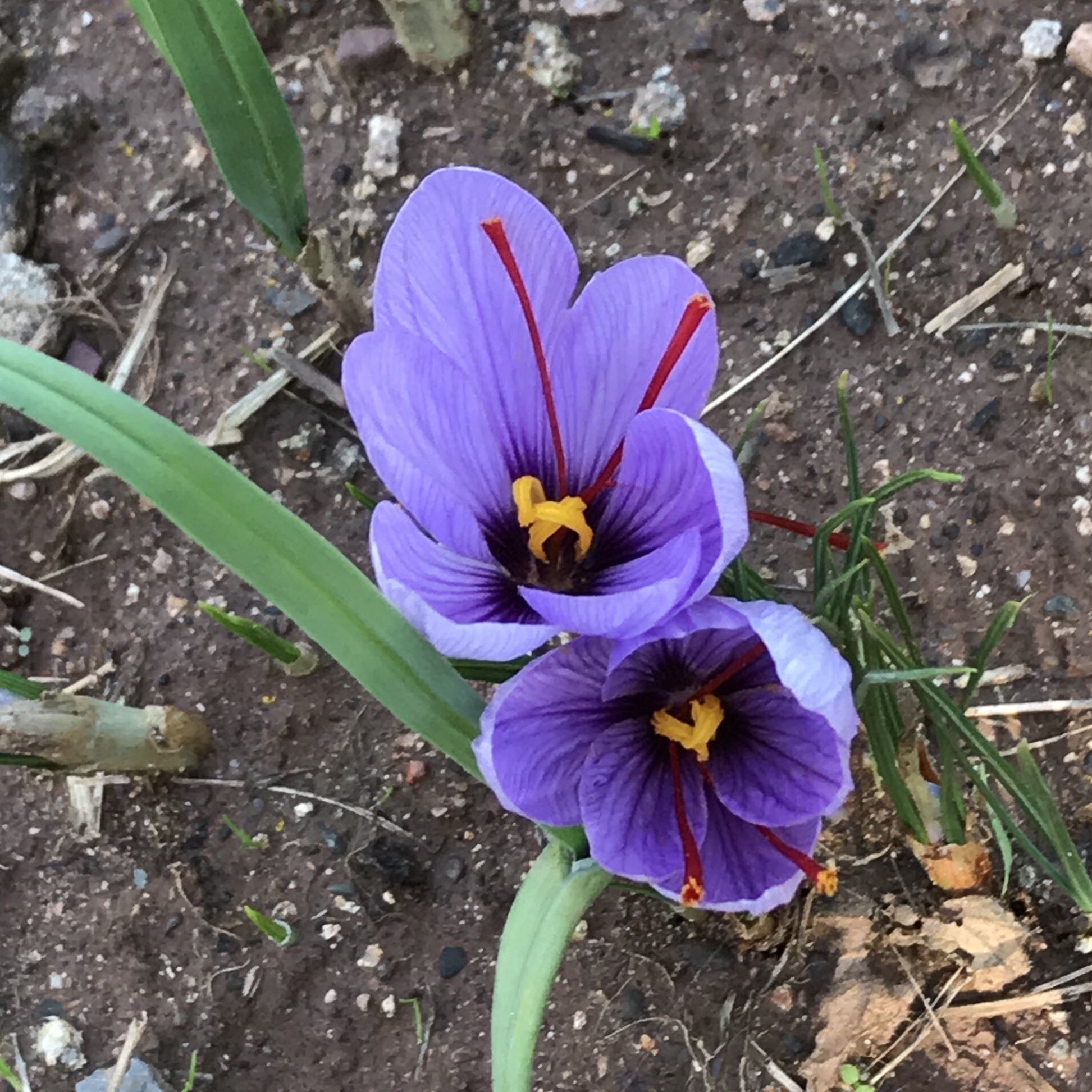
Synchronistically, we’d arrived the day before the four best and busiest days of the year: the saffron harvest. Every year, from November 4 – 8, when the flowers of the crocus sativa bloom, dozens of local women are hired to do the delicate work of pulling the bright red pistils out of the flowers, nipping off the yellow end with their fingernails just so, to produce the tiny strands of highly aromatic spice so highly valued throughout the Mediterranean, and the world.
Crocus flowers harvested the morning of our visit
Pistils
Instead of watching the women at work, we sat down on the stools around one of the round tables and learned how to pull the pistils out of the flowers ourselves! Then we saw the drying process and smelled the exquisitely freshly dried product.
Saffron before drying
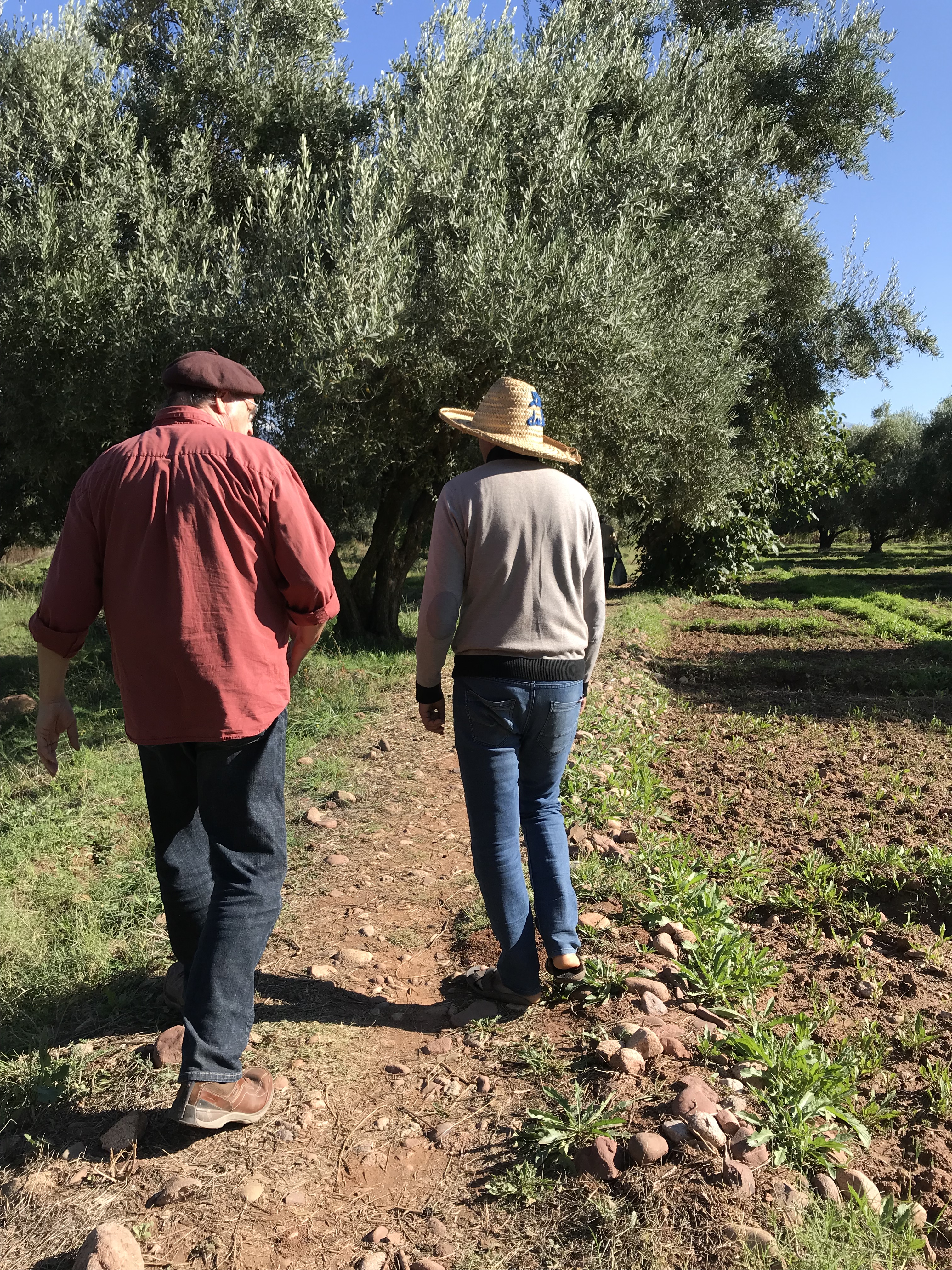
The second part of the tour was a leisurely walk through the farm, where a wide array of other herbs are grown, and trees: olive, walnut, persimmon, pomegranate, date, apple, and argan for oil, all arranged around small square plots in which the crocus bulbs were planted. The day’s harvest was already picked, but a few flowers were left for the tourists.
Crocus sativa
Dates
Olives
Tom and our guide
Roses in November
There were also goats and donkeys.
Tomorrow we’ll visit another local farm, one that calls itself the bio-aromatique, organic-aromatic, farm. After today’s surprise, I can’t wait.
The evening Tom and I returned from Le Havre with our rented van full of the boxes we’d shipped from Los Angeles, our neighbors Ann and Leif greeted us in front of our house with sad news. Andreas, the other newcomer to our neighborhood, a Swiss artist who’d also moved to Cordes from California, had died suddenly.
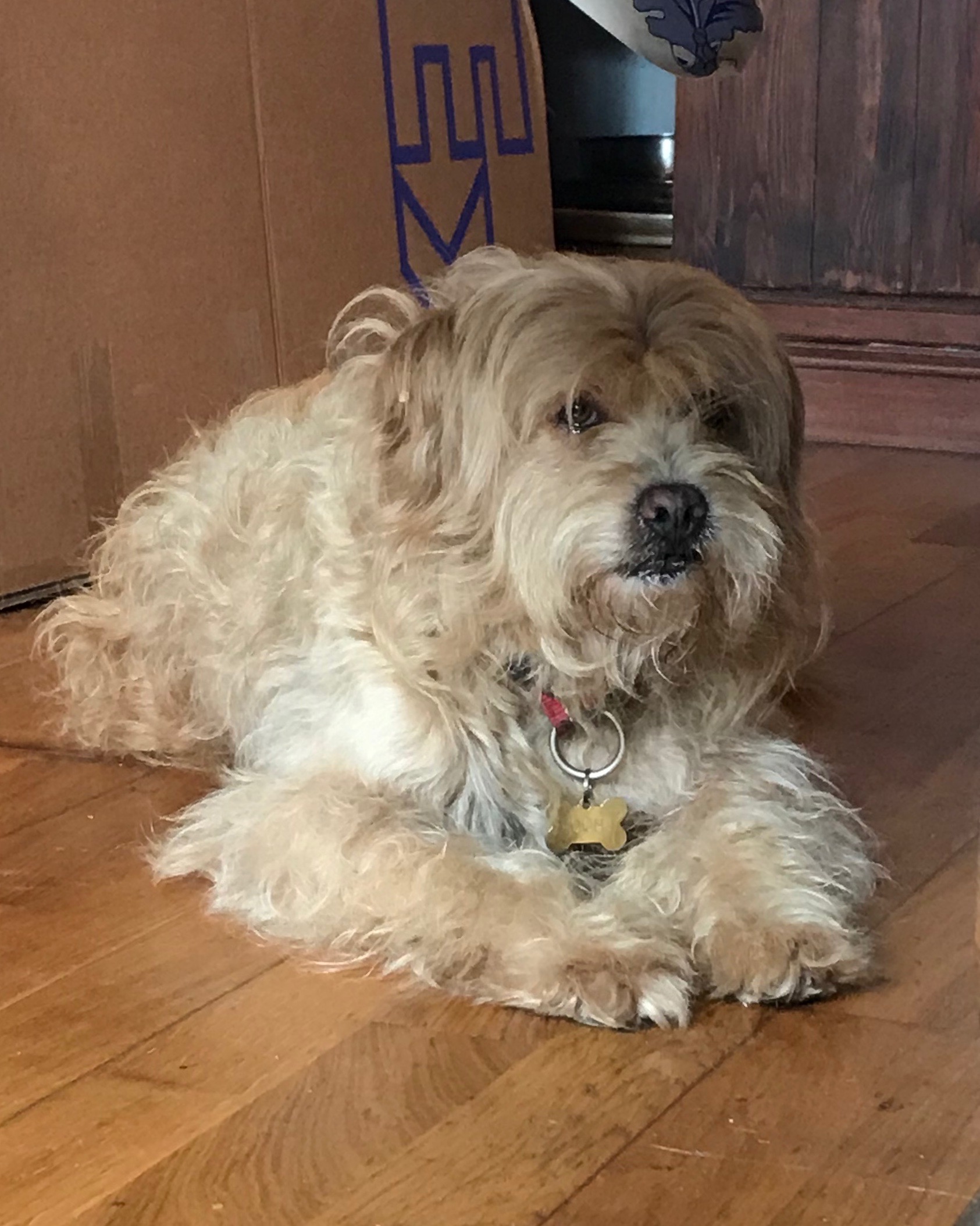
His dog Mocha was staying with another neighbor, Dominique, who couldn’t keep her until Andreas’s relatives came, which could be several weeks. Not only did Pompom the cat object, but Mocha’s barking was bothering Dominique’s guests.
When we saw that the address on Mocha’s address was Bancroft Way, Berkeley, CA, the solution was obvious. Mocha would come to stay with us until Andreas’s family decided where she would go.
The next day, after we returned the van to Albi where we’d rented it, we picked Mocha up at Dominique’s house. Mocha was not happy. She didn’t want to stay with us. It was clear that she loved Andreas very much and was grieving deeply.
So, when Tom opened the door take some empty boxes to the recycling, she was out like a flash.
Naturally, she headed back straight to Andreas’s place. Tom and I managed to corner her briefly, but when a car went by and we had to alter our very strategically chosen positions, she took off again, this time down the street toward the bistro where Andreas, like most Cordais, liked to sit.
We had pictures on my phone, and people knew Mocha, but no one had seen her. She was spotted near Andreas’s place several times. We left a note with Tom’s French phone number on his door; people called, but no one could catch her. Pretty soon half the village was involved.
At 10:30 that night we heard voices in front of our house and looked out the window to see Leif, who told us that Dominique found Mocha sleeping on Andreas’s step, scooped her up, and now had her in her car. She’d be right over.
So Mocha came home. She had chopped sausage and a little duck for dinner. And she went to sleep on our bed.
Day by day she is becoming more accustomed to her new home. She no longer pulls on the leash when we go near Andreas’s house. She enjoys hanging out at the bistro, where she’s very popular.
And she loves being groomed! (Not so much the bath.)
But a long walk, table food, and sleeping on a good bed suits her very well!
Now we’ve heard from the family that we can keep her!
Thank you, Andreas, for this wonderful new family member.
From Tuesday to Friday each week, I watch a little girl called Éva, who is 17 months old. She is a delightful child, full of life, curiosity, and good humor.
This week Éva wasn’t feeling well, so we watched one of Mr. Rogers’ operas, “Windstorm in Bubbleland,” over and over. Éva is born to opera: her father is the director of OperaSLO, and her mother is a great lover of opera.
I enjoyed Windstorm so much that I played it for Tom and later for a friend.
In the opera, Hildegarde Hummingbird, played by Lady Elaine, warns the people of Bubbleland that a great windstorm is coming, but no one will listen to her.
“Why won’t you believe me?” she asks, and the people of Bubbleland sing back,
“Because we don’t want to!”
The summary of Windstorm in Bubbleland on IMDB ends:
The wind attempts to utterly demolish Bubbleland. The fate of the world rests in the wings of an unsung feathered heroine.
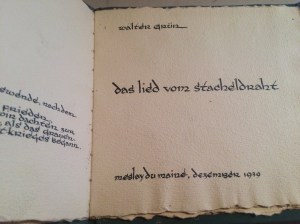
This morning, the morning following the Paris attacks, the dawn of the apocalypse, I came across an old, handmade book hidden among some papers I was sorting for our coming move. It is a poem by Walter Gruen, written in December, 1939, while he was interned in Meslay du Maine, France, along with the artist who created the little book, Hugo Price, my father, and many other Austrian and German Socialists, intellectuals and artists.
The Song of Barbed Wire
Black and full of clouds
hardly any stars shine in the sky…
Will the night ever go away and the sky begin to lighten?
Barbed wire
separates us from love.
Longing consumes us.
When will freedom blossom?
Freedom, ah, you are so ardently awaited!
Every suffering
has its end.
The sun rises again…
March storms rage,
Longing becomes fulfilled!
Barbed wire
in all the lands
freedom is denied …
March storms will thunder
Freedom will return.
Moments after I shared the book with Tom, we discovered a hummingbird trapped in each of the three skylights in our bedroom. Three hummingbirds! Three rufous hummingbirds, the California version of Hildegarde, banging their heads against the glass.
We tried to free them, but it was time to go to the farmers’ market. After making sure the cats were elsewhere, we left the three hummingbirds to exhaust themselves until they fell, and hopefully to fly away when they recovered.
As I got into the car with my bags for the market, I moved a piece of paper from my seat. It was a flyer for a friend’s radio show:
Four hummingbirds!
A couple hours later, two of the three in the skylights were gone. The last one, like Hildegarde at the end of the opera, lay silent on the floor. As I picked the tiny body up, it woke, shook itself, and flew off. Like Hildegarde.
Traditionally a harbinger of the joy of life and of synchronicity, hummingbirds also symbolize courage, adaptability, determination and flexibility.
Four hummingbirds show up just when I’m feeling the end of the world is surely at hand. There must be a message here, don’t you think?