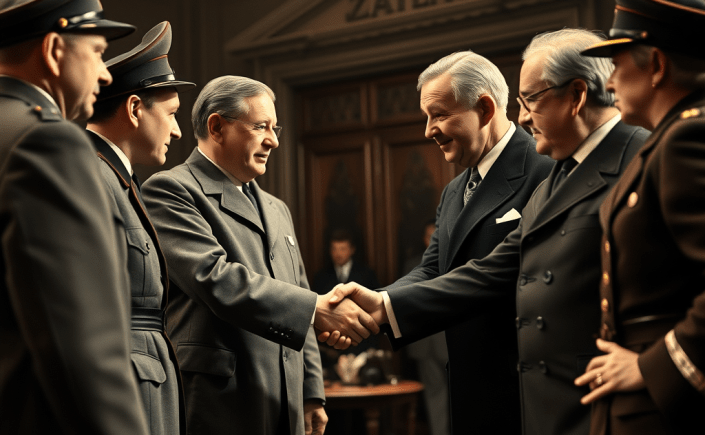
Rosh Hashanah, Vienna, 1935

This seems like the right day to share the Rosh Hashanah section of Underground, the second volume of Two Suitcases, which is currently being considered by agents.

May the new year bring you many moments of joy and small delights. May we all find the courage to stand up for our neighbors, the strength to resist instead of bending to dark forces, and the flexibility to let go and move on when it’s necessary.

And, even in the dark times, let there be singing. (paraphrase of Bertolt Brecht)

Shana Tova.

UNDERGROUND

Chapter 26

THE NUREMBERG LAWS

September 16, 1935

10 am

Basel

Emil picks up a copy of the Der Bund at a kiosk before boarding the morning train to Vienna. If all goes well, he’ll arrive in time for the festive meal his mother will have ready at sunset to celebrate Rosh Hashanah, the Jewish New Year.

Seated by a window, he reads the headlines about some laws that were announced the day before at the Nazi Party rally in Nuremberg.

ANTI-JEWISH LAWS PASSED IN GERMANY

Non-Aryans deprived of Citizenship and Right to Marry

Hitler warns that Provocative Acts will draw Reprisals

Two laws have been enacted, the Law for the Protection of German Blood and German Honor, and the Reich Citizenship Law. 

The first of them bans marriage between Jews and non-Jewish Germans, criminalizes sexual relations between them, and prohibits Jews from employing German women under the age of 45 as maids.

The second defines who the first law applies to. Only individuals of “German or kindred blood” can now be citizens of Germany. Jews are relegated to the status of “subjects of the state.” The new law defines a Jew as anyone with three or more Jewish-born grandparents, including converts to Christianity and children and grandchildren of such converts.

Emil expected the news to be bad but he’s still shocked to see the prohibitions in black and white. Between his regular features, his red hair, and his apparent disinterest in religion and politics, Emil is rarely identified as a Jew, and, to be honest, he rarely identifies himself as one. The Swiss people with whom he works assume he’s a Catholic Austrian, and he hasn’t disabused them. But this news from Germany shakes him to the core. He wouldn’t be safe in Germany, and if Germany takes over Austria, of which there is talk, his family will not be safe in Austria.

What a blow to Jews, particularly on the eve of the most holy days of the year, he thinks. Rosh Hashanah begins that night and will be celebrated for two days. A week later comes the day of atonement, Yom Kippur, when Jews fast, the most sacred ritual of the year. He puts the newspaper down and closes his eyes. It’s good that he’s on his way home—he wants to be with his family.

In the seat behind Emil, two businessmen, one Swiss and one Austrian, are talking.

“They’ve changed the flag in Germany, did you see that?” says the Swiss. 

“No, to the Swastika?”

“Yes, on a red background. It doesn’t surprise me. Hitler says his Reich will last a thousand years, so naturally he would put his own flag in place.”

The Austrian is nonplussed. “I read that they’ve formally downgraded the Jews to non-citizens. Not a bad idea, if you ask me. They’re not so much of a problem in Switzerland, but in Germany—and in my own country—the Jews have had far too much power for too long.”

“In what way?”

“In the universities, for a start, and in banking, of course, but it’s far more than that. For years, the Jews in Vienna have controlled the discourse. They’ve set the tone for what people think! They decide what’s good and what’s bad. That’s the real reason the Germans are smart to do what they’re doing.”

The Swiss man isn’t convinced. “I don’t buy it. Why would a strong, intelligent people like the Austrians let that happen?”

“I’m sure if they knew it was happening they wouldn’t have agreed to it. But the Jews are sneaky, and they have international connections that quietly help get them into positions of power.”

“I’ve heard those arguments before, but I don’t understand why it should be true in Germany and Austria, but not in Switzerland.”

The Austrian man’s lip curls. “It is, my friend. You and your countrymen choose not to see it.”

Emil shudders. 

* * *

Leopoldstadt

A few hours later

Emil puts his suitcase down on front of his parents’ door, and takes in the enticing smell of his mother’s cholent filling the hallway. The savory bean stew with bits of meat and potatoes has always been his favorite. This is the first time he’s been home since April, almost half a year, and the smell of the cholent makes him happy he came. He just hopes he won’t find his parents, Ottilie and Richard, in exactly the same positions in which he left them, his mother chattering nervously in the kitchen, his father slouching in his chair, ignoring her.

In fact, when his father opens the door, Ottilie is busy in the kitchen and the state of the living room indicates that Richard had just risen from his chair when Emil rang the doorbell. But things have changed. The place is much cleaner. The untidy piles of newspapers on the dining room table have been replaced with a tablecloth. 

An hour later, as Ottilie is putting out place settings, the doorbell rings again. 

“Tante Stefi! Nathan!” Emil is pleased to greet his mother’s sister and her son, his cousin Nathan. “I didn’t expect to see you!” 

“We couldn’t stay away from you forever,” Stefi says, patting Emil’s cheek as if he were a small child. “No matter what your father did.” 

“Mutti! You promised not to make remarks like that!” Nathan, nine years younger than Emil, will be entering university this fall if Emil’s calculations are right. The cousins haven’t seen each other since the bank failure five years ago, when Richard’s part in the mismanagement of the Creditanstalt Bank led to its collapse, and took Ottilie’s family fortune—and that of many other Jewish depositors—with it. The scandal had split the family, with Stefi’s husband refusing to speak to Richard since then. Nathan was a child at the time. Now he’s almost a man.

Richard speaks up, a false heartiness making his voice too loud. “Welcome, welcome! L’Shana Tova!” 

New Year’s greetings are shared all around, the guests’ coats hung on the coat tree, and the family makes themselves comfortable around the table. The men put on their yarmulkes and Emil’s father, his tallit, or prayer shawl

Ottilie emerges from the kitchen to light the candles and say the opening blessing, and Richard follows by blessing the wine. The blessing of the Challah, a beautifully braided loaf of bread glistening with egg wash, fresh from the oven, is next.

As everyone takes a piece of the bread and dips it into honey to celebrate the sweetness of life, Emil comments,

“Not such a happy new year for the Jews in Germany.” 

Bread and honey in their mouths, no one says a word.

Next, slices of apples are dipped in the honey, and Emil smiles along with everyone else as the blessing is chanted and wishes for a sweet new year are exchanged. Carp in sulz, fish in cold jellied broth, is the next course. 

Between the prayers and the sharing of ritual foods, the family catches up on the news. Nathan will not be attending university although he has been preparing for it for years. Instead, he will be a clerk in the bookshop owned by one of his father’s cousins. No one asks why his father isn’t there—they all know he blames Richard for the whole family’s financial difficulties. 

Then the real meal begins. Ottilie brings everyone some homemade chicken broth with two matzo balls in each bowl.

Stefi is surprised. “Matzo balls! But it’s Rosh Hashanah, not Pesach!”

“It isn’t so often I have my whole family here,” Ottilie says. “I made all of Emil’s favorites. I want to lure him back to Vienna!”

Emil smiles at her.  “So far, so good.”  

Three more times through the long meal he tries to talk about the Nuremberg Laws, and three more times he’s shut down by one or more of his relatives.

Chapter 27

MAKING AMENDS

September 17, 1935

late morning

Café Josef Weiss and Café Central

After the morning service at the synagogue, Leo and Felix walk over to their regular café, where they find Anna, Max, and Hugo standing beside the locked door. 

“I guess they don’t work on the Jewish holidays either,” Anna says. “But why don’t we go somewhere else? I’m sure the cafés in the Inner City are all open.”

So it is that most of the group is at Café Central when Emil walks in. Warm greetings are exchanged and Emil joins them at their table.

“So,” Felix says, “who went to synagogue this morning?” 

“I did,” says Emil. “The singing was outstanding. There’s a new cantor at my family’s temple.”

Leo looks around the circle, his head cocked. “Nobody else? Yet none of us went to work.” He raises his bushy eyebrows. “Felix and I went with the family. I enjoyed the music too—the fellow who blew the shofar did a particularly impressive job—but it was the rabbi’s talk that will stay with me.”

“And so?” asks Hugo. 

“He brought up a tradition that I had either forgotten or isn’t often followed. In the eight days between Rosh Hashanah and Yom Kippur, it is our responsibility to make amends.”

Anna interrupts. “We all know that. It’s nothing new.”

“But this rabbi suggested that we take the project much more seriously, that we go and  knock on the doors of the people we may have wronged, and apologize face to face,” Leo says.

His brother adds, “I think it’s a good idea. I’m planning to do it. Is anyone else up for the challenge?” He lights a cigarette and looks at each of the others questioningly.

“It’s not for me,” Max says. “I wouldn’t want to take the chance that my apology wouldn’t be accepted. I could have a big argument on my hands.”

Anna thinks for a moment and then says, “I think it’s a very good idea. It’s excellent psychology.  Everyone feels better after Yom Kippur because you get rid of whatever guilt you were feeling. Confession in Catholic Church does the same thing. Taking the trouble to face the people you may have hurt or caused problems for makes a big difference to everyone involved. I’m in, even though I almost never take religious customs seriously.”

“Really?” says Max, incredulous. “You are my sister Anna, aren’t you? And not her long-lost twin?” 

Anna scoffs.  

Max turns to the others. “Have any of you ever heard my sister apologize to anybody about anything?”

A ripple of laughter spreads around the table. Emil raises one finger. “I have.” He looks at Anna. “We were walking in the Heiligenstädter Park, arguing.” He crooks an eyebrow at Anna as if to say, do you remember? “I was defending Karl Lueger, the Christian Socialist mayor who built so much of Vienna’s infrastructure, and you were rightly calling him a populist and an anti-Semite. I said it didn’t matter, the city was better because of what he did, no matter what his politics were. The argument ended when you apologized, as I recall, and admitted I was right.”

“That is certainly not how I remember it!” cries Anna, dark eyes flashing. “As I recall, we came to the end of the park and I said, ‘Let’s not argue anymore—let’s talk about something else.’”

Emil looks down his nose. “I don’t think so. But let me be the one to say ‘let’s not argue’ this time. And let me apologize for remembering the incident differently.”

“No,” says Hugo thoughtfully, “I don’t think that’s the kind of apology the rabbi meant. As my mother used to say, apology is cheap currency. It’s easy to apologize without meaning it because it doesn’t cost anything.” 

Emil is surprised. “But I’m genuinely sorry, Hugo. It doesn’t count if you haven’t stewed on the offense first?”

Felix answers. “Emil is right, Hugo. Both kinds of apologies are effective so long as they’re sincere.”

Anna doesn’t give anyone else the chance to respond. “But apologies can also be used to get one’s way! Willi is a master of it!” She grimaces, thinking of the little boy she’s caring for. “He does something truly terrible, like hitting another boy,” she throws up her hands in frustration, “and then he apologizes to the other child—and to us, and his teachers, and to the injured child’s parents—and it all sounds perfectly sincere! He looks like he really means it.”

“He’s learned how to put on exactly the right face,” agrees Hugo. “In fact, he can be so believable that I’m taken in every time. I think he’s making sincere promises, from the bottom of his tough little heart, and I give him another chance.” He snorts, blowing cigarette smoke out of the corner of his mouth.

Anna continues, “But afterwards he can never manage to keep up the good behavior, no matter what his intention is. He always slides back. Poor Willi.” She sighs. “He’s only 10.”  

Of the five men at the table, only Hugo looks at Anna sympathetically. 

Emil is admiring the line of her chin and her high cheekbones. He finds her especially attractive when she’s passionate. 

Max is fuming silently. In his book, Anna is sharing one more reason why Willi needs to move on.

“So, is Anna the only one taking up the challenge, then? Is it just the two of us? Leo?” asks Felix after a pause. 

In the end, Max is the only one who doesn’t agree to make amends that week. 

As they get up to leave, Emil and Anna make a date to meet again in two days.

* * *

September 19, 1935

late morning

Café Landtmann, Vienna

Anna arrives at the café 10 minutes early and immediately orders a coffee. She prefers to pay her own way, even though she knows Emil can well afford to pay for them both. The fact that she has barely begun a new job as an office clerk after more than a year of not working doesn’t change how she feels.

As she inhales the scent and sips the coffee very slowly, she notices an older, neatly bearded man talking to a younger man at the next table. Can it be Professor Doctor Freud? It isn’t the first time Anna has seen him—she heard him lecture at the university several times—but that was always from a distance. She listens carefully. If she isn’t mistaken, he and the younger man are talking about cigars. 

Doctor Freud lights one and breathes in the smoke contentedly. The younger man speaks. 

“Of course you are aware of the recently enacted Nuremberg Laws in Germany, Herr Professor?” 

“I am, and I find it most concerning.” The older man moves his jaw in a peculiar way as he speaks.

“Professor, you are Jewish. If Germany were to annex Austria, as Hitler desires, would you go to Palestine, as so many Jews have? I know you stated a few years ago that you didn’t support establishing a Jewish state in Palestine.”

“That’s correct, and I stand by my words. I don’t think that Palestine could ever become a Jewish state, or that the Christian and Islamic worlds would ever be prepared to have their holy places under Jewish care. It would seem more sensible to me to establish a Jewish homeland on less historically-burdened land.”

At that moment, Emil slides into in the chair opposite Anna. She’s was so engaged in Freud’s conversation that she didn’t even notice him entering the café.

“Anna,” he says without greeting her formally, “I want to apologize more fully.” He leans forward, puts his elbows on the table, and looks at her intently, a crooked smile on his face.

She pulls herself away from Freud’s words, and turns to Emil, tipping her head toward the psychologist and discreetly pointing with her finger.

Emil glances at Freud and mouths “Freud?”  

She nods “Yes!”

But the moment is gone. The professor and the young man are standing and then moving toward the door.

Emil and Anna sit and talk at the café all morning. He begs her pardon for having acted superior and not always listening to her. She begs his for having gotten angry too quickly and for her own variety of acting superior. 

He tells her about some of his eccentric coworkers at Sandoz. She tells him about her boring office job. 

“I spend my days sitting in a row with a dozen other women, all of us copying information from hand-written bills of sale into enormous ledgers, and then adding up column after column of numbers,” she says. “You can’t imagine how frustrating it is when the sums don’t come out right. I’m very tempted to leave them wrong.” 

Emil raises both eyebrows. Anna continues, “I dislike the old crone in charge of us enough to be glad to get her in trouble, even though in the end, it would be me who’d get fired.”  She pulls a piece of paper out of her bag. “Look. This is my boss.” She holds out a caricature of an angry older woman with exaggerated hawk-like features. “One of the other women drew it and gave it to me.” They both chuckle.

“It’s good!” he says. “I can imagine her perfectly.”

They go on to tell old stories, and they laugh until the man who has taken Freud’s table turns around and glares at them.

* * *

Felix and Leo begin the day by apologizing to their mother for all their boyhood antics. The family spends hours reminiscing, hooting with laughter, as one old story leads to another.

* * *

Hugo is shifting from foot to foot impatiently in front of Gert’s door when she returns from work.

“Gert, listen. There’s something I need to tell you. I realized that I take you for granted far too often. I am so sorry.” His words flood out.

Gert smiles a little as she inserts her key in the lock. “My goodness, what brings this on? Come in, come in.”

They sit at her table, and he tells her about the rabbi, and about the agreement between their Jewish friends to take making amends seriously. As he speaks, he realizes there’s more he wants to say. He takes a deep breath.

“I have another apology, too. Our relationship is years old now,” he says. “I should have asked you to marry me a long time ago.” Another breath. He looks down and then up, into her eyes. “Gert, will you marry me?”

Gert grins from ear to ear. “Hugo! Of course! I forgive you everything and yes, I will marry you!”

* * *

Max unpacks two radios and assembles three lamps that morning.

* * *

Later in the week,  Emil and Gisi meet for a walk in the Stadtpark. Though they’ve agreed that nothing would change, it has. There’s a new distance between them, a slight hesitation before they begin to speak, more silences between their words.

He tells her about the apologies he made to some of his school friends, one who had completely forgotten the incident Emil was apologizing for, the other who remembered it very well and was surprisingly grateful to Emil for stopping by. 

“And Max? “ asks Gisi. “Was he there when you all agreed to carry out this project to make amends? Because I haven’t seen him all week.”

My first professional review!

Today, while searching for something else, I came upon a review of Red Vienna that I didn’t know existed.

Here it is:

I feel … understood.

It makes me want to cry, because really, what more do any of us want?

Read the review, read the book—get it from bookshop.org or through your local bookseller.

The second volume of Two Suitcases, Underground, is moving closer to publication. I’m currently looking for people who’d like to read the manuscript and write me a blurb for the back cover or the inside front pages. If you’re interested, write to me and I’ll send you the first 20 pages. Then if you decide you want to continue, I’ll send you more.

Now I think I’ll reread that review and feel appreciated. What a feeling. I am so very grateful.

Another frightening parallel: The July Pact

A crazy thing happened a couple weeks ago. I’d finished the first draft of Underground, the second volume of Two Suitcases, and was reading through it to check the chapter headings and dates. Imagine my surprise when I discovered that, by the stroke of a key, I’d skipped writing a whole year of history and my story.

Sure enough, I’d typed July 9, 1935 at the beginning of one chapter—and July 11, 1936 on the next. So, back to making a timeline of the history, back to my sources already on the bookshelves upstairs, back to the endlessly generous internet.

At first, I had a hard time moving forward on the missing piece. The parallels between events in Austria in the thirties and the news from America were particularly powerful as I was completing the draft, and I was in a race to finish it on inauguration day. And I did! Except for July 1935 to July 1936.

Now, I’m almost finished the missing year. It was an interesting challenge to weave the characters’ stories into the history so that they would flow nicely into the already-written part, July ’36 to March ’38. But I’m almost there. I was writing about the reception of the Nuremberg Race Laws as Musk and his team trashed USAID.

And now I’m writing about the July Pact, or or Juliabkommen, a handshake deal between Austria and Germany that took place in July, 1936. Today, while looking into it more closely, I found a blog by Elizabeth Sunflower, who also wrote a novel set in Austria in 1937. About a year ago, she posted a blog about the July Pact. It’s succinct and timely.

Here’s the link

https://elizabeth-sunflower.com/austrias-unfortunate-fate-the-july-pact-and-its-role-in-wwii/.

But wait! There’s more.

A new, virtually typo-free version of Red Vienna is now available. You can get it at https://bookshop.org/p/books/red-vienna-eve-neuhaus/21038712?ean=9781636830582&next=t&next=t or through your local independent bookstore.

(I noticed when I copied that link to bookstore.org that they are offering it at 20% off.)

The Day Before Everything Changes: Reflections on Friendship and Exile

I’m sure there are many reasons not to post the penultimate chapter of a work in progress before publication, but sometimes it feels to me as if the piece itself is begging me to get it out there now, on its own.

The chapter, “In the Company of Friends,” takes place on the day Austria gives up its independence and becomes part of Germany in March 1938, the day before Hitler marches triumphantly into Vienna, warmly welcomed by most Austrians.

I am posting it the day before Trump’s second inauguration.

The process and timing of writing Two Suitcases has always been more or less outside of my own volition. The parallels to events in the US aren’t something I look for and work at adding to my story. It’s the other way around. The story refuses to tell itself through me until the unfolding events push it to be told.

Those of you who’ve read Red Vienna or followed my blogs will be familiar with the characters and setting—I hope the chapter is meaningful even if you haven’t. Take the trouble to read it to the end, even if meeting the eight characters all at once is confusing. Don’t let the names of the Viennese foods trip you up either. They’re all described earlier in the story.

In brief, the young people in the group who come together in the chapter are all Social Democratic activists. For the four years covered in the second volume of Two Suitcases, they’ve been working underground to keep their vision of a kinder, more thoughtful, more equitable world alive. As Austria capitulates, most of them plan to go into exile.

Chapter 52

In the company of friends

Friday, March 11, 1938

early evening

Vienna

Gisi can hear the sound of Austrian State Radio everywhere as she hurries over to Max’s workshop, a covered bowl in a basket on her arm. There’d just been a radio announcement that the Plebiscite on Austrian independence had been canceled. Chancellor Schuschnigg would be making a major address to the country any minute, and Gisi wants to be with Max to hear it.

She’s not alone. Within the hour, nudged by a phone call or a knock on the door, everyone else in the group decides that they too would like to listen to the Chancellor’s speech in the company of friends. 

At his shop, Max and Leo move a big table close to the best radio, and the others bring eight odd chairs and stools to put around it. Near the table’s center is Gisi’s bowl of Kaiserschmarrn, its sweet fragrance surrounding it, a jar of applesauce beside it. 

Toni is warming some rind souppe on the coal stove. Its beefy aroma soon fills the little workshop and drifts into the store. On the workbench is a collection of bowls, cups, and spoons that Max brought down from his apartment, along with his last three cans of pickled herring.

Gert slices the loaf of black bread she brought and is putting it on the table when Hugo enters the shop with a smile and a swagger. 

“Look!” he cries when all eyes are on him. He pulls a bottle from his bag. “Slivovitz! A full bottle of everybody’s favorite plum brandy! What is there to save it for?” Eight glasses and cups are quickly found and filled.

Leo contributes a block of Bergkäse cheese. Felix, looking apologetic, sets out a bit of butter, an almost empty jar of honey, and half a jar of Powidl.

“What do you expect?” he asks. “I’ve been imagining leaving my home every day for weeks. Why would I have any food there?”

The crowning glory of the table is an Obstkuchen, a buttery cake that Anna baked and decorated with dried apricots and cherries as the rays of a canned peach sun. 

Felix is the last of them putting soup in his bowl when Max calls out, “Listen! Schuschnigg is about to speak!” as he turns up the volume of the radio. The music, a symphony by Beethoven, stops abruptly and the dignified voice of the Chancellor comes through.

“Women and men of Austria,

This day has placed us in a tragic and decisive situation. I have to give my Austrian fellow countrymen the details of the events of today.

The German Government today handed to President Miklas an ultimatum, with a time limit, ordering him to nominate as chancellor a person designated by the German Government, and to appoint members of a cabinet on the orders of the German Government. Otherwise German troops would invade Austria.

I declare before the world that the reports launched in Germany concerning disorders by the workers, the shedding of streams of blood, and the creation of a situation beyond the control of the Austrian Government are lies from A to Z. President Miklas has asked me to tell the people of Austria that we have yielded to force since we are not prepared, even in this terrible situation, to shed blood. We have decided to order the troops to offer no resistance.

I say goodbye with the heartfelt wish that God will protect Austria. God save Austria!”

The symphony resumes. No one says anything—they’re all in shock, though surely the announcement was inevitable. 

Max rocks back and forth on his chair. 

Gisi feels her tears rising. 

Anna’s anger shows in her eyebrows and trembling lips.

Hugo begins to speak a couple of times but stops. 

Beethoven’s music fills the shop.

Finally, Hugo raises his glass. “May God, or fortune, or whatever you believe in, protect us!” They each take a sip of the brandy.

Max looks at the table. “Let’s not waste this beautiful meal. Eat!”

“Wait,” cries Gert, “I have another toast.” She raises her glass again. “To friendship!”

Anna adds “And peace!” and they drink again.

Max glances at his empty glass. “Hugo, another round?” and Hugo pours out the last of the brandy.

Leo starts the toasts again. “To solidarity!”

“And to a kinder, more thoughtful, more equitable world!” adds Toni, and the last of the brandy is gone.

With bittersweet slowness, one by one, they pick up their spoons and begin to eat the rich, warm soup. 

After savoring her second spoonful, Gisi speaks. “This is so good, Toni. But why did you make it today? Rinde soupe, especially with so much meat in it,is Sunday fare at our house.”

Toni smiles ruefully. “I made it for Leo. Before the Chancellor announced his resignation, I was planning to take it over to his place. I thought, I thought…” she stops and looks at Leo, who has already finished his soup and is wondering if there is more. Now he looks at her, his companion for so many years, and his eyes fill with sadness. She continues, “I thought it might be our last meal together—for a while, I mean—or our last meal in Vienna. Oh, I don’t know what I mean.”

Anna looks around the table. “It’s true, isn’t it? This will probably be our last meal together for most of us.”

“You aren’t the only one to feel that way,” Hugo says. “It’s why we all came.” He picks up a plate and fills it with cheese, bread, and several pieces of pickled herring. The others follow, until nothing is left at the center of the table but the sweets.

Suddenly, flickering light pours through the small window at the front of the shop and the boom of chanting voices shakes the room. Max runs to look out. 

“It’s our neighbors,” he says, returning to the table. “Marching with torches and chanting Heil Hitler.”

Oh, God,” Anna replies. “Why is it always so hard to believe the worst until it’s staring you in the face?”

“Listen,” says Gisi. “I have an idea. After we’re done eating…”

“If anyone can still eat,” Anna responds.

Gisi looks at her. “Try,” she says. “When our stomachs are full of this delicious food, I want us to do an exercise I did in one of my psych classes. Max, do you have some paper and pencils here?”

Max, his mouth full of bread spread with butter and Powidl, nods yes and points to the workshop.

“Anna, since you’re not going to eat, why don’t you help me out by finding the paper and cutting or tearing it into pieces about as big as…” she pauses to think, “as big as an Ausweis.” 

“I’m eating,” Anna says, picking up a hefty piece of herring, putting it in her mouth, and chewing it slowly. “But I’ll do it later.”

The light and sound of the marchers fades into the distance.

“I suppose Miklas is in charge now that Schuschnigg has resigned,” Hugo muses. “Though Hitler probably has a successor in mind for the Chancellor’s position. Or maybe he’ll be Chancellor himself.”

Gert puts down her fork with a clatter. “Let’s not talk about it, Hugo. Let’s not talk politics for once.”

Hugo looks surprised and a little hurt. “Okay, what should we talk about then?”

Gisi is ready. “Let’s talk about the exercise I want to do.” She smiles as brightly as she can manage. “My professor gave us the assignment to make a list, in order of importance to each of us personally, of the five things we think matter the most.”

“In what sense?” asks Gert. “Do you mean things like money and housing? Or actions like pleasing your parents or doing work that makes you happy?”

“Yes, all of that, as well as qualities like patience and perseverance and generosity.”

“Okay, I’m ready to get the pieces of paper,” Anna gets up. “How many will we need?”

Gisi wrinkles her nose. “I think four per person will do. Max, can you find us all pencils or pens? Shall we do my exercise before cutting into Anna’s beautiful cake or after we eat it?” 

“After,” says Felix, starting to clear the table. No one objects.

“Max, is there water down here? I’ll wash these plates and we can use them for the cake,” Leo offers. 

A few minutes later the group settles down to make their lists, some at the big table, others scattered throughout the store, Max at his table in the workshop. Silence settles over them like snow. 

Gert is the first to finish. “What shall we do with our lists when they’re done?”

“Put them on the table where everyone can see them,” Gisi answers. “There’s a second part of the exercise coming.”

When all the lists are finished and everyone has read theirs aloud, she says, “Now, on your second piece of paper, write down an action anyone can take to create a world in which the ideas or things you most value can be realized in their largest sense. For example, to promote the value of ‘Peace on earth,’ you could write ‘try to always be kind’ for the second round.” 

“I get it,” Toni says. “I wrote down ‘my friends’ as a personal value, and I can think of dozens of ways to would promote friendship generally, like ‘appreciate everybody’s uniqueness’ or ‘think of others before yourself.’”

“That’s it. Try to make the action as universally useful as possible.” 

An hour later, and after another round of the exercise, Felix is picking up the plates again. Every crumb of the cake is gone. Hugo is copying out the same list eight times onto eight pieces of paper. Each of the friends signs their name eight times. 

Before they hug and say long goodbyes, they each have a copy of the actions tucked away in a safe place.

Take care of the old and the young, and those who have less than you  –  Gisi

Keep your sense of humor  –  Max

Be ready to let go. Remember what really matters  –  Anna

Hold your head high  –  Leo

Believe in magic  –  Gert

Breathe  –  Felix

Choose kindness  –  Toni 

Hold onto your vision of a better world – Hugo

The Rise of Austria’s First Dictatorship: Key Insights

In the process of writing the second volume of Two Suitcases I continually return to historical sources to check that I’m getting the story right. As I reviewed and revised a chapter in which the Revolutionary Socialist Party of Austria is introduced, I came across an article I hadn’t read before, “Thinking
 Cosmopolitan
 or 
How
 Joseph
 became
 Joe 
Buttinger” by Philipp Luis Strobl. What a find!

Joseph Buttinger will be making at least a cameo appearance in my new novel, but I think his story should be shared now because of its relevance to the current political situation in the US. I’ve cut and pasted the opening below. The entire article, even in its slightly flawed English translation, is worth reading. Read it here: http://www.science.usd.cas.cz/Presentations/Strobl.pdf

On
 May
 27,
 1932,
 the
 Austrian
 parliament
 approved
 a
 new
 government
 that
 would change
 the 
democratic 
course 
the 
country 
had
 pursued 
since the 
end 
of 
the 
First 
World War.
 The
 new
 chancellor
 Engelbert
 Dollfuß
 now
 was
 in
 charge
 of
 the
 country’s leadership.
 On
 October
 1,
 he
 used
 a
 so‐called
 “emergency
 degree”,
 a
 wartime
 relict,
 to rule
 the 
country 
without 
the 
approbation 
of 
the 
Austrian
 parliament. 
That
 was 
the
 hour of
 birth
 of
 Austria’s
 first
 dictatorship.
 The
 consequences
 for
 the
 people
 were
 fatal. Unliebsame
 Personen
 as
 “unpleasing”
 persons
 were
 called
 at
 that
 time
 had
 more
 and more
 problems
 living
 a
 normal
 life.
 Particularly
 intellectuals
 who
 were
 engaged
 in
 the ideas
 of
 psychoanalysis,
 neopositivism,
 or
 austromarxism
 (socialism)
 had
 to
 fear reprisals 
from
 the
 government. Life 
became
 very 
hard
 for 
the
 government’s
 opponents, but
 for
 most
 of
 these
 persons,
 the
 situation
 turned
 from
 bad
 to
 worse
 with
 the incorporation
 of
 Austria
 into
 Hitler’s
 German
 Reich
 in
 1938.
 So‐called
 “enemies
 of
 the government”
 were
 forced
 to
 emigrate
 ‐
 and
 many
 of
 them
 did
 so.
 According
 to
 a
 1941 Office
 of
 Strategic
 Service
 memorandum,
 more
 than
 40,000
 Austrians 
had immigrated
 to the
 United 
States 
during
 the
 three
 years
 since
 the
 “Anschluss”
 in
 1938. This
 paper
 is
 about 
one 
of 
those 
who
 emigrated
 as
 a 
result 
of 
ideological
 reasons.

Synchronicity: Tarot Cards, the Witches’ Market, and the Aurora Borealis

Sometimes I have extraordinary dreams—some of them are told in the links below—and sometimes my life is filled with extraordinary synchronicity. A few weeks ago I was graced with a series of delightful synchronicities.

That weekend, Tom was still in Africa so I had plenty of time to work on my book. There were no real meals to think about, minimal shopping to do, just the dog to walk, which is good for me and almost always a pleasure. I was on a roll.

The last three chapters that I’d written were all pretty dark— the excerpt I published here a few weeks ago is part of one of them—so I decided to add in a lighter one. I gathered my characters in Gert’s parents’ sitting room for New Year’s Eve, had Gert put on some popular music with funny lyrics—it was good fun to do that research—and pretty soon everyone was singing and dancing. They couldn’t dance for all the hours before midnight though, so I figured they could play games. More interesting research. No parlor games popped up, but card games were popular. The first card games from that time and place that came up in my search were played with tarot cards. Good idea. Let the characters play the game and afterwards draw a card. Or better, I’d draw a card for each of them.

The characters probably would have used an Industrie und Glück deck, but I used what I had on hand—I’ve accumulated a good number of tarot decks over the years. The first one I found was my well-worn Waite/Rider deck from the 1970’s.

An Industrie und Glück deck:

I divided out the major arcana cards from my deck, drew one for each of the characters, and then wrote them into my story:

Gert puts one of the decks into two piles. “Pull the chairs back into a circle with a table at the center while I sort the cards.” When the chairs are in place she explains, “I’m putting the major cards, the tarocks, in one pile and the minor cards in the other. Then we’ll each draw one of the tarocks, and I’ll explain what they mean. Or at least what I think they mean.”

“Ooh, she’s going to tell our fortunes!” says Toni. “How exciting!”

“Me first!” Gisi calls out. “I want to get it over with.”

“Okay.” Gert shuffles the smaller set of cards and fans them out so Gisi can choose one.

Gisi looks at the backs of the cards carefully. She runs a finger over them. “No,” she says. “I can’t do it. Someone else has to start. Sorry.” She sits back in her chair.

“I’ll do it!” volunteers Max. Gert shuffles the cards again and fans them out for Max. He doesn’t hesitate, immediately drawing a card from the center of the deck and turning it over.

“It’s Der Naar, the Fool. What does it mean?” he asks Toni.

“Well, that’s appropriate,” she laughs. “It’s the wild card in the deck. It symbolizes beginnings, innocence, spontaneity, and a free spirit.”

“Very appropriate!” Hugo agrees. “I’ll go next.” He runs his finger over the cards a few times before drawing Der Herrscher. 

Gert smiles.The Emperor. Another good fit. The Emperor represents authority, the establishment, structure, and a father figure. He’s the ultimate ruler of the world.”

“Good God,” says Hugo. “Is that how you all see me? I always wanted to be an artist. Isn’t there an artist card?” 

“You are an artist,” says Anna, “but the card fits, Hugo. Accept your destiny.” Everyone laughs.

Leo volunteers next. He draws the Magician.

“Ah, my favorite,” says Gert. “Der Magier is the first of the Tarocks. It symbolizes manifestation and means that you can make your wishes come true.”

“Phew! A lucky one for me! What should I wish for?”

“That’s up to you,” Gert replies.

“Then I wish the power of Der Magier for all of us. May all our wishes come true.”

“Leo, generous as always! Thank you, my friend,” says Hugo.

The last rays of sun fill the room.

Everyone is smiling.

“Thanks!” says Anna. “I’ll go next, now that I have the power to make my wishes come true.” She takes only a moment to draw Die Sonne, the Sun.

Gert claps her hands. I think Leo’s card worked. Die Sonne signifies enlightenment, joy, marriage, and happiness.” Anna looks at the card and grins.

“You are an excellent fortune teller, Gert,” says Gisi. “I guess I’ll risk taking a card now.”

Gert reshuffles and fans the deck out on the table. Gisi looks over the back of the cards several times, pauses, and then slowly draws out a card slowly. She studies closely, holding it up to see it better. “I have no idea what this means,” she says, turning it around so everyone can see.

“Oh, it’s der Gehenkte, the Hanged Man,” says Gert. “It’s a complicated card, but it generally points to pausing—voluntarily or involuntarily—in order to assess your situation. It can also mean that it’s time to shift your perspective. Sometimes it means you’ll have to make a sacrifice.”

“Aha!” says Max, rubbing his hands together. “I thought this would go a little deeper eventually. I think it’s an accurate reading of where you are in life, Gisi—of where we all are, no? Very interesting, Gert!”

“It is a good representation. All of our lives are held up right now, aren’t they. None of us knows where we’ll be in a year,” muses Gisi, tracing the form of the hanged man with her finger.

 Hugo says, “I think all the cards have all been pretty good representations of who we are, or of who we could be.”  

“I’ll go next,” Toni volunteers, and Gert lays out the cards again. Toni also takes her time to choose. Eventually she closes her eyes and stabs randomly at a card. 

“The Hermit,” announces Gert. “Huh. Der Eremit isn’t a card I would have associated with you, Toni. The Hermit is a person who gains wisdom by being alone, through introspection. It also means the answer to your question will be found within.”

Toni is surprised too. “Soul-searching certainly isn’t something I’ve done much of so far in my life. All the other cards have seemed so exactly right though. Maybe I should take it up.”

“My turn now,” calls out Felix. “I’m so curious! Every one of these cards has been fascinating to consider.” Gert offers him the deck.

“Temperance. Die Mäßigkeit. Moderation,” she says when she see what he chooses. “Is that you, Felix? Or is the card advising you to be more balanced, more patient?”

“The latter,” says his brother. “Obviously.”

“I beg your pardon, Leo. I am the model of Patience. I ooze Balance from every pore.”  Felix stands on one leg, extending his arms, wobbling a bit, but then holding the pose.

“Very good!” Anna claps and the rest of the group joins in. 

“And now,’ Gert says. “I’ll pick one for myself.” She shuffles the cards three times and then riffles them. At last she chooses a card. 

It’s Der Tod, the Death Card. 

Everyone in the circle looks stricken. 

“Wait, wait,” Gert cries. “It doesn’t mean death literally! None of the cards are meant to be understood literally. It symbolizes transformation or change, or an ending.”

Anna sighs audibly.  “Of course, none of them is literal. Still, it’s shocking to draw it.”

Gert is shaken, but she hides it. “How about if we transition to Jause now? My parents will be home any minute. Come help me in the kitchen, ladies.”

When I had written that far, I took a break and walked the dog up the hill. It was surprisingly crowded in the village Saturday afternoon. Then I remembered that it was the day of the Witches’ Market!

There must have been half a dozen readers or sellers of Tarot readers there.

The second synchronicity occurred a week or so later. My chapter was dated January 25, 1938, so I followed my usual process of looking up what happened in Vienna at the time. It was a tense time then, six weeks before the Anschluss, when Austria merges into Germany.

In late January that year, the Northern Lights were visible in Vienna for the first time since 1805, just days before Napoleon marched into Vienna. Many Viennese saw their appearance in 1938 as an omen. Others were more hopeful—they thought it marked the birth of a princess in Holland.

I wrote the Aurora Borealis into my story by weaving together bits of whatever eyewitness reports I could find. The pictures were all in black and white, but the words were evocative. I went to bed imagining it.

In the morning, I saw that my social media was filled with pictures of the current Aurora Borealis.

January 1938, Vienna

To the credit of all the people who say “Can’t wait for the next volume!” on their reviews of Red Vienna, I’ve been working hard at it. Underground ends at the Anschluss, when most of Austria joyfully welcomes Hitler as their leader. which takes place from March 11th to 13th, 1938.

Here’s a taste of what I wrote today. As it seems so often, the news I read in the morning seems eerily parallel to what’s happening in my story.

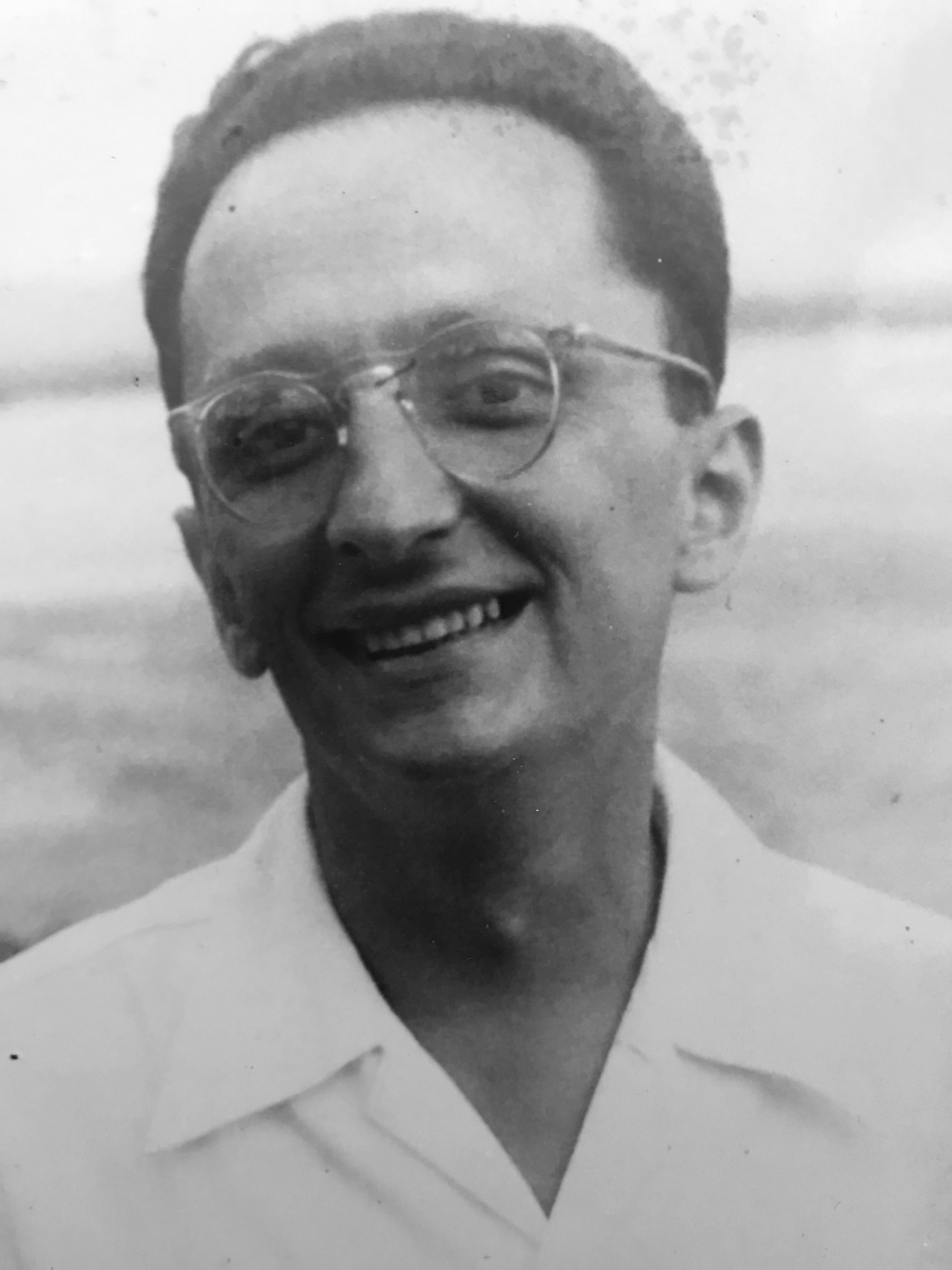
Here’s a photo of the man on whom I based the character, Hugo.

And here is my father, on whom Max is based.

January 27, 1938

Max’s workshop

Vienna

Max has the radio on whenever he can, day and night. He follows the news from as many sources as possible, hearing stories few others hear, and hearing the ones that everybody knows reported from widely varying perspectives. His shop is more popular as a source of news than it is of lamps, chairs, or radios.

“Listen to this,” he says to Hugo, who’s perched on stool at the workbench next to Max. “A German diplomat told a commentator I follow that Hitler is spending most of his time at his retreat in Berchtesgaden near the Austrian border.”

“I had heard that, yes,” says Hugo. “He’s so close he can see Austria.”

“Well, apparently he almost never goes out anymore, and here’s how he spends his time there: he has a huge collection of postcards of Vienna and other Austrian cities that he spreads out on his desk to look at while planning where to put his Brown Houses, the Nazi party headquarters. They say he spends hours at it. And he has a street map of Vienna tacked up on the wall where he’s marked the buildings he wants to replace with ones he’s designing himself. He’s obsessed—it takes up all his time.”

“Not good,” Hugo says. “Not good at all.”

“What concerns me almost as much is that I overheard someone else telling the same story to a group at the cafe yesterday and everyone thought it was funny. What do they think, that Hitler is a joke?”

“There’s no point in pretending that Hitler won’t be welcome here, Max. The Nazi tactic of causing chaos and confusion in Austria over the last few years has led most of the population to want peace at any cost, and they think becoming part of Germany will bring it.”

“It’s so ironic, isn’t it? That the man who tells the French Ambassador that he ‘will soon have Schuschnigg’s head’ should be associated with peace.” Max shakes his head. “No one believes that what I read in Feuchtwanger’s book is true either. It’s fiction, I’m told over and over, often in the most condescending way.”

“Classic it-could-never-happen-here thinking,” agrees Hugo. “Austria would never let the Jews be treated so badly. Well, we shall see soon enough.” He lights a cigarette. “I’ve finished almost all the new exit papers, by the way. Leo will be printing them in a few days.”

“That’s a relief. Are you including an Ausweis for Gisi’s mother and Gert’s parents? They would need them to get out, even if they aren’t Jewish.”

“I am, but I’m doing those last, in case I don’t have the time to finish them. Gert’s parents will never leave, and I seriously doubt Gert will. I think her family has always been more important to her than our crazy off-and-on relationship. What about Gisi?”

“She claims she’ll leave, but she started the new term at medical school this week and she told me she has some of the best professors in the program. And her mother steadfastly refuses to even consider following her. To be honest, I’m not sure if she’ll give all that up for me.”

“It’s a lot to ask. Gert would be leaving a promising career in fashion, a job she loves, and, as you saw at New Year’s, a very comfortable home that will come to her someday. What does she gain by leaving?”

Max looks pensive. “Gisi is in a similar position, minus the bourgeois apartment. What do I have to offer her? We would be leaving with not much more than the clothes on our backs.”

Hugo smiles wryly. “It sounds like you and I are talking ourselves out of leaving.”

“No, of course not. We have no choice. All Jews should be ready to go at a moment’s notice. It’s a shame so few are.”

“People don’t like to face an uncertain future. It’s so much easier to imagine that life will go on the way it is than to face the reality of a darker times ahead. I have first hand experience, though, because of Hilda and Karl’s disappearance. And I understand the pain of losing a child. I’ve already faced some of what the future could hold for many people.”

“Maybe words aren’t enough to convince people. Maybe firsthand experience is necessary. Although I have to say that for me, reading those chapters in The Oppermanns about the months that followed Hitler becoming Chancellor was enough.”

Hugo thinks for a moment. “We were fortunate to have Youth Leaders like Papanek and the others who set an example for us when they left in ’34.”

“That’s true. It’s also easier for us to imagine living somewhere else because we were raised in an Internationalist milieu. Remember? We were, what, eighteen, when we took part in the International Socialist Youth Congress? It’s very different than coming up in a Nationalist milieu that values Blood and Soil over Friendship and Peace.”

Hugo sighs deeply. “God, these are hard times.”

A Marriage of Convenience – an excerpt from Underground

Underground is the second volume of Two Suitcases. This is an early draft of one of its chapters, including the photographs I used to write parts of it.

Chapter 39

Doctor Rudy Pollack

August 28, 1937

Westbahnhof station, Vienna

Dr. Pollack arrives by train. A tall man in his mid-fifties, portly but not overly so, he has  a generous moustache and wears small rimless spectacles. In one hand, he carries an old leather suitcase, and in the other, a smaller bag, and his hat. Anna and Max, who’d been waiting at the station, recognize him immediately from the photograph he’d sent. Anna slips it back into her bag the moment they spot him. 

“Dr. Pollack!” she calls out, and he turns toward her and smiles. 

“Fräulein Baum! Call me Rudy, please.” He puts down his suitcase and offers her his hand. “I’m very glad to meet you at last,” he says slowly in German.

“And I you! Do call me me Anna,” she says, and then she introduces her brother. Max picks up the older man’s suitcase and leads them out of the station to the tram stop, where they stand and wait together.

Dr. Pollack makes a wry face. “My German is very poor. You will have to forgive me.” He has a gentle manner, Anna thinks, and his eyes are kind.

“And my English is very poor,” she answers in careful English. “We will have to forgive each other.”

“But we will manage!” they both say, he in German, she in English, and all three of them laugh.

Anna continues in English, hoping she’ll remember the words she’d copied into her little notebook that morning, and that she’ll pronounce them well enough to be understood. “We will take you first to your hotel, and then, if you are not too tired, we will go for something to eat at the Prater.”

He responds in English. “Well said! I am happy to go to my hotel and then eat at the Prater.” 

On the tram, Max and Anna share a seat. “I think it will work out, Anna,” Max says. “You can tell right away that he’s a good man.“

A few hours later, Gisi, Max, Anna and Rudy emerge from another tram. In front of them, the Riesenrad, the tallest ferris wheel in the world, rises high above the trees and buildings, its thirty coaches carrying a dozen passengers each, swinging gently.

“Cor, Blimey!” says Rudy in English, looking amazed. “It’s enormous, indeed!”

“Cor, Blimey,” repeats Anna slowly.  “It is en…nor…” but she can’t remember the rest. She sighs.

“You’ll learn, Anna,” Gisi says to her. “Don’t worry. It won’t take long.”

The conversation goes on like that, Rudy exclaiming over the park-like grounds, the rides and games, and the crowds, young and old, rich and poor. Between them, they piece together a basic understanding. 

Eventually a grand plaza with a massive domed building at its end opens in front of them. Crowds fill the long, broad, tree-lined square, almost everyone moving in the direction of the ornate exposition complex, the Rotunde, at the end.

“It’s especially busy today because Die Messe Wien, the Vienna Fair, will only be at the Rotunde for one more week,” remarks a short man beside them in perfect English and then in German. He points toward the great gates of the exhibition center with his cane. Wearing a slightly floppy black hat and baggy trousers, he paces himself to seem like he’s part of their party, though no one noticed him before. “It’s the greatest exposition in the world in the most magnificent setting in the world. You are on your way to see it?” He switches between languages remarkably fluidly. 

“No,” Max responds. “Not today.”

“But it is very much worth your time! There are hundreds of marvelous exhibits from every corner of Austria, all the latest and best products are on display for you to see or try. Please reconsider. I would be delighted to be your guide.” He tips his hat. “Let me introduce myself—I am Hans Wurstel.”

“We don’t need a guide, Herr Wurstel, thank you,” says Anna firmly, but the little man continues, first in German then in English. 

“A translator, then. Forgive me for eavesdropping but I couldn’t help noticing your difficulties in communicating.” 

“Okay, Herr Wurstel,” Rudy agrees. “I’m willing to pay you to translate for a short time.” He turns to the other two and says, “This will make it so much easier.”

Herr Wurstel translates his words and thanks Rudy. Turning to the German-speakers again, he tells them, “Your English friend is both wise and kind.” In both tongues, he goes on. “Let me tell you something about the Prater as we walk. Where did you say you were going?”

Anna, Max and Gisi look at each other in surprise. “We hadn’t said,” Max says. He smiles just a little as he continues, “but, in fact, we are on our way to a restaurant to eat some würstel .” 

He isn’t sure that he trusts the fellow, especially with name like that, but having a translator is probably a good idea. Marriage is a serious thing. 

Gisi doesn’t like the little man at all. She promises herself that she will keep a constant eye on him, and tucks her bag more securely under her arm.

Anna feels relieved. How fortunate, she thinks, that they should meet such a bright and funny man to provide just the service they need at the moment they need it. And more fortunate even, is that there is someone among them who’s willing and able to pay for it. 

The little man laughs heartily. “Of course! You came for wurstel, the sausage, and you found Wurstel, the translator and guide. I am indeed the man of the moment. Not only is Wurstel my name—not an easy one to grow up with, you can imagine—but we have just passed through Der Wurstelprater,  the world’s most amusing amusement park. The Prater itself is much larger, of course.” He indicates the enormity of the rest of the park with his stick, nearly hitting several passers-by.

The group spreads out to give their guide room. 

“The Prater was originally Austria’s Imperial Hunting Ground, and only imperial guests could enjoy it. But in 1766, Emperor Josef II, a great reformer, donated part of his grounds to the city to be used as a park. He’s believed to have said, ‘If I only wanted to associate with people of my own kind, I could stay in the Imperial Crypt.’”

“He was ahead of his time,” comments Anna.  

“It didn’t take long for inns, cafes, and Lebzelter, gingerbread, bakers to line its boundary. Many of the restaurants served the same delicious wurstel that you’ll be having this evening. When puppet theaters, seesaws, merry-go-rounds, and bowling alleys appeared behind the restaurants, the area became known as the Wurstelprater.”

When was the Riesenrad built?” asks Rudy. 

“In 1897. It was a great success at first, but during the Great War it was almost dismantled. By then it was badly run-down, and close to being sold for the value of the iron, which was much needed for the war. It would have happened, the great wheel might have met its demise, but oddly, not enough workers could be found to take it apart. Instead a rich business man came forward, bought it, and restored it. It’s still privately owned.”

“I could have told that story,” Max mutters to Gisi. “We didn’t have to pay for it.”

“You could have told it in English?” she asks softly. 

Wurstel continues. “But the Rotunde, which you see before you now,was built in 1873 for the World’s Fair. Its dome is the largest in the world, larger, I’m proud to say, than even the Pantheon in Rome.” They pause to admire the massive structure. “It weighs 4000 metric tons. Can you imagine?”

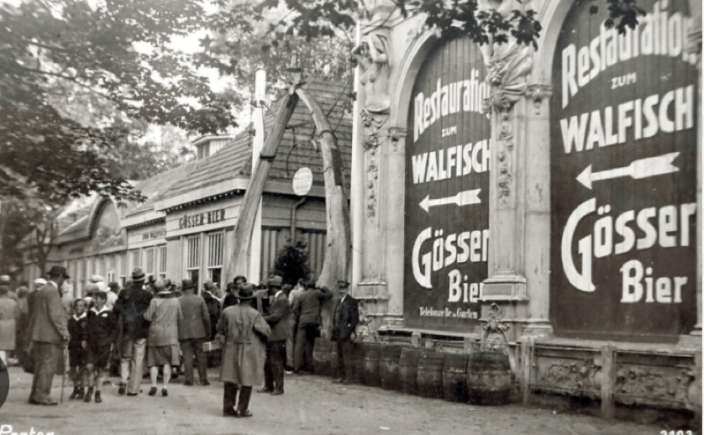
Ten minutes later, they’re approaching Zum Walfisch

“Can’t miss it!” cries Herr Wurstel, standing below the large signs pointing to the popular restaurant.

“Wait, let me take a picture of you there,” says Rudy, pulling a camera from his bag.

“Certainly,” agrees the little man. “If you will give me one moment.” He takes off his hat, blows on it to get rid of the dust, and, in a few deft movements, gives it more of a point at the top. Once the black hat is back on his head in a satisfactory position, he pulls a cigar from his pocket, lights it, and takes a couple of puffs. Thrusting one leg forward and holding the cigar up as if he’s about to take another puff, he says,

“There. I’ll hold this pose. Go ahead and take your picture. And then we’ll have the rest of you here with me for another shot. Good?”

Rudy is ready, and the shutter of his camera clicks.

Herr Wurstel releases his pose. “Now, another one with just Fraulein Baum and me.”

“Wait!” cries Gisi. “How much will these photos cost? Do you charge people to be in their pictures?” Herr Wurstel translates for Rudy.

Rudy replies to him in English and Wurstel says to the others, “He says the cost doesn’t matter—he just wants to remember this lovely day.”

“I want to talk to you privately,” Max says to Anna and Gisi as he leads them out of hearing distance. “It’s not the cost—though it takes some chutzpah to charge people to take your picture—it’s that we don’t know where the photos could end up. They could be lost or stolen and fall into the wrong hands. Then there would be proof of this encounter.”

Anna looks at him as if he’s crazy. “I’m marrying Rudy at the Rathaus tomorrow. What more proof could be needed?”

“I don’t know. You never know. These times are so uncertain.” 

Gisi says, “Dr. Pollack’s reputation could be harmed, I imagine, if the photos got into the wrong hands.”

“I say it’s his decision.” Anna is clear. “If Rudy wants the photos, and he doesn’t care if Wurstel charges for his presence in them, he can do what he wants. I’ll smile. I owe it to him.”

Two suitcases full of books: Book and audiobook launch events in Cordes and on Zoom

Very heavy. You can imagine. They travelled home from California with me last week, and here they are on their way into our house:

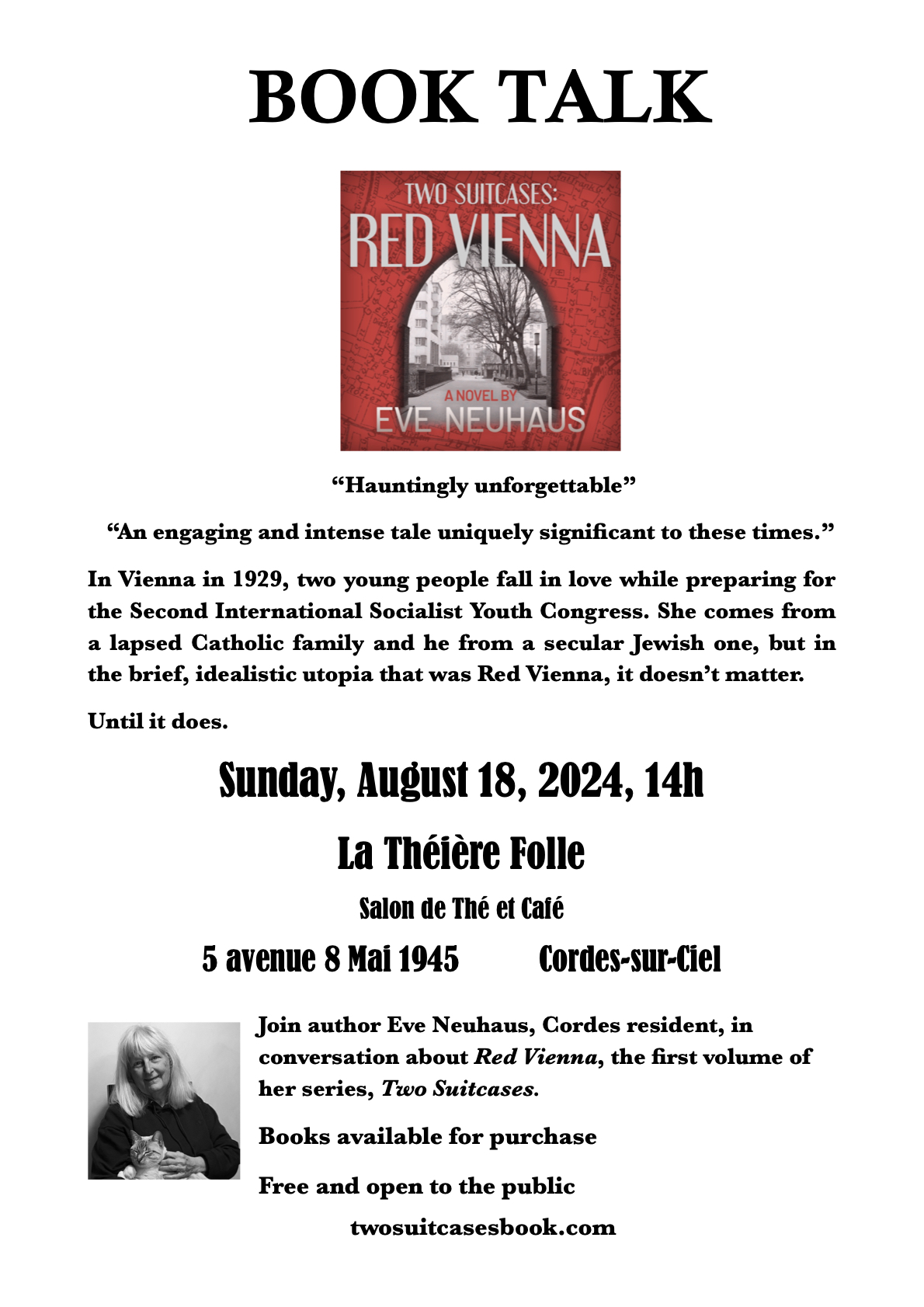
And now, having some copies of Red Vienna to pass on, I’ve set up two events.

It was at the back of my mind to do a launch of some sort locally, maybe in my living room or in someone else’s living room, but when I saw the back room at La Théiere Folle, the new salon de thé in Cordes, I couldn’t resist asking the proprietors, Ricky and Axel, if they’d be willing to host it there.

So, here’s the plan:

And then, for those farther away, the narrator of the audiobook version of Red Vienna and I are doing an audiobook launch on Zoom. I’ll add the details about it in my next post, but here are the basics. Join us if you can!

Learn more about Red Vienna, read excerpts, and reviews at twosuitcasesbook.com

Eve Neuhaus Interview on NPR affiliate KCBX: A Day of Delights

I’m pleased to pass on the link to my most recent interview about Red Vienna, this one on the NPR affiliate in San Luis Obispo, KCBX.

The interview was aired on my best birthday ever. As my voice reached thousands of people, I was enjoying a lunch at Cafe Leila in Berkeley with two old and dear girlfriends. We opened the place and we closed it.

I’d already had a terrific meal out the night before with my son-and daughter-in-law, and a magnificent gluten-free breakfast with my Berkeley family. Mariposa Bakery is the best!

After lunch, we took BART back to Pleasanton, where I’ve been staying to help out with our daughter’s three-year old boy and newborn baby.

Imagine our surprise as this character came out of the station.

The day ended with a superb paella at my daughter’s place in Pleasanton.

It was over the top. I am grateful beyond words to my family and friends for making it all happen.

Listen to the interview: https://www.kcbx.org/podcast/central-coast-voices/2024-07-18/eve-neuhaus-author-of-red-vienna