The dawning of the Age of Aquarius
A couple weeks ago, in response to a friend’s distress over the heart-wrenching news, I responded, “Maybe we’re moving from the three dimensional world into the fourth and fifth dimensions.”
I said it lightly—and, sadly, I doubt that my friend was any less upset after I said it—but I do take refuge in the thought. It gives me comfort to imagine that, as the world as we know it becomes less and less sustainable, there’s more out there than meets the eye.
After sending the idea into cyberspace, I spent the week reflecting on how such a shift might unfold. I stopped listening to the news, I focused on internal work, and I reflected on how the 3-D world might intersect with the 4 and 5 dimensional worlds.
It’s an area that’s interested me for as long as I can remember. Even as a child I had extraordinary dreams. I’m prone to synchronicity. I was more at ease in the world of make-believe than in the real world for many years. I love fiction, especially fiction with magical elements. Speculative and science fiction appeals, too, as do the edges of science and philosophy. It’s where I usually go, along with increasing my time in meditation and contemplation, when the world is too much.
So, for a week or so in mid-July, I paid more attention to my posture and my breath, I meditated more, and I tuned into the cosmic hum more often. Instead of the news, I listened to archetypal astrology—Richard Tarnas, Heather Ensworth, and Rick Levine—and I took lots of time for reverie.
In 1969, when the Fifth Dimension told the world about the dawning of the Age of Aquarius, astrologers believed it had already been happening in fits and starts for a long time. And the sun did shine in the late 60’s and early 70’s—for a little while anyway.
A whole generation of kids and young adults valued peace and love over money. I was in my late teens then, and I was completely swept away by hippie values. I still am. It’s heartbreaking that the promise often attributed to Jimi Hendrix, “When the power of love overcomes the love of power, the world will know peace,” hasn’t yet happened.
What astrologers are saying these days is that the transition to the age of Aquarius, which is indeed upon us, involves a major shift in consciousness, a change in essential values, and ultimately, a move from focusing on gathering goods to generating good.
Whether any of us alive on earth today will live long enough to enjoy such a world seems doubtful to me, but I see great value in releasing the expectation that life will return to the state it was in when we grew up. Opening one’s heart and mind to some of the infinite possibilities the future could bring seems like a much better option than hanging onto a vision of reality that’s crumbling into the past.
I love the idea that our perception of the measurable world will soon be enhanced by a greater understanding its more subtle aspects, as well as its place in the greater, less dense whole.
The pull of the three-dimensional world
Imagine my surprise then, when, in the midst of my dedication to exploring higher dimensions, the 3-D world intervened with an invitation to appreciate, if not acquire, a genuine treasure.
Tom had recently come into a small inheritance. At the time, that money wasn’t three dimensional at all—it was some numbers on a screen. It occurred to me that rather than putting it in the bank, we might make it more productive by buying a building here in Cordes-sur-Ciel. Tom could move his little chocolate shop there, and an apartment or two would provide us with some income. I took time out from my reverie to look at what was on the market.
Who knew a magnificent piece of untouched old Cordes just 200 steps from our front door would immediately turn up? Such an opportunity! Unoccupied for 50 years but clean and sound, the owner had maintained it more or less as a memorial to her parents. Embossed wallpaper, plump feather beds, wool mattresses, lace curtains. And an old bakery.
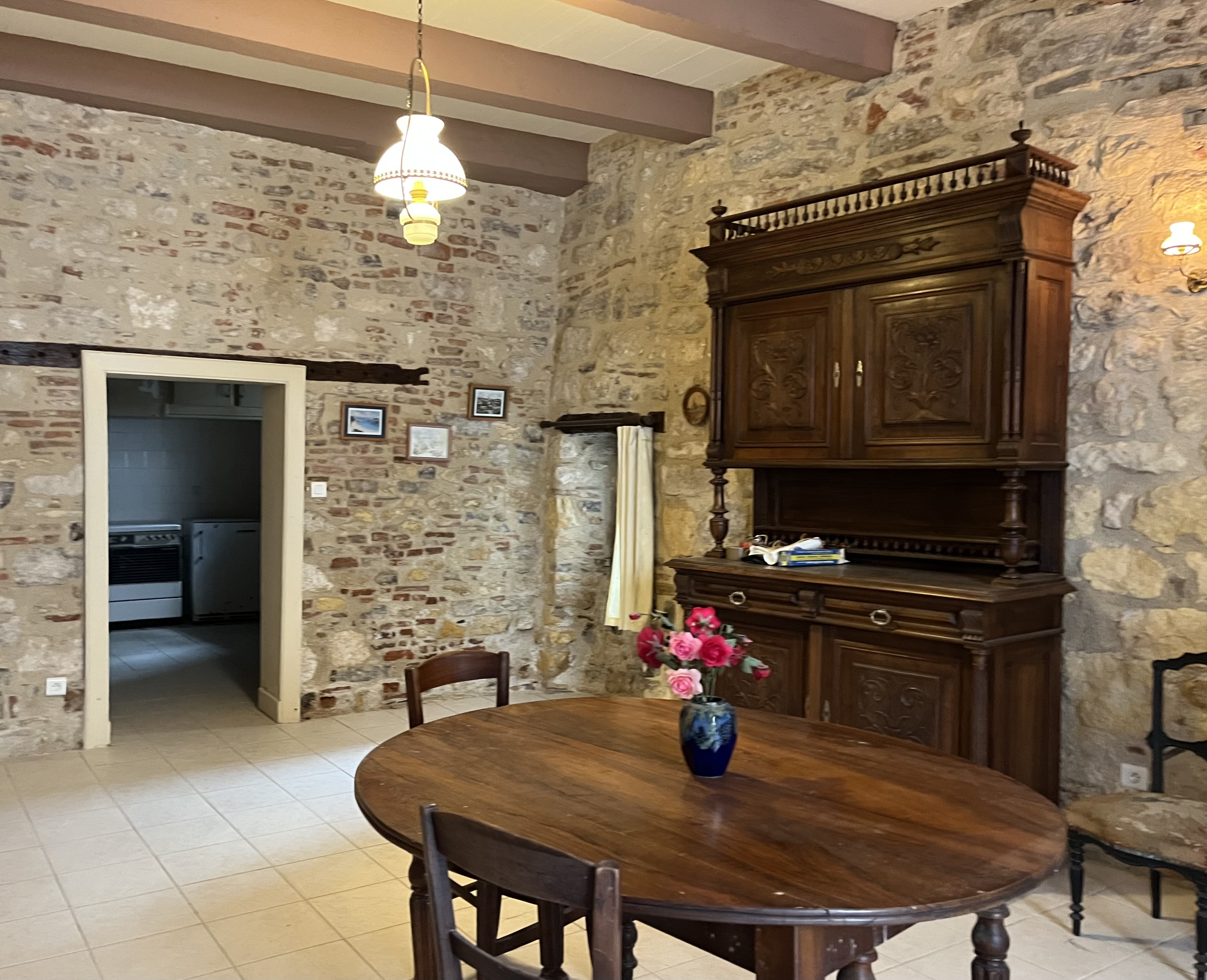
Tom’s shop would go in this room. That’s a kitchen behind it. Perfect.

It is very, very charming, a magical place.

Filled with stuff like this.
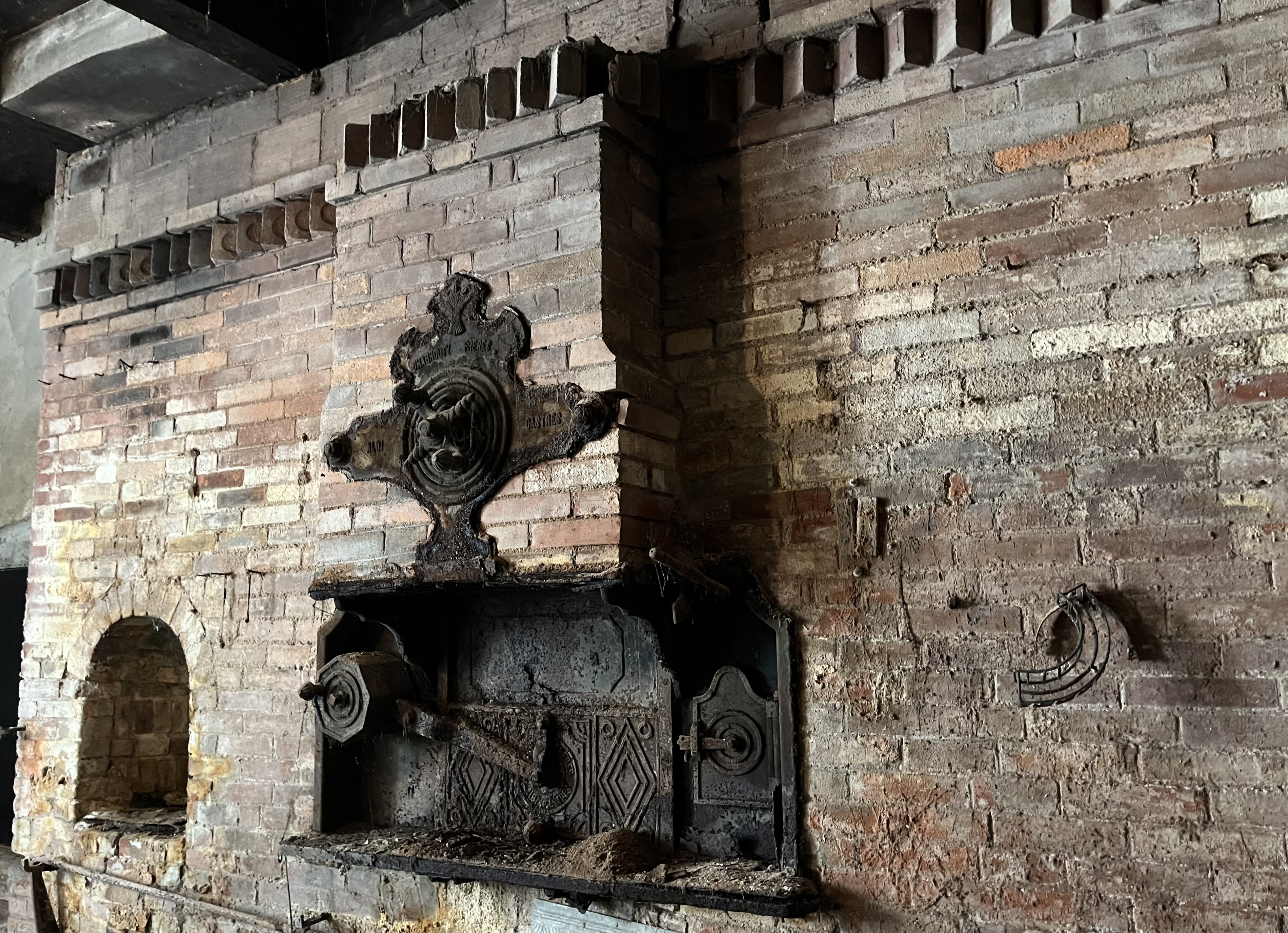

And that that ancient bakery!
Of course there are more a few black holes that would need to be dealt with, like the low wooden shelf or seat in the downstairs bathroom that I thought might be a well. When we lifted the top off, layers and layers of newspaper, paint, and rust showered down. No point in looking in.
But it would be possible for someone to live in that house almost as is. Some plumbing would probably have to be done, but the first floor has 25-year old decent wiring and lighting. The bedrooms are delightful as they are, and so is the upstairs bathroom. A temporary kitchen of some sort could be set up, though the old wood and gas cookers, gems themselves, are there.
With tax and fees, the house and bakery would cost roughly 100 000€. Tax is 950€/year. So appealing! I almost couldn’t resist.
The morning after we saw it, however, the weight of the project hit me. We live so lightly now: small house, very small electric car, and everything we need in walking distance.
Why would I even consider taking on a huge stone building, no matter how beautiful it is?? Then I realized how much of my mental and physical energy had already gone into that place over the last three days!
I went back to listening to astrology and contemplating existence outside the confines of time and space.
Beyond the confines of the 3-D World
Einstein identified the fourth dimension as time, already a stretch to envision as a dimension, but the fifth is even harder to understand. Our civilization is so thoroughly engrossed in the gross world of matter that we can barely imagine it. Subtler worlds, if our physical science-based understanding gives them any credence at all, are only very slowly being discovered. Ganesh Baba often pointed to the discovery of electricity when talking about increasing understanding of subtle energies.
On the second day I spent with Ganesh Baba, he drew a diagram on a paper napkin that he told me encapsulated his entire cosmology. In brief, in an endless cycle, consciousness creates matter, and matter evolves into consciousness.

(To align with the yogic teaching that good posture is essential to conscious evolution, he placed “Homo Erectus,” meaning having a straight back, above “Homo Sapiens.” The spine running up the center is replicated in the human body as the chakra system.)
Ganesh Baba described eight fields functioning in eight dimensions: matter, energy, space, time, life, mind, intelligence, and consciousness, each more subtle than the last. He identifies the fifth dimension as life. Indeed, neither time nor life is understood very well at this point of human evolution, and mind is an even greater mystery.
The Cycle of Synthesis is an attempt at a 2-D representation of an 8-D cosmos, a fractal universe, microcosm in macrocosm and vise versa. It is not static—rather, it is constantly in flow, twisting and turning, expanding and contracting, in an infinite number of directions, smaller and smaller, greater and greater, replicating itself in an infinite number of manifestations, each one connected to all the others.
As in a Moebius strip, the twists in the helix at the center of the drawing indicate shifts from one dimension to the next.

Passing through them is like water going down a drain. The water turns more and more quickly until suddenly it’s somewhere else. I think the transition human consciousness is going through is like that.
It’s interesting to consider that the perspective of the lower dimension is always subsumed into the perspective of the higher one, as when a point becomes a line, a line becomes a square, and a square becomes a cube.
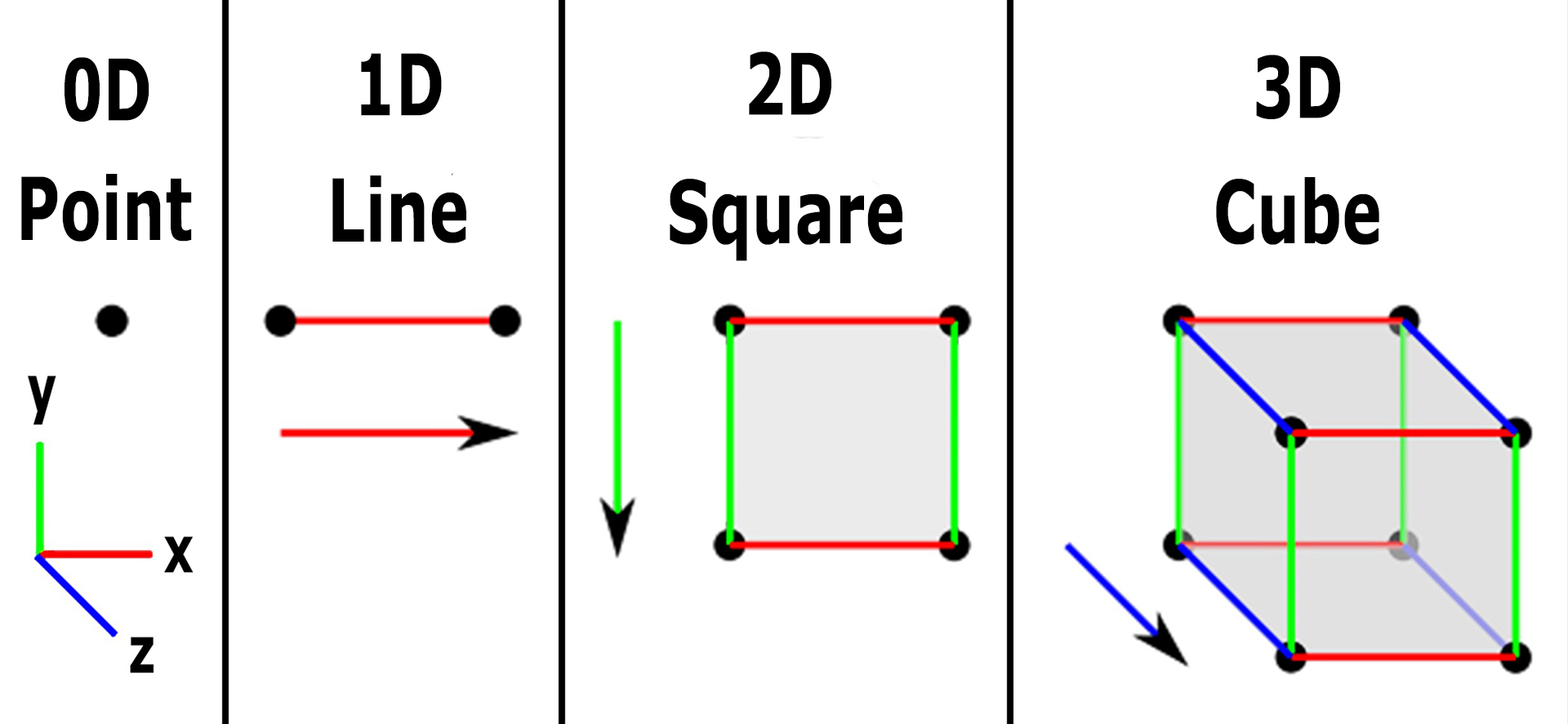
If the point moves, a line exists. The line moves into a square, and the square moves to become a cube. Move the cube, and time exists. But beyond that?
What comes first? Consciousness or matter?
In most non-Western perspectives on existence, consciousness precedes matter. Even in the bible, God creates the earth. Assuming that only what can be measured is real is a recent twist in human understanding. It’s a limiting conception, though certainly a useful one in the practical world. If the great god of civilization, Science, wants to survive the coming twist, it will have to let go of the shores of time and space and greet the coming age of immeasurability with curiosity and eager anticipation.
I have less hope for the other worldwide religion of our era, the Economy, and its god, Money. I can easily see Mr. Moneybags falling off the edge of the earth to become a monster. An idea that particularly struck me during my studies at Pacifica Graduate Institute is that as dominant mythologies shift, for example from the “pagan” religions to Christianity, the old gods are forced underground, or off the edge of the earth, where they’re perceived as devils. It happens every time.
In Ganesh Baba’s model, following the downward arrow on the left, consciousness condenses into matter. Then, as it evolves back toward its source, more and more of the whole becomes comprehensible. As well as being reflected in the human body as the chakras, the Cycle of Synthesis mirrors Indian theory of the Yugas, a cycle of epochs in which the understanding of subtle things recedes as the earth moves away from the center of the universe, and increases again after it reaches its nadir and moves toward the center again.
So, if, as many astrologers are now saying, we are moving out of the Kali Yuga, the period of least understanding, into an era in which subtle energies will become more apparent, we will have to learn to navigate in the bio-psychic and intello-conscious fields in Baba’s diagram, the dimensions beyond space and time.
One way to do that is to begin by paying more attention to the interface, the twist, the liminal place, where fourth and fifth dimensional events show up in the 3-D world.
That’s why the dramatic incursion, in the form of that very attractive, very large three-dimensional stone house, into my fourth- and fifth-dimensional musings struck me. It was magic. That opportunity came into my physical world via a current of synchronicity. Its appearance overrode the laws of time and space, and I was very nearly beguiled.
What’s next?
Now, I’m on the lookout for magic. I’m asking a question before going to sleep, hoping for a response in my dreams. I’m actively looking for coincidence, actively seeking synchronicity.
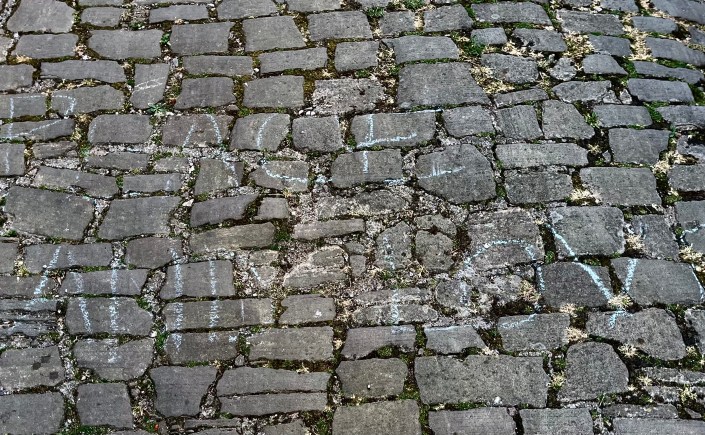
So it was that I noticed some writing in blue chalk on the cobblestones of Rue Saint Louis as I walked Mocha one morning this week, when I had just begun this essay. The message is a little hard to read, but the words are in English, even though I found it in our beautiful French village.

Rue Saint Louis

PEACE AND LOVE
It’s still the answer.

 Eve Neuhaus