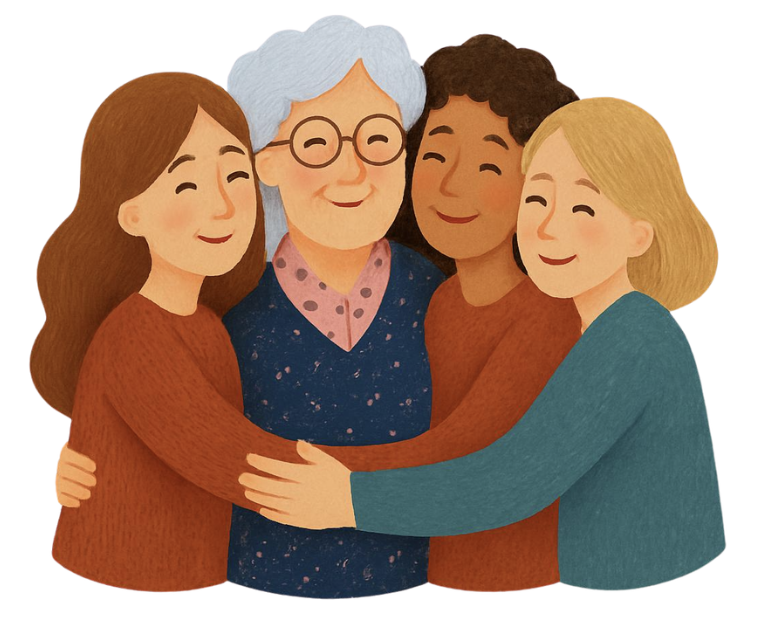
At just before six in the evening on February 20, 2026, I was immersed in a Japanese-style hot tub, perfectly round and not too hot, with three dear women friends. With our legs bobbing in the warm water in front of us, the four of us formed a Celtic cross.
It was a seminal moment. We all knew it.
At just that time, the conjunction of Neptune and Saturn was exact. Not only was it exact, which happens every 36 years, but it was exact at 0° Aries, which only happens every 6000 years.
And, not only was it exact, but it fell exactly on the north node of the moon in my birth chart. And we were at that spa at that moment to celebrate the birthday of one of the other women.
That’s a lot of astrology to unpack, and I’ll do it, but first, take a look the Sabian symbol for 0° Aries:
A Woman Just Risen From The Sea; A Seal Is Embracing Her
I hoped the four of us would take that moment to rise from the water and embrace, but, sadly, the water wasn’t welcoming enough for any of us to feel like submerging.
So we meditated and emerged from there to embrace.
What’s the significance of all this?
Last night I dreamed that I was deep in a forest with a group of people. We’d had to escape from somewhere and there was a question about whether we had brought the right stuff with us and whether there was enough food. It was a fairly large group of people, maybe twenty or thirty. I was at the back of the group, walking slowly with a companion. When we caught up with the others, they were cooking and eating. I was happy to see that they had roasted some chicken and that I had a choice of either a leg or a breast piece—I didn’t want them both because it seemed like too much.
Our whole civilization is entering the deep woods of uncertainty, and the question of whether we’re bringing the right things with us matters. The dream is reassuring—there’s enough chicken for us to have a choice, even if we’re the last to be served. Yet it would be a mistake to take it literally. Most of us won’t have to carry chickens along as we navigate the deep woods. We have to take some form of symbolic sustenance.
In the fall, while preparing a presentation for the Seeker’s Compass (watch it here: https://youtu.be/iQIEb5dbF9w), I remembered the profound importance of living symbolically. I’ve appreciated the idea since I was fourteen or so, when the marvelous creative writing teacher at my summer camp introduced us to the power of myth through the work of CG Jung and Joseph Campbell. (My eternal thanks go to Joe Beatty at Lighthouse Art and Music Camp). Ever since, I’ve attended to the metaphors behind details of daily life. I even studied myth at Pacifica and, in my work with Alice O. Howell, focused on seeing the sacred on the commonplace as well as on astrology—but when I used those words “living a symbolic life” in that talk, something powerful reawakened in me.
In the talk I said something like, “In these liminal times, living a symbolic life is surely one of the ways through to the next world.” It wasn’t a phrase I intended to put into that talk, which I gave several times, live and on camera, with and without notes. It wasn’t in my notes.
After the talk, I thought, huh, good thing nobody asked me a question about that—I wouldn’t have known what to say, or who to attribute it to for certain. I thought I remembered hearing it first in a talk by James Hillman at Pacifica, and had assumed it was his. It actually comes from Jung himself. InThe Symbolic Life: a collection of miscellaneous writings, he says,
You see, man is in need of a symbolic life – badly in need. We only live banal, ordinary, rational, or irrational things . . . but we have no symbolic life. Where do we live symbolically? Nowhere except where we participate in the ritual of life. . . .
Have you got a corner somewhere in your house where you perform the rites, as you can see in India? Even the very simple houses there have at least a curtained corner where the members of the household can perform the symbolic life, where they can make their new vows or their meditation. We don’t have it; we have no such corner. We have our own room, of course, – but there is a telephone that can ring us up at any time, and we always must be ready. We have no time, no place.
We have no symbolic life, and we are all badly in need of the symbolic life. Only the symbolic life can express the need of the soul – the daily need of the soul, mind you! And because people have no such thing, they can never step out of this mill – this awful, banal, grinding life in which they are “nothing but.” . . .
Everything is banal; everything is “nothing but,” and that is the reason why people are neurotic. They are simply sick of the whole thing, sick of that banal life, and therefore they want sensation. They even want a war; they all want a war; they are all glad when there is a war; they say, “Thank heaven, now something is going to happen – something bigger than ourselves!”
These things go pretty deep, and no wonder people get neurotic. Life is too rational; there is no symbolic existence in which I am something else, in which I am fulfilling my role, my role as one of the actors in the divine drama of life.
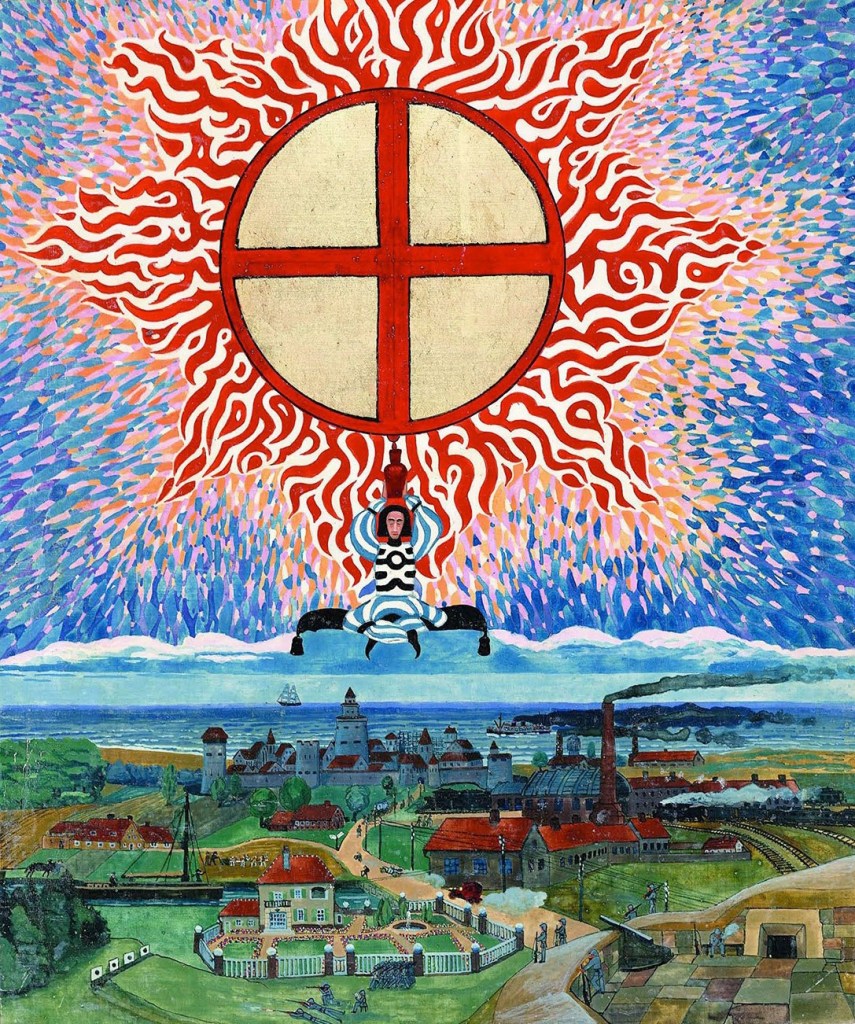
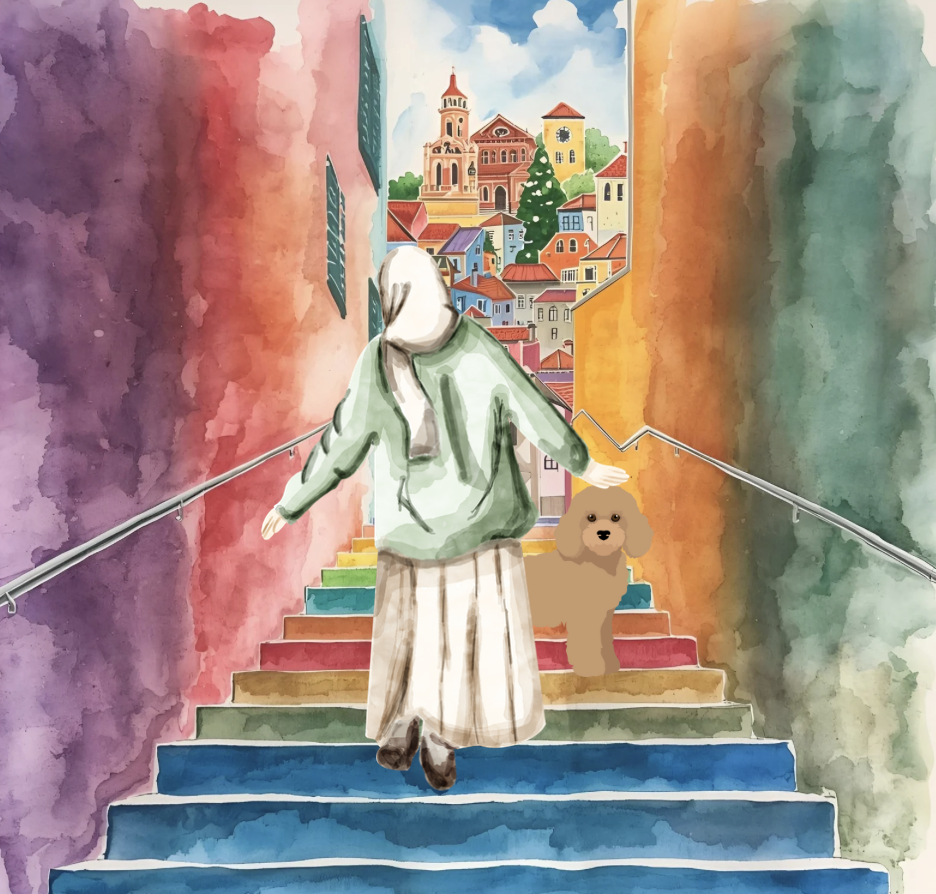
After I copied and pasted the above text into this essay, I thought I’d look for an image to illustrate the concept, maybe something from Jung’s The Red Book. The very first image that came up in my search was this one:
Over the top synchronicity.
But to return to the astrology that marked the moment: when the woods get deep and all the trees look alike, I often look up at the stars. Astrology provides a symbolic map for understanding changes in our personal and civilizational lives.
Astrology divides the celestial sphere into 12 sections or signs of 30 degrees each, for a total of 360 degrees. 0° Aries is considered the first degree of the zodiac, the threshold of a new level in the upward spiral of change. The exact passage, or conjunction, of two planets that appear to be moving slowly through the heavens, occurring at 0° Aries begs exploration.
Saturn is the furthest away of the seven “planets,” which in astrology include the sun and the moon, which are visible to the naked eye. Thus, it’s what holds the “world” together, the outer boundary, the structure.
Neptune, discovered using a telescope in 1846, was assigned the farthest out concepts of the time: imagination, illusions, dreams, the abstract, the mysterious.
The conjunction of Saturn and Neptune indicates a merger of structure with dreams.
In a birth chart, the planets are laid out on the zodiac in the position they were in at a person’s birth, each planet at a certain degree in one of the twelve segments, or signs.
In 1925, an astrologer, Marc Edmund Jones, and a clairvoyant, Elsie Wheeler, created a series of 360 images, one for each of the degrees of the zodiac. They called them the Sabian symbols. Each one is completely unique. For example, the woman rising from the sea embraced by the seal is followed by a man entertaining a group of people, and a few degrees later, by a triangle with wings.
In addition to the planets, there are other markers that are assigned meaning, among them the lunar nodes, which mark the moon’s orbit as it intersects the apparent path of the sun. The south node is said to show what a person comes into life with, and the north node what their purpose is.
One of the basic things astrologers do is to compare the position of the planets in the sky at present, or at any given time, to their positions at the time of one’s birth. Thus, I knew that the rare conjunction of Saturn and Neptune at 0° Aries coincided with the position of the north node in my birth chart at 0° Aries. When I looked up the significance of that, Astrology.com said, “When planetary transits touch your north node directly, you’ll find significant, destined events and meetings take place. The north node is uncharted terrain and unlocks the key to your life’s purpose.”
So, there I was, creating one of the four limbs of that cross in a circle at the exact moment of the structure/dream collaboration, at the exact point in time when I am supposed to come into whatever I came into this life to do. And with three dear friends, one of whose birthday was at the same time.
It’s taken too many words and too much time to get to this point in the story, so I’ll explore where the experience took me in my next post.
This is a vision that came to me not long ago when I was doing longer than usual meditations in the morning. I’d been sitting for maybe 45 minutes when it floated into my head.
C’est une vision qui m’est venue il n’y a pas longtemps, alors que je faisais une méditation plus longue que d’habitude le matin. J’étais assise depuis environ 45 minutes quand elle m’est venue à l’esprit.
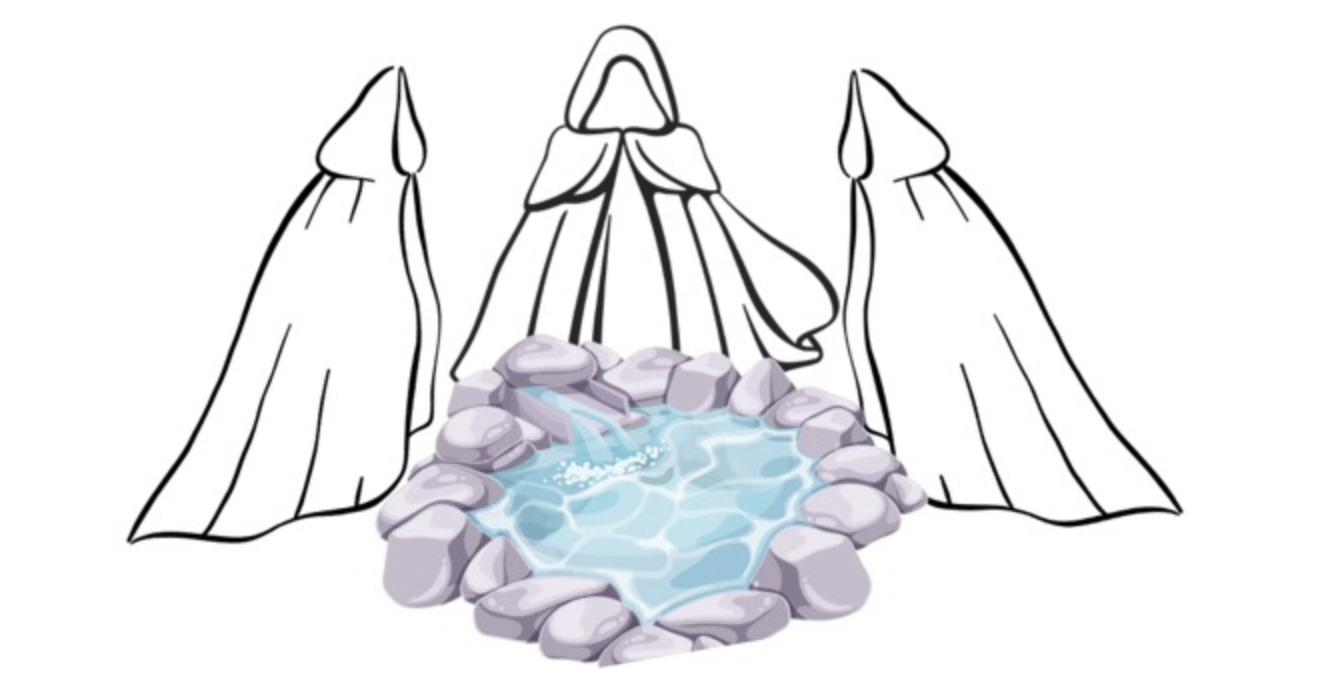
In the vision, I am sitting in front of a spring with low circular wall around it.
Dans cette vision, je suis assise devant une source entourée d’un muret circulaire.
From my left comes a figure in a white cape and hood. Without saying anything, she seats herself on the opposite side of the spring. I see that she is a very, very old woman.
De ma gauche arrive une silhouette vêtue d’une cape blanche à capuche. Sans dire un mot, elle s’assoit à l’autre côté de la source. Je vois qu’il s’agit d’une femme très, très âgée.
We sit together quietly for a while. I close my eyes.
Nous restons assises ensemble en silence pendant un moment. Je ferme les yeux.
When I open them, I see that many women in white have come.
Quand je les rouvre, je vois que de nombreuses femmes vêtues de blanc sont arrivées.
I’m so pleased to be there, I feel full of joy. I love these women. I love being part of a circle of women sitting around a spring. I feel so blessed.
Je suis tellement heureuse d’être là, je me sens remplie de joie. J’aime ces femmes. J’aime faire partie d’un cercle de femmes assises autour d’une source. Je me sens tellement bénie.
Then I remember something I had read the night before.
Puis je me souviens de quelque chose que j’avais lu la veille au soir.
It’s something a friend, Robert Sachs, said in a response on Facebook. His exact words don’t come to me, but what I remember is “One drop of love can overcome all the difficulties going on around you.”
C’était quelque chose qu’un ami, Robert Sachs, avait dit en réponse sur Facebook. Je ne me souvenais pas exactement de ses mots, mais ce dont je me souvenais, c’était : « Une goutte d’amour peut surmonter toutes les difficultés qui vous entourent. »
“One drop of love can overcome all the difficulties going on around you.”
« Une goutte d’amour peut surmonter toutes les difficultés qui vous entourent. »
The idea pleases me. It makes me even happier to have remembered it.
Cette idée me plaît. Je suis encore plus heureux de m’en être souvenu.
.While I’m feeling that ebullient love bubbling up inside me, and that deep, deep comfort that being loved brings, I notice a disturbance off to the right.
Alors que je sentais cet amour bouillonnant monter en moi, et ce profond réconfort que procure le fait d’être aimée, j’ai remarqué une agitation sur ma droite.
A man is coming, a man who, for his head, has the tip of a penis.
Un homme s’approchait, un homme dont la tête était remplacée par le bout d’un pénis.
So I look at him, and while I’m looking at him, lots of other guys join him from all directions. As I watch, all of their penis-heads start growing and getting bigger and bigger, and their necks are stretching longer and longer, until one of them hits another one and then suddenly they’re all bashing each other with their penises, with their long penises.
Je le regarde, et pendant que je le regarde, beaucoup d’autres hommes le rejoignent de tous parts. Alors que je les observe, leurs têtes de pénis commencent à grossir et à devenir de plus en plus grosses, et leurs cous s’allongent de plus en plus, jusqu’à ce que l’un d’eux en frappe un autre et qu’ils se mettent soudainement à se frapper les uns les autres avec leurs pénis, leurs longs pénis.
And we women, we‘re just sitting there, around the source, in meditation, in silence, holding that space.
Et nous, les femmes, nous sommes simplement assises là, autour de la source, en méditation, en silence, gardant cet espace.
My parents were immigrants. They left Vienna in March, 1938, and arrived in Philadelphia in November, 1942, on a Portuguese ship called the Serpa Pinto.
Mes parents étaient des immigrants. Ils ont quitté Vienne en mars 1938 et sont arrivés à Philadelphie en novembre 1942, à bord d’un navire portugais appelé le Serpa Pinto.
Connected to the Quaker community through their pacifism, they settled in Philadelphia.
Liés à la communauté Quaker par leur pacifisme, ils s’installèrent à Philadelphie.
Though they’d only brought two suitcases with them in 1942, by the mid-1950’s, they’d already sold our rowhouse in a working-class suburb south of the city and built a split-level on a one acre plot in a middle-class suburb in the northwest. My little family truly lived the American dream.
Alors qu’ils n’avaient emporté que deux valises avec eux en 1942, au milieu des années 1950, ils avaient déjà vendu notre maison mitoyenne dans une banlieue ouvrière au sud de la ville et construit une maison à deux niveaux sur un terrain d’un acre dans une banlieue bourgeoise au nord-ouest. Ma petite famille vivait véritablement le rêve américain.
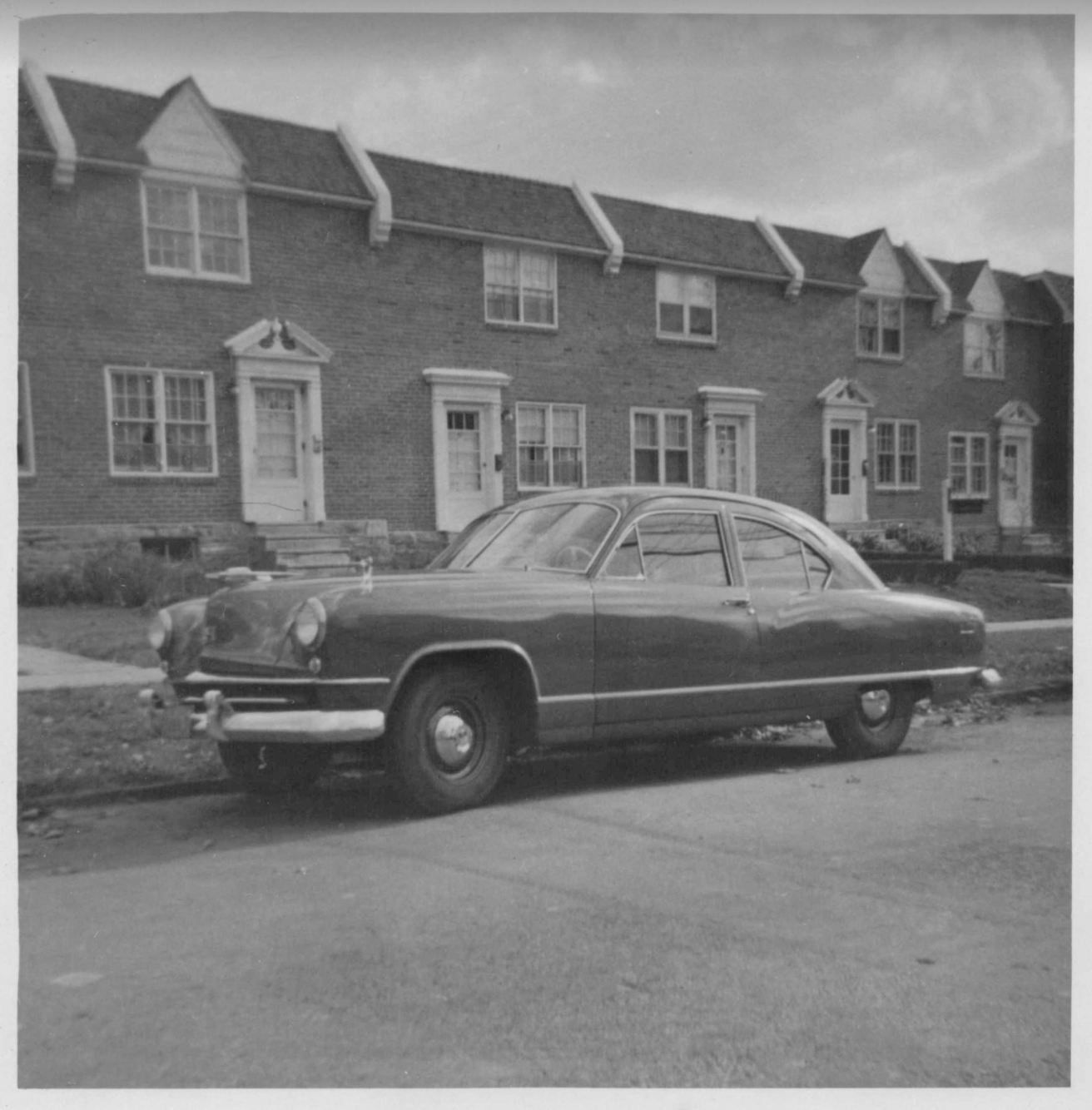
The second car my parents bought, the Kaiser, in front of their house in Morton in the early 1950s – La deuxième voiture achetée par mes parents, la Kaiser, devant leur maison à Morton au début des années 1950
Occasionally, we’d have guests from Europe or other parts of the country, usually other immigrants. After a day in Philadelphia seeing the Liberty Bell, which you could touch then, and Independence Hall, we’d cram into our car, me in the middle of the front seat, guests in the back, and take route 1, or later the turnpike, through New Jersey to New York City, where my father’s sister and most of their social circle had settled.
De temps en temps, nous recevions des invités venus d’Europe ou d’autres régions du pays, généralement d’autres immigrants. Après une journée passée à Philadelphie à visiter la Liberty Bell, que l’on pouvait alors toucher, et l’Independence Hall, nous nous entassions dans notre voiture, moi au milieu du siège avant, les invités à l’arrière, et empruntions la route 1, puis l’autoroute, pour traverser le New Jersey jusqu’à New York, où la sœur de mon père et la plupart de leur cercle social s’étaient installés.
Aside from the visit to Eclair Bakery, the best part of the trip to New York was the ride on the Staten Island Ferry. It cost a quarter round-trip and it went by the Statue of Liberty.
Outre la visite à la boulangerie Eclair, le meilleur moment de notre séjour à New York a été la traversée en ferry de Staten Island. Le billet aller-retour coûtait 25 cents et nous sommes passés devant la Statue de la Liberté.
Most of the other passengers on the ferry were commuters, so it wasn’t too hard to find places to stand on the side where you could see the statue. Every time we passed her, my father would proudly tell the story of how the statue was a gift from France, where he and my mother lived between 1938 and their arrival in America. My favorite part of the tale was where the money came from to build the enormous statue and the pedestal to hold it.
La plupart des autres passagers du ferry étaient des navetteurs, il n’était donc pas trop difficile de trouver des places où se tenir debout sur le côté d’où l’on pouvait voir la statue. Chaque fois que nous passions devant elle, mon père racontait fièrement comment cette statue avait été offerte par la France, où lui et ma mère avaient vécu entre 1938 et leur arrivée en Amérique. Ce que je préférais dans cette histoire, c’était l’origine des fonds qui avaient permis de construire cette statue gigantesque et le piédestal qui la soutenait.
It wasn’t France’s national government that paid for the gift. That would have been considered inappropriate. Instead, hundreds of municipalities, from tiny villages to great cities, gave thousands of francs to build the statue. Schoolchildren saved up and donated centimes. Descendants of French soldiers who fought in the American Revolution contributed. The skin of the statue is made of copper offered by a French copper company.
Ce n’est pas le gouvernement français qui a financé ce cadeau. Cela aurait été considéré comme inapproprié. Ce sont plutôt des centaines de municipalités, des petits villages aux grandes villes, qui ont donné des milliers de francs pour construire la statue. Les écoliers ont économisé et donné des centimes. Les descendants des soldats français qui ont combattu pendant la Révolution américaine ont également contribué. La peau de la statue est faite de cuivre offert par une entreprise française spécialisée dans ce métal.
Yet when the gift was finally ready, it wasn’t certain that the statue would ever be erected in America, Many powerful Americans, including the New York Times, opposed it. But in the end, Joseph Pulitzer organized a campaign asking children to contribute pennies, and enough money was raised to install Lady Liberty in New York Harbor.
Cependant, lorsque le cadeau fut enfin prêt, il n’était pas certain que la statue serait un jour érigée en Amérique. De nombreux Américains influents, dont le New York Times, s’y opposaient. Mais finalement, Joseph Pulitzer organisa une campagne demandant aux enfants de donner quelques centimes, et suffisamment d’argent fut récolté pour installer Lady Liberty dans le port de New York.
I collected pennies. And I carried a carefully constructed Unicef donation box with me every Halloween. I knew about children contributing to great causes.
Je collectionnais les pièces de monnaie. Et chaque Halloween, je portais avec moi une boîte de dons pour l’Unicef soigneusement fabriquée. Je savais que les enfants pouvaient contribuer à de grandes causes.
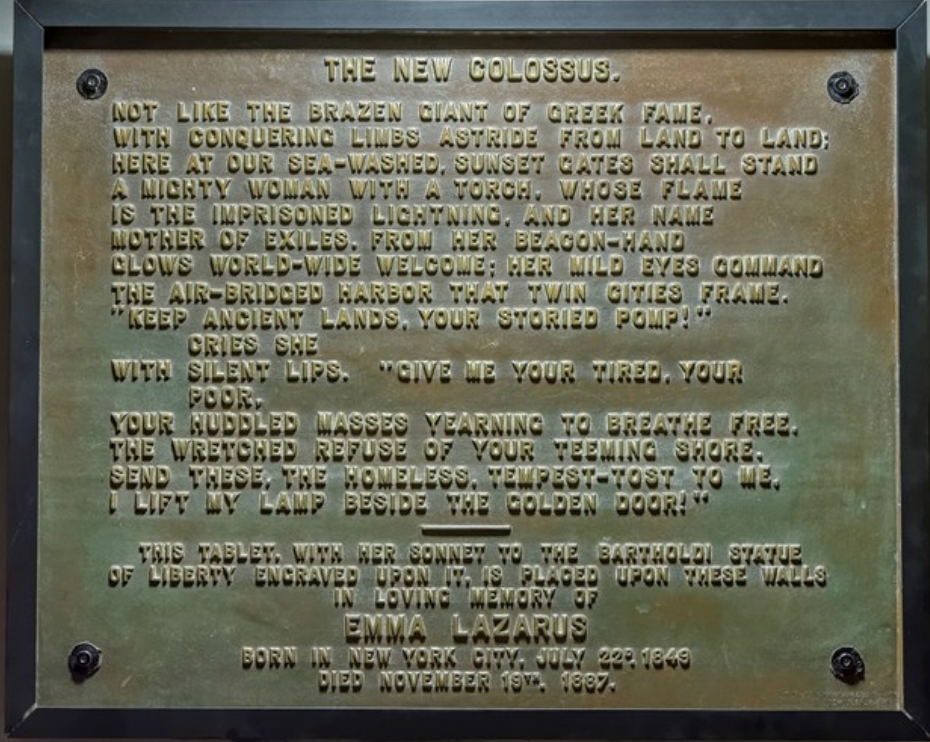
And then there was Emma Lazarus’s poem, The New Colossus, which was written for the statue.
Et puis il y avait le poème d’Emma Lazarus, The New Colossus, qui avait été écrit pour la statue.
“Give me your tired, your poor,
Your huddled masses yearning to breathe free,
The wretched refuse of your teeming shore.
Send these, the homeless, tempest-tost to me,
I lift my lamp beside the golden door!”
« Donnez-moi vos pauvres, vos exténués,
La foule qui aspire à vivre libre,
Le rebut de vos rivages surpeuplés.
Envoyez-moi ces sans-abri, ces victimes de la tempête,
Je lève ma lampe près de la porte dorée ! »
I felt both embraced and empowered by the Statue of Liberty.
Je me suis sentie à la fois étreinte et inspirée par la Statue de la Liberté.
Now, that idealism is gone, the wretched refuse scorned, and immigrants imprisoned. The golden door is closed.
Aujourd’hui, cet idéalisme a disparu, les misérables sont méprisés et les immigrants emprisonnés. La porte dorée est fermée.
My father, a green card holder who was never naturalized, would be living in fear instead of pride.
Mon père, titulaire d’une carte verte qui n’a jamais été naturalisé, vivrait dans la peur plutôt que dans la fierté.
Today I woke up in a different world than I lived in yesterday. Granted it’s two weeks that I’ve been suffering from the terrible flu that’s going around this year, but I do feel much better. Almost myself. Yet today something new is happening. Beyond the lingering cough and minor aches and pains, there’s a delicate sense of vibrancy. My first thought was that I was feeling spring coming, that the seeds and roots, asleep underground for the winter, were waking up. Hope rekindling.
Aujourd’hui, je me suis réveillé dans un monde différent de celui dans lequel je vivais hier. Certes, cela fait deux semaines que je souffre de cette terrible grippe qui sévit cette année, mais je me sens beaucoup mieux. Je suis presque redevenu moi-même. Pourtant, aujourd’hui, quelque chose de nouveau se produit. Au-delà de la toux persistante et des douleurs mineures, je ressens une délicate sensation de vitalité. Ma première pensée a été que je sentais le printemps arriver, que les graines et les racines, endormies sous terre pendant l’hiver, se réveillaient. L’espoir renaissait.
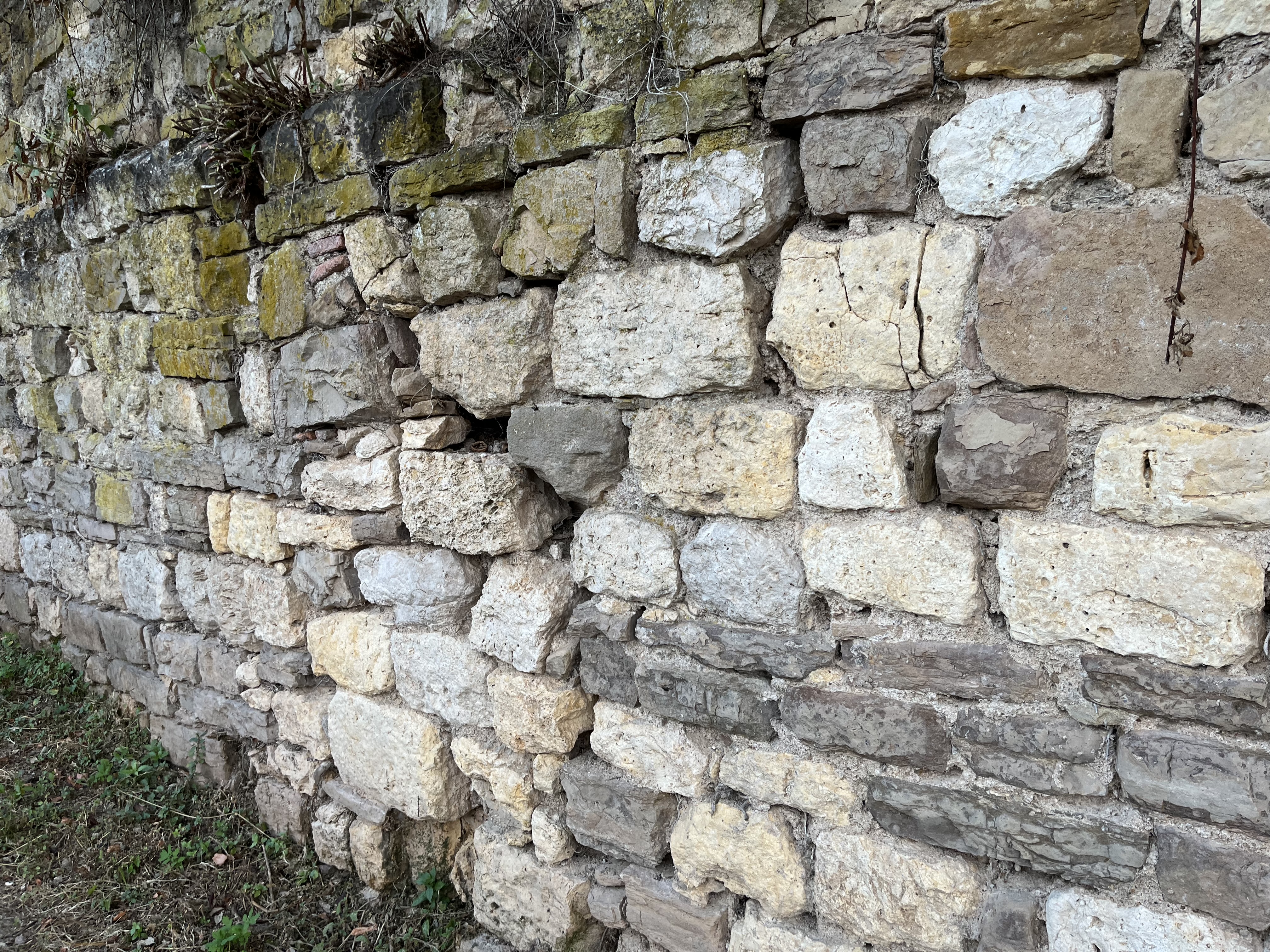
When I went out into the village to take the dog for her morning walk, the sensation expanded. “Good morning,” I said to the stones in the ancient wall as I always do. Immeasurably slowly, in a voice too deep for my ears to hear, one of the stones replied. “Good morning.”
Lorsque je suis sortie dans le village pour promener mon chien, cette sensation s’est amplifiée. « Bonjour », ai-je dit aux pierres du mur ancien, comme je le fais toujours. D’une lenteur infinie, d’une voix trop grave pour que mes oreilles puissent l’entendre, l’une des pierres m’a répondu : « Bonjour ».
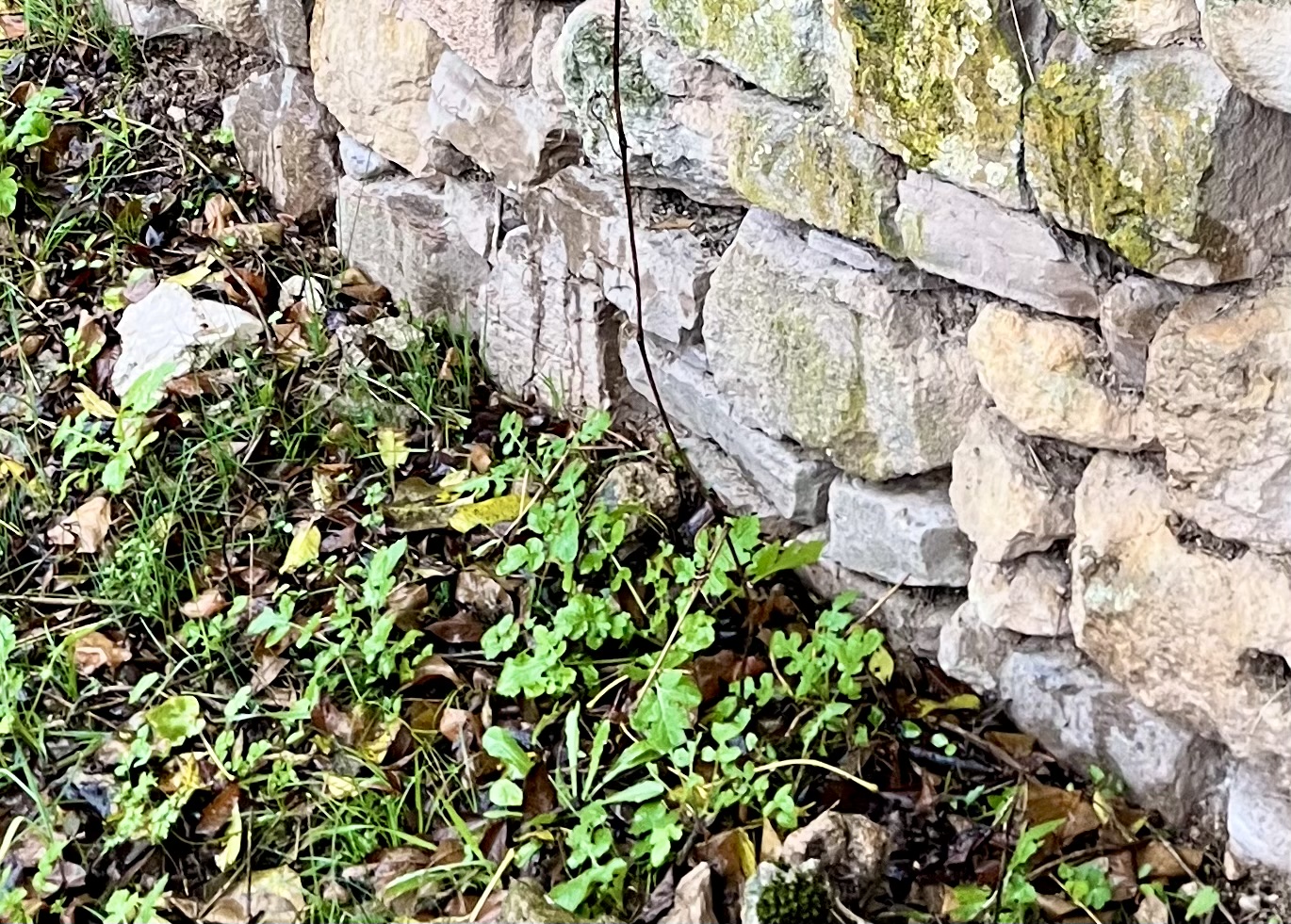
“Hello! Hello! Hello” I felt the leaves of little plants at the foot of the wall tinkle. “Hello!” I answered, tickled by the vibration.
« Bonjour ! Bonjour ! Bonjour ! » Je sentais les feuilles des petites plantes au pied du mur vibrer. « Bonjour ! » répondis-je, chatouillé par la vibration.
Over the next few moments, everything around me reached out to greet me. I barely have words to describe it. Rich, orchestral, multi-layered, subtle, vibrant, exciting, joyous. I couldn’t get enough. It lasted through our whole walk. I felt embraced, engulfed, held, welcomed by an enchanted world.
Au cours des instants qui ont suivi, tout ce qui m’entourait s’est mis à m’accueillir. Je n’ai pas vraiment les mots pour décrire ça. C’était riche, orchestral, complexe, subtil, vibrant, exaltant, joyeux. Je n’en avais jamais assez. Ça a duré tout le long de notre balade. Je me sentais enlacé, enveloppé, soutenu, accueilli par un monde enchanté.
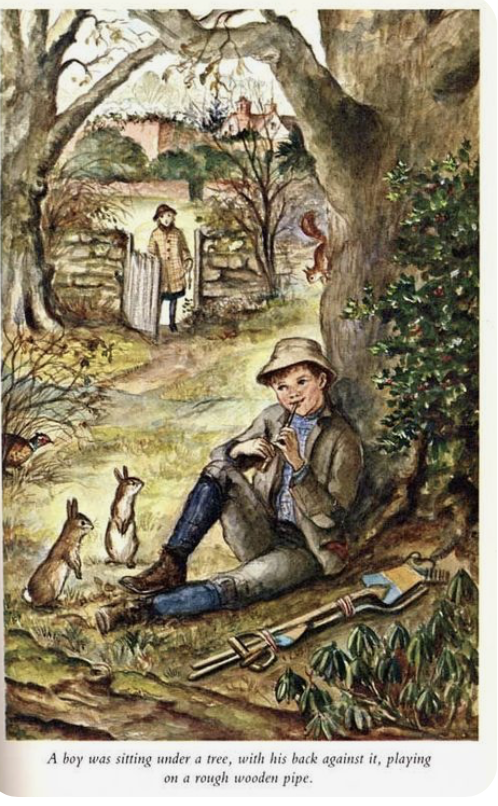
It’s something I’ve wished for as long as I can remember, the world of make-believe I lived in as a solitary child surrounded by dolls, stuffed animals, and toys who all talked. When I outgrew that world, I longed to be like Dickon in The Secret Garden who talked with the animals.
C’est quelque chose que j’ai toujours souhaité, depuis aussi longtemps que je me souvienne : le monde imaginaire dans lequel je vivais quand j’étais une enfant solitaire, entourée de poupées, d’animaux en peluche et de jouets qui parlaient tous. Quand j’ai dépassé cet âge, j’ai rêvé d’être comme Dickon dans Le Jardin Secret, qui parlait avec les animaux.
The Secret Garden, illustration by Tasha Tudor
One of the best parts of visiting Alice O. Howell in her handsome Victorian home in Monterey, Massachusetts, was seeing in person the hand-decorated signs on objects everywhere with their names on them. The names were very clever, often delightfully metaphorical, always charming, sometimes so funny you’d laugh every time you remembered them. Which, unfortunately, I don’t. My favorite of Alice’s books has always been been The Dove in the Stone, which I find speaks to the re-enchantment of the world in more comprehensible language than much of the post-Jungian work on the same subject.
L’un des meilleurs moments de ma visite chez Alice O. Howell, dans sa magnifique maison victorienne de Monterey, dans le Massachusetts, a été de voir de mes propres yeux les étiquettes décorées à la main apposées sur tous les objets, avec leur nom inscrit dessus. Les noms étaient très ingénieux, souvent délicieusement métaphoriques, toujours charmants, parfois si drôles qu’on ne pouvait s’empêcher de rire chaque fois qu’on s’en souvenait. Ce qui, malheureusement, n’est pas mon cas. Mon livre préféré d’Alice a toujours été The Dove in the Stone, qui, selon moi, parle du réenchantement du monde dans un langage plus compréhensible que la plupart des ouvrages post-jungiens sur le même sujet.
Since Mocha and I have been home, the sensation of all-encompassing aliveness has barely abated. “Have a glass of water,” called the faucet as I was taking off my shoes. And I did, greeting and thanking the glass that held the sparkling. living liquid. feeling the water’s aliveness as it traveled through my body.
Depuis que Mocha et moi sommes rentrés à la maison, cette sensation de vitalité omniprésente ne s’est pratiquement pas atténuée. « Bois un verre d’eau », m’a invité le robinet alors que j’enlevais mes chaussures. C’est ce que j’ai fait, en saluant et en remerciant le verre qui contenait ce liquide vivant et pétillant, tout en ressentant la vitalité de l’eau qui parcourait mon corps.
Iain McGilchrist would say that such a sense of connectedness, of amity, of being part of the family of everything, resides in the right brain. It is endemic to the top half of the Cycle of Synthesis, which I’ve been exploring in a recent series of talks.
Iain McGilchrist dirait qu’un tel sentiment d’appartenance, d’amitié, de faire partie de la famille de tout, réside dans le cerveau droit. Il est endémique à la moitié supérieure du Cycle de Synthèse, que j’ai exploré dans une récente série de conférences.
As I write, the feeling is fading a bit, becoming background to a more ordinary foreground.
Au moment où j’écris, ce sentiment s’estompe quelque peu, passant à l’arrière-plan pour laisser place à un premier plan plus ordinaire.
I hope. I believe, I trust, it will come back.
J’espère. Je crois, j’ai confiance, cela reviendra.
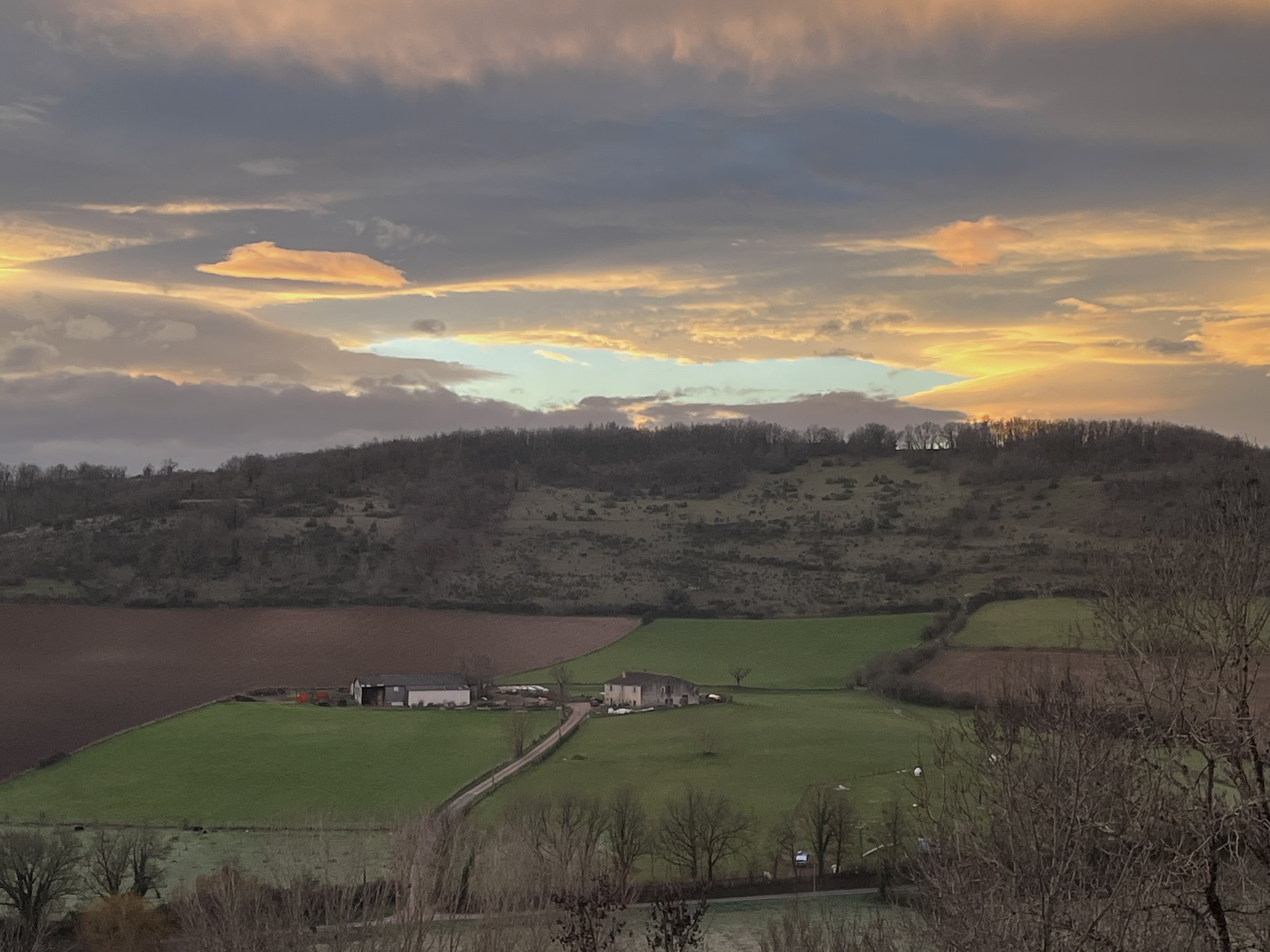
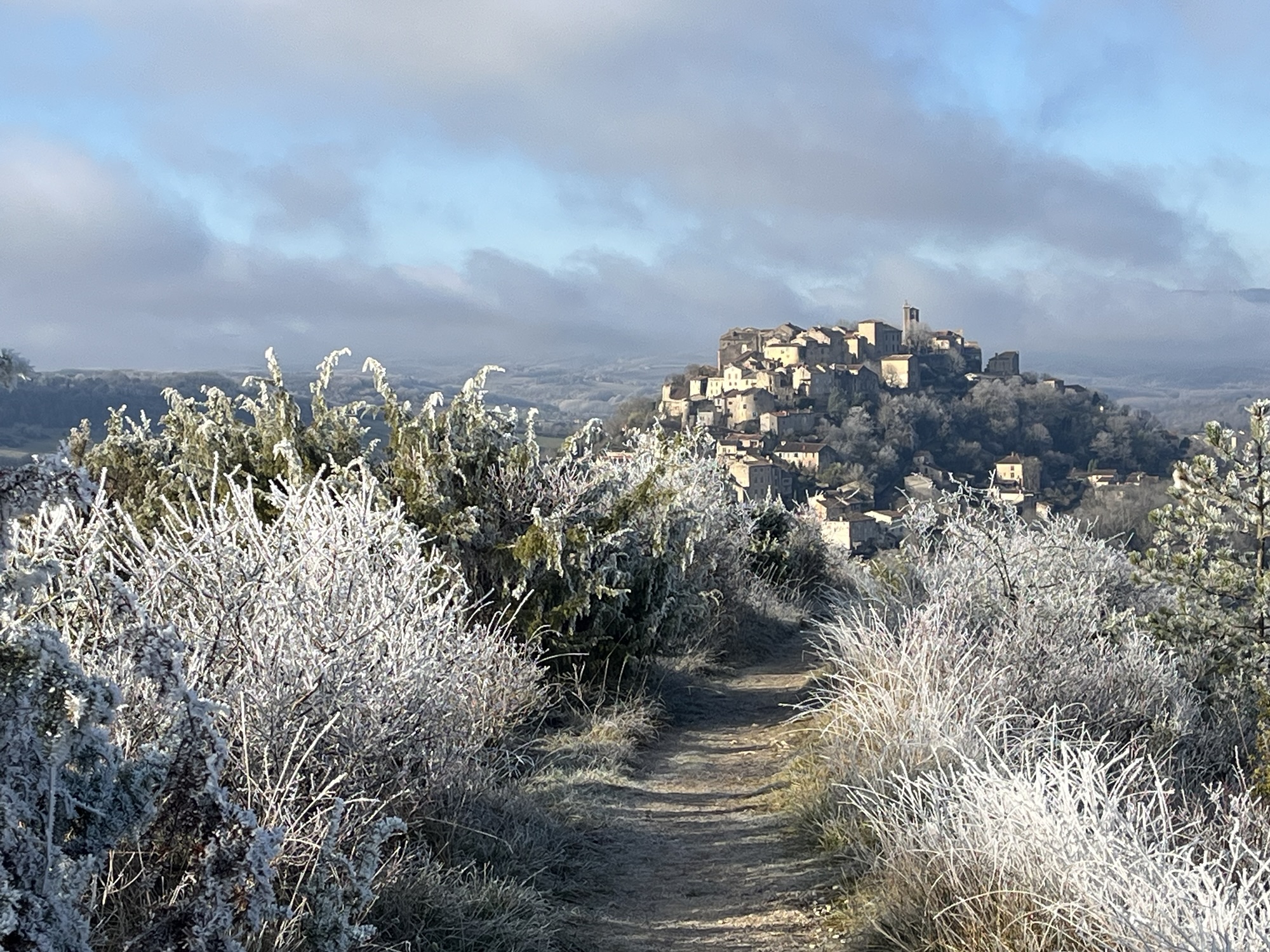
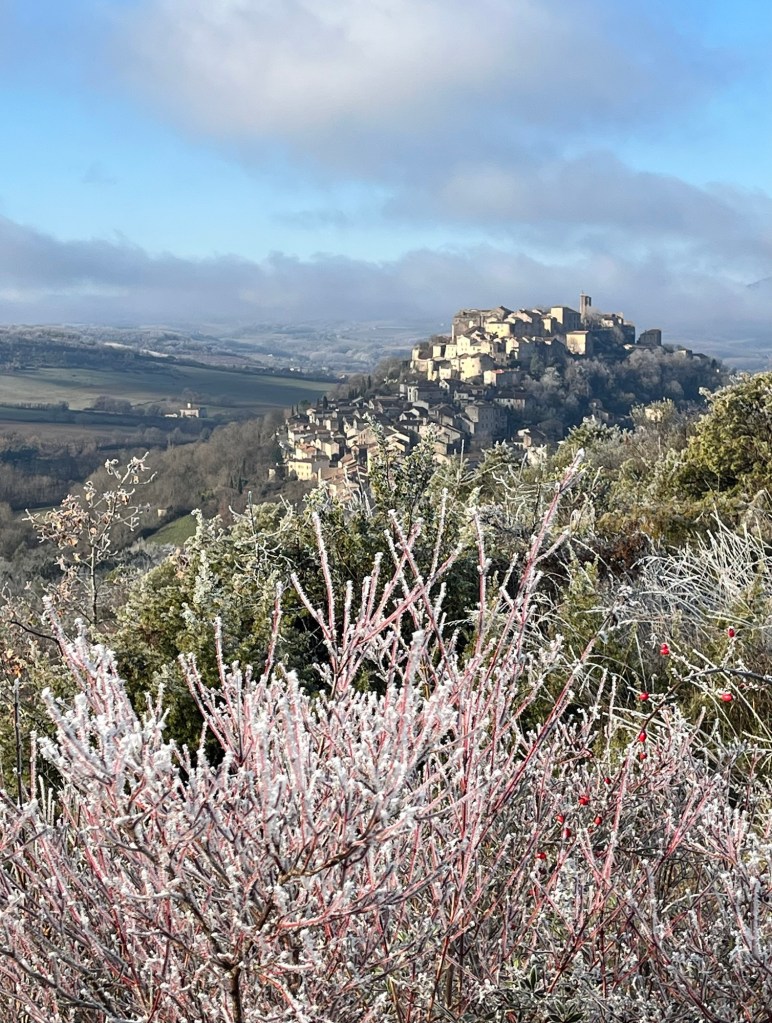
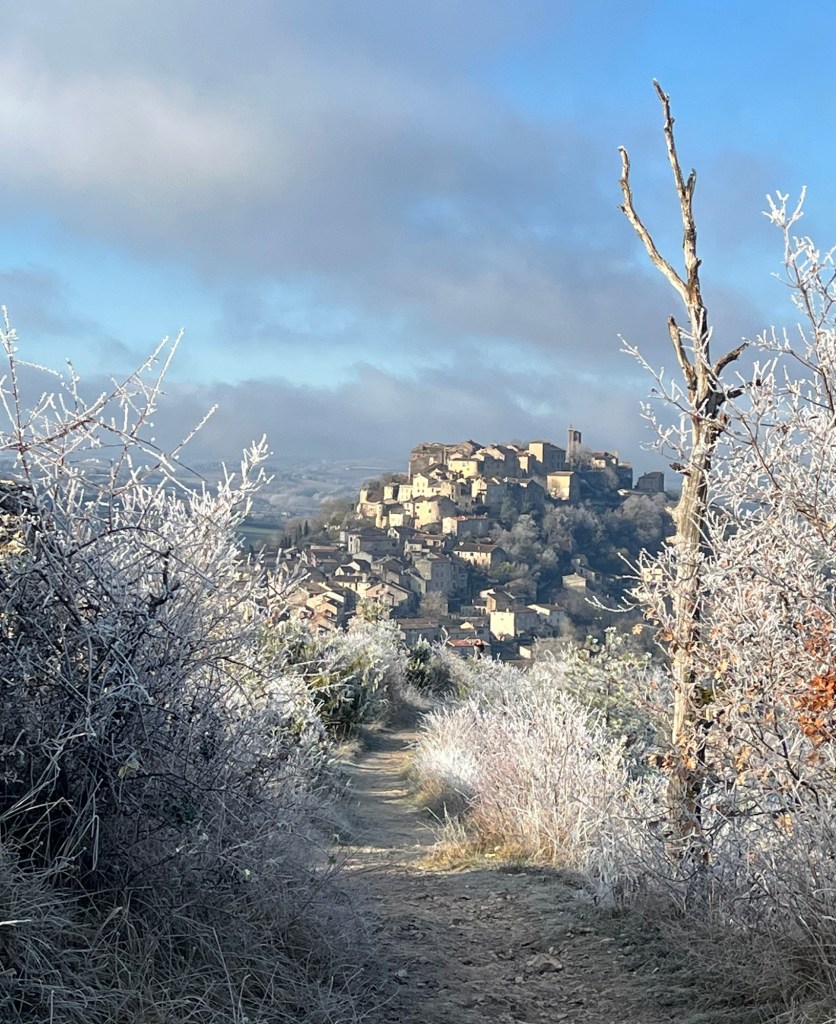
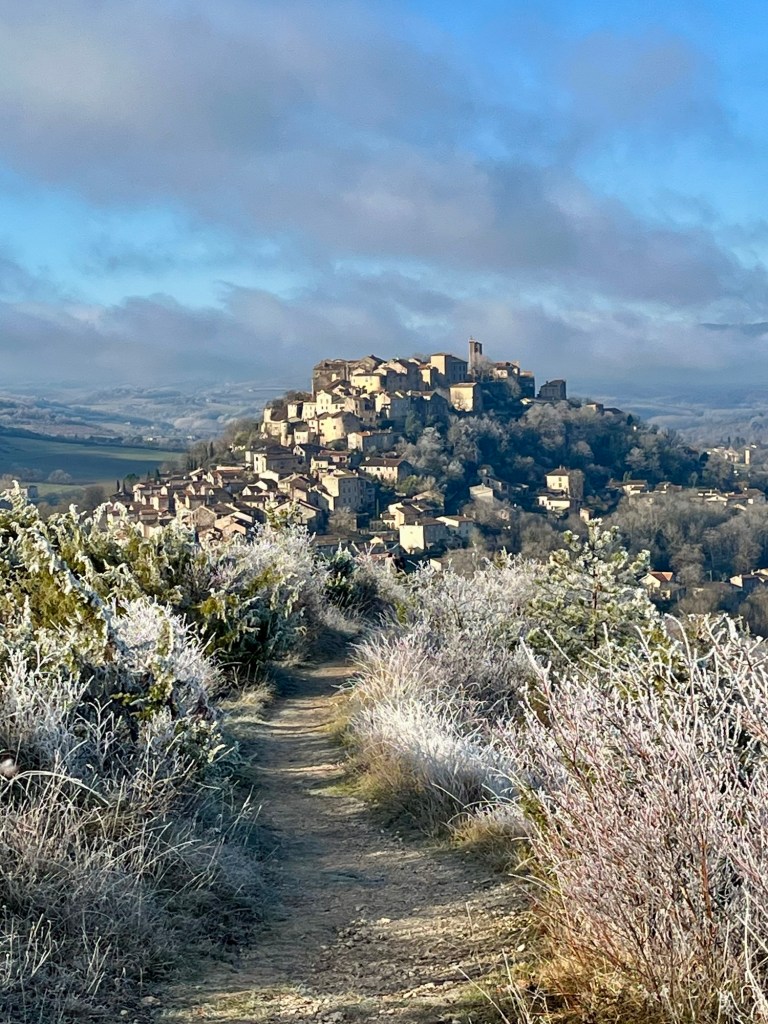
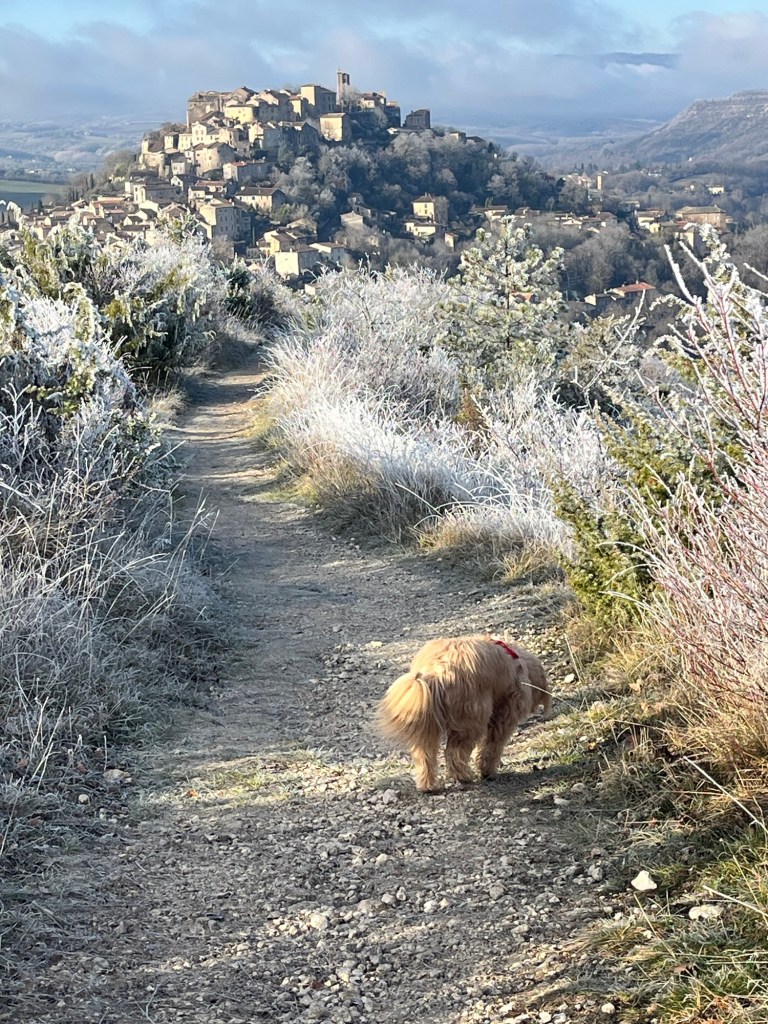
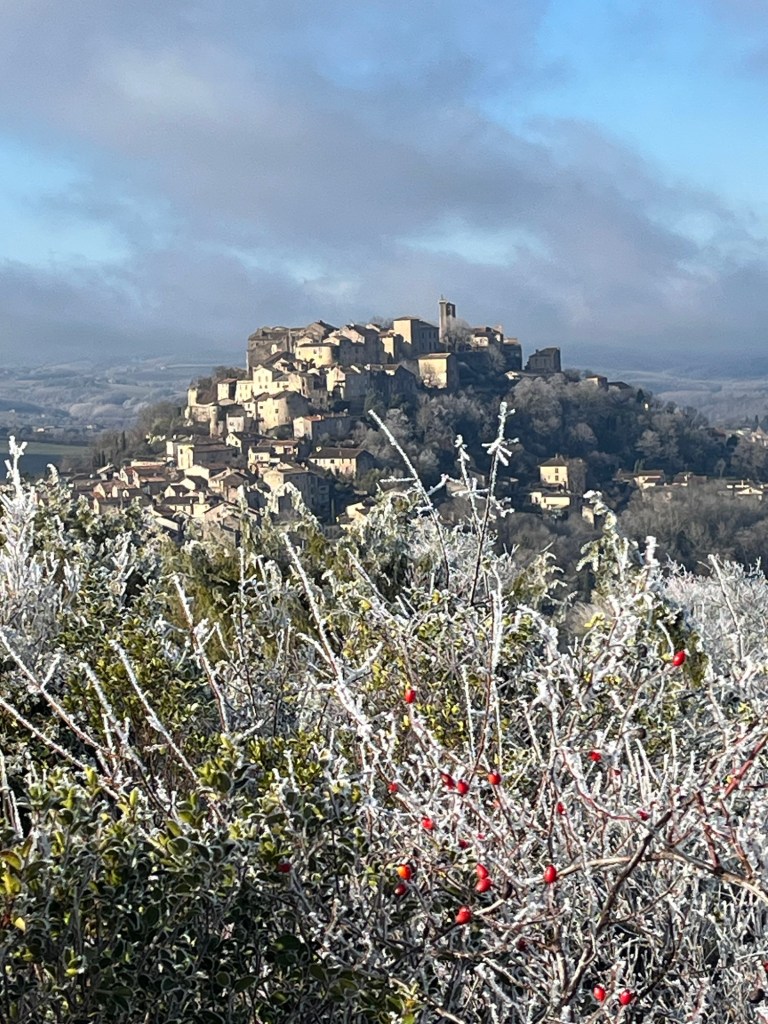
Once in a while, the fog that rises from the valleys surrounding Cordes-sur-Ciel freezes.
Overnight the dense cloud that made driving so difficult the night before becomes a delicate crystalline web, clinging to the edges of every leaf, every branch.
It’s magic.
This morning we walked to the le Grain de Sel, the chalky outcropping you can see from our street.
It’s a short but steep climb to walk there from our house, but you can drive up past it and take a flat path too.
Wishing you all a year filled with glimmers of hope, fresh insights, many moments of pure joy and raucous laughter, and at least a few of breathtaking awe.
It really is. I know not a lot of people think about stuff like this, but I do.
Today I put up a video of the presentation I gave to a couple of audiences on the subject over the past couple weeks. The video isn’t perfect even though I recorded it quite a few times. I wanted to do it one more time but Tom convinced me that it’s better with all the mistakes. “It’s more human,” he said. Good point. It’s not AI.
So, the presenatation is an exploration of the metaphor of the caterpillar dissolving into soup in order to become a butterfly, offering tools and understandings for navigating the liminal realms into which humanity seems to be dissolving.
It runs about 45 minutes. Take a look and tell me what you think.
Early this morning, at about 4:30, I was woken by a dream.
Someone is knocking at the door. I know it’s still night and at first I resist answering. The knocking persists, so at last I get up and go downstairs. At the door is the UPS man who shows up periodically in my dreams. He’s in this one, for example: https://eveneuhaus.com/2017/04/22/the-changing-room/) In the new dream, he hands me a soft package wrapped in white paper.
When I unwrap it, I see that it’s a fairy godmother dress, complete with folding wings. I am delighted.
As I wake up, my inner eyes still on the sparkling costume, I realize that I’d been blessed with another gift from Alice O. Howell, the third powerful vision she’s blessed me with.
The first came in a dream too, the night before I had my first of our long interchange of e-mails, talks on Skype, and occasional visits. In that dream, the central image was a telescope or kaleidoscope that I found in my pocket unexpectedly. When I looked into it, my own eye looked back.
The second was a vision in a meditation a couple days after she passed. In it, she was flying back and forth past me merrily, calling out “Look! I’ve left that troublesome body!”
And now she sends me a fairy godmother costume right when I need one. Oh my goodness, I am grateful beyond words.
Over the last few weeks, I’ve been busy preparing my talk for the Seekers Compass on November 16. Deadlines suit me. I like to work intensively on a project, and I have been working very intensively on this one. Day and night.
The talk is titled “Everyday Magic- synchronicity, symbols, and in-sight.” I gave it the name before I had any real idea about what I’d be saying, but I trust my intuition in matters like this. I planned to began the research by looking up the word “synchronicity.” I wanted to now what people are saying about it now.
I was off. I spent at least a couple of weeks down that rabbit hole.
Somewhere along the way, an app for recording and analyzing dreams, Temenos, was recommended. I downloaded it and immediately began having a series of dreams related, not surprisingly, to my upcoming talk. Using the voice recorder is much easier than writing down dreams. And, as these things go, the more you pay attention to your dreams, the more you remember them.
Weeks pass. I begin an outline of my talk but it’s uninspired. I start over, this time using images. Since it’s an online presentation, I pull up Keynote, which I haven’t used for many years, and start to play with it. As those of you close to me know, I’ve always been drawn to computer technology. It runs in my family. Alice gave me permission to love it when she explained that the waves of the symbol of Aquarius are energy waves, not water waves. Aquarius is an air sign. She eagerly embraced electronic communication.
The images I came up with soon coalesced into a detailed breakdown of the diagram Ganesh Baba drew for me on a paper napkin in a diner in Watkins Glen, New York, in 1979, the first full day I spent with him. It’s a diagram of the cosmos. At the time that he drew it for me and pounded the numerology associated with it into my head, we thought we only had that time together, so there was a strong sense of urgency. “This is your work,” he told me. Study it, remember it, and pass it on.
Ganesh Baba the day we went to Watkins Glen
It took me about two weeks to get an explanation of his diagram into images and language that I hope will be intelligible. Yesterday afternoon I decided that part of my presentation was finished.
When I went to bed I asked for a dream to guide the rest of my presentation, which is, after all, about Everyday Magic: Synchronicity, Symbols, and In-Sight.
I got a Fairy Godmother costume from Alice.
To top it off, I had a related vision about it in my meditation this morning, but I think I’ll save that for the talk itself.
Now I’m off to work on that presentation again, feeling very grateful indeed.
Look! I’m doing an online presentation that you can sign up for using the link on the picture. It’s an extension of the ponderings I’ve been doing on my blog in recent months. See you there?
Type the word “magic” into the search on my blog to get an idea of what I’ll be talking about.
Use the link at the bottom of the description to sign up.
This seems like the right day to share the Rosh Hashanah section of Underground, the second volume of Two Suitcases, which is currently being considered by agents.
May the new year bring you many moments of joy and small delights. May we all find the courage to stand up for our neighbors, the strength to resist instead of bending to dark forces, and the flexibility to let go and move on when it’s necessary.
And, even in the dark times, let there be singing. (paraphrase of Bertolt Brecht)
Shana Tova.
UNDERGROUND
Chapter 26
THE NUREMBERG LAWS
September 16, 1935
10 am
Basel
Emil picks up a copy of the Der Bund at a kiosk before boarding the morning train to Vienna. If all goes well, he’ll arrive in time for the festive meal his mother will have ready at sunset to celebrate Rosh Hashanah, the Jewish New Year.
Seated by a window, he reads the headlines about some laws that were announced the day before at the Nazi Party rally in Nuremberg.
ANTI-JEWISH LAWS PASSED IN GERMANY
Non-Aryans deprived of Citizenship and Right to Marry
Hitler warns that Provocative Acts will draw Reprisals
Two laws have been enacted, the Law for the Protection of German Blood and German Honor, and the Reich Citizenship Law.
The first of them bans marriage between Jews and non-Jewish Germans, criminalizes sexual relations between them, and prohibits Jews from employing German women under the age of 45 as maids.
The second defines who the first law applies to. Only individuals of “German or kindred blood” can now be citizens of Germany. Jews are relegated to the status of “subjects of the state.” The new law defines a Jew as anyone with three or more Jewish-born grandparents, including converts to Christianity and children and grandchildren of such converts.
Emil expected the news to be bad but he’s still shocked to see the prohibitions in black and white. Between his regular features, his red hair, and his apparent disinterest in religion and politics, Emil is rarely identified as a Jew, and, to be honest, he rarely identifies himself as one. The Swiss people with whom he works assume he’s a Catholic Austrian, and he hasn’t disabused them. But this news from Germany shakes him to the core. He wouldn’t be safe in Germany, and if Germany takes over Austria, of which there is talk, his family will not be safe in Austria.
What a blow to Jews, particularly on the eve of the most holy days of the year, he thinks. Rosh Hashanah begins that night and will be celebrated for two days. A week later comes the day of atonement, Yom Kippur, when Jews fast, the most sacred ritual of the year. He puts the newspaper down and closes his eyes. It’s good that he’s on his way home—he wants to be with his family.
In the seat behind Emil, two businessmen, one Swiss and one Austrian, are talking.
“They’ve changed the flag in Germany, did you see that?” says the Swiss.
“No, to the Swastika?”
“Yes, on a red background. It doesn’t surprise me. Hitler says his Reich will last a thousand years, so naturally he would put his own flag in place.”
The Austrian is nonplussed. “I read that they’ve formally downgraded the Jews to non-citizens. Not a bad idea, if you ask me. They’re not so much of a problem in Switzerland, but in Germany—and in my own country—the Jews have had far too much power for too long.”
“In what way?”
“In the universities, for a start, and in banking, of course, but it’s far more than that. For years, the Jews in Vienna have controlled the discourse. They’ve set the tone for what people think! They decide what’s good and what’s bad. That’s the real reason the Germans are smart to do what they’re doing.”
The Swiss man isn’t convinced. “I don’t buy it. Why would a strong, intelligent people like the Austrians let that happen?”
“I’m sure if they knew it was happening they wouldn’t have agreed to it. But the Jews are sneaky, and they have international connections that quietly help get them into positions of power.”
“I’ve heard those arguments before, but I don’t understand why it should be true in Germany and Austria, but not in Switzerland.”
The Austrian man’s lip curls. “It is, my friend. You and your countrymen choose not to see it.”
Emil shudders.
* * *
Leopoldstadt
A few hours later
Emil puts his suitcase down on front of his parents’ door, and takes in the enticing smell of his mother’s cholent filling the hallway. The savory bean stew with bits of meat and potatoes has always been his favorite. This is the first time he’s been home since April, almost half a year, and the smell of the cholent makes him happy he came. He just hopes he won’t find his parents, Ottilie and Richard, in exactly the same positions in which he left them, his mother chattering nervously in the kitchen, his father slouching in his chair, ignoring her.
In fact, when his father opens the door, Ottilie is busy in the kitchen and the state of the living room indicates that Richard had just risen from his chair when Emil rang the doorbell. But things have changed. The place is much cleaner. The untidy piles of newspapers on the dining room table have been replaced with a tablecloth.
An hour later, as Ottilie is putting out place settings, the doorbell rings again.
“Tante Stefi! Nathan!” Emil is pleased to greet his mother’s sister and her son, his cousin Nathan. “I didn’t expect to see you!”
“We couldn’t stay away from you forever,” Stefi says, patting Emil’s cheek as if he were a small child. “No matter what your father did.”
“Mutti! You promised not to make remarks like that!” Nathan, nine years younger than Emil, will be entering university this fall if Emil’s calculations are right. The cousins haven’t seen each other since the bank failure five years ago, when Richard’s part in the mismanagement of the Creditanstalt Bank led to its collapse, and took Ottilie’s family fortune—and that of many other Jewish depositors—with it. The scandal had split the family, with Stefi’s husband refusing to speak to Richard since then. Nathan was a child at the time. Now he’s almost a man.
Richard speaks up, a false heartiness making his voice too loud. “Welcome, welcome! L’Shana Tova!”
New Year’s greetings are shared all around, the guests’ coats hung on the coat tree, and the family makes themselves comfortable around the table. The men put on their yarmulkes and Emil’s father, his tallit, or prayer shawl.
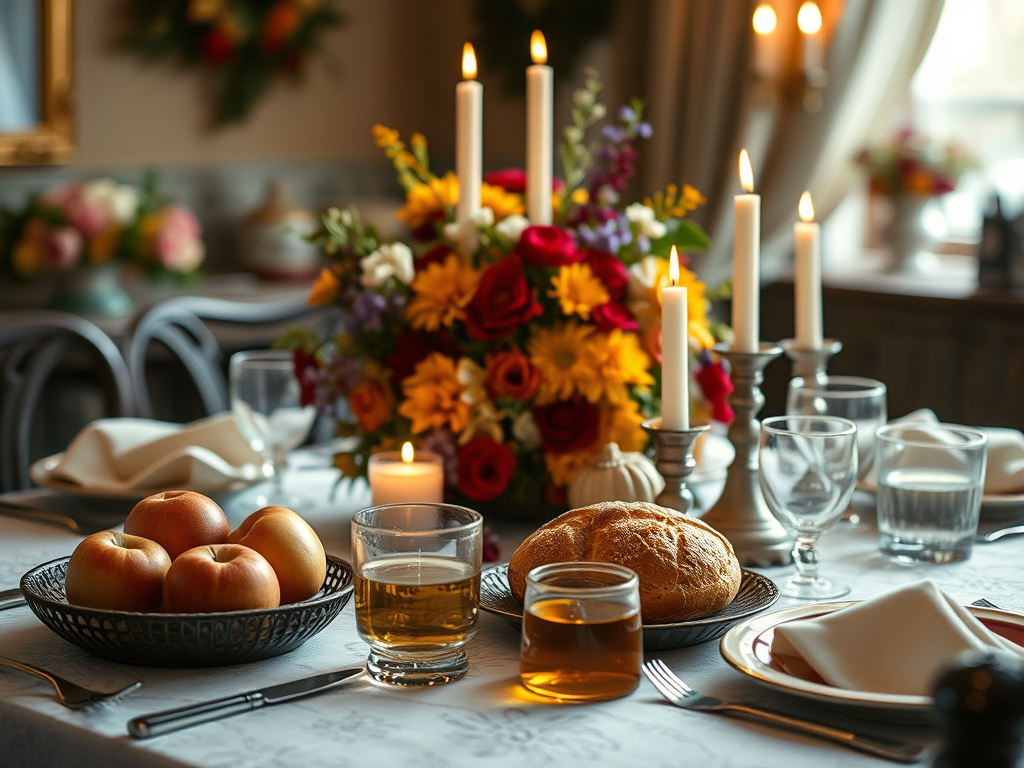
Ottilie emerges from the kitchen to light the candles and say the opening blessing, and Richard follows by blessing the wine. The blessing of the Challah, a beautifully braided loaf of bread glistening with egg wash, fresh from the oven, is next.
As everyone takes a piece of the bread and dips it into honey to celebrate the sweetness of life, Emil comments,
“Not such a happy new year for the Jews in Germany.”
Bread and honey in their mouths, no one says a word.
Next, slices of apples are dipped in the honey, and Emil smiles along with everyone else as the blessing is chanted and wishes for a sweet new year are exchanged. Carp in sulz, fish in cold jellied broth, is the next course.
Between the prayers and the sharing of ritual foods, the family catches up on the news. Nathan will not be attending university although he has been preparing for it for years. Instead, he will be a clerk in the bookshop owned by one of his father’s cousins. No one asks why his father isn’t there—they all know he blames Richard for the whole family’s financial difficulties.
Then the real meal begins. Ottilie brings everyone some homemade chicken broth with two matzo balls in each bowl.
Stefi is surprised. “Matzo balls! But it’s Rosh Hashanah, not Pesach!”
“It isn’t so often I have my whole family here,” Ottilie says. “I made all of Emil’s favorites. I want to lure him back to Vienna!”
Emil smiles at her. “So far, so good.”
Three more times through the long meal he tries to talk about the Nuremberg Laws, and three more times he’s shut down by one or more of his relatives.
Chapter 27
MAKING AMENDS
September 17, 1935
late morning
Café Josef Weiss and Café Central
After the morning service at the synagogue, Leo and Felix walk over to their regular café, where they find Anna, Max, and Hugo standing beside the locked door.
“I guess they don’t work on the Jewish holidays either,” Anna says. “But why don’t we go somewhere else? I’m sure the cafés in the Inner City are all open.”
So it is that most of the group is at Café Central when Emil walks in. Warm greetings are exchanged and Emil joins them at their table.
“So,” Felix says, “who went to synagogue this morning?”
“I did,” says Emil. “The singing was outstanding. There’s a new cantor at my family’s temple.”
Leo looks around the circle, his head cocked. “Nobody else? Yet none of us went to work.” He raises his bushy eyebrows. “Felix and I went with the family. I enjoyed the music too—the fellow who blew the shofar did a particularly impressive job—but it was the rabbi’s talk that will stay with me.”
“And so?” asks Hugo.
“He brought up a tradition that I had either forgotten or isn’t often followed. In the eight days between Rosh Hashanah and Yom Kippur, it is our responsibility to make amends.”
Anna interrupts. “We all know that. It’s nothing new.”
“But this rabbi suggested that we take the project much more seriously, that we go and knock on the doors of the people we may have wronged, and apologize face to face,” Leo says.
His brother adds, “I think it’s a good idea. I’m planning to do it. Is anyone else up for the challenge?” He lights a cigarette and looks at each of the others questioningly.
“It’s not for me,” Max says. “I wouldn’t want to take the chance that my apology wouldn’t be accepted. I could have a big argument on my hands.”
Anna thinks for a moment and then says, “I think it’s a very good idea. It’s excellent psychology. Everyone feels better after Yom Kippur because you get rid of whatever guilt you were feeling. Confession in Catholic Church does the same thing. Taking the trouble to face the people you may have hurt or caused problems for makes a big difference to everyone involved. I’m in, even though I almost never take religious customs seriously.”
“Really?” says Max, incredulous. “You are my sister Anna, aren’t you? And not her long-lost twin?”
Anna scoffs.
Max turns to the others. “Have any of you ever heard my sister apologize to anybody about anything?”
A ripple of laughter spreads around the table. Emil raises one finger. “I have.” He looks at Anna. “We were walking in the Heiligenstädter Park, arguing.” He crooks an eyebrow at Anna as if to say, do you remember? “I was defending Karl Lueger, the Christian Socialist mayor who built so much of Vienna’s infrastructure, and you were rightly calling him a populist and an anti-Semite. I said it didn’t matter, the city was better because of what he did, no matter what his politics were. The argument ended when you apologized, as I recall, and admitted I was right.”
“That is certainly not how I remember it!” cries Anna, dark eyes flashing. “As I recall, we came to the end of the park and I said, ‘Let’s not argue anymore—let’s talk about something else.’”
Emil looks down his nose. “I don’t think so. But let me be the one to say ‘let’s not argue’ this time. And let me apologize for remembering the incident differently.”
“No,” says Hugo thoughtfully, “I don’t think that’s the kind of apology the rabbi meant. As my mother used to say, apology is cheap currency. It’s easy to apologize without meaning it because it doesn’t cost anything.”
Emil is surprised. “But I’m genuinely sorry, Hugo. It doesn’t count if you haven’t stewed on the offense first?”
Felix answers. “Emil is right, Hugo. Both kinds of apologies are effective so long as they’re sincere.”
Anna doesn’t give anyone else the chance to respond. “But apologies can also be used to get one’s way! Willi is a master of it!” She grimaces, thinking of the little boy she’s caring for. “He does something truly terrible, like hitting another boy,” she throws up her hands in frustration, “and then he apologizes to the other child—and to us, and his teachers, and to the injured child’s parents—and it all sounds perfectly sincere! He looks like he really means it.”
“He’s learned how to put on exactly the right face,” agrees Hugo. “In fact, he can be so believable that I’m taken in every time. I think he’s making sincere promises, from the bottom of his tough little heart, and I give him another chance.” He snorts, blowing cigarette smoke out of the corner of his mouth.
Anna continues, “But afterwards he can never manage to keep up the good behavior, no matter what his intention is. He always slides back. Poor Willi.” She sighs. “He’s only 10.”
Of the five men at the table, only Hugo looks at Anna sympathetically.
Emil is admiring the line of her chin and her high cheekbones. He finds her especially attractive when she’s passionate.
Max is fuming silently. In his book, Anna is sharing one more reason why Willi needs to move on.
“So, is Anna the only one taking up the challenge, then? Is it just the two of us? Leo?” asks Felix after a pause.
In the end, Max is the only one who doesn’t agree to make amends that week.
As they get up to leave, Emil and Anna make a date to meet again in two days.
* * *
September 19, 1935
late morning
Café Landtmann, Vienna
Anna arrives at the café 10 minutes early and immediately orders a coffee. She prefers to pay her own way, even though she knows Emil can well afford to pay for them both. The fact that she has barely begun a new job as an office clerk after more than a year of not working doesn’t change how she feels.
As she inhales the scent and sips the coffee very slowly, she notices an older, neatly bearded man talking to a younger man at the next table. Can it be Professor Doctor Freud? It isn’t the first time Anna has seen him—she heard him lecture at the university several times—but that was always from a distance. She listens carefully. If she isn’t mistaken, he and the younger man are talking about cigars.
Doctor Freud lights one and breathes in the smoke contentedly. The younger man speaks.
“Of course you are aware of the recently enacted Nuremberg Laws in Germany, Herr Professor?”
“I am, and I find it most concerning.” The older man moves his jaw in a peculiar way as he speaks.
“Professor, you are Jewish. If Germany were to annex Austria, as Hitler desires, would you go to Palestine, as so many Jews have? I know you stated a few years ago that you didn’t support establishing a Jewish state in Palestine.”
“That’s correct, and I stand by my words. I don’t think that Palestine could ever become a Jewish state, or that the Christian and Islamic worlds would ever be prepared to have their holy places under Jewish care. It would seem more sensible to me to establish a Jewish homeland on less historically-burdened land.”
At that moment, Emil slides into in the chair opposite Anna. She’s was so engaged in Freud’s conversation that she didn’t even notice him entering the café.
“Anna,” he says without greeting her formally, “I want to apologize more fully.” He leans forward, puts his elbows on the table, and looks at her intently, a crooked smile on his face.
She pulls herself away from Freud’s words, and turns to Emil, tipping her head toward the psychologist and discreetly pointing with her finger.
Emil glances at Freud and mouths “Freud?”
She nods “Yes!”
But the moment is gone. The professor and the young man are standing and then moving toward the door.
Emil and Anna sit and talk at the café all morning. He begs her pardon for having acted superior and not always listening to her. She begs his for having gotten angry too quickly and for her own variety of acting superior.
He tells her about some of his eccentric coworkers at Sandoz. She tells him about her boring office job.
“I spend my days sitting in a row with a dozen other women, all of us copying information from hand-written bills of sale into enormous ledgers, and then adding up column after column of numbers,” she says. “You can’t imagine how frustrating it is when the sums don’t come out right. I’m very tempted to leave them wrong.”
Emil raises both eyebrows. Anna continues, “I dislike the old crone in charge of us enough to be glad to get her in trouble, even though in the end, it would be me who’d get fired.” She pulls a piece of paper out of her bag. “Look. This is my boss.” She holds out a caricature of an angry older woman with exaggerated hawk-like features. “One of the other women drew it and gave it to me.” They both chuckle.
“It’s good!” he says. “I can imagine her perfectly.”
They go on to tell old stories, and they laugh until the man who has taken Freud’s table turns around and glares at them.
* * *
Felix and Leo begin the day by apologizing to their mother for all their boyhood antics. The family spends hours reminiscing, hooting with laughter, as one old story leads to another.
* * *
Hugo is shifting from foot to foot impatiently in front of Gert’s door when she returns from work.
“Gert, listen. There’s something I need to tell you. I realized that I take you for granted far too often. I am so sorry.” His words flood out.
Gert smiles a little as she inserts her key in the lock. “My goodness, what brings this on? Come in, come in.”
They sit at her table, and he tells her about the rabbi, and about the agreement between their Jewish friends to take making amends seriously. As he speaks, he realizes there’s more he wants to say. He takes a deep breath.
“I have another apology, too. Our relationship is years old now,” he says. “I should have asked you to marry me a long time ago.” Another breath. He looks down and then up, into her eyes. “Gert, will you marry me?”
Gert grins from ear to ear. “Hugo! Of course! I forgive you everything and yes, I will marry you!”
* * *
Max unpacks two radios and assembles three lamps that morning.
* * *
Later in the week, Emil and Gisi meet for a walk in the Stadtpark. Though they’ve agreed that nothing would change, it has. There’s a new distance between them, a slight hesitation before they begin to speak, more silences between their words.
He tells her about the apologies he made to some of his school friends, one who had completely forgotten the incident Emil was apologizing for, the other who remembered it very well and was surprisingly grateful to Emil for stopping by.
“And Max? “ asks Gisi. “Was he there when you all agreed to carry out this project to make amends? Because I haven’t seen him all week.”
Le vendredi suivant celui où les pierres noires étaient apparues puis avaient disparu, je suis retourné à Emmaüs pour voir si la personne qui les avait emportées chez elle par inadvertance les avait peut-être rapportées.
The day began well with a slow drive—our Ami only goes 45km (28mph)—through the hills, lush green with all the rain, while chatting with a friend, Anu, who’s only in Cordes a short time each year.
La journée a bien commencé par une balade tranquille en voiture – notre Ami ne roule qu’à 45 km/h – à travers les collines verdoyantes après la pluie, tout en discutant avec une amie, Anu, qui ne passe que peu de temps à Cordes chaque année.
It was on our walk to Emmaüs from the car that I made my first mistake. As I was telling Anu about the ephemeral black stones, we passed a woman talking to a couple as she bent over to arrange some white stones in a tray in front of her garage door. We laughed—white stones this week!—and I’m certain I heard the words, “la magie des pierres,” (the magic of stones) but we didn’t stop to hear more.
C’est lors de notre promenade entre Emmaüs et la voiture que j’ai commis ma première erreur. Alors que je parlais à Anu des pierres noires éphémères, nous avons croisé une femme qui discutait avec un couple, penchée pour ranger des pierres blanches dans un plateau devant la porte de son garage. Nous avons ri– des pierres blanches cette semaine !–et je suis certaine d’avoir entendu les mots « la magie des pierres », mais nous ne nous sommes pas arrêtées pour en savoir plus.
Did I pause to hear more? No.
Me suis-je arrêté pour en savoir plus ? Non.
The black stones had not been returned to the store. My round table wasn’t there, not was the small carpet for the upstairs landing.
Les pierres noires n’avaient pas été rapportées au magasin. Ma table ronde n’était pas là, pas plus que le petit tapis destiné au palier à l’étage.
But, in the same place in the kitchen section that I’d found the black stones on the glass candy dish the previous week, I found a brass monkey on a crocodile.
Mais, au même endroit dans la section cuisine où j’avais trouvé les pierres noires sur le plat à bonbons en verre la semaine précédente, j’ai trouvé un singe en laiton sur un crocodile.
“What a treasure!” said the guardian of the kitchen section as she wrapped my 1€ find in newspaper.
« Quel trésor ! » s’exclama la gardienne du rayon cuisine en emballant ma trouvaille à 1 € dans du papier journal.
On our way out of the store, I unwrapped it to show Anu, who, being Indian, immediately recognized that my treasure was from the Panchatantra teaching story, “The Monkey and the Crocodile.” We were talking about that as we passed the tray of white stones, still displayed in front of the garage door.
En sortant du magasin, je l’ai déballé pour le montrer à Anu qui, étant indienne, a immédiatement reconnu que mon trésor provenait du conte pédagogique du Panchatantra, « Le singe et le crocodile ». Nous en parlions en passant devant le plateau de pierres blanches, toujours exposé devant la porte du garage.
Did I stop to take a picture? No.
Est-ce que je me suis arrêté pour prendre une photo ? Non.
When I came home, I looked up the story. Here’s my favorite rendition of it:
Once upon a time, a monkey lived in a tree by a river. The monkey was alone as he had no friends or family but he was happy and content. The tree gave him plenty of sweet jamun fruit to eat. It also gave him shade from the sun and shelter from the rain.
One day, a crocodile was swimming up the river. He climbed on to the bank to rest under the monkey’s tree.
‘Hello,’ called the monkey, who was a friendly animal.
‘Hello,’ replied the crocodile, surprised. ‘Do you know where I can get some food?’ he asked. ‘I haven’t had anything to eat all day and I am hungry.’
Now you might think that the crocodile would want to eat the monkey, but this was a very kind and gentle crocodile and the thought never entered his head.
‘I have lots of fruit in my tree. Would you like to try some?’ said the monkey, who was also very kind.
He threw some jamun fruit down to the crocodile. The crocodile was so hungry that he ate up all the jamuns even though crocodiles don’t usually eat fruit. He loved the sweet tangy fruit and the pink flesh made his tongue turn purple.
‘Come back whenever you want more fruit,’ said the monkey, when the crocodile had eaten all he wanted.
Soon the crocodile was visiting the monkey every day. The two animals became good friends. They would talk, tell each other stories and eat lots of sweet jamuns together.
One day, the crocodile told the monkey about his wife and family.
‘Please take some fruit for your wife as well when you go back today,’ said the monkey.
The crocodile’s wife loved the jamuns. She had never eaten anything so sweet before but she was not as kind and gentle as her husband.
‘Imagine how sweet the monkey would taste as he eats these jamuns every day,’ she said to her husband.
The kind crocodile tried to explain to his wife that he could not possibly eat the monkey.
‘He is my best friend,’ he said.
The crocodile’s greedy wife would not listen. To get her husband to do what she wanted, she pretended to be ill.
‘I am dying and only a sweet monkey’s heart can cure me!’ she cried to her husband. ‘If you love me, you will catch your friend the monkey and let me eat his heart.’
The poor crocodile did not know what to do. He did not want to eat his friend but he could not let his wife die.
At last, he decided what he must do and the next time he visited the monkey he asked him to come to meet his wife as she wanted to thank him in person for the lovely jamun fruit.
The monkey was pleased but said he could not possibly go because he did not know how to swim.
‘Don’t worry about that,’ said the crocodile. ‘I’ll carry you on my back.’
The monkey agreed and jumped onto the crocodile’s back.
So the two friends moved out into the deep wide river.
When they were far away from the bank and the jamun tree, the crocodile said, ‘I am so sorry but my wife is very ill and says that the only cure is a monkey’s heart. I am afraid that I have to kill you, although I will miss our talks.’
The monkey thought quickly and said, ‘Dear friend, I am very sorry to hear of your wife’s illness. I am glad that I will be able to help her but I have left my heart behind in the jamun tree. Do you think we could go back so that I can fetch it?’
The crocodile believed the monkey. He turned and swam quickly to the jamun tree. The monkey jumped off his back and climbed into the safety of his tree.
‘I thought you were my friend,’ he called. ‘Don’t you know that we carry our hearts within us? I will never trust you again or give you fruit from my tree. Go away and don’t come back.’
The crocodile felt foolish. He had lost a friend and a supply of good sweet fruit. The monkey had saved himself because he had thought quickly. From that day on, he never trusted crocodiles again.
Quand je suis rentré chez moi, j’ai cherché cette histoire. Voici un lien vers le conte en français :
It took me about a week of asking my French neighbors to learn that putting white stones in front of your house for good luck or to make it welcoming is an old, local custom, and even longer to find an article about it.
Il m’a fallu environ une semaine pour apprendre, en interrogeant mes voisins français, que placer des pierres blanches devant sa maison pour porter chance ou la rendre accueillante est une ancienne coutume locale, et encore plus longtemps pour trouver un article à ce sujet.
“Healing stones in the French countryside: forgotten knowledge
Not so long ago, the French countryside was rich in ancestral knowledge passed down from generation to generation, whispered in hushed tones or through age-old gestures. Among these traditions, the art of healing with stones, known as lithotherapy, held a discreet but essential place in the daily lives of villagers.”
Since learning about the magic of white stones, I’ve noticed how often there’s one white cobblestone on the street in front of houses, or a white stone placed at the corner of a house. I got to know my neighbors better by asking my neighbors about the custom, and I put a couple white stones on my own windowsill, too.
Depuis que j’ai découvert la magie des pierres blanches, j’ai remarqué qu’il y avait souvent un pavé blanc devant les maisons ou une pierre blanche placée au coin d’une maison. J’ai adoré interroger mes voisins sur cette coutume et j’ai moi-même placé deux pierres blanches sur le rebord de ma fenêtre.
So, even though I missed the opportunity to learn the magic of the stones from the woman in Carmaux, and I missed the chance to take a picture there, I did get another good story.
Ainsi, même si j’ai raté l’occasion d’apprendre la magie des pierres auprès de la femme de Carmaux, et même si je n’ai pas pu prendre de photo là-bas, j’ai tout de même obtenu une autre belle histoire.
The moral of the Monkey and the Crocodile and of my own story is similar.
Even though bad things happen, good thinking and smart actions can lead to happy endings.
La morale de l’histoire du singe et du crocodile, et celle de ma propre histoire, est similaire..
Même lorsque des événements malheureux surviennent, une réflexion positive et des actions intelligentes peuvent mener à une issue heureuse.






















 Eve Neuhaus