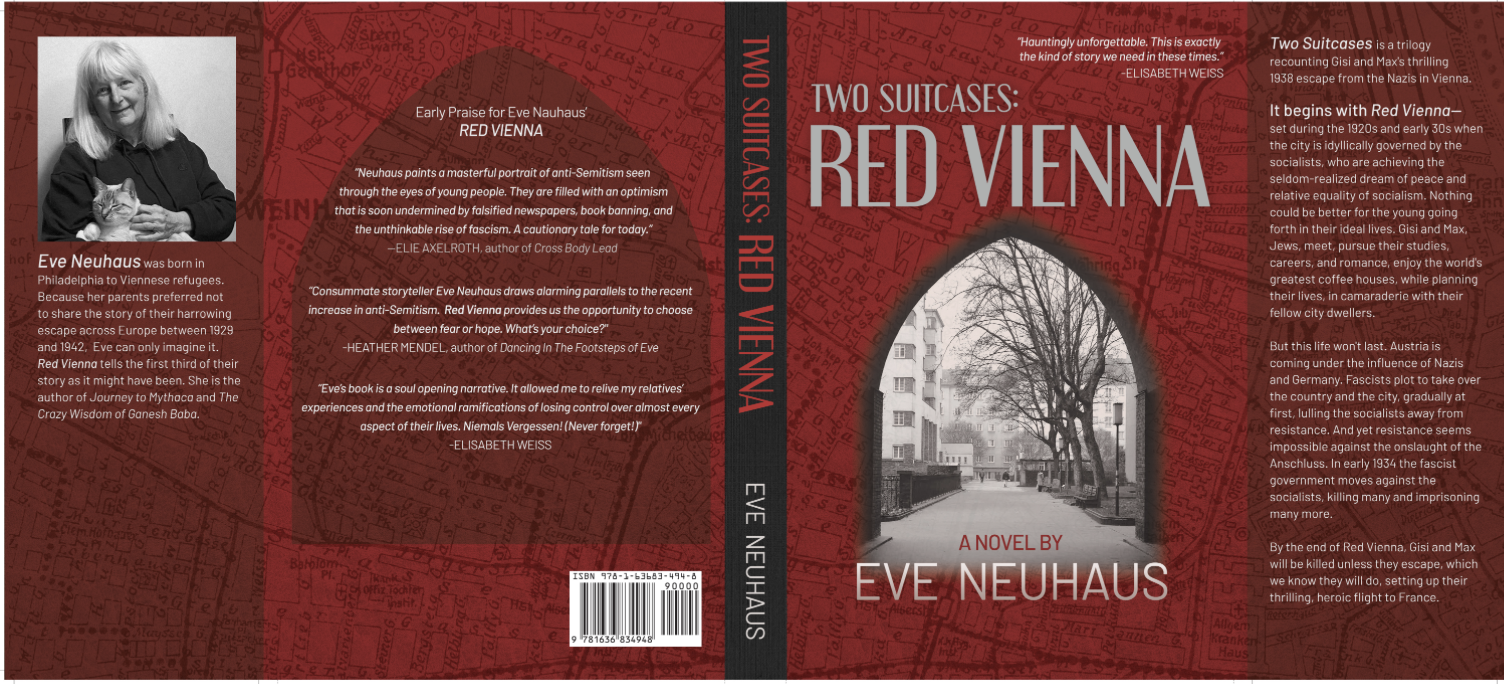
Red Vienna is coming, I promise you. But, as anyone who has published a book will tell you, it always takes longer than you hoped.
While I wait I’ve been working on Underground, the second volume of Two Suitcases. After the fascist government of Austria banned the Social Democratic party, its activist members went underground, hence the title of the volume. In the outer world Leo works as a printer, and Hugo grinds lenses for an optician, but their real work takes place very discretely in a basement room in one of the social housing complexes.
Here’s the part I wrote today.
Chapter 19
Hijinks
April 20, 1935
a hidden room in the basement of Goethe-hof, a social housing complex
Leo and Hugo lean over a heavily crossed out and written over text, the harsh light above them creating a circle on the old table. Next to them is a stack of the official stationery of the President of the Police, Dr. Skubl. The pages even have his rubber-stamped signature at the bottom.
“No,” says Leo, pointing to the text. “Change it to make Skubl say, ‘As our noble police are currently occupied with arresting Socialists, Communists, and other anti-Fascists, the duty falls upon the public to keep down common crime.’ Add the word ‘noble.’”
“Right, right, that works better,” Hugo answers, looking up a moment and cleaning his glasses. “And the next part is good too, but let’s also make him assure the people that their taxes are being well-spent. Huh. Why don’t we invite people to inspect the police headquarters so they can see with their own eyes the absurd sums of money our government is spending on armaments to deploy against political opponents?”
Leo laughs. “Great idea!”
Hugo thinks. “How about advertising an Open House at police headquarters every Sunday morning? The invitation would specifically say it’s to see the vast armory of tanks, machine guns, rifles, gas weapons, etc., etc., ready to kill their neighbors and co-workers, all funded by their taxes. Let Skubl say it’ll start in May.”
“That’s it, perfect. Write down what you want it to say. I’ll get the type set.”
“We have a dozen sheets of this stationery, more than enough to get it out to the state newspaper, the radio, and the foreign press.”
“I can do some posters and flyers announcing the Sunday Open Houses, too.” Leo smiles at the thought of the police headquarters being overrun with people demanding to see the armory.
“Excellent. Make sure they give the reason for the Open House clearly: to see the weaponry meant to control the opposition.”
“It’ll have to be very carefully worded.”
“Of course. I trust you,” Hugo says, putting on his jacket. “Show me the first drafts when they’re ready.”
At just the same time in another neighborhood
Frau Selma Schmid of Habbichergasse is looking out of the window of her small apartment. The weather is changing. Soon it’ll be raining again, she thinks, and it’s so cold for April. I should start a fire. As she takes some old papers from the pile to throw into the cold coal stove, she glances at the program from an event she and her husband attended the week before. How proud she felt to see Major Fey, noble leader of the Heimwehr, as he was installed as Regent of Austria. Such an honor. Frau Schmid loves pageantry. Fondly, she recalls standing next to her father as the funeral procession of Emperor Franz Josef went by in 1916. Life was much better under the monarchy, even at the end, during that horrible war.
As she’s about the crumple the program up, she notices the words, “Free to the bearer of this program” and she looks more closely. What is free? Nothing is free anymore.
The door opens and Herr Schmid, disheveled after his afternoon nap, comes in. “What are you doing?” he asks grumpily. “We can’t afford a fire. It’s the middle of spring, what are you thinking?”
“But look, my dear! To think I almost threw this away! On the back of the program to Regent Fey’s installation is a generous donation by his supporters. It says that if we bring this program to any of the shops listed here, we’ll be offered our choice of goods worth 10 schillings! That’s three loaves of bread!”
“Now, why would anyone do that? It makes no sense at all to me,” mutters Herr Schmid, sitting down to look at the program.
“But that’s what it says,” his wife points out. “Look at the list. All these merchants are making the offer just to celebrate Regent Fey.”
“Well,” grunts her husband. “That’s what it says alright. Put on your coat. We’ll go to Oberhoffer’s—you see, he’s listed here—and see what’s left in his shop. Very little, I’m betting. He’s an old fool to have made such an offer.”
“Herr Oberhoffer is an honorable man, Richard. And a patriot. I’ll get my bag.”
Ten minutes later, the couple is entering the bakery while another couple opens an umbrella outside the shop.
“Georg! I told you it was a scam!” the woman is saying.
“But it was the official program. The guard at the gate was handing them out. I saw it myself,” her husband insists as they walk away.
“Ha,” says Herr Schmid to his wife Selma. “I told you so. You heard that. It’s a scam.”
“I’m going in anyway. I want to hear what Herr Oberhoffer has to say,” she replies, entering the shop.
“Nothing!” comes a shout from behind the counter. “I have nothing to say! Except that it’s not true, I’m not offering anybody anything for free!”
The Schmids stare at the baker.
“Nobody gets anything for free from me!” the baker goes on.
“What a miser!” says Herr Schmid to Selma as he turns and leaves. “He should have been generous and gone along with it even if it was a scam. That’s the last he’ll see of me!”
His wife hurries out after him.
In the hidden room in the basement of Goethe-hof
Leo says to Hugo, “Before you go, do you happen to have heard how the programs for Fey’s installation as Regent of Austria worked out? I printed a thousand of them even though they only expected a few hundred at the event. Franz said they’d be distributed at the event itself and that the rest would be left here and there all over the city.” He chuckles. “Halfway through the program we said Fey would be officially declaring himself Regent of the country he destroyed. That was the exact language. Of the country he destroyed. I wonder how many people read far enough to see that.”
“I’ll bet they read far enough on the back to see the list of shops in Vienna where they could get 10 schillings worth of free goods by presenting the program. I’ll have to ask around to see how that turned out.”
“It makes me laugh just to think of it,” Leo smiles.
“It’s incredibly frustrating, though, that our communication system is so limited. Without being able to use the post, telephone, or the telegraph, sometimes it takes weeks before I hear the results of something we planned and printed right here.”
“That’s true. Our illegal network is disrupted ridiculously often. Collection points can’t be accessed because a new neighbor moved onto the block, or worse, because one of our ‘postmasters’ has been arrested. All too frequently I send out a draft of something to someone who doesn’t dare come here in person to check it, and I get a reply days or weeks after the event I was printing the flyers for was supposed to have happened.”
Hugo opens the door to leave. “It feels like we’re in the middle ages, doesn’t it?” he says.
 Eve Neuhaus
Love the cover! Elie
Elie Axelroth elie@elieaxelroth.com https://elieaxelroth.com/
You can order my novel, CROSS BODY LEAD, winner of a 5-star review from Reader Views. For more information, see my website: http://www.elieaxelroth.com
>
Well done Eve! The cover looks great. Wishing you all the best! It’s lovely to see it coming into being having read those early drafts in our little writing group a few years ago. Very encouraging and inspiring. 🥰❤️
Thanks, Ann. It’s taken a very long time!
Another reply/response I liked the way you told 2 viewpoints of the story of the leaflet campaigns, the 2 men working on that and the citizens taken in by the “scam” of free goods from businesses. I think it helps to show the various reactions, emotions and moods of the characters. At our point in history it’s easy to have black and white view of what happened then, not knowing the living conditions of ordinary people or why they may have been taken in by the various promises made by those in authority. The clickbait of the 1920s and 30s! On a personal note, your book jacket says your parents didn’t speak of their journey across Europe. I have perhaps forgotten what you’ve told me. Did you find out about it from other relatives? I have heard from some people here in France that their parent(s) who were in the Resistance never speak/spoke about that. It was perhaps too harrowing or they preferred to move on, not be considered heroic. All the bestJanet
Hi Janet. I’m so glad you liked that excerpt. It was an experiment to insert the piece in the middle. I felt like too much of the story was being told by people who didn’t experience what it was like in the regular world then. Over the past couple days I’ve added some more little stories like it into the text. Too bad I didn’t think of it when I was working on the first volume. My parents told me relatively little from those times. I pieced it together from relatives’ and friends’ stories and by doing a huge amount of research. That’s why I just used them as inspiration for fiction rather than trying to get down the details as they actually happened. I try to get the history as accurate as I can, and then I weave the characters’ stories through it.
You continue to whet our appetites for the entire trilogy even as we join you in eagerly awaiting Red Vienna! I concur with Janet Milligan that discarding the nuances–the human particularities–from our view of history intensifies the risk of imposing black and white thinking on the present. Two Suitcases, whatever the timing of its tripartite emergence, will provide very necessary medicine for a major illness of our times. Too many complex issues suffer from being seen through the lens of “Are you ‘them’ or ‘us?'” For example, the rise in present-day anti-semitism is a truly alarming development. At the same time, resistance to Netanyahu and to funding his violence is NOT anti-semitism, and, in fact, many of Netanyahu’s most persistent resistors are Jewish people moved to action by their faith. In the face of the many issues that can divide us, the fragment you sent raises the question: are WE ready to communicate, to manifest solidarity, in needed ways in the event an oppressive government hits the “internet kill switch” as has happened in other parts of the world? How strong are our bonds, and to what lengths are we ready to go to keep them strong in the event of growing headwinds of adversity? These are scary times, but there is hope as long as we are all co-authors of this story, not mere spectators; let’s close with a thought from Dr. King, whose 95th birthday is tomorrow, the 21st: “When our days become dreary with low-hanging clouds, and our nights beome darker than a thousand midnights, we will know that we are living in the creative turmoil of a genuine civilization struggling to be born.” I’d like to think that “Red Vienna” will share elements of such a civilization whose birth was aborted then, but is overdue now. As Dr. King reminds us: “Love is the heartbeat of the moral cosmos.”
Wow, Eric, I hope the books live up to your expectation! But you’re right – they’re about resilience in the face of tyranny, about holding onto a vision of a caring, egalitarian, and kind world. Thanks so much for your thoughts. (And for the recommendation to read and listen to Bayo Akomolafe, who is indeed a breath of fresh air.)