White stones, a monkey and a crocodile: further reflections on magic in daily life

Des pierres blanches, un singe et un crocodile : autres réflexions sur la magie dans la vie quotidienne

The Friday following the one when the black stones appeared and disappeared, I went back to Emmaüs to see if the person who’d taken them home inadvertently might have brought them back.

Le vendredi suivant celui où les pierres noires étaient apparues puis avaient disparu, je suis retourné à Emmaüs pour voir si la personne qui les avait emportées chez elle par inadvertance les avait peut-être rapportées.

The day began well with a slow drive—our Ami only goes 45km (28mph)—through the hills, lush green with all the rain, while chatting with a friend, Anu, who’s only in Cordes a short time each year.

La journée a bien commencé par une balade tranquille en voiture – notre Ami ne roule qu’à 45 km/h – à travers les collines verdoyantes après la pluie, tout en discutant avec une amie, Anu, qui ne passe que peu de temps à Cordes chaque année. 

It was on our walk to Emmaüs from the car that I made my first mistake. As I was telling Anu about the ephemeral black stones, we passed a woman talking to a couple as she bent over to arrange some white stones in a tray in front of her garage door. We laughed—white stones this week!—and I’m certain I heard the words, “la magie des pierres,” (the magic of stones) but we didn’t stop to hear more.

C’est lors de notre promenade entre Emmaüs et la voiture que j’ai commis ma première erreur. Alors que je parlais à Anu des pierres noires éphémères, nous avons croisé une femme qui discutait avec un couple, penchée pour ranger des pierres blanches dans un plateau devant la porte de son garage. Nous avons ri– des pierres blanches cette semaine !–et je suis certaine d’avoir entendu les mots « la magie des pierres », mais nous ne nous sommes pas arrêtées pour en savoir plus. 

Did I pause to hear more? No.

Me suis-je arrêté pour en savoir plus ? Non. 

The black stones had not been returned to the store. My round table wasn’t there, not was the small carpet for the upstairs landing.

Les pierres noires n’avaient pas été rapportées au magasin. Ma table ronde n’était pas là, pas plus que le petit tapis destiné au palier à l’étage.

But, in the same place in the kitchen section that I’d found the black stones on the glass candy dish the previous week, I found a brass monkey on a crocodile.

Mais, au même endroit dans la section cuisine où j’avais trouvé les pierres noires sur le plat à bonbons en verre la semaine précédente, j’ai trouvé un singe en laiton sur un crocodile.

“What a treasure!” said the guardian of the kitchen section as she wrapped my 1€ find in newspaper.

« Quel trésor ! » s’exclama la gardienne du rayon cuisine en emballant ma trouvaille à 1 € dans du papier journal. 

On our way out of the store, I unwrapped it to show Anu, who, being Indian, immediately recognized that my treasure was from the Panchatantra teaching story, “The Monkey and the Crocodile.” We were talking about that as we passed the tray of white stones, still displayed in front of the garage door.

En sortant du magasin, je l’ai déballé pour le montrer à Anu qui, étant indienne, a immédiatement reconnu que mon trésor provenait du conte pédagogique du Panchatantra, « Le singe et le crocodile ». Nous en parlions en passant devant le plateau de pierres blanches, toujours exposé devant la porte du garage. 

Did I stop to take a picture? No.

Est-ce que je me suis arrêté pour prendre une photo ? Non.

When I came home, I looked up the story. Here’s my favorite rendition of it:

The Monkey and the Crocodile

https://worldstories.org.uk/reader/the-monkey-and-the-crocodile/english/993

Once upon a time, a monkey lived in a tree by a river. The monkey was alone as he had no friends or family but he was happy and content. The tree gave him plenty of sweet jamun fruit to eat. It also gave him shade from the sun and shelter from the rain.

One day, a crocodile was swimming up the river. He climbed on to the bank to rest under the monkey’s tree.

‘Hello,’ called the monkey, who was a friendly animal.

‘Hello,’ replied the crocodile, surprised. ‘Do you know where I can get some food?’ he asked. ‘I haven’t had anything to eat all day and I am hungry.’

Now you might think that the crocodile would want to eat the monkey, but this was a very kind and gentle crocodile and the thought never entered his head.

‘I have lots of fruit in my tree. Would you like to try some?’ said the monkey, who was also very kind.

He threw some jamun fruit down to the crocodile. The crocodile was so hungry that he ate up all the jamuns even though crocodiles don’t usually eat fruit. He loved the sweet tangy fruit and the pink flesh made his tongue turn purple.

‘Come back whenever you want more fruit,’ said the monkey, when the crocodile had eaten all he wanted.

Soon the crocodile was visiting the monkey every day. The two animals became good friends. They would talk, tell each other stories and eat lots of sweet jamuns together.

One day, the crocodile told the monkey about his wife and family.

‘Please take some fruit for your wife as well when you go back today,’ said the monkey.

The crocodile’s wife loved the jamuns. She had never eaten anything so sweet before but she was not as kind and gentle as her husband.

‘Imagine how sweet the monkey would taste as he eats these jamuns every day,’ she said to her husband.

The kind crocodile tried to explain to his wife that he could not possibly eat the monkey.

‘He is my best friend,’ he said.

The crocodile’s greedy wife would not listen. To get her husband to do what she wanted, she pretended to be ill.

‘I am dying and only a sweet monkey’s heart can cure me!’ she cried to her husband. ‘If you love me, you will catch your friend the monkey and let me eat his heart.’

The poor crocodile did not know what to do. He did not want to eat his friend but he could not let his wife die.

At last, he decided what he must do and the next time he visited the monkey he asked him to come to meet his wife as she wanted to thank him in person for the lovely jamun fruit.

The monkey was pleased but said he could not possibly go because he did not know how to swim.

‘Don’t worry about that,’ said the crocodile. ‘I’ll carry you on my back.’

The monkey agreed and jumped onto the crocodile’s back.

So the two friends moved out into the deep wide river.

When they were far away from the bank and the jamun tree, the crocodile said, ‘I am so sorry but my wife is very ill and says that the only cure is a monkey’s heart. I am afraid that I have to kill you, although I will miss our talks.’

The monkey thought quickly and said, ‘Dear friend, I am very sorry to hear of your wife’s illness. I am glad that I will be able to help her but I have left my heart behind in the jamun tree. Do you think we could go back so that I can fetch it?’

The crocodile believed the monkey. He turned and swam quickly to the jamun tree. The monkey jumped off his back and climbed into the safety of his tree.

‘I thought you were my friend,’ he called. ‘Don’t you know that we carry our hearts within us? I will never trust you again or give you fruit from my tree. Go away and don’t come back.’

The crocodile felt foolish. He had lost a friend and a supply of good sweet fruit. The monkey had saved himself because he had thought quickly. From that day on, he never trusted crocodiles again.

Quand je suis rentré chez moi, j’ai cherché cette histoire. Voici un lien vers le conte en français :

Le Singe et le Crocodile

It took me about a week of asking my French neighbors to learn that putting white stones in front of your house for good luck or to make it welcoming is an old, local custom, and even longer to find an article about it.

Il m’a fallu environ une semaine pour apprendre, en interrogeant mes voisins français, que placer des pierres blanches devant sa maison pour porter chance ou la rendre accueillante est une ancienne coutume locale, et encore plus longtemps pour trouver un article à ce sujet.

The article begins:

Healing stones in the French countryside: forgotten knowledge

Not so long ago, the French countryside was rich in ancestral knowledge passed down from generation to generation, whispered in hushed tones or through age-old gestures. Among these traditions, the art of healing with stones, known as lithotherapy, held a discreet but essential place in the daily lives of villagers.”

Since learning about the magic of white stones, I’ve noticed how often there’s one white cobblestone on the street in front of houses, or a white stone placed at the corner of a house. I got to know my neighbors better by asking my neighbors about the custom, and I put a couple white stones on my own windowsill, too.

Depuis que j’ai découvert la magie des pierres blanches, j’ai remarqué qu’il y avait souvent un pavé blanc devant les maisons ou une pierre blanche placée au coin d’une maison. J’ai adoré interroger mes voisins sur cette coutume et j’ai moi-même placé deux pierres blanches sur le rebord de ma fenêtre.

So, even though I missed the opportunity to learn the magic of the stones from the woman in Carmaux, and I missed the chance to take a picture there, I did get another good story.

Ainsi, même si j’ai raté l’occasion d’apprendre la magie des pierres auprès de la femme de Carmaux, et même si je n’ai pas pu prendre de photo là-bas, j’ai tout de même obtenu une autre belle histoire.

The moral of the Monkey and the Crocodile and of my own story is similar.

Even though bad things happen, good thinking and smart actions can lead to happy endings.

La morale de l’histoire du singe et du crocodile, et celle de ma propre histoire, est similaire..

Même lorsque des événements malheureux surviennent, une réflexion positive et des actions intelligentes peuvent mener à une issue heureuse.

The Queen Of Cordes has fallen – la reine de Cordes est tombée

Last night the storm hit. All day I’d been watching the weather to see if Cordes was likely to be in the path of a small but exceptionally intense storm crossing the south of France. Yes, said the weather forecast, no, said the forecast, yes. By 6 in the evening it was here. In force.

La nuit dernière, la tempête a frappé. Toute la journée, j’ai regardé la météo pour voir si Cordes était susceptible de se trouver sur la trajectoire d’une petite tempête exceptionnellement intense qui traversait le sud de la France. Oui, disait la météo, non, disait la météo, oui. À 18 heures, l’orage était là. En force.

Mocha was frightened in advance, as she often is. When she tried to hide under the chair I was sitting on, she knocked over a full cup of tea. Tom and I were cleaning up the mess—there was tea on books, games, a pillow, the floor, the power strip for all the electronic devices, the chair itself, the side table, and the dog was dripping—as huge gusts of wind and rain tore down the streets and battered the village.

Mocha était effrayée à l’avance, comme elle l’est souvent. En essayant de se cacher sous la chaise sur laquelle j’étais assis, elle a renversé une pleine tasse de thé. Tom et moi étions en train de nettoyer le désordre – il y avait du thé sur des livres, des jeux, un oreiller, le sol, la barre d’alimentation de tous les appareils électroniques, la chaise elle-même, la table d’appoint, et le chien dégoulinait – alors que d’énormes rafales de vent et de pluie déchiraient les rues et frappaient le village.

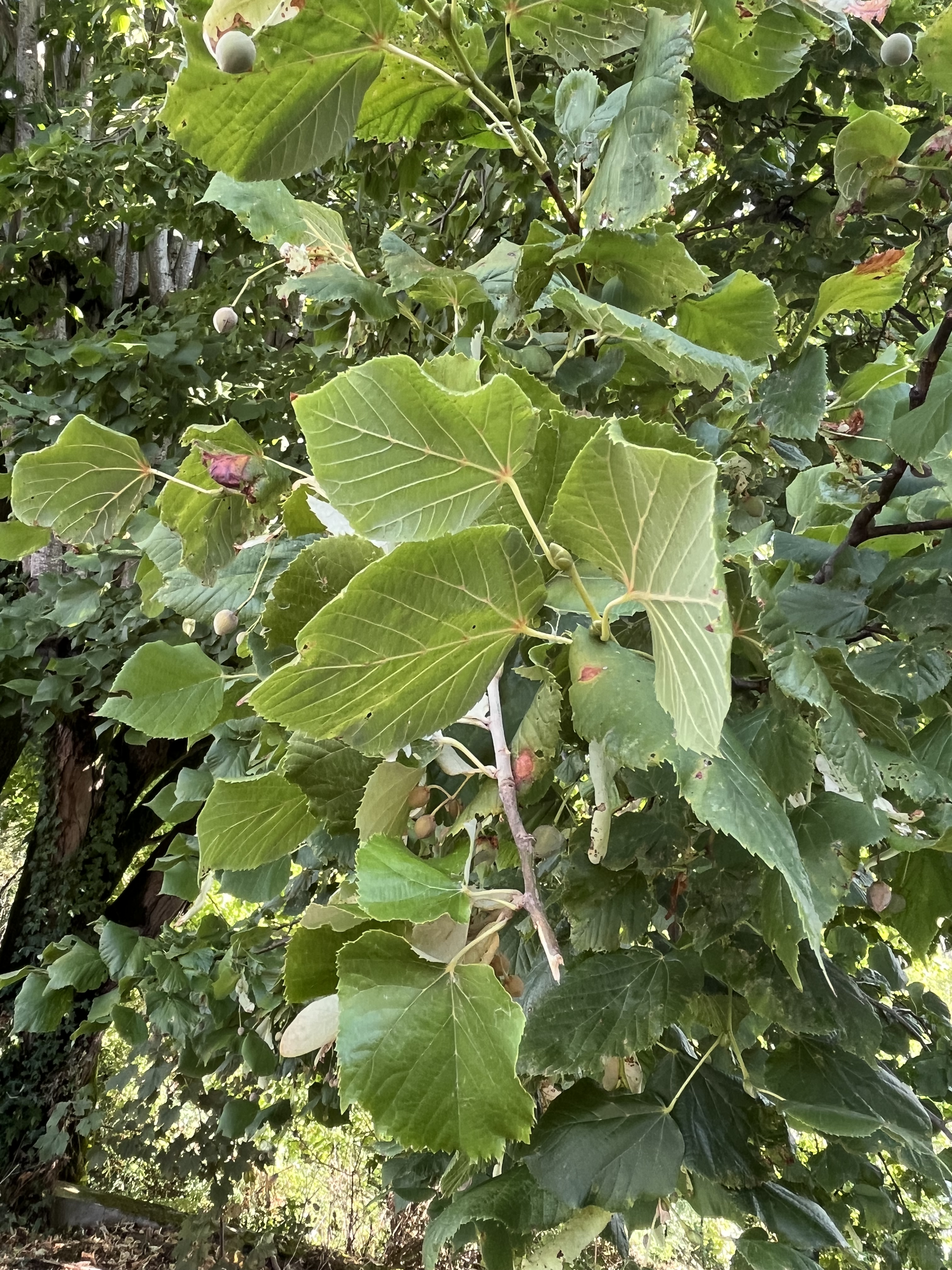
I didn’t know until morning that the huge linden tree at the Barbacane had fallen.

Je n’ai su qu’au matin que l’énorme tilleul de la Barbacane était tombé.

She had graced the square below the round tower guarding our fortified city for as long as anyone who was standing near me as we listened to the chainsaw cutting her to pieces could remember.

Elle ornait la place située sous la tour ronde qui gardait notre ville fortifiée depuis aussi longtemps que ceux qui se tenaient près de moi alors que nous écoutions la tronçonneuse la découper en morceaux pouvaient s’en souvenir.

Linden trees can be female or male, though their flowers are hermaphroditic. Cordes has several male trees—they’re the ones with the heavenly scent in the late spring—but the one at the Barbacane was female, and ready to drop her seeds. She was perfectly formed, with a beautiful round top that rose above the houses and provided a circle of deep shade.

Les tilleuls peuvent être femelles ou mâles, mais leurs fleurs sont hermaphrodites. Cordes possède plusieurs arbres mâles – ce sont eux qui dégagent un parfum céleste à la fin du printemps – mais celui de la Barbacane était femelle et prêt à laisser tomber ses graines. Il était parfaitement formé, avec une belle cime ronde qui s’élevait au-dessus des maisons et offrait un cercle d’ombre profonde.

After paying homage to her uprooted body, I took a little branch and visited some of the other grand trees pf Cordes. The black locust behind the library seemed very sad to me. So did the horse chestnuts, who are suffering from leaf-miners themselves. But the other lindens seemed the most affected.

Après avoir rendu hommage à son corps déraciné, j’ai pris une petite branche et j’ai visité quelques autres grands arbres de Cordes. Le robinier derrière la bibliothèque m’a semblé bien triste. Il en va de même pour les marronniers d’Inde, qui souffrent eux aussi de la mineuse. Mais les autres tilleuls semblaient les plus touchés.

When I touched the little branch I’d taken from the queen tree to the linden on rue de Colombier, the living tree grabbed hold of the branch of its queen tightly. As I held onto my branch and pulled on it gently, I could feel a vibration running through my body that made me not want to let go either.

Lorsque j’ai touché la petite branche que j’avais prise de l’arbre reine au tilleul de la rue de Colombier, l’arbre vivant s’est agrippé fermement à la branche de sa reine. Alors que je m’accrochais à ma branche et que je tirais doucement dessus, je sentais une vibration parcourir mon corps qui me poussait à ne pas la lâcher non plus.

In ancient Celtic societies, like the Gauls who lived here before the Romans, people gathered to celebrate and dance under linden trees, as well as to hold official meetings to restore peace and justice. The linden tree was believed to preserve the truth. In German mythology, it is the tree of peace and love.

Dans les anciennes sociétés celtiques, comme les Gaulois qui vivaient ici avant les Romains, les gens se réunissaient pour célébrer et danser sous les tilleuls, ainsi que pour tenir des réunions officielles afin de rétablir la paix et la justice. Le tilleul était censé préserver la vérité. Dans la mythologie allemande, il est l’arbre de la paix et de l’amour.

La Place du Tilleul by Jacques Chies https://galerie-labarbacane.fr/en/artiste/jacques-chies/

My heart is broken.

Mon cœur est brisé.

Tiny Worlds: Discovering Secrets in Abandoned Spaces

For years I’ve watching the slow disintegration of the door of an abandoned house on rue de la Bouteillerie. Once in a while I take a picture of it, or of some part of it.

Yesterday I took a few pictures. Here’s the first one:

You can eat that plant with the round leaves. It’s called Le Nombril-de-Vénus (Umbilicus rupestris), Venus’s belly button, in French, or Pennywort in English.

It wasn’t till I got home and took a look at the pictures, though, that I realized that some magic is taking place behind that door.

There’s a tiny world with a staircase inside!

I wonder if very small people use those stairs?

Next time I pass I guess I’ll have to lie down on my stomach to get a better look.

Synchronicity: Tarot Cards, the Witches’ Market, and the Aurora Borealis

Sometimes I have extraordinary dreams—some of them are told in the links below—and sometimes my life is filled with extraordinary synchronicity. A few weeks ago I was graced with a series of delightful synchronicities.

That weekend, Tom was still in Africa so I had plenty of time to work on my book. There were no real meals to think about, minimal shopping to do, just the dog to walk, which is good for me and almost always a pleasure. I was on a roll.

The last three chapters that I’d written were all pretty dark— the excerpt I published here a few weeks ago is part of one of them—so I decided to add in a lighter one. I gathered my characters in Gert’s parents’ sitting room for New Year’s Eve, had Gert put on some popular music with funny lyrics—it was good fun to do that research—and pretty soon everyone was singing and dancing. They couldn’t dance for all the hours before midnight though, so I figured they could play games. More interesting research. No parlor games popped up, but card games were popular. The first card games from that time and place that came up in my search were played with tarot cards. Good idea. Let the characters play the game and afterwards draw a card. Or better, I’d draw a card for each of them.

The characters probably would have used an Industrie und Glück deck, but I used what I had on hand—I’ve accumulated a good number of tarot decks over the years. The first one I found was my well-worn Waite/Rider deck from the 1970’s.

An Industrie und Glück deck:

I divided out the major arcana cards from my deck, drew one for each of the characters, and then wrote them into my story:

Gert puts one of the decks into two piles. “Pull the chairs back into a circle with a table at the center while I sort the cards.” When the chairs are in place she explains, “I’m putting the major cards, the tarocks, in one pile and the minor cards in the other. Then we’ll each draw one of the tarocks, and I’ll explain what they mean. Or at least what I think they mean.”

“Ooh, she’s going to tell our fortunes!” says Toni. “How exciting!”

“Me first!” Gisi calls out. “I want to get it over with.”

“Okay.” Gert shuffles the smaller set of cards and fans them out so Gisi can choose one.

Gisi looks at the backs of the cards carefully. She runs a finger over them. “No,” she says. “I can’t do it. Someone else has to start. Sorry.” She sits back in her chair.

“I’ll do it!” volunteers Max. Gert shuffles the cards again and fans them out for Max. He doesn’t hesitate, immediately drawing a card from the center of the deck and turning it over.

“It’s Der Naar, the Fool. What does it mean?” he asks Toni.

“Well, that’s appropriate,” she laughs. “It’s the wild card in the deck. It symbolizes beginnings, innocence, spontaneity, and a free spirit.”

“Very appropriate!” Hugo agrees. “I’ll go next.” He runs his finger over the cards a few times before drawing Der Herrscher. 

Gert smiles.The Emperor. Another good fit. The Emperor represents authority, the establishment, structure, and a father figure. He’s the ultimate ruler of the world.”

“Good God,” says Hugo. “Is that how you all see me? I always wanted to be an artist. Isn’t there an artist card?” 

“You are an artist,” says Anna, “but the card fits, Hugo. Accept your destiny.” Everyone laughs.

Leo volunteers next. He draws the Magician.

“Ah, my favorite,” says Gert. “Der Magier is the first of the Tarocks. It symbolizes manifestation and means that you can make your wishes come true.”

“Phew! A lucky one for me! What should I wish for?”

“That’s up to you,” Gert replies.

“Then I wish the power of Der Magier for all of us. May all our wishes come true.”

“Leo, generous as always! Thank you, my friend,” says Hugo.

The last rays of sun fill the room.

Everyone is smiling.

“Thanks!” says Anna. “I’ll go next, now that I have the power to make my wishes come true.” She takes only a moment to draw Die Sonne, the Sun.

Gert claps her hands. I think Leo’s card worked. Die Sonne signifies enlightenment, joy, marriage, and happiness.” Anna looks at the card and grins.

“You are an excellent fortune teller, Gert,” says Gisi. “I guess I’ll risk taking a card now.”

Gert reshuffles and fans the deck out on the table. Gisi looks over the back of the cards several times, pauses, and then slowly draws out a card slowly. She studies closely, holding it up to see it better. “I have no idea what this means,” she says, turning it around so everyone can see.

“Oh, it’s der Gehenkte, the Hanged Man,” says Gert. “It’s a complicated card, but it generally points to pausing—voluntarily or involuntarily—in order to assess your situation. It can also mean that it’s time to shift your perspective. Sometimes it means you’ll have to make a sacrifice.”

“Aha!” says Max, rubbing his hands together. “I thought this would go a little deeper eventually. I think it’s an accurate reading of where you are in life, Gisi—of where we all are, no? Very interesting, Gert!”

“It is a good representation. All of our lives are held up right now, aren’t they. None of us knows where we’ll be in a year,” muses Gisi, tracing the form of the hanged man with her finger.

 Hugo says, “I think all the cards have all been pretty good representations of who we are, or of who we could be.”  

“I’ll go next,” Toni volunteers, and Gert lays out the cards again. Toni also takes her time to choose. Eventually she closes her eyes and stabs randomly at a card. 

“The Hermit,” announces Gert. “Huh. Der Eremit isn’t a card I would have associated with you, Toni. The Hermit is a person who gains wisdom by being alone, through introspection. It also means the answer to your question will be found within.”

Toni is surprised too. “Soul-searching certainly isn’t something I’ve done much of so far in my life. All the other cards have seemed so exactly right though. Maybe I should take it up.”

“My turn now,” calls out Felix. “I’m so curious! Every one of these cards has been fascinating to consider.” Gert offers him the deck.

“Temperance. Die Mäßigkeit. Moderation,” she says when she see what he chooses. “Is that you, Felix? Or is the card advising you to be more balanced, more patient?”

“The latter,” says his brother. “Obviously.”

“I beg your pardon, Leo. I am the model of Patience. I ooze Balance from every pore.”  Felix stands on one leg, extending his arms, wobbling a bit, but then holding the pose.

“Very good!” Anna claps and the rest of the group joins in. 

“And now,’ Gert says. “I’ll pick one for myself.” She shuffles the cards three times and then riffles them. At last she chooses a card. 

It’s Der Tod, the Death Card. 

Everyone in the circle looks stricken. 

“Wait, wait,” Gert cries. “It doesn’t mean death literally! None of the cards are meant to be understood literally. It symbolizes transformation or change, or an ending.”

Anna sighs audibly.  “Of course, none of them is literal. Still, it’s shocking to draw it.”

Gert is shaken, but she hides it. “How about if we transition to Jause now? My parents will be home any minute. Come help me in the kitchen, ladies.”

When I had written that far, I took a break and walked the dog up the hill. It was surprisingly crowded in the village Saturday afternoon. Then I remembered that it was the day of the Witches’ Market!

There must have been half a dozen readers or sellers of Tarot readers there.

The second synchronicity occurred a week or so later. My chapter was dated January 25, 1938, so I followed my usual process of looking up what happened in Vienna at the time. It was a tense time then, six weeks before the Anschluss, when Austria merges into Germany.

In late January that year, the Northern Lights were visible in Vienna for the first time since 1805, just days before Napoleon marched into Vienna. Many Viennese saw their appearance in 1938 as an omen. Others were more hopeful—they thought it marked the birth of a princess in Holland.

I wrote the Aurora Borealis into my story by weaving together bits of whatever eyewitness reports I could find. The pictures were all in black and white, but the words were evocative. I went to bed imagining it.

In the morning, I saw that my social media was filled with pictures of the current Aurora Borealis.

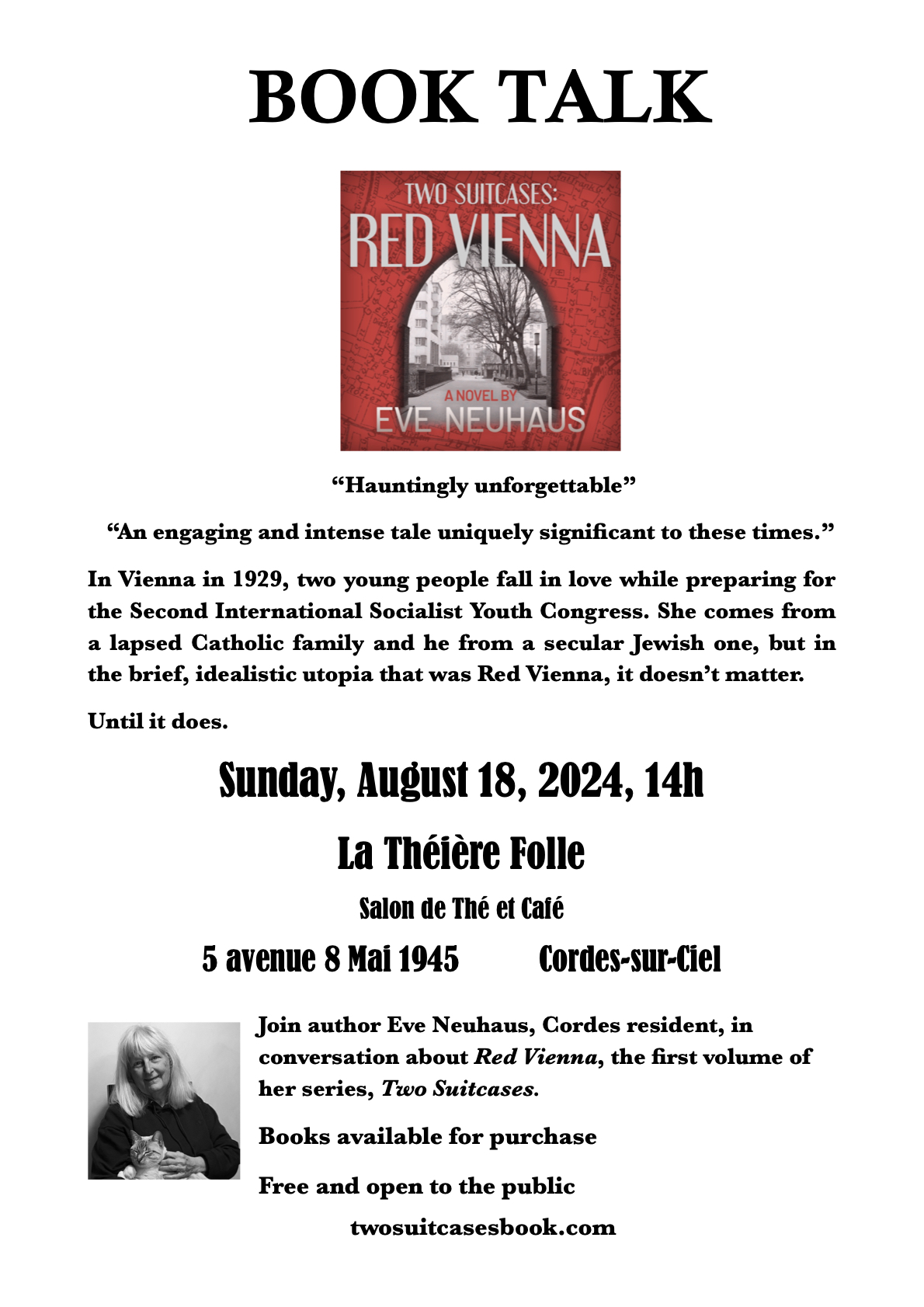
Two suitcases full of books: Book and audiobook launch events in Cordes and on Zoom

Very heavy. You can imagine. They travelled home from California with me last week, and here they are on their way into our house:

And now, having some copies of Red Vienna to pass on, I’ve set up two events.

It was at the back of my mind to do a launch of some sort locally, maybe in my living room or in someone else’s living room, but when I saw the back room at La Théiere Folle, the new salon de thé in Cordes, I couldn’t resist asking the proprietors, Ricky and Axel, if they’d be willing to host it there.

So, here’s the plan:

And then, for those farther away, the narrator of the audiobook version of Red Vienna and I are doing an audiobook launch on Zoom. I’ll add the details about it in my next post, but here are the basics. Join us if you can!

Learn more about Red Vienna, read excerpts, and reviews at twosuitcasesbook.com

Just when you’re not expecting it…

Three days ago a friend suggested I join a Facebook group I’d never heard of, the Dull Women’s Club, so I could read some of the wonderful stories ordinary women from all over the world have posted. After about half an hour of reading, I dashed off an introduction to myself and my quiet world here in rural France. Who knew that a couple days later that post would have so many likes (12.5k this morning) and that it would lead to having contact with so many remarkable women? What an incredible experience.

I spent most of the next two days responding to the comments. I wanted to respond to every single one—so many of them touched my heart so deeply. What’s amazing about the stories is their ordinariness.

My teacher Alice O. Howell‘s book The Dove in the Stone is subtitled Finding the Sacred in the Commonplace, and that’s been my path ever since I first read it. I even facilitated a long-running discussion group about the book at my dining room table on Thursday mornings. But even though I was exploring the book every week and had a reasonable understanding of it, I can remember the exact moment that its importance sank into my bones.

We had a huge house in California then, very different from the little one we live in now. One or two of our five kids were always in college then, causing a major drain on our finances, so I cleaned the house myself. One day I’d climbed up to dust a high shelf and I was thinking about how to present the next chapter in The Dove and the Stone the next day. I picked up a small vase and was turning it in my hand to get the dust out of the cracks when it struck me.

Our big house

The understanding hit me in the heart like an electric shock and then rippled through my body. This is it. This is what I’m here for, to see the sacred in the commonplace. I had to climb down and make a cup of tea.

Our little house in France

So, when I came across the Facebook group filled with introductions to ordinary women my heart filled with joy. For the second time in my life I felt that I’d truly met my tribe. (The first was when I was 12 and went to an art and music camp for the first time.) But this time the tribe is hundreds of thousands of women.

Suddenly, as a result of the opportunity of meeting so many people through the facebook group, Red Vienna, is selling well, and lots of people are reading my blog.

On top of that, I found an outstanding narrator to for the audiobook version and her first sample arrived in my mailbox this morning.

I cannot express my gratitude. It’s over the top.

Carnaval de la Caitiviá – a revival of the spirit of Occitanie in Cordes-sur-Ciel

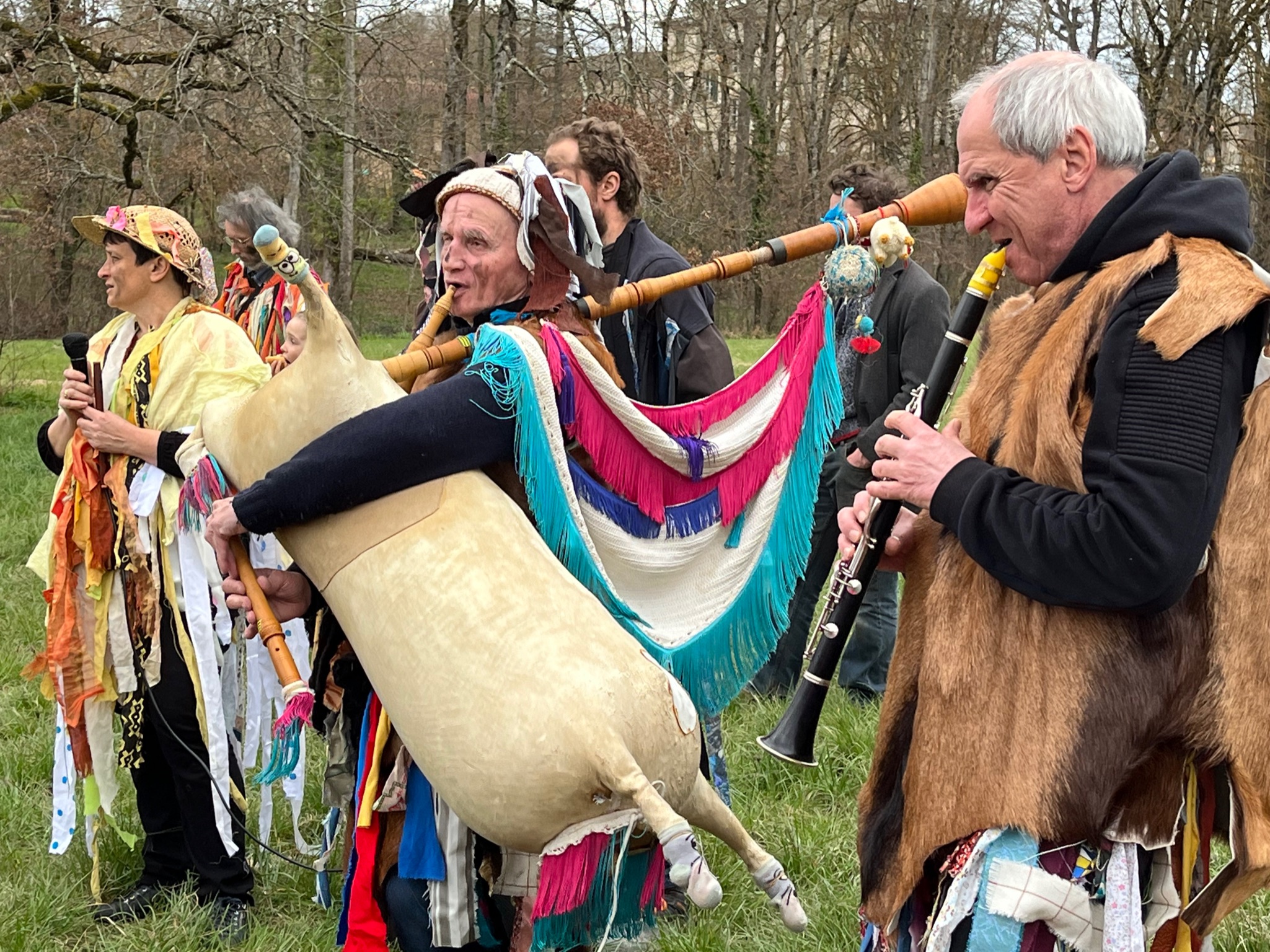
Carnaval de la Caitiviá took place in Cordes yesterday, after being postponed a week because of bad weather. It was, as good rituals should be, both festive and cathartic. School children in costume paraded through the villages of Cordes and Les Cabannes dancing and drumming to traditional Occitan music. They were led by a big cardboard effigy of Monsieur Carnaval, scapegoat for all the miseries of the participants, who was burned at the end.

The invitation to participate read (in Google translation):

“This Carnival will be that of the caitiviá (of the destitute), festive and demanding. Carnival-goers of all ages, disguised as destitute and excluded from all eras, will stroll through the streets of Cordes and Cabannes.

Loud and joyful, it will be accompanied by artists and musicians, including those from the music conservatory (Cordes and Carmaux branches), La Talvera and the Cantanha choir, themselves supported by children from surrounding schools who will have made their own instruments. The highlight of this Carnival will be the judgment and the cremation of Mr. Carnival, scapegoat for the miseries suffered by the carnival people who will judge him and celebrate his departure with a pantagruelic shared meal! So put on your most beautiful “petaçons” [pétassous] (destitute clothing made of pieces of patched fabric) or another disguise of your choice and join the procession!”

It was indeed loud and joyful!

La Talvera, the cultural association that organizes it, is dedicated to reviving the Occitan culture and language of the area. In addition to yesterday’s extraordinary event, they just published a new book of local legends.

It was a delight to follow the parade through the village and up the path to the meadow where the effigy would be burned.

I can imagine how much fun the participants, especially the children, had in preparing. The costumes were stunning.

Tom and I missed the judging, something we won’t do again, but when the parade reached the meadow, the dancing continued.

La Talvera, the band, lived up to its reputation as the best traditional Occitan band in France. We’re so fortunate to have them based here in Cordes.

The music and dancing paused as the wishes the participants had attached to the effigy were read aloud – let a cafe reopen at the center of the village, let me never be spanked, reduce the price of fuel – as M. Carnaval was wheeled to the pyre and installed.

Then it began again, the crowd swirling around the giant figure as the fire was started.

The fire grew and grew until it engulfed the figure.

A cheer went up as the head fell off!

This is the second year Carnival has been celebrated in Cordes. The revival of an ancient ritual like the Carnaval de la Caitiviá is just what this changing world needs.

We are so very fortunate to have it happening here in Cordes!

Chat Nomade

I’m busy getting ready for the first Chat Nomade, a pop-up cafe filled with cat art and objects. Nicole Barrière, Jude Brazendale, Marie-Josèphe Boyé and I are planning it for the first weekend of October, at Tom’s and my place. In November, it’ll be at someone else’s place.

At this point we’re working on the poster and making or collecting cat things.

Cordais friends, mark your calendars now and join us Saturday or Sunday afternoon between 2 and 5 the first weekend of the month for the Chat Nomade.

Je suis occupé à me préparer pour le premier Chat Nomade, un café éphémère rempli d’art et d’objets félins. Nicole Barrière, Jude Brazendale, et Josèpha Boyé et moi le prévoyons pour le premier week-end d’octobre, chez Tom et chez moi. En novembre, ce sera chez quelqu’un d’autre.

À ce stade, nous travaillons sur l’affiche et fabriquons ou collectons des objets “chat”.

Amis Cordais, à vos agendas dès maintenant et rejoignez-nous samedi ou dimanche après-midi entre 14h et 17h le premier week-end du mois pour Chat Nomade.

An afternoon walk

Please join me and Mocha on our walk around the village this afternoon.

Along the footpath between le Barri and le Bouysset.
C D B ?
The new owners have cleaned up the area behind a house along the path.
This is part of a ruin that now has a sign on it saying it will soon be renovated.
A lovely old garden gate in le Bouysset
I know this valerian is an invasive plant but it’s so beautiful!
Poppies root anywhere. The walls in Cordes have lots of these arches built into them.

Now I’ve come round the west end of the village. This is the guardian of a garage, I think.

Abandoned gardens like this one aren’t uncommon.

Heading down the north side now.

I’m walking on footpaths mostly.

It’s high rose season now.

Almost home now. The cat disappeared when he sensed Mocha coming.

And look! Henri IV is in his place waiting for us again.

Flowers we saw on our evening walk

Mocha and I usually take a walk after dinner. This is a small sample of what I saw.

Mocha, of course, only paid attention to the smells and the other dogs.

The weather has been so bizarre that I thought the roses were already done. Fortunately, I was wrong.

Same goes for the irises. The red valerian (Jupiter’s Beard) is doing very well this year. It doesn’t care if the weather is bizarre or not.

This time of year the vines start taking over. I’m not sure what this one is, but it’s everywhere.

When we came home, Henri IV was waiting.