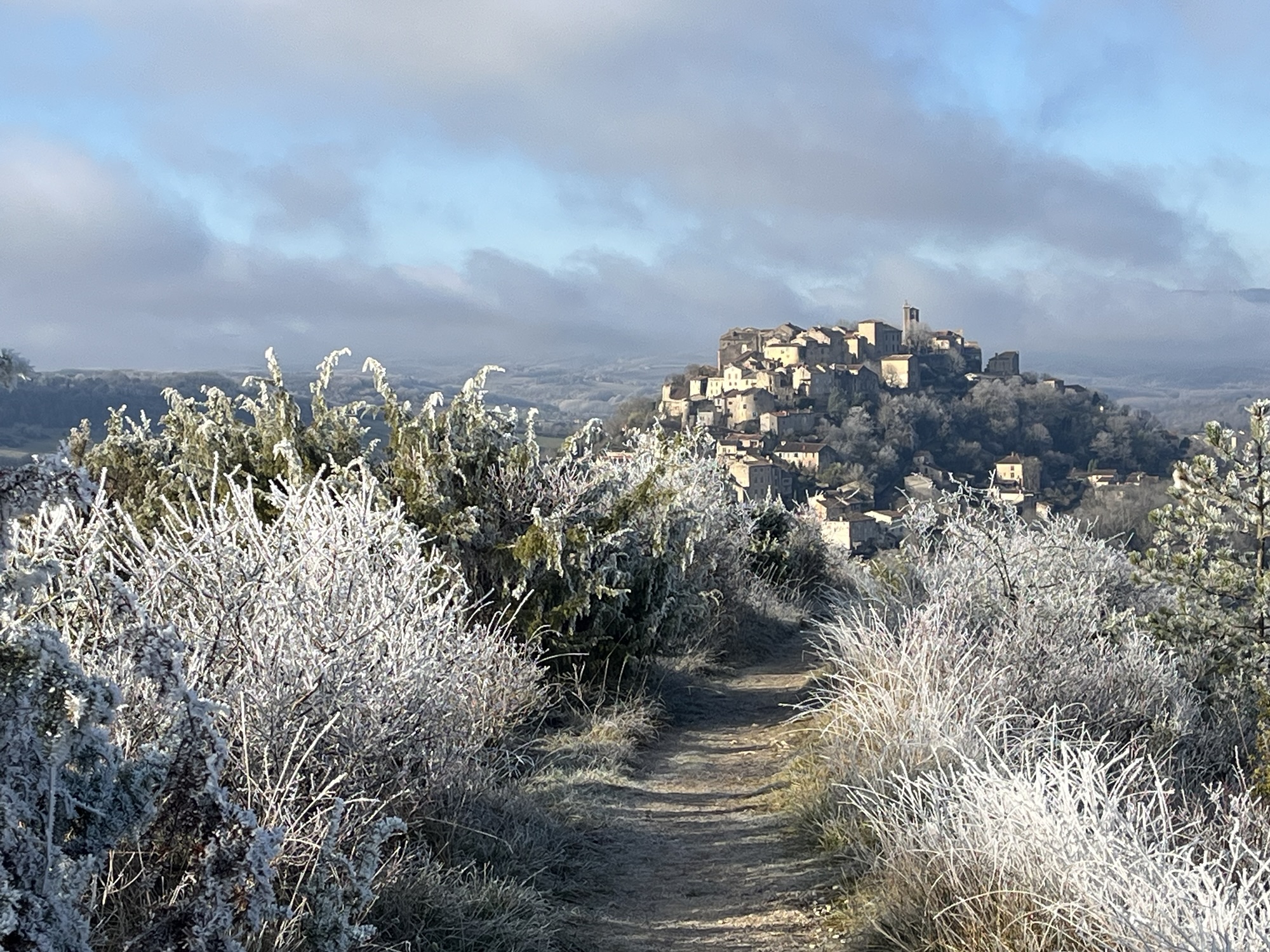
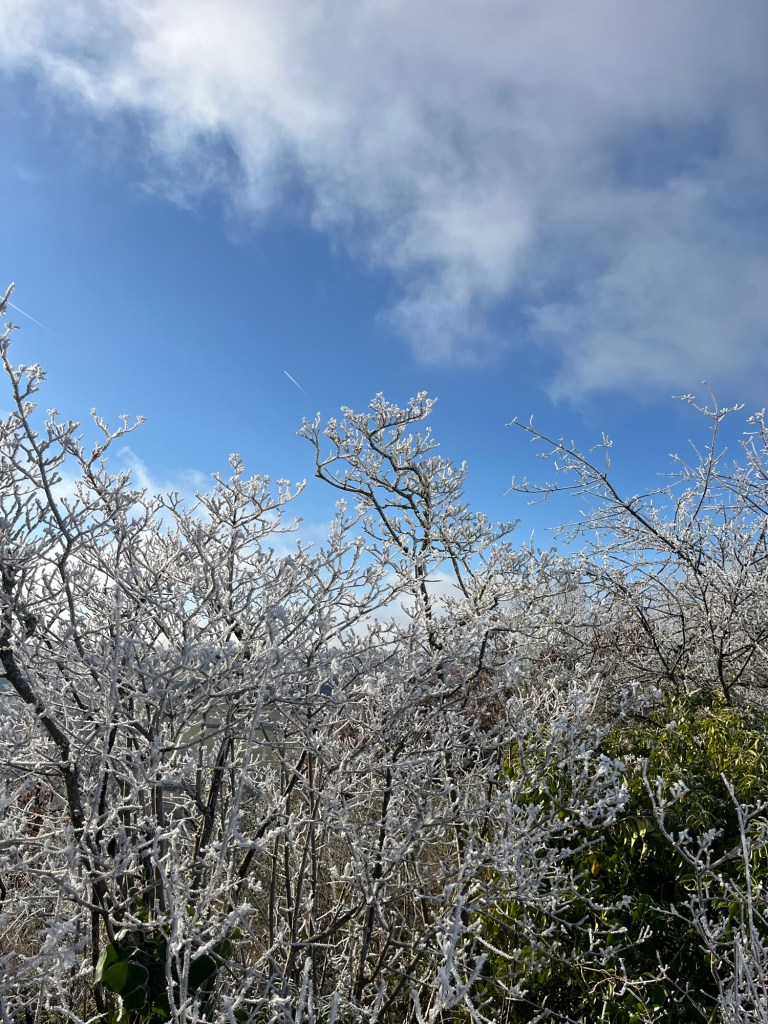
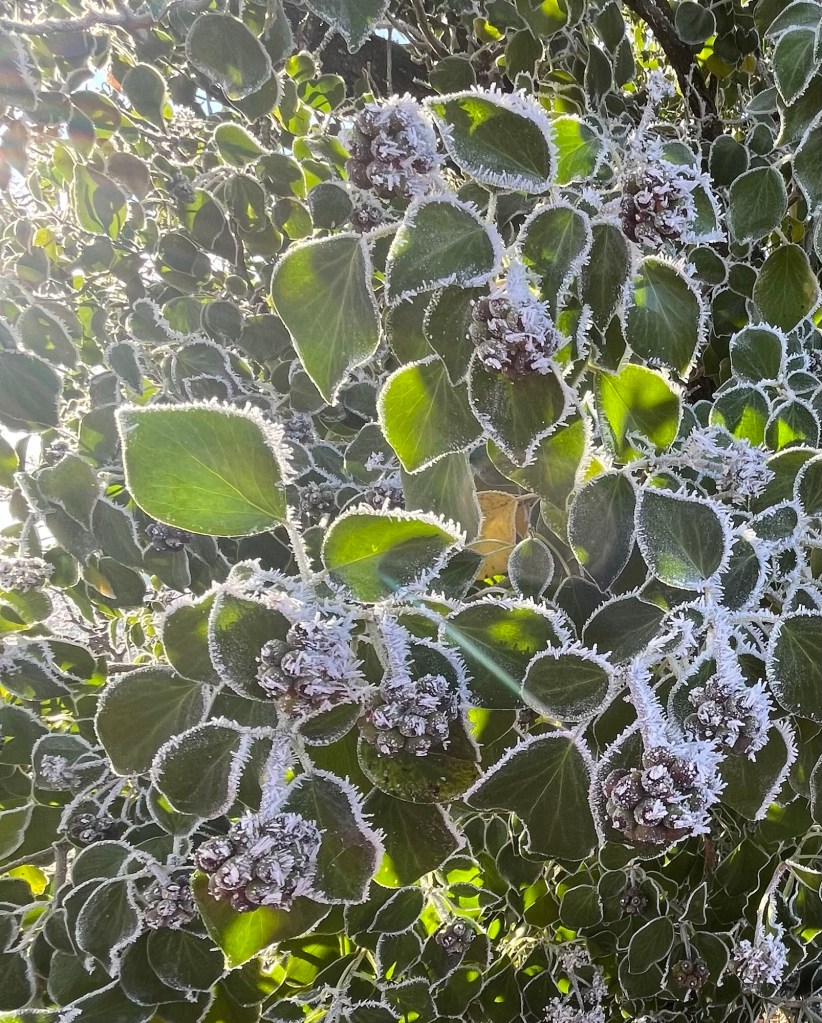
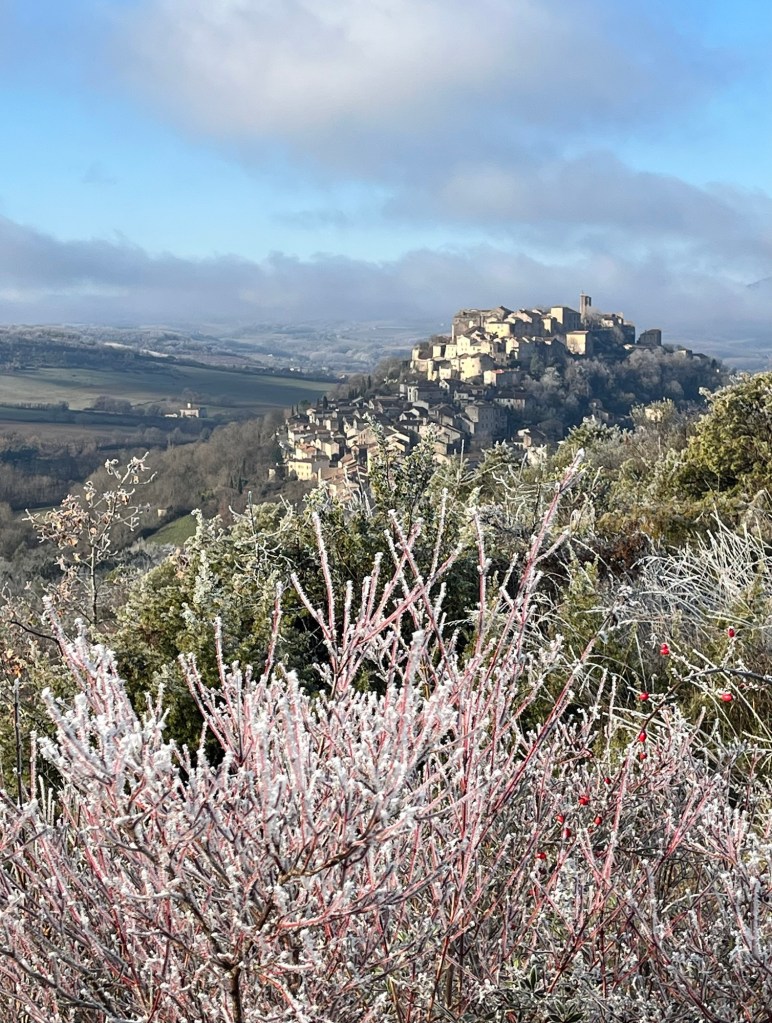
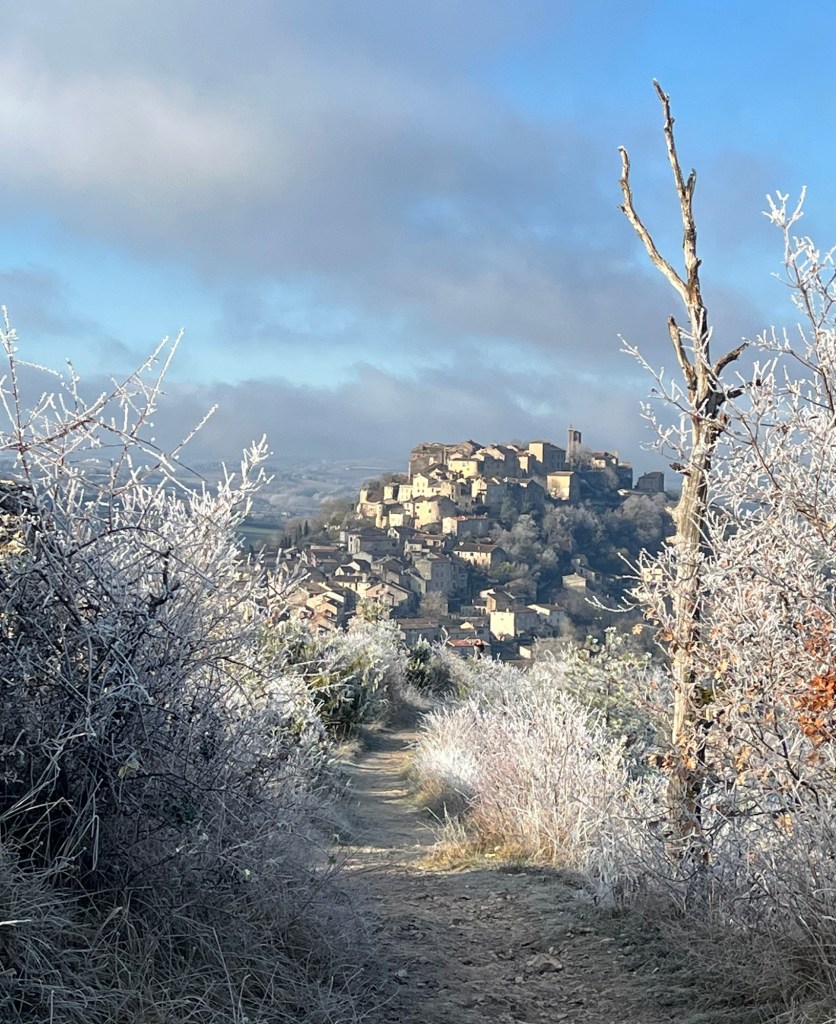
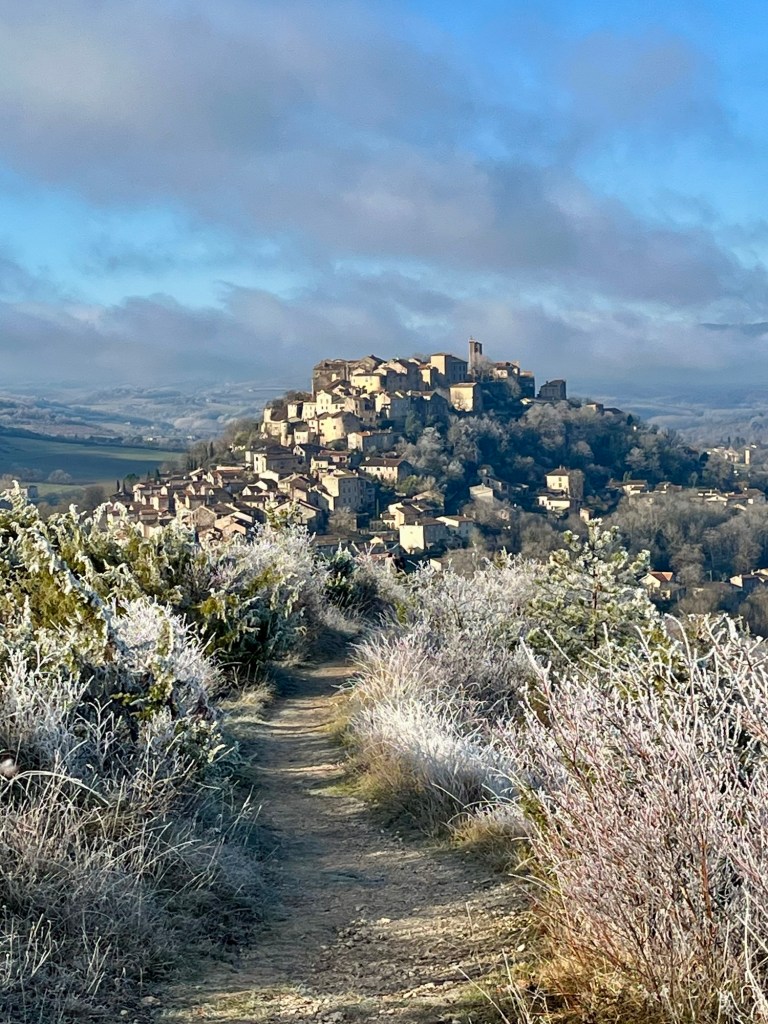
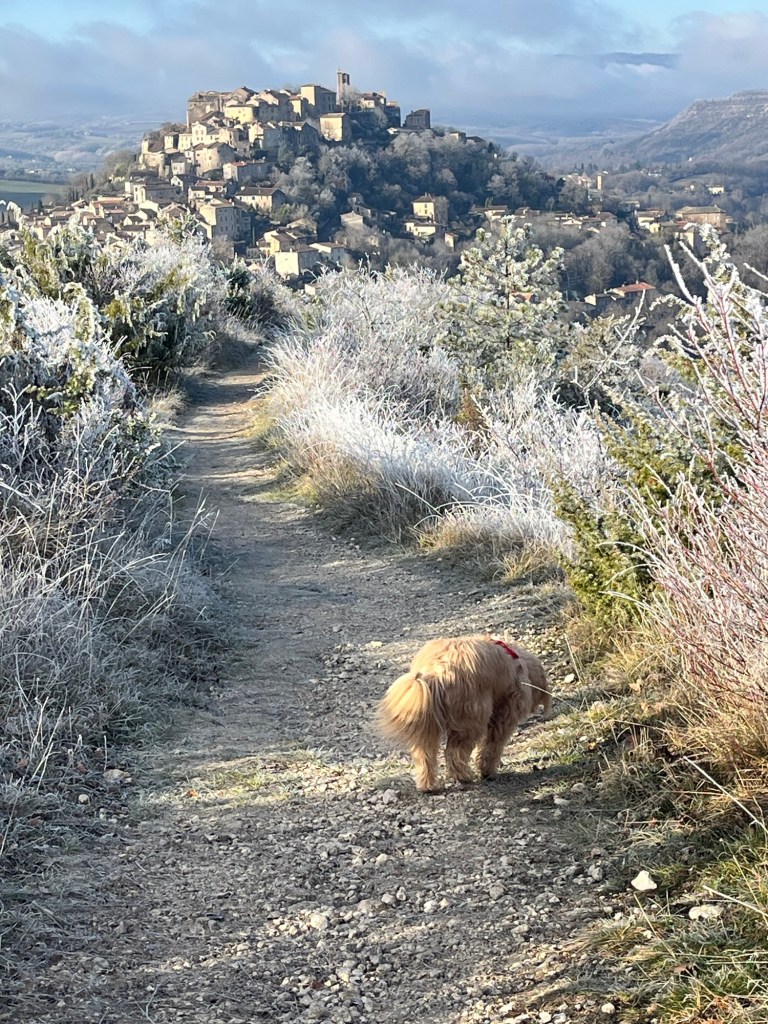
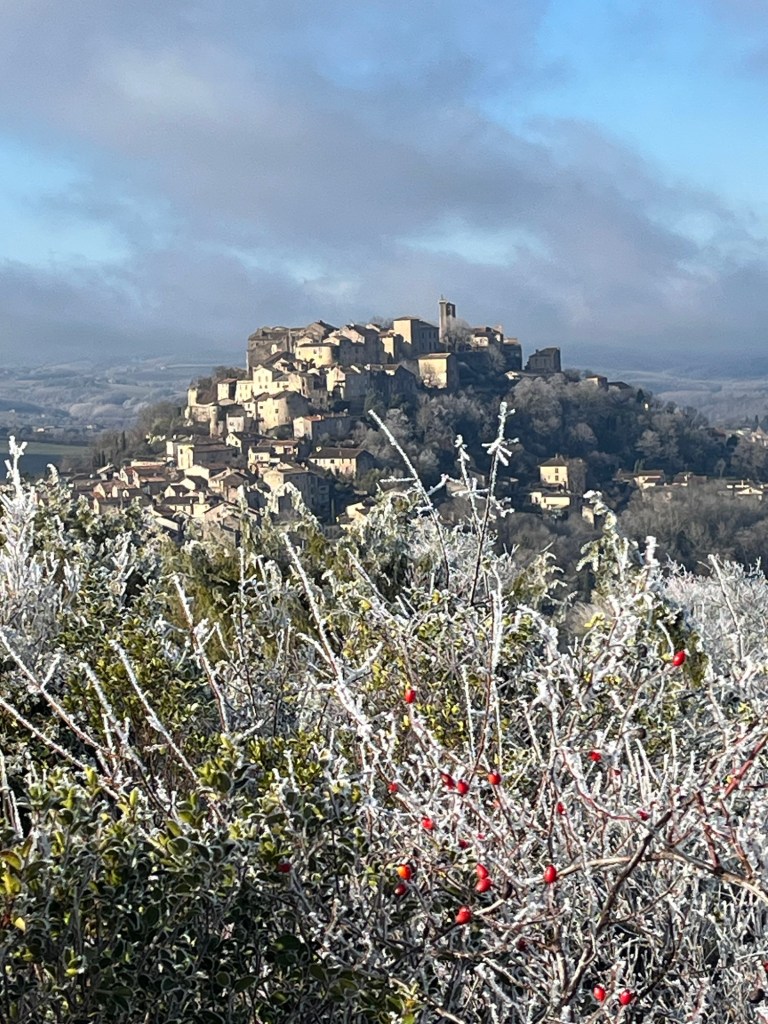
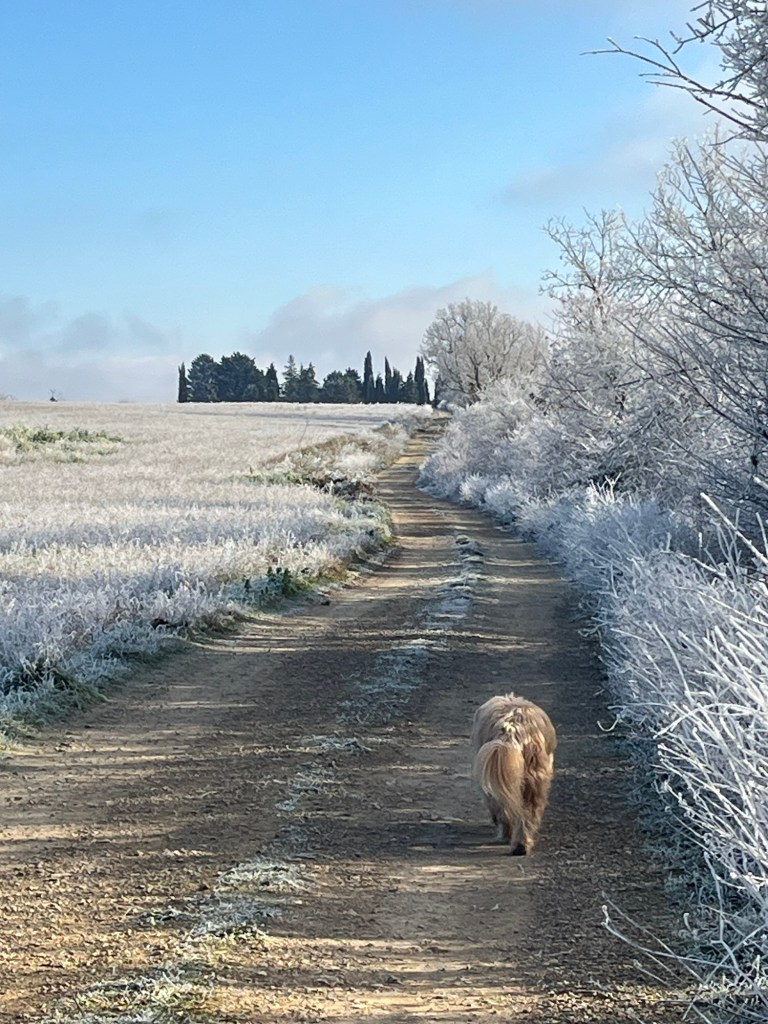
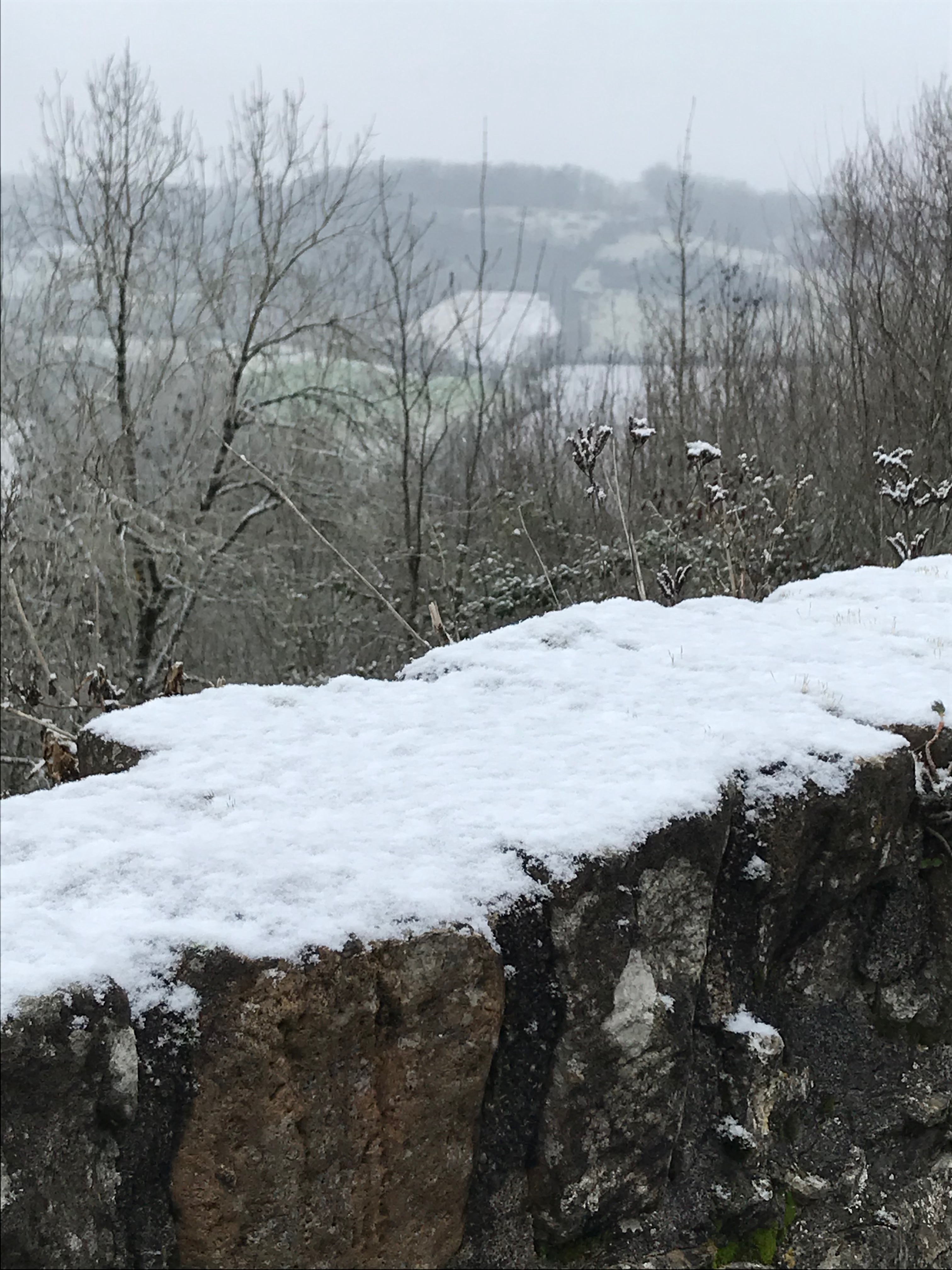
Once in a while, the fog that rises from the valleys surrounding Cordes-sur-Ciel freezes.
Overnight the dense cloud that made driving so difficult the night before becomes a delicate crystalline web, clinging to the edges of every leaf, every branch.
It’s magic.
This morning we walked to the le Grain de Sel, the chalky outcropping you can see from our street.
It’s a short but steep climb to walk there from our house, but you can drive up past it and take a flat path too.
Wishing you all a year filled with glimmers of hope, fresh insights, many moments of pure joy and raucous laughter, and at least a few of breathtaking awe.
Le vendredi suivant celui où les pierres noires étaient apparues puis avaient disparu, je suis retourné à Emmaüs pour voir si la personne qui les avait emportées chez elle par inadvertance les avait peut-être rapportées.
The day began well with a slow drive—our Ami only goes 45km (28mph)—through the hills, lush green with all the rain, while chatting with a friend, Anu, who’s only in Cordes a short time each year.
La journée a bien commencé par une balade tranquille en voiture – notre Ami ne roule qu’à 45 km/h – à travers les collines verdoyantes après la pluie, tout en discutant avec une amie, Anu, qui ne passe que peu de temps à Cordes chaque année.
It was on our walk to Emmaüs from the car that I made my first mistake. As I was telling Anu about the ephemeral black stones, we passed a woman talking to a couple as she bent over to arrange some white stones in a tray in front of her garage door. We laughed—white stones this week!—and I’m certain I heard the words, “la magie des pierres,” (the magic of stones) but we didn’t stop to hear more.
C’est lors de notre promenade entre Emmaüs et la voiture que j’ai commis ma première erreur. Alors que je parlais à Anu des pierres noires éphémères, nous avons croisé une femme qui discutait avec un couple, penchée pour ranger des pierres blanches dans un plateau devant la porte de son garage. Nous avons ri– des pierres blanches cette semaine !–et je suis certaine d’avoir entendu les mots « la magie des pierres », mais nous ne nous sommes pas arrêtées pour en savoir plus.
Did I pause to hear more? No.
Me suis-je arrêté pour en savoir plus ? Non.
The black stones had not been returned to the store. My round table wasn’t there, not was the small carpet for the upstairs landing.
Les pierres noires n’avaient pas été rapportées au magasin. Ma table ronde n’était pas là, pas plus que le petit tapis destiné au palier à l’étage.
But, in the same place in the kitchen section that I’d found the black stones on the glass candy dish the previous week, I found a brass monkey on a crocodile.
Mais, au même endroit dans la section cuisine où j’avais trouvé les pierres noires sur le plat à bonbons en verre la semaine précédente, j’ai trouvé un singe en laiton sur un crocodile.
“What a treasure!” said the guardian of the kitchen section as she wrapped my 1€ find in newspaper.
« Quel trésor ! » s’exclama la gardienne du rayon cuisine en emballant ma trouvaille à 1 € dans du papier journal.
On our way out of the store, I unwrapped it to show Anu, who, being Indian, immediately recognized that my treasure was from the Panchatantra teaching story, “The Monkey and the Crocodile.” We were talking about that as we passed the tray of white stones, still displayed in front of the garage door.
En sortant du magasin, je l’ai déballé pour le montrer à Anu qui, étant indienne, a immédiatement reconnu que mon trésor provenait du conte pédagogique du Panchatantra, « Le singe et le crocodile ». Nous en parlions en passant devant le plateau de pierres blanches, toujours exposé devant la porte du garage.
Did I stop to take a picture? No.
Est-ce que je me suis arrêté pour prendre une photo ? Non.
When I came home, I looked up the story. Here’s my favorite rendition of it:
Once upon a time, a monkey lived in a tree by a river. The monkey was alone as he had no friends or family but he was happy and content. The tree gave him plenty of sweet jamun fruit to eat. It also gave him shade from the sun and shelter from the rain.
One day, a crocodile was swimming up the river. He climbed on to the bank to rest under the monkey’s tree.
‘Hello,’ called the monkey, who was a friendly animal.
‘Hello,’ replied the crocodile, surprised. ‘Do you know where I can get some food?’ he asked. ‘I haven’t had anything to eat all day and I am hungry.’
Now you might think that the crocodile would want to eat the monkey, but this was a very kind and gentle crocodile and the thought never entered his head.
‘I have lots of fruit in my tree. Would you like to try some?’ said the monkey, who was also very kind.
He threw some jamun fruit down to the crocodile. The crocodile was so hungry that he ate up all the jamuns even though crocodiles don’t usually eat fruit. He loved the sweet tangy fruit and the pink flesh made his tongue turn purple.
‘Come back whenever you want more fruit,’ said the monkey, when the crocodile had eaten all he wanted.
Soon the crocodile was visiting the monkey every day. The two animals became good friends. They would talk, tell each other stories and eat lots of sweet jamuns together.
One day, the crocodile told the monkey about his wife and family.
‘Please take some fruit for your wife as well when you go back today,’ said the monkey.
The crocodile’s wife loved the jamuns. She had never eaten anything so sweet before but she was not as kind and gentle as her husband.
‘Imagine how sweet the monkey would taste as he eats these jamuns every day,’ she said to her husband.
The kind crocodile tried to explain to his wife that he could not possibly eat the monkey.
‘He is my best friend,’ he said.
The crocodile’s greedy wife would not listen. To get her husband to do what she wanted, she pretended to be ill.
‘I am dying and only a sweet monkey’s heart can cure me!’ she cried to her husband. ‘If you love me, you will catch your friend the monkey and let me eat his heart.’
The poor crocodile did not know what to do. He did not want to eat his friend but he could not let his wife die.
At last, he decided what he must do and the next time he visited the monkey he asked him to come to meet his wife as she wanted to thank him in person for the lovely jamun fruit.
The monkey was pleased but said he could not possibly go because he did not know how to swim.
‘Don’t worry about that,’ said the crocodile. ‘I’ll carry you on my back.’
The monkey agreed and jumped onto the crocodile’s back.
So the two friends moved out into the deep wide river.
When they were far away from the bank and the jamun tree, the crocodile said, ‘I am so sorry but my wife is very ill and says that the only cure is a monkey’s heart. I am afraid that I have to kill you, although I will miss our talks.’
The monkey thought quickly and said, ‘Dear friend, I am very sorry to hear of your wife’s illness. I am glad that I will be able to help her but I have left my heart behind in the jamun tree. Do you think we could go back so that I can fetch it?’
The crocodile believed the monkey. He turned and swam quickly to the jamun tree. The monkey jumped off his back and climbed into the safety of his tree.
‘I thought you were my friend,’ he called. ‘Don’t you know that we carry our hearts within us? I will never trust you again or give you fruit from my tree. Go away and don’t come back.’
The crocodile felt foolish. He had lost a friend and a supply of good sweet fruit. The monkey had saved himself because he had thought quickly. From that day on, he never trusted crocodiles again.
Quand je suis rentré chez moi, j’ai cherché cette histoire. Voici un lien vers le conte en français :
It took me about a week of asking my French neighbors to learn that putting white stones in front of your house for good luck or to make it welcoming is an old, local custom, and even longer to find an article about it.
Il m’a fallu environ une semaine pour apprendre, en interrogeant mes voisins français, que placer des pierres blanches devant sa maison pour porter chance ou la rendre accueillante est une ancienne coutume locale, et encore plus longtemps pour trouver un article à ce sujet.
“Healing stones in the French countryside: forgotten knowledge
Not so long ago, the French countryside was rich in ancestral knowledge passed down from generation to generation, whispered in hushed tones or through age-old gestures. Among these traditions, the art of healing with stones, known as lithotherapy, held a discreet but essential place in the daily lives of villagers.”
Since learning about the magic of white stones, I’ve noticed how often there’s one white cobblestone on the street in front of houses, or a white stone placed at the corner of a house. I got to know my neighbors better by asking my neighbors about the custom, and I put a couple white stones on my own windowsill, too.
Depuis que j’ai découvert la magie des pierres blanches, j’ai remarqué qu’il y avait souvent un pavé blanc devant les maisons ou une pierre blanche placée au coin d’une maison. J’ai adoré interroger mes voisins sur cette coutume et j’ai moi-même placé deux pierres blanches sur le rebord de ma fenêtre.
So, even though I missed the opportunity to learn the magic of the stones from the woman in Carmaux, and I missed the chance to take a picture there, I did get another good story.
Ainsi, même si j’ai raté l’occasion d’apprendre la magie des pierres auprès de la femme de Carmaux, et même si je n’ai pas pu prendre de photo là-bas, j’ai tout de même obtenu une autre belle histoire.
The moral of the Monkey and the Crocodile and of my own story is similar.
Even though bad things happen, good thinking and smart actions can lead to happy endings.
La morale de l’histoire du singe et du crocodile, et celle de ma propre histoire, est similaire..
Même lorsque des événements malheureux surviennent, une réflexion positive et des actions intelligentes peuvent mener à une issue heureuse.
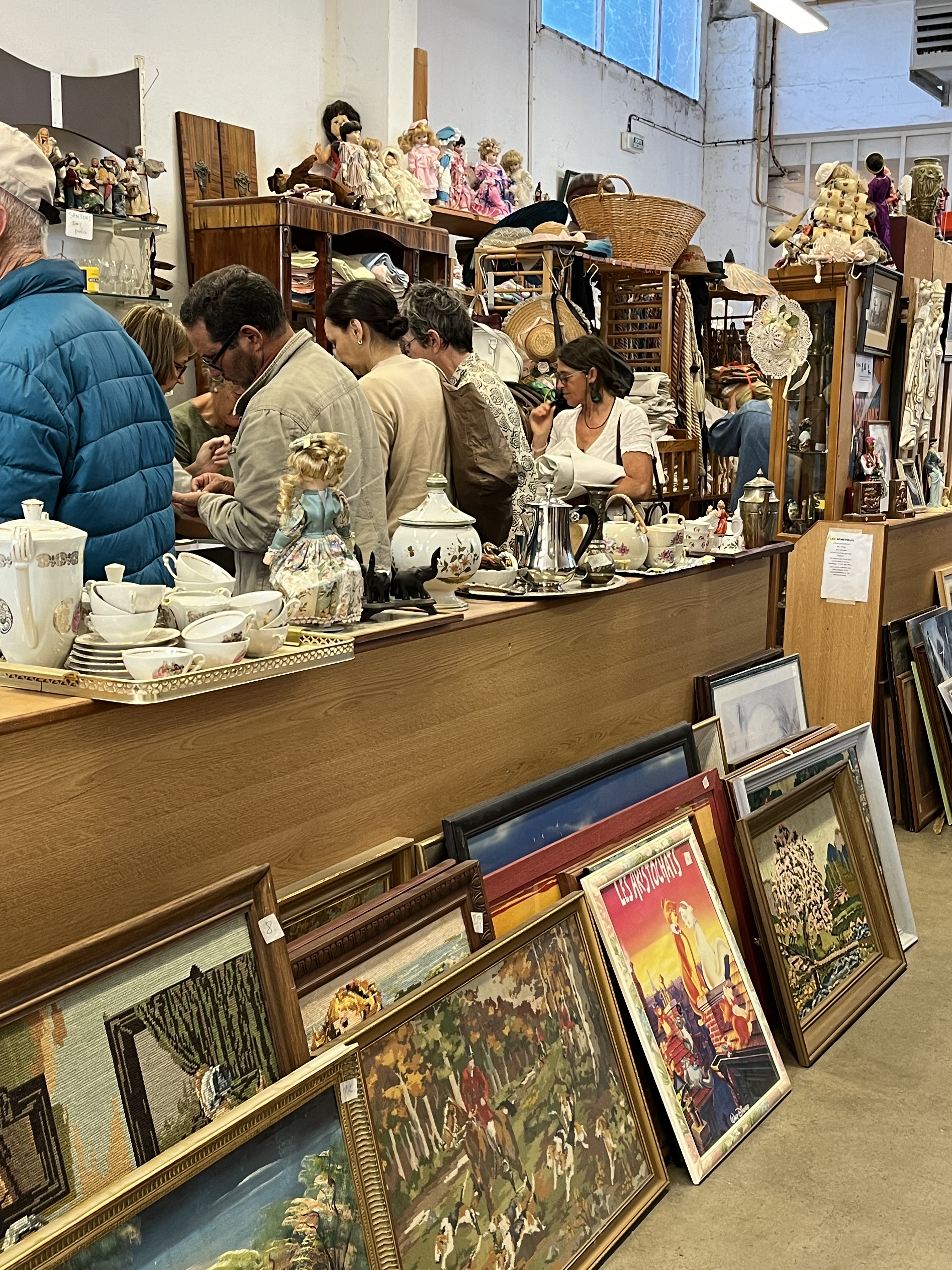
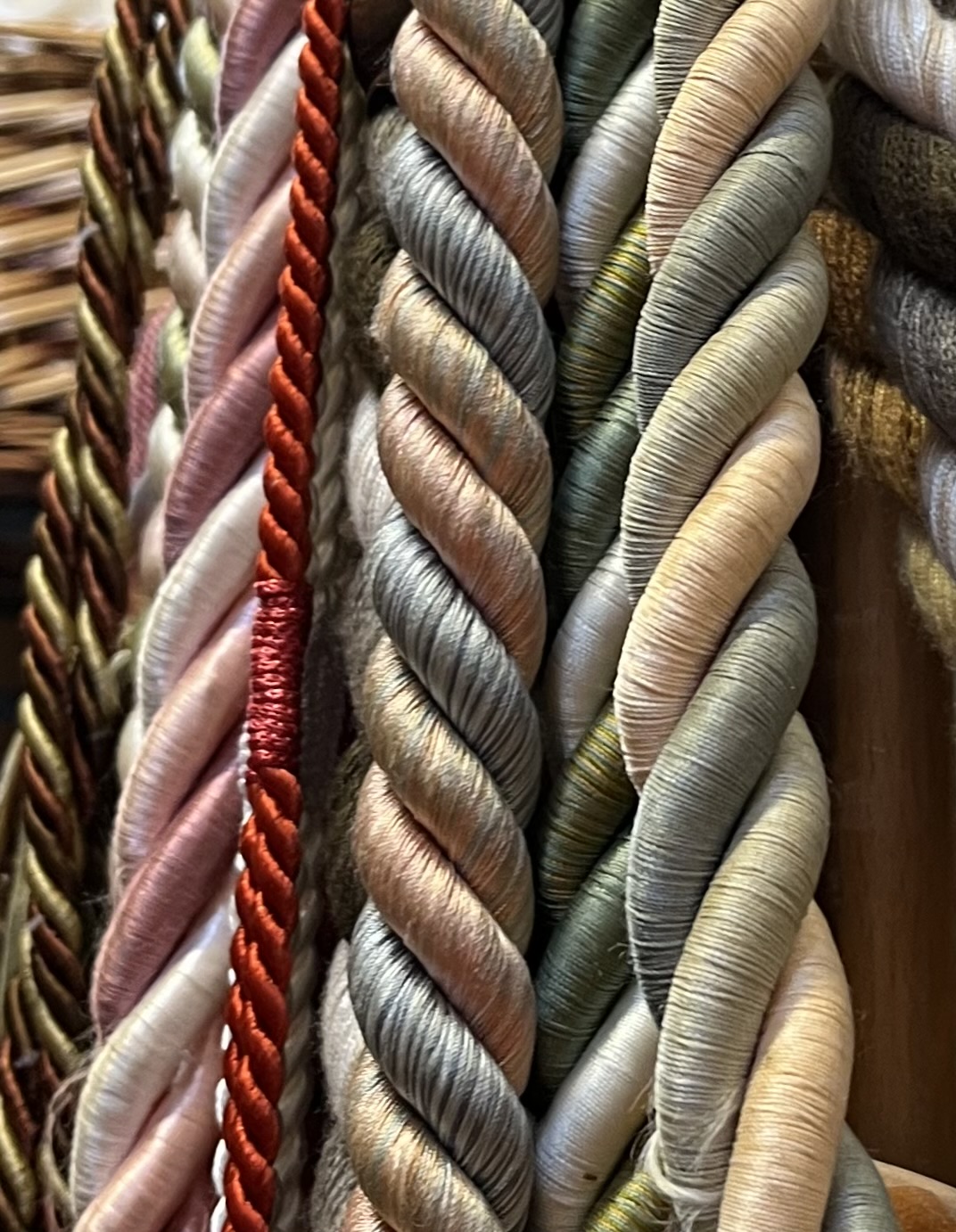
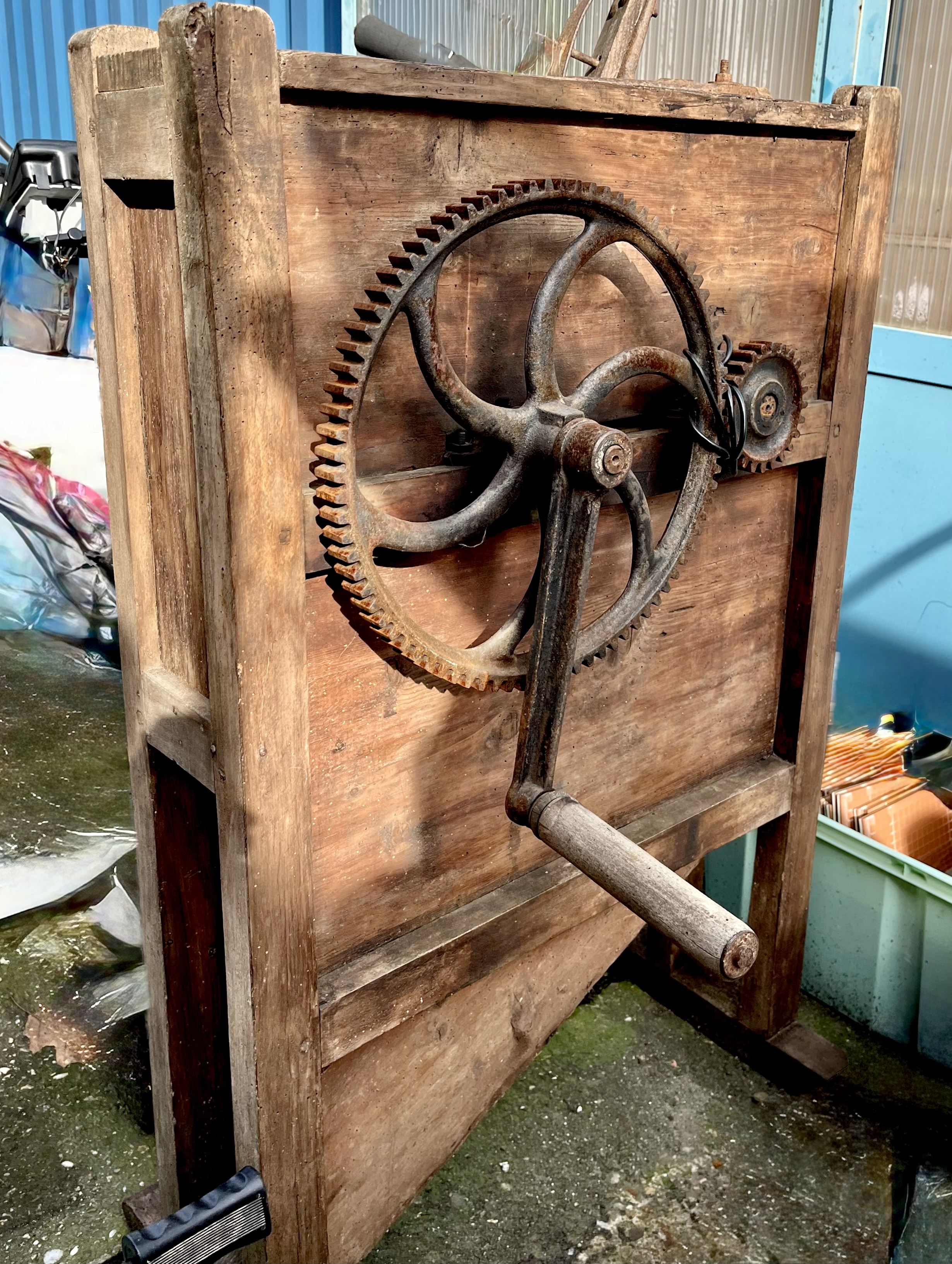
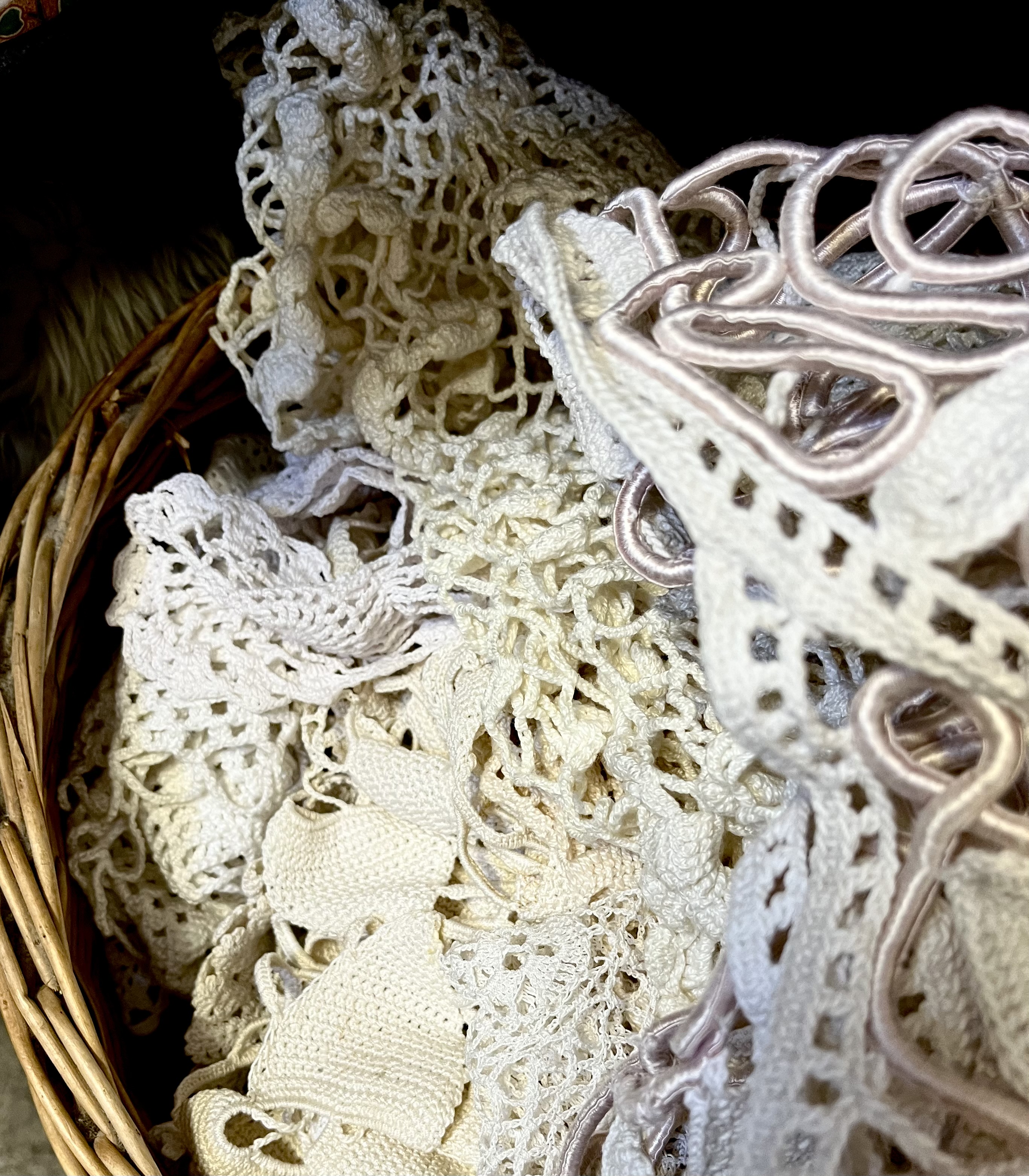
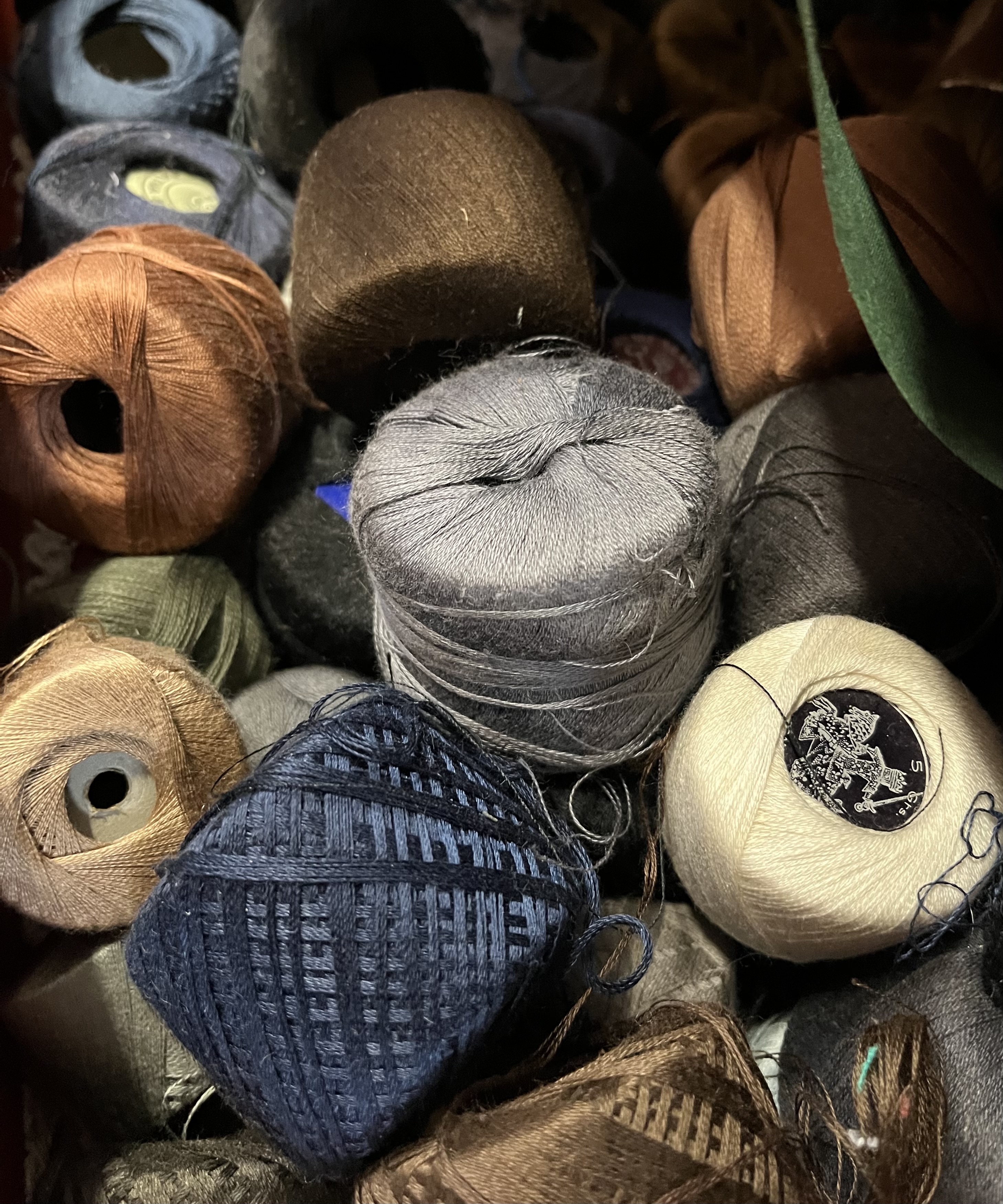
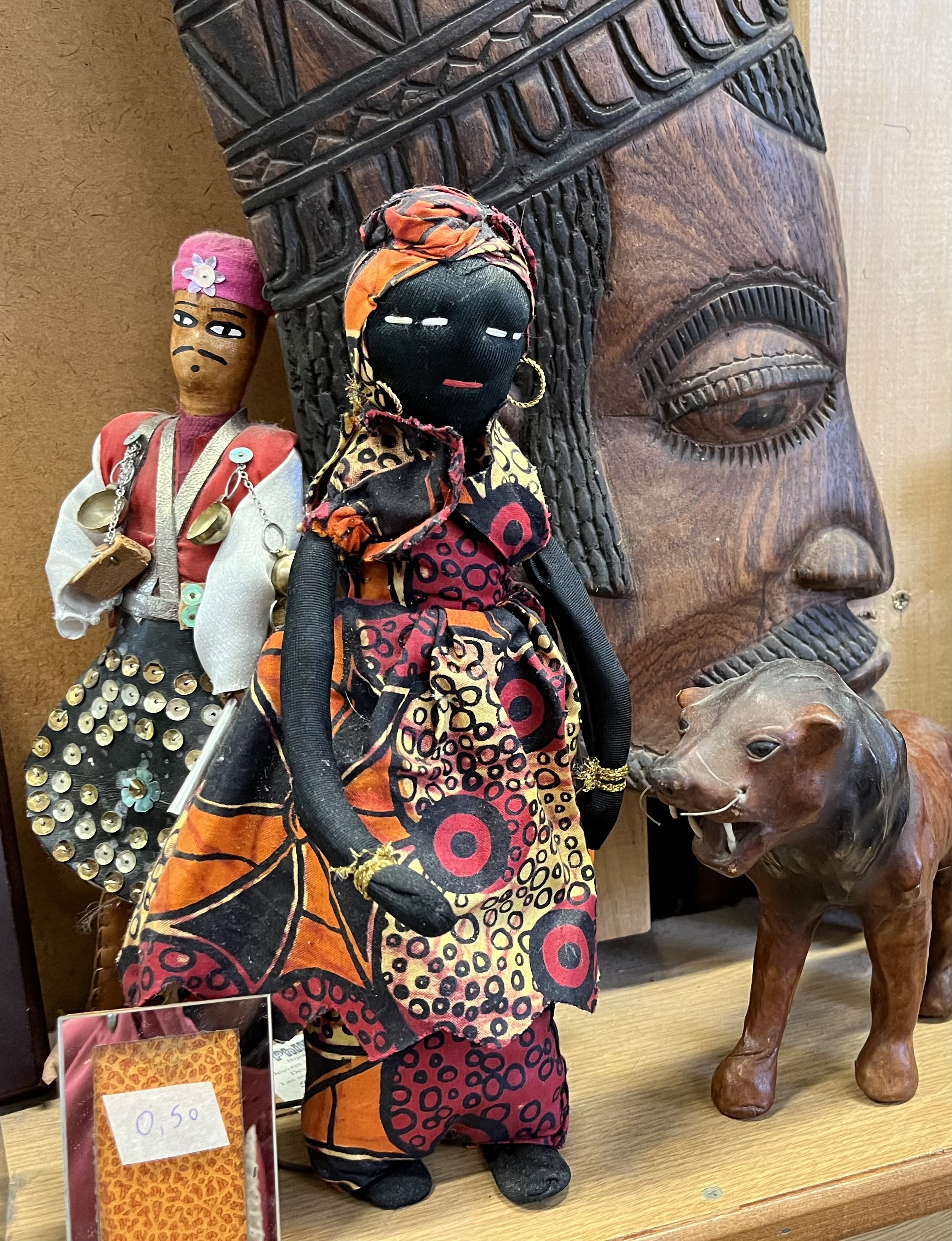
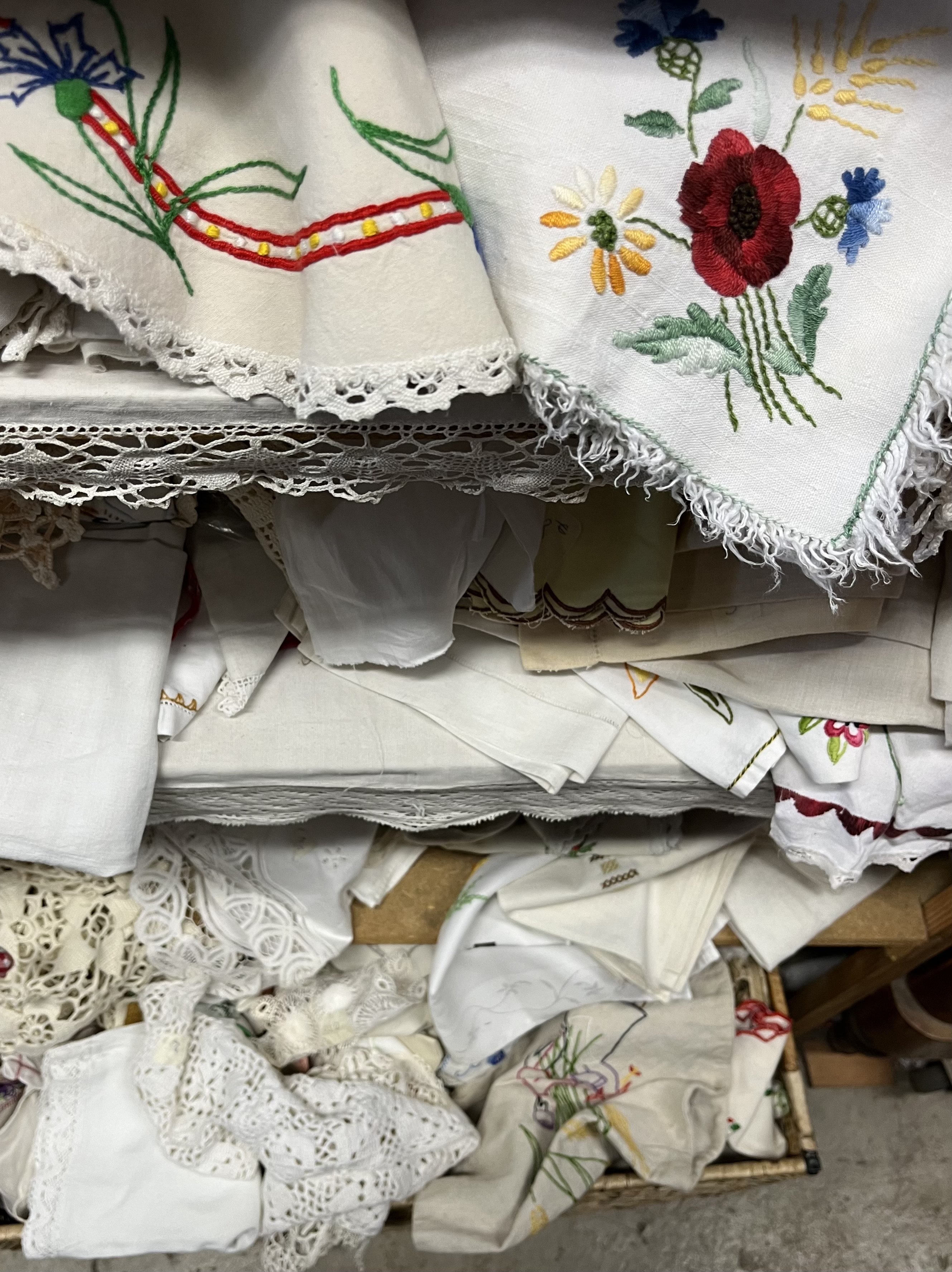
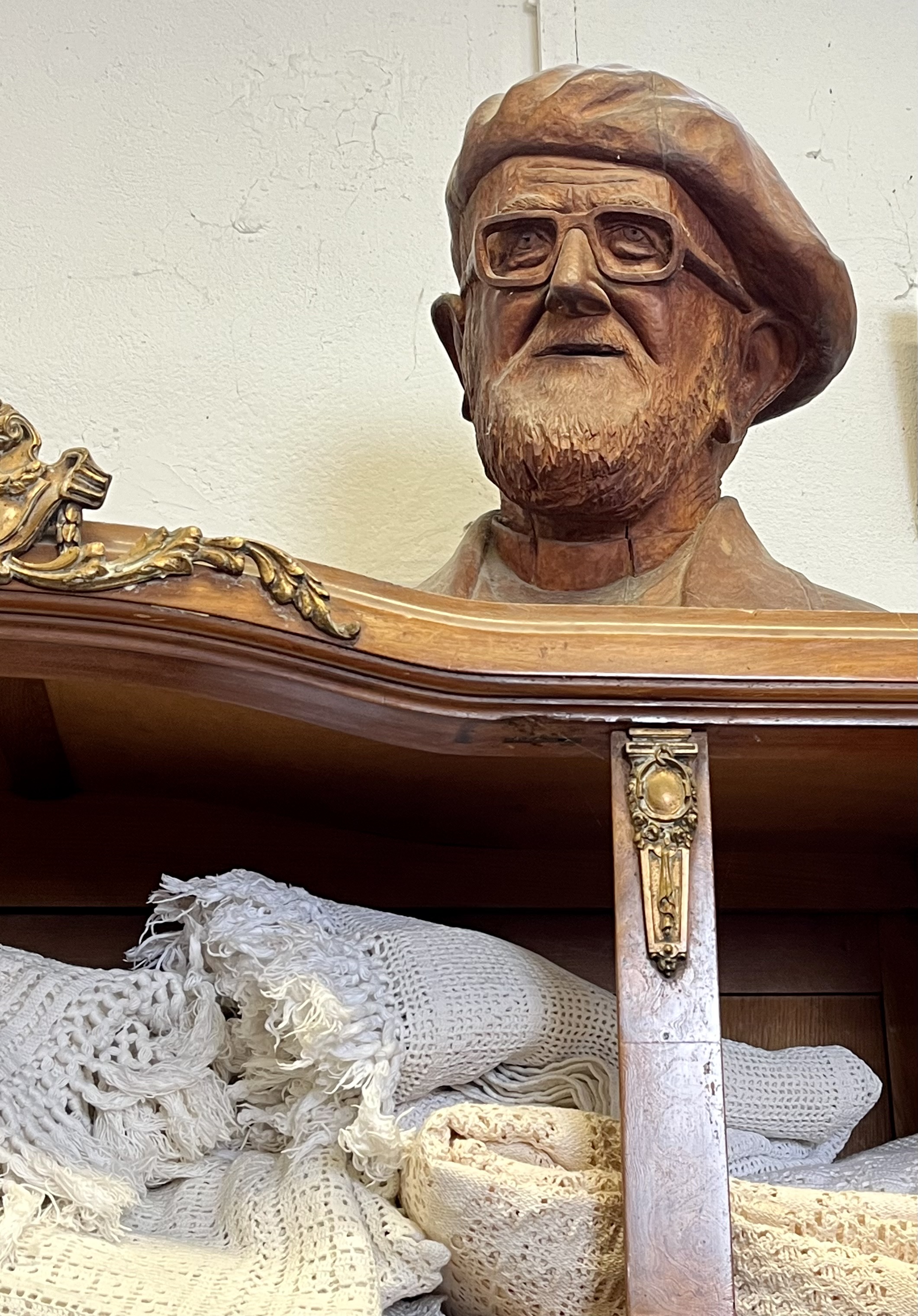
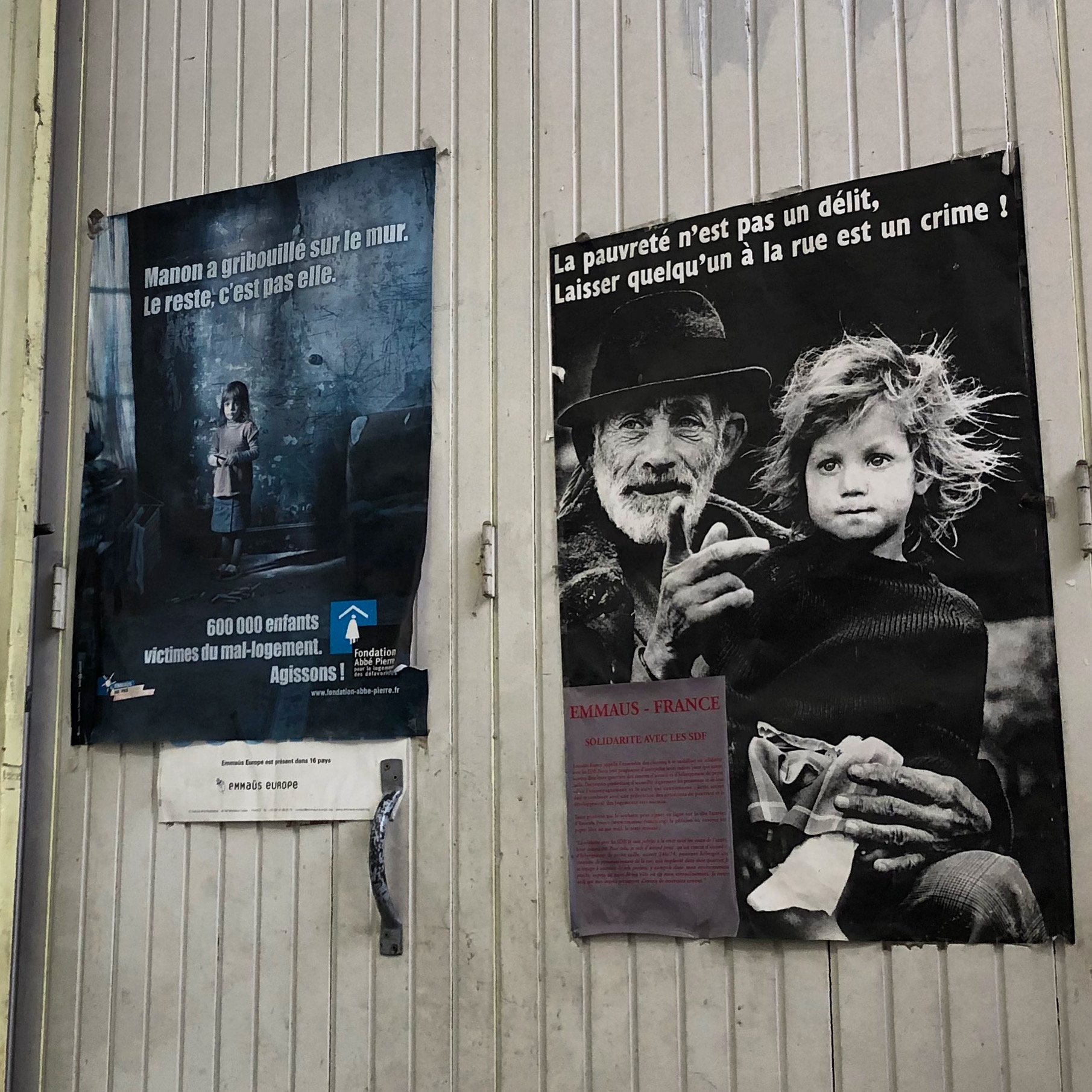
Emmaüs, the big thrift store in Carmaux, is only open on Fridays.Like all thrift stores, it’s a magical place.I thought I’d take a break from watching the sky fallto share some of the pictures I’ve taken there over the years.Lots of these are available in the vintage fabric sectionan old farm implementKnitting supplies have their own areaAmazing laceI want all the buttons, but what would I do with them?Emmaüs is my regular source for threadThe six interior spaces have employees who set aside your choices and give you a chit on a little piece of paper. You take the chits to the cashier who tears off half and gives you back the rest so you can retrieve your items.There are so many tempting things to take homeThe linens are exquisiteSometimes the line at the cashier takes a long time.Sadly, Emmaus founder Abbe Pierre was accused of sexual misconduct and his name was removed from the organization.His presence in the many Emmaus shops and charities was ubiquitous, but all the posters and busts are gone now.His good works go on, though, regardless of his offenses.
The name of the street on which Tom and I (and Mocha and Henri IV) live is called Rue de l’Acampadou, which we’ve been told means something like “between the fields and the town.” Our neighborhood is called Quartier du Barri. Opposite our house is a low wall and the stairs to our garden.
Below that, almost all the way down to the stream, L’Aurasse, is a wooded hillside.
Our house is blocked by trees in this picture, but you can see Simone’s house with the blue shutters next door.
When we first came to Cordes, we walked along the road below our house and tried to come up the hillside on some overgrown footpaths. Mocha was so covered in burrs and sticky seeds when we came home from that walk that we stuck to better maintained paths for a good year and a half after that.
One day during last spring’s confinement, I discovered that the paths on our hillside had been cleared. I went down a set of formerly bramble-covered stone stairs just up from our house and found that there was a maze of cleared paths zigzagging up and down the hill in broad sloping swaths.
Some of the paths were left narrow. I preferred those to the wide ones at first.
Mocha and I began to explore the maze of paths. I was surprised at how wide most of them were, as wide as roads. Over the summer, you could hear the noise of brush cutters as the village cleared more and more.
It was a dry summer. The cut grass lay on the dusty pathways. I took Mocha along the paths but all I saw was the wildlife cover that was gone. The paths made me sad.
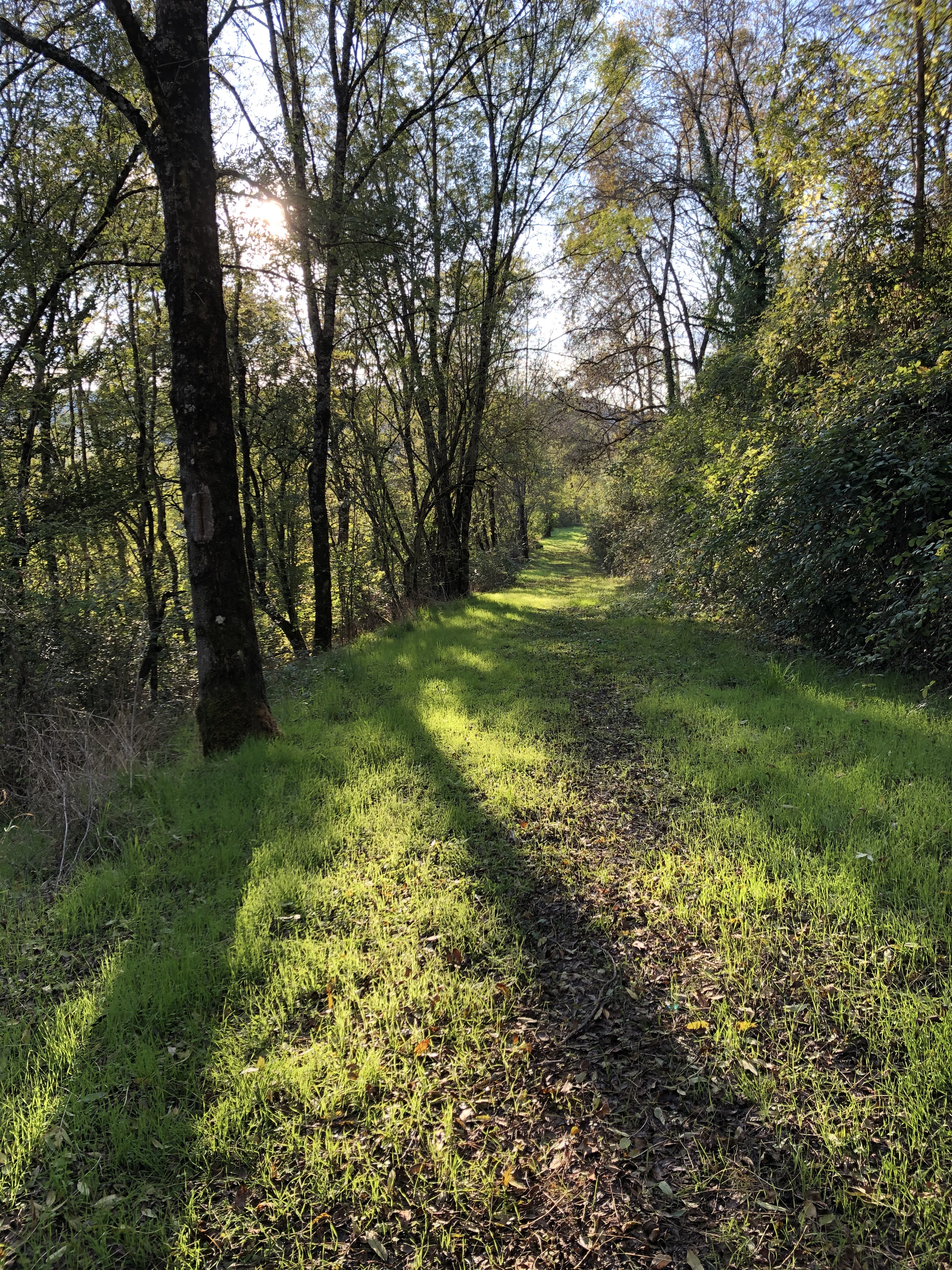
Then fall came and it began to rain, and the paths became beautiful grassy walkways. I read somewhere that they have a name, Les Terrasses du Barri, and I realized that they were indeed terraces, and no doubt very ancient.
Now that we’re in the second confinement, which limits walking for exercise to one kilometer from home, I’m realizing what an extraordinary treasure is across the street from our house.
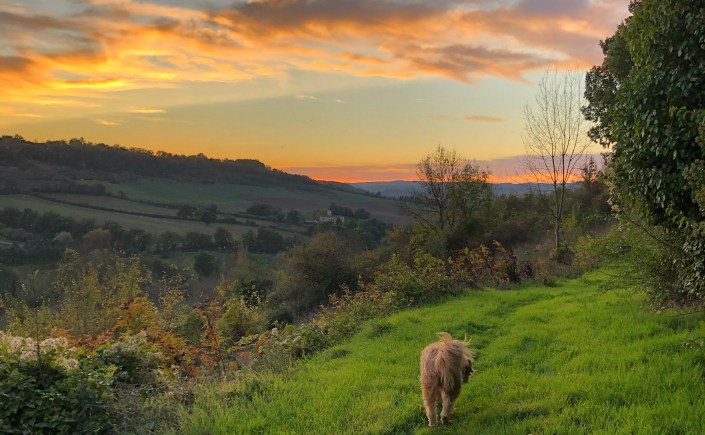
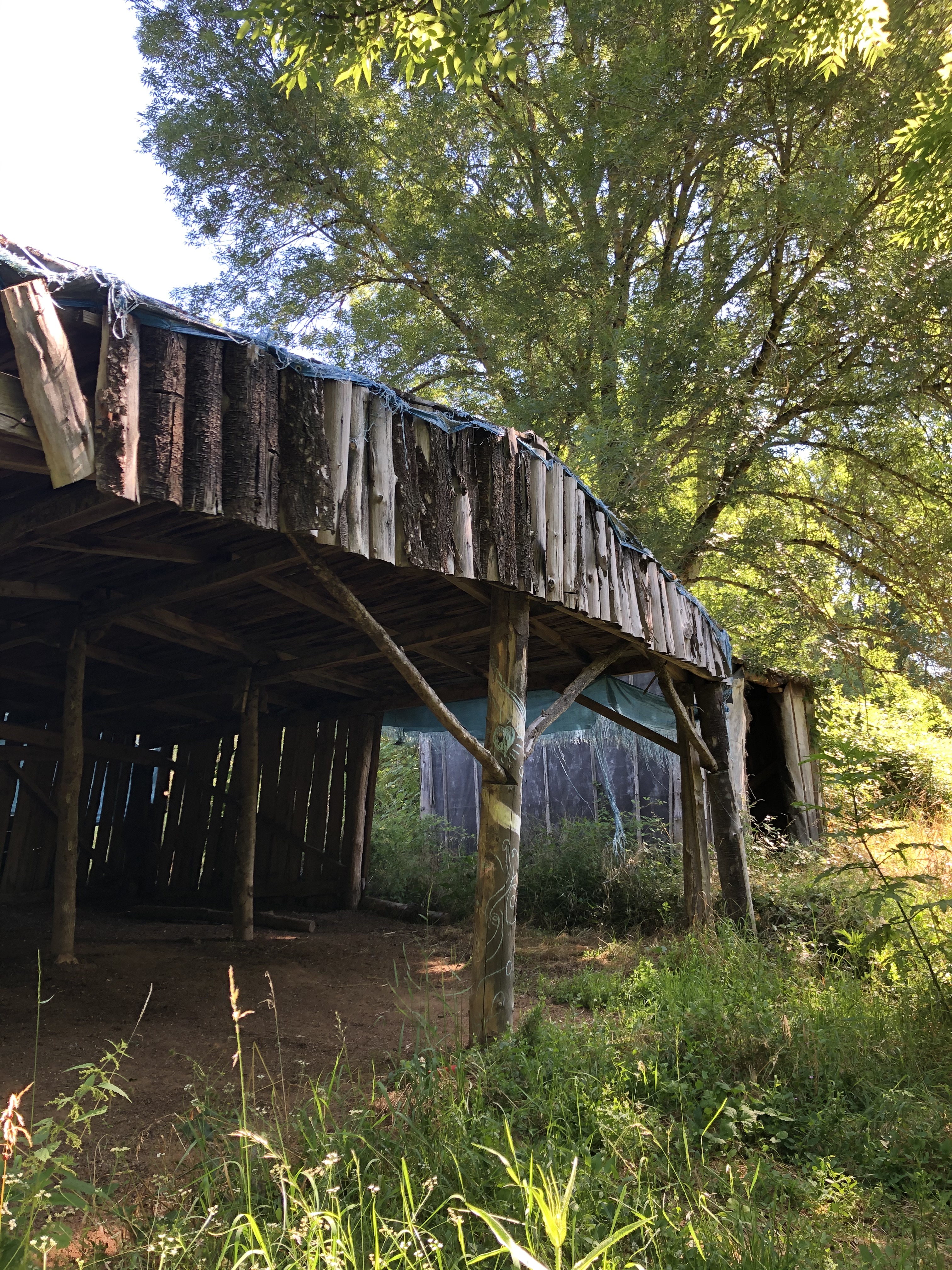
Mocha enjoys being off leash.Sunset is our favorite time to go You can see how they zigzag here. At the top a house on rue de l’Acampadou is peeking through.There are a few landmarks. This spring is running now. It’s just off a a small meadow with rock I like to sit on to meditate.There are a number of very big trees like this ash that I like to lean on and look up.This structure was part of the Medieval Festival a few years ago. Wood was stored in it and burned in the small building next to it to demonstrate how charcoal was traditionally made.
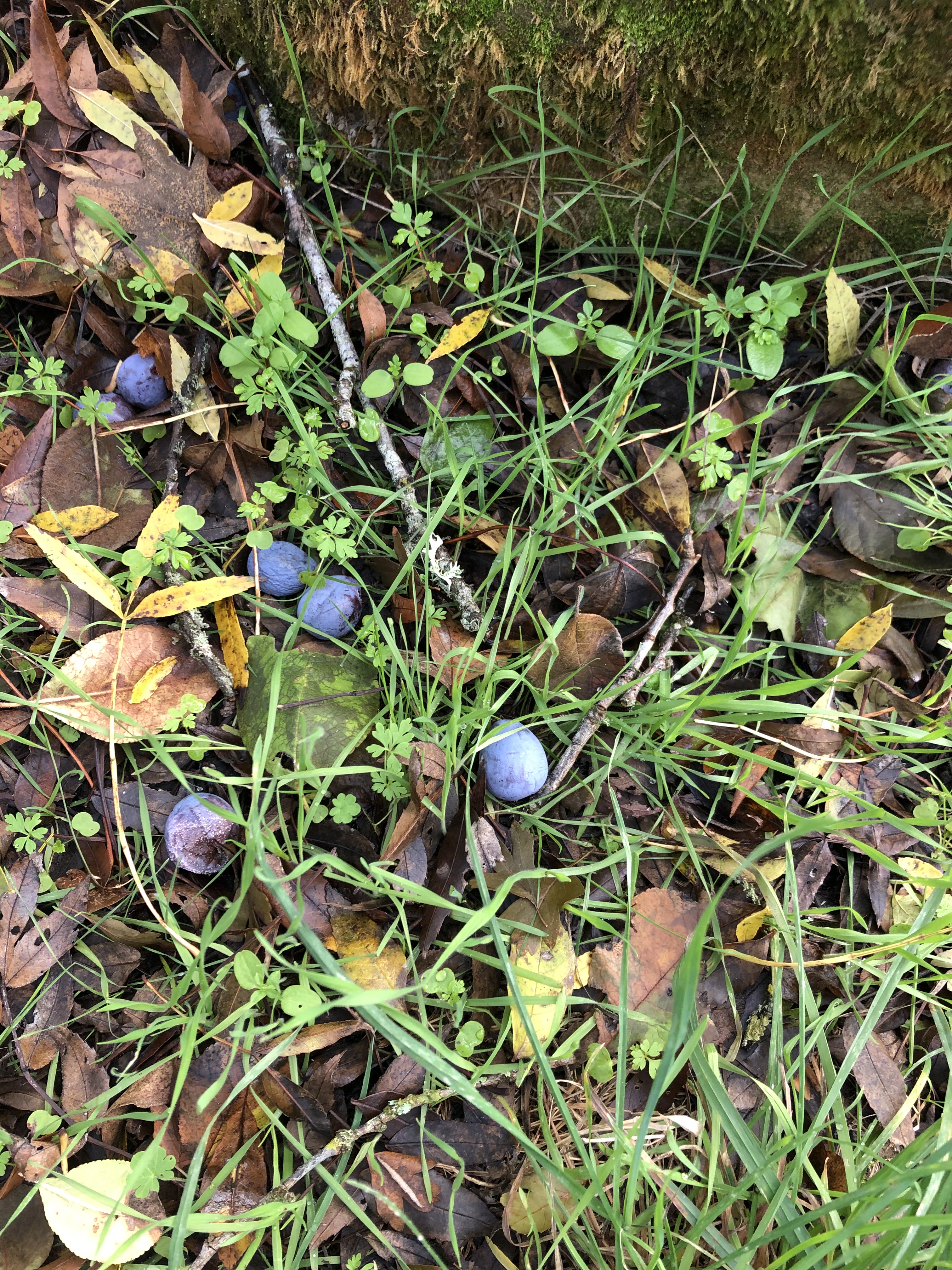
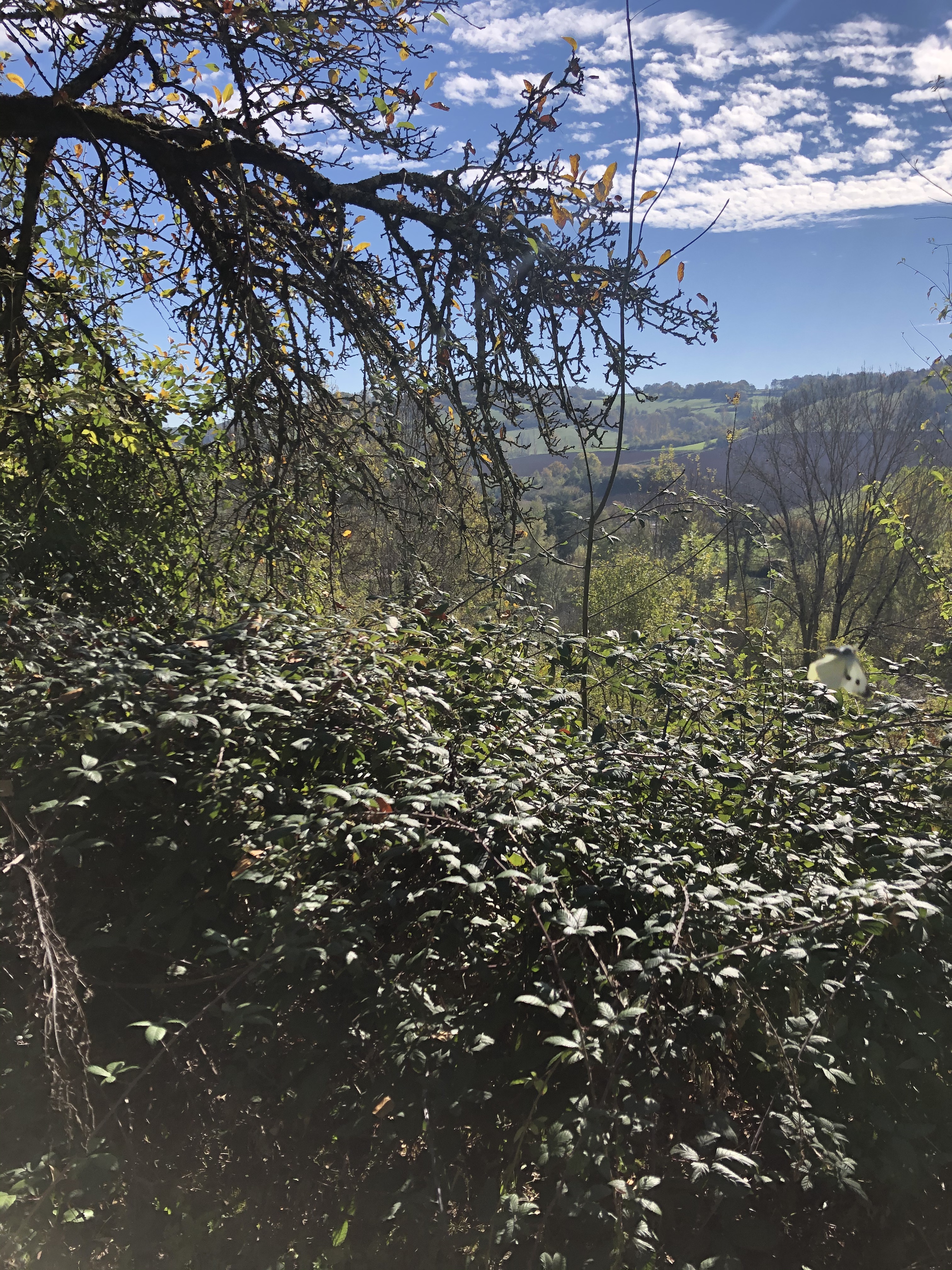
The woods are full of foods, like these wild plums, and medicinals waiting to be gathered.RosehipsFigsNettleAnd blackberries.It’s the end of our walk, but Mocha thinks there are still interesting things to see. Tomorrow, Mocha.
We’re told that this winter is not typical for Cordes-sur-Ciel, that it was unusually short, that, in fact, it may well not be over yet.
On nous dit que cet hiver n’est pas typique de Cordes-sur-Ciel, qu’il a été exceptionnellement court, qu’en fait, il se pourrait bien qu’il ne soit pas encore terminé.
After six weeks in California, we came back to our little house in Cordes on January 11. The skies were gray, but the fields were still green.
Après six semaines en Californie, nous sommes rentrés dans notre petite maison à Cordes le 11 janvier. Le ciel était gris, mais les champs étaient toujours verts.
January 11 11 janvier
It was cold that month, cold and damp and very gray.
Il faisait froid ce mois-ci, froid et humide et très gris.
January 17 17 janvier
It even snowed a little.
Il a même neigé un peu.
January 23 23 janvier
January 25 25 janvier
But it was cozy indoors and there were at least a couple sunny and clear days each week.
Mais c’était agréable à l’intérieur et il y avait au moins deux journées ensoleillées et claires chaque semaine.
My favorite chair for reading. Ma chaise préférée pour lire.
Tom is trying it out. Tom l’essaie.
It was a good time for making potimarron soup.
C’était un bon moment pour faire de la soupe au potimarron.
And poached pears.
Et des poires pochées.
I love seeing the trees and bushes without leaves.
J’aime voir les arbres et les buissons sans feuilles.
We took long walks with the dog. One day, I noticed hyacinths in bud in front of a neighbor’s house. It happens, our neighbor said, but then it gets very, very cold again, and the buds never bloom.
Nous avons fait de longues promenades avec le chien. Un jour, j’ai remarqué des jacinthes en boutons devant la maison d’un voisin. Cela arrive, a dit notre voisin, mais ensuite, il fait à nouveau très froid et les bourgeons ne fleurissent jamais.
January 19
It was about then that a fortunate thing happened. We’d wondered who the abandoned garden across the street from our house belonged to, and had asked around before we left for California. We could look over the wall and see that, though largely covered in brush, it looked like there there were fruit trees, a chicken coop, and maybe a well.
C’était à peu près alors qu’une chose chanceuse s’est produite. Nous nous étions demandés à qui appartenait le jardin abandonné situé de l’autre côté de la rue de notre maison et nous l’avions demandé avant notre départ pour la Californie. Nous pourrions regarder par-dessus le mur et voir que, bien que largement recouvert de broussailles, il semblait y avoir des arbres fruitiers, un poulailler et peut-être un puits.
Travelling for so long – we’d left Cordes in mid-October for Morocco, stayed four weeks, returning for only a couple, before our time in California – I was longing for roots. As I fell asleep in all those different beds, I’d imagine asking for permission to use that garden: cleaning it up, pruning the trees, digging over the beds and planting vegetables and flowers, and maybe even having a few chickens.
Voyager pendant si longtemps – nous avions quitté Cordes à la mi-octobre pour le Maroc, sommes restés quatre semaines et n’y étions revenus que deux semaines avant notre séjour en Californie – je rêvais de racines. Quand je me suis endormi dans tous ces différents lits, j’imagine que demander l’autorisation d’utiliser ce jardin: le nettoyer, tailler les arbres, creuser par-dessus les lits, planter des légumes et des fleurs et peut-être même avoir quelques poulets.
Our neighbors, Dominique and Lucie, were kind enough to keep Mocha for us while we were gone. A week or so after we came back, we invited them over for dinner. To our delight, Dominique told us the garden belonged to Lucette, who passed away three years ago, and whose house was maintained by her children, though they rarely use it. Coincidentally, they were there that weekend.
Nos voisins, Dominique et Lucie, ont eu la gentillesse de garder Mocha pour nous pendant notre absence. Environ une semaine après notre retour, nous les avons invités à dîner. À notre plus grand plaisir, Dominique nous a dit que le jardin appartenait à Lucette, décédée il y a trois ans et dont la maison était entretenue par ses enfants, bien qu’ils l’utilisent rarement. Par coïncidence, ils étaient là ce week-end.
The next morning, Tom went over, introduced himself, and minutes later, we had permission to use the garden.
Le lendemain matin, Tom est allé se présenter, et quelques minutes plus tard, nous avons eu la permission d’utiliser le jardin.
The chicken coop. I took this picture from an angle where the piles of trash and old building materials weren’t visible. Le poulailler. J’ai pris cette photo sous un angle où les piles de déchets et les vieux matériaux de construction n’étaient pas visibles.
I was pleased to discover a clothesline, partly covered in vines and brambles, but functional. Artichokes, planted randomly on the lawn and in the beds, were thriving. That’s the door to the chicken coop in the background. J’ai eu le plaisir de découvrir une corde à linge, partiellement recouverte de vignes et de ronces, mais fonctionnelle. Les artichauts, plantés au hasard sur la pelouse et dans les parterres, étaient en plein essor. C’est la porte du poulailler à l’arrière-plan.
It is a well! C’est un puits!
There’s an old pump that we haven’t got working yet. Il y a une vieille pompe avec laquelle nous n’avons pas encore travaillé.
And, even though it was January, there were irises blooming.
Et, même si c’était en janvier, des iris étaient en fleurs.
I think they are Iranian iris, Iris reticulata. Je pense que ce sont des iris iraniens, Iris reticulata.
We also found a peach tree already budding.
Nous avons également trouvé un pêcher en herbe.
So we began work in the garden, pruning, clearing brush, cleaning up in general.
Nous avons donc commencé à travailler dans le jardin: élagage, débroussaillage, nettoyage en général.
Shirtsleeve weather Assez chaud pour pas de manteau
I had no idea how much joy hanging the clothes to dry would bring me. Je n’avais aucune idée de la joie que j’avais à suspendre des vêtements.
A neighbor gave us a little table and chair. Un voisin nous a donné une petite table et une chaise.
Tom repaired the steps going down to the well. Tom a réparé les marches qui descendent au puits.
We found a small enamel bucket and began using the well to water the fruit trees. Nous avons trouvé un petit seau en émail et avons commencé à utiliser le puits pour arroser les arbres fruitiers.
We carried the water in a bigger bucket. Nous avons porté l’eau dans un plus grand seau.
One Saturday, we bought four little strawberry plants and set them in the ground in a neat row. Un samedi, nous avons acheté quatre petits plants de fraises et les avons placés dans le sol de manière ordonnée.
Every couple days I pick fresh irises for the table. They’re very delicate and don’t last long. Tous les deux jours, je choisis des iris frais pour la table. Ils sont très délicat et ne dure pas longtemps.
On February 10, M. Jazz de Rodez, a cat of great dignity and considerable curiosity, came to live with us.
Le 10 février, M. Jazz de Rodez, un chat d’une grande dignité et d’une grande curiosité, est venu vivre avec nous.
He took over the upper floor of the house immediately. Il a immédiatement pris possession de l’étage supérieur de la maison.
At this point, he owns every room except the one Mocha is in. À ce stade, il possède toutes les pièces, sauf celle de Mocha.
Mocha likes Jazz a lot more than Jazz likes her. If Mocha showed her considerable interest in the cat in some way other than barking, the process of integration would be going better. Mocha aime beaucoup Jazz beaucoup plus que Jazz ne l’aime bien. Si Mocha manifestait un intérêt considérable pour le chat autrement qu’en aboyant, le processus d’intégration se déroulerait mieux.
While the two of them make their peace, the garden keeps growing.
Alors que les deux font leur paix, le jardin ne cesse de croître.
Daffodils on our street February 20 Jonquilles dans notre rue.
Peach blossoms about to open. Fleurs de pêche sur le point de s’ouvrir. February 28
First peach blossom. Première fleur de pêche. March 3
Tree peony. Pivoine arbustive. February 28
Apricot blossom Fleur d’abricot March 3
Now there are trees in bloom everywhere.
Maintenant, il y a des arbres en fleurs partout.
Wild plum or maybe almond Prune sauvage ou peut-être d’amande March 5
Inside, Mocha waits a little impatiently to be taken for a walk.
A l’intérieur, Mocha attend un peu avec impatience de se promener.
And Jazz is sleeping on my lap.
Et Jazz dort sur mes genoux.
I don’t think winter will come back this year.
Je ne pense pas que l’hiver reviendra cette année.
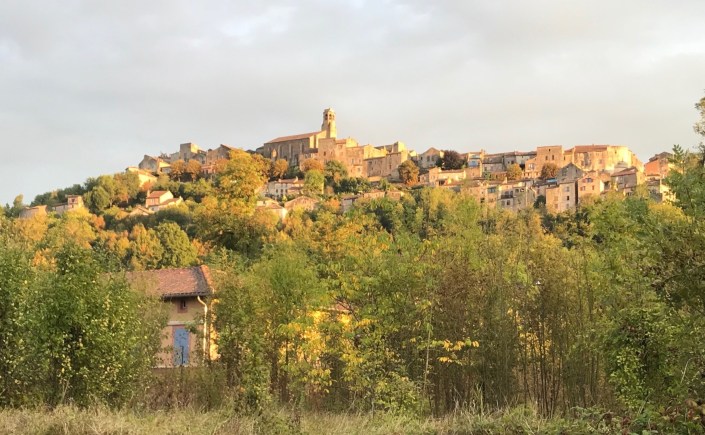
Cordes-sur-Ciel was built as a safe haven for people who lost their homes in the nearby city of Saint Marcel, which was razed during the Albigensian Crusade. Said to be the first of the bastides, it has five walls built in concentric circles.
(More about the history of Cordes-sur-Ciel can be found here.)
A neighbor recently told us that the stone wall across from our home is the unfinished fifth wall. Indeed, our house is just below the Porte de l’Horloge, the eastern entrance to the medieval city, which is in the fourth wall, built between the 14th and 16th century. Our neighborhood, quartier du Barri, is a 17th century suburb of the medieval village.
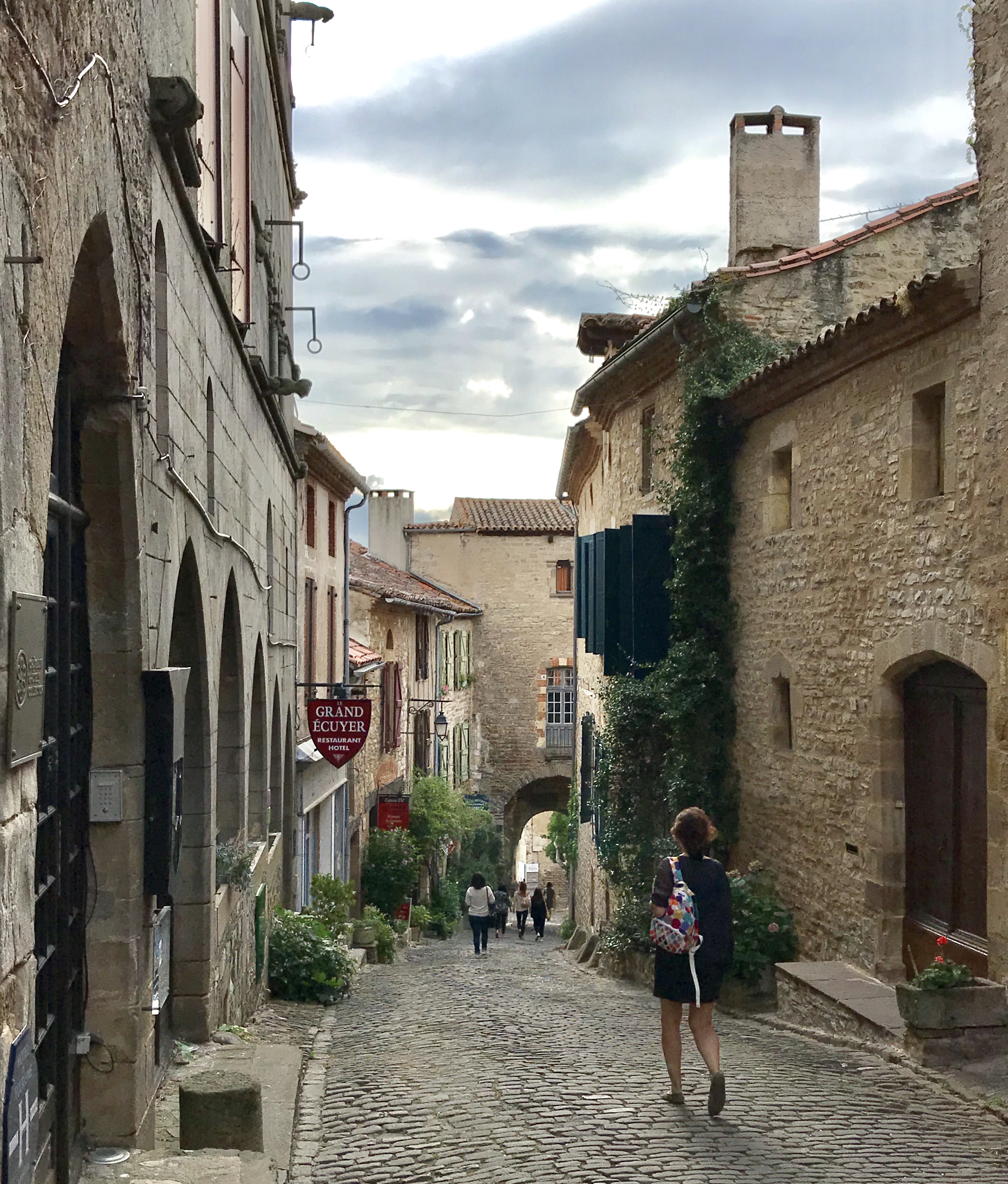
Cordes sits on a rocky outcropping, and is entirely built of local stone: limestone, sandstone, and dolomite. The houses are stone and the streets in the medieval village are cobbled. Walls surround every garden and line every street.
There are walls upon walls upon walls.
Living without a car gives me plenty of time to appreciate stone walls all around. One of the most delightful things about Cordes is its authenticity: it looks like and is a place that has been continually inhabited since the 13th century. The walls reflect its history.
They bring me peace, connectedness, and a sense of stability. They are the keepers of the stories.
I never tire of their variety, their richness, their complexity.
In a village of art, the stone walls are perhaps the greatest art.
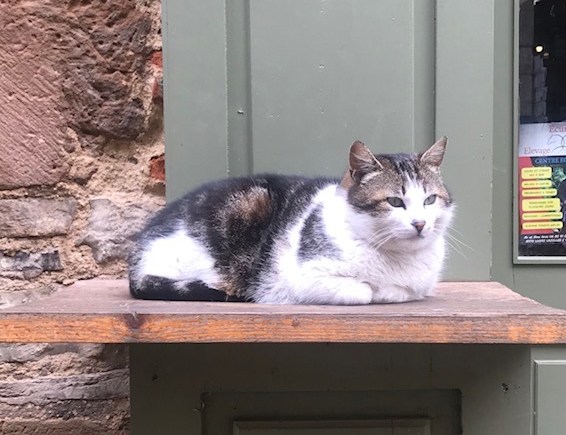
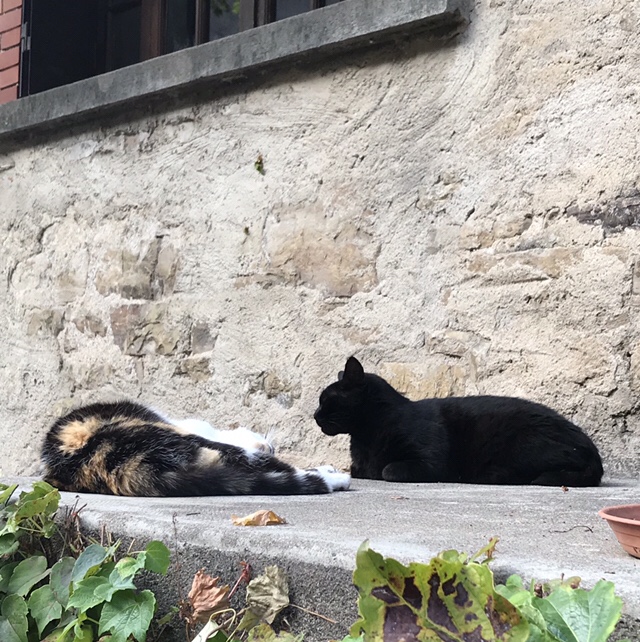
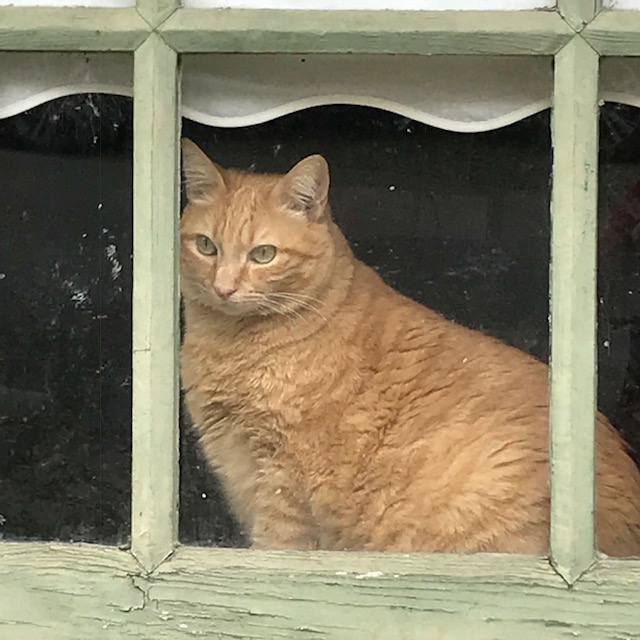
Although it is a dog, a wonderful dog, who came to us almost immediately upon our arrival in Cordes, the village is better known for its cats.
Almost everyone in Cordes-sur-Ciel has a cat. And, like a mini-Istanbul, Cordes is home to many feral cats.
In addition to doing their regular work with the rodent population, these wild cats drink water from bowls left out for them and eat kibble sprinkled on people’s doorsteps. (Mocha is also a big fan of the kibble, and has to be convinced daily that it’s not for her.)
There’s an organization, Le Chat D’Oc, that catches, spays and releases, finds homes for, or keeps as many of the feral cats as they can, and individuals do their part, but there are still plenty of cats.
Mocha, at this point in her life, is a rabid cat-chaser. She’s not great with certain dogs either, but I haven’t seen a cat that doesn’t run from her yet. This one was coming up the Pater Noster stairway very confidently – until Mocha gave him the eye.
The next moment, he was gone.
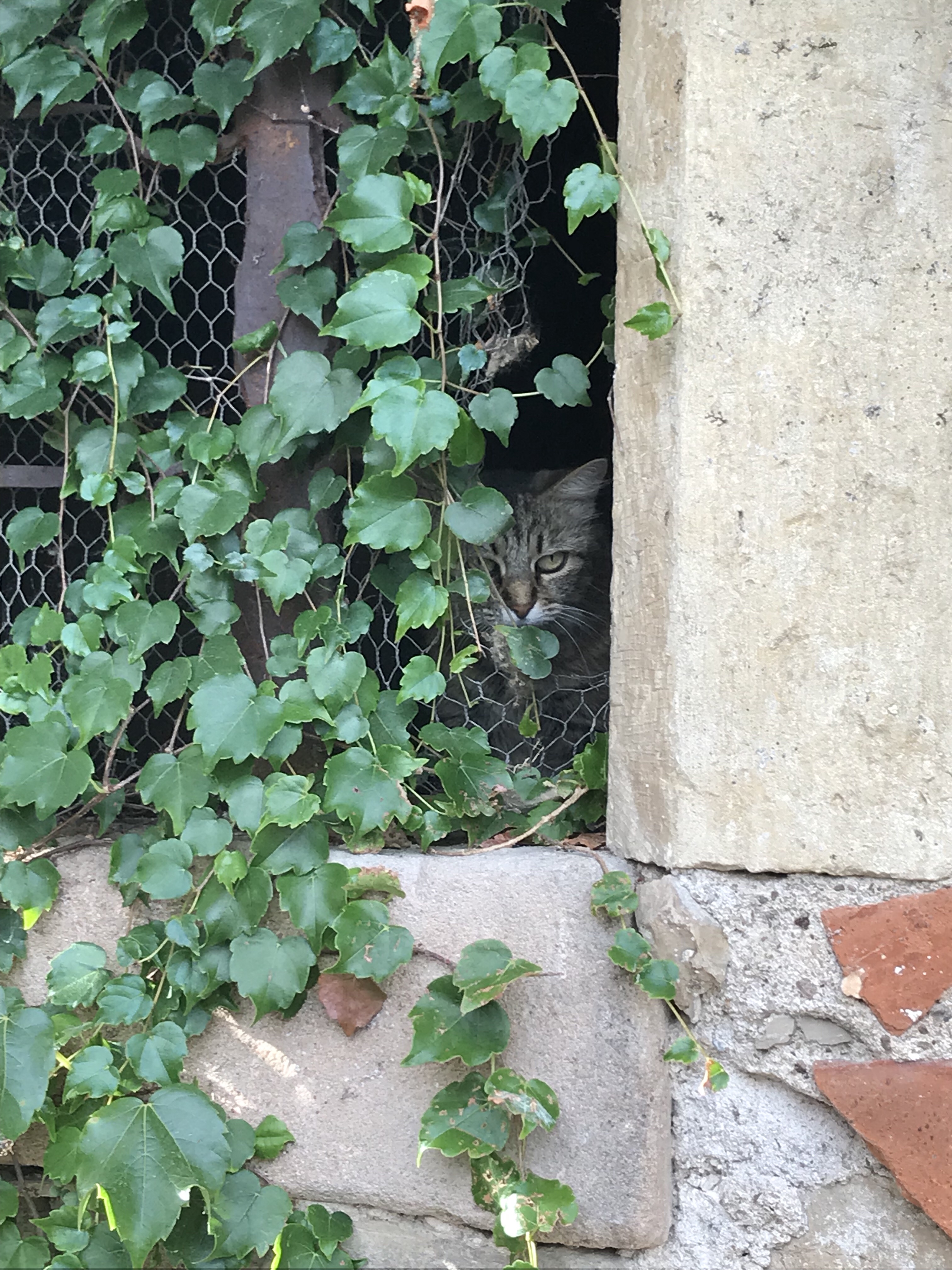
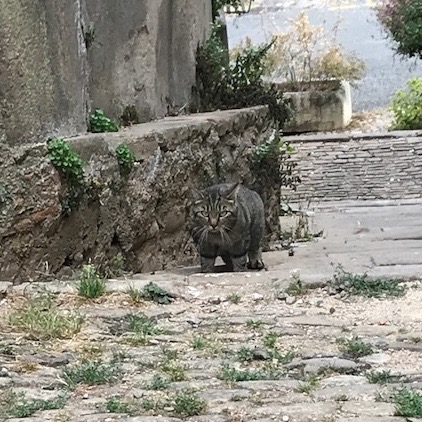
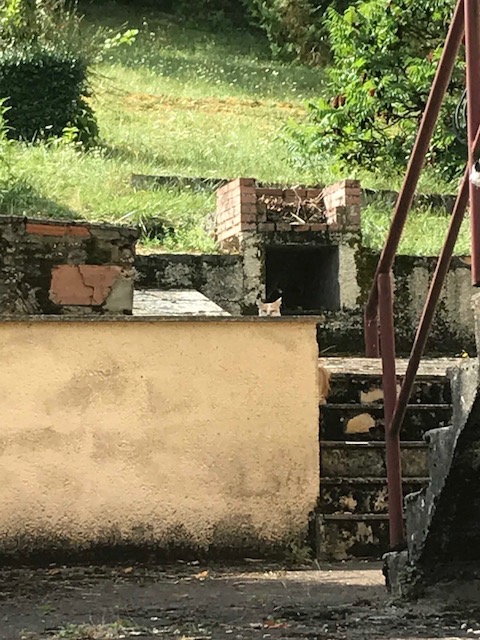
Most of them keep their distance.
This guy, who lives along the footpath where we take our regular evening walk, has been getting braver daily.
I’m working on Mocha.
I don’t know how long I’ll be able to live here without a cat in the house.
Cordes-sur-Ciel, population roughly 1000, sits on a hill overlooking the valley of the Cérou, which flows into the Aveyron and then into the Tarn. Our house is on the south side of the hill; the Cérou is on the north. Just to the northwest of the village there is another even smaller village, Les Cabannes, though which the Cérou flows.
The Cérou in Les Cabannes
La quincaillerie
Les Cabannes, a fifteen minute walk from our house, is the home of the local quincaillerie, hardware store, a very important place when one is just moving into a new house.
At the post office, there’s a community center where you can print a page for 15 centimes, which makes getting a printer seem wasteful.
Tom enjoying a beer and the paper at the café in Les Cabannes
There’s also a bistro we like, Le Petit Café, with a dog called Luigi who’s in love with Mocha. This isn’t as endearing as one might think. Luigi is very passionate. He recently followed us to the post office with such enthusiasm that Mocha and I had to take refuge until the post mistress phoned the café to send someone to pick Luigi up. No one could come in or out of the post office until he was gone. Now one of us goes to the café in advance to ask them to hold onto Luigi while we’re there or when passing by.
About halfway between Les Cabannes and Cordes is our favorite grocery store, Prim’Frais,which specializes in local products. They have a nice selection of relatively exotic items, like fresh herbs, too.
Vegetables at the Prim’Frais
Lately, we’ve been going to Les Cabannes almost every day.
In addition to the Prim’frais, there’s a gas station along the way. The mechanic has a junk yard for parts, and an eye for interesting stuff.
There’s the nose and cockpit of a crashed plane for example:
Here’s what it looks like inside:
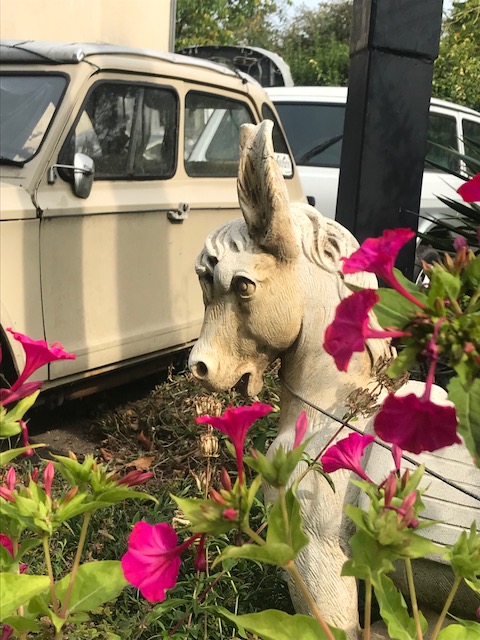
There’s also a Renault that’s been there so long it’s getting covered in moss.
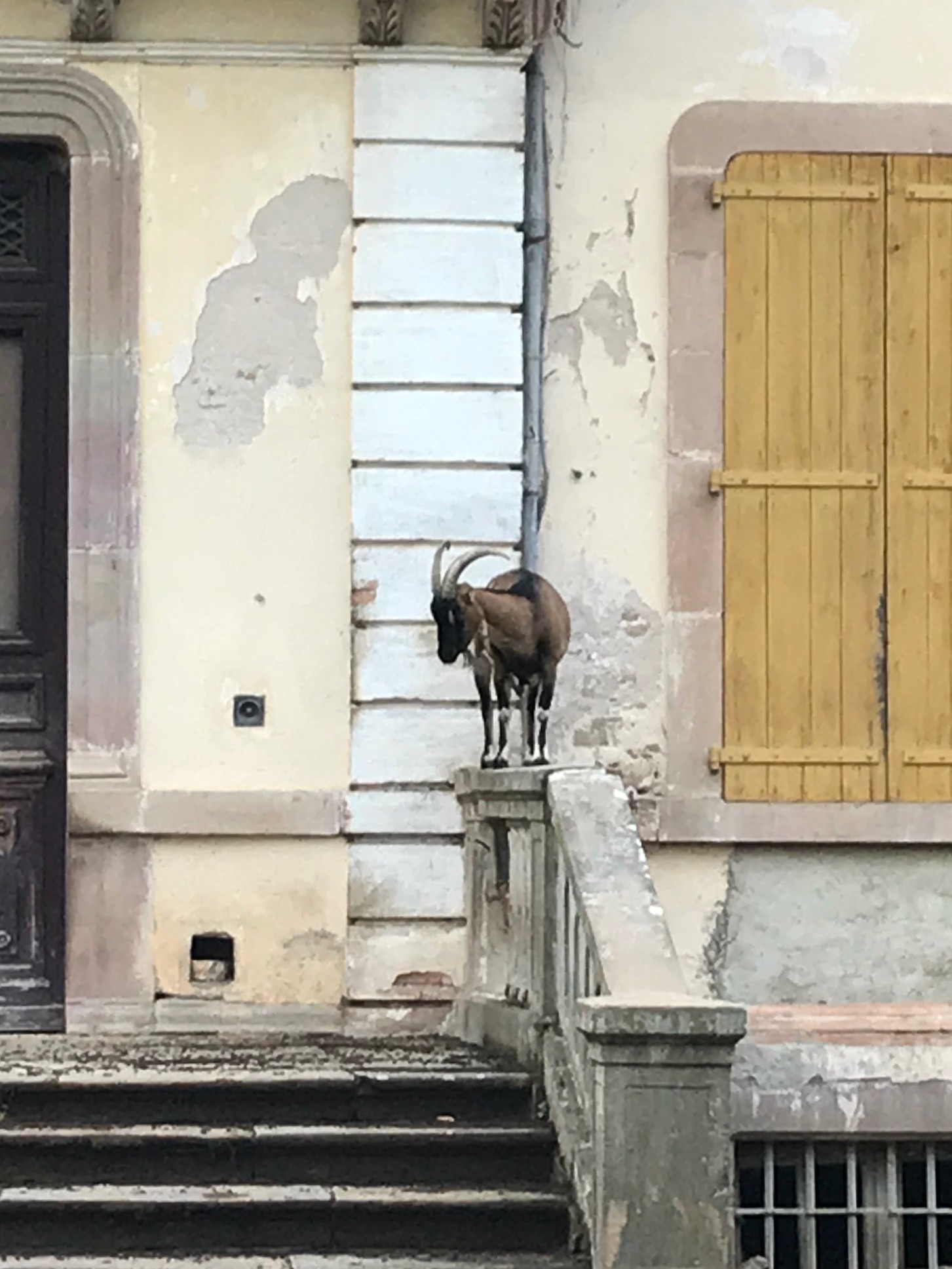
And, if you take Rue des Tanneries home, you might see a goat or two!
The evening Tom and I returned from Le Havre with our rented van full of the boxes we’d shipped from Los Angeles, our neighbors Ann and Leif greeted us in front of our house with sad news. Andreas, the other newcomer to our neighborhood, a Swiss artist who’d also moved to Cordes from California, had died suddenly.
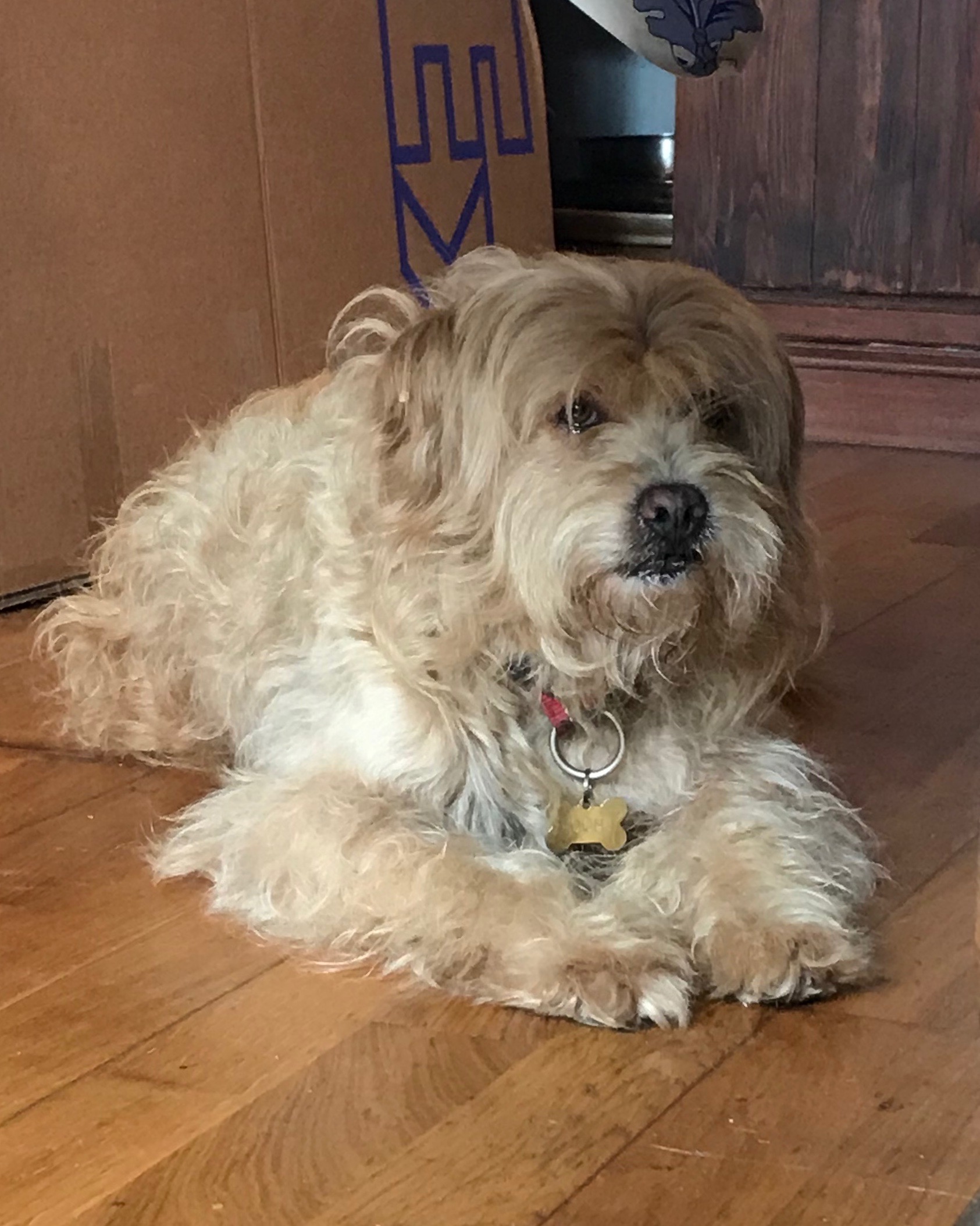
His dog Mocha was staying with another neighbor, Dominique, who couldn’t keep her until Andreas’s relatives came, which could be several weeks. Not only did Pompom the cat object, but Mocha’s barking was bothering Dominique’s guests.
When we saw that the address on Mocha’s address was Bancroft Way, Berkeley, CA, the solution was obvious. Mocha would come to stay with us until Andreas’s family decided where she would go.
The next day, after we returned the van to Albi where we’d rented it, we picked Mocha up at Dominique’s house. Mocha was not happy. She didn’t want to stay with us. It was clear that she loved Andreas very much and was grieving deeply.
So, when Tom opened the door take some empty boxes to the recycling, she was out like a flash.
Naturally, she headed back straight to Andreas’s place. Tom and I managed to corner her briefly, but when a car went by and we had to alter our very strategically chosen positions, she took off again, this time down the street toward the bistro where Andreas, like most Cordais, liked to sit.
We had pictures on my phone, and people knew Mocha, but no one had seen her. She was spotted near Andreas’s place several times. We left a note with Tom’s French phone number on his door; people called, but no one could catch her. Pretty soon half the village was involved.
At 10:30 that night we heard voices in front of our house and looked out the window to see Leif, who told us that Dominique found Mocha sleeping on Andreas’s step, scooped her up, and now had her in her car. She’d be right over.
So Mocha came home. She had chopped sausage and a little duck for dinner. And she went to sleep on our bed.
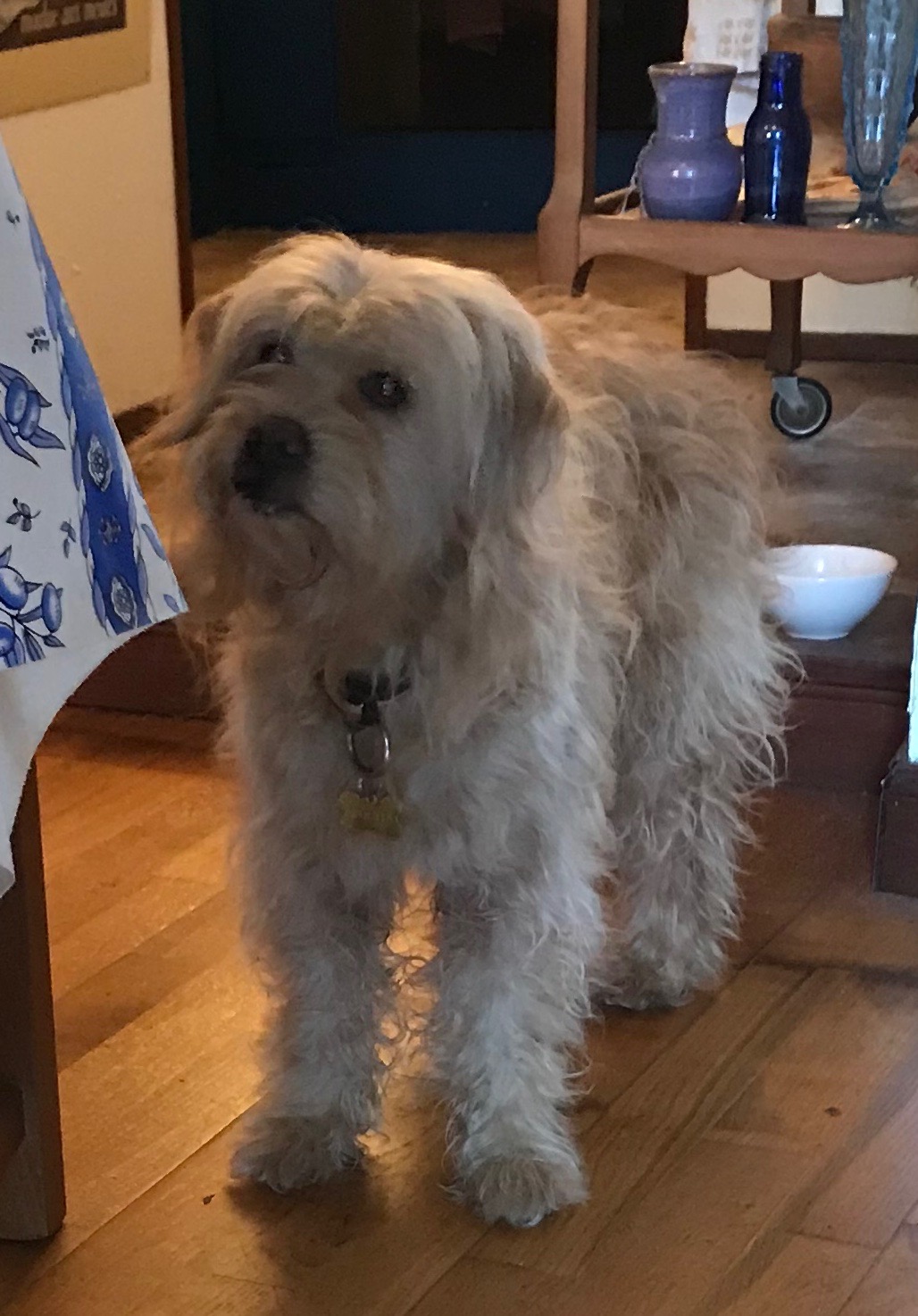
Day by day she is becoming more accustomed to her new home. She no longer pulls on the leash when we go near Andreas’s house. She enjoys hanging out at the bistro, where she’s very popular.
And she loves being groomed! (Not so much the bath.)
But a long walk, table food, and sleeping on a good bed suits her very well!
Now we’ve heard from the family that we can keep her!
Thank you, Andreas, for this wonderful new family member.
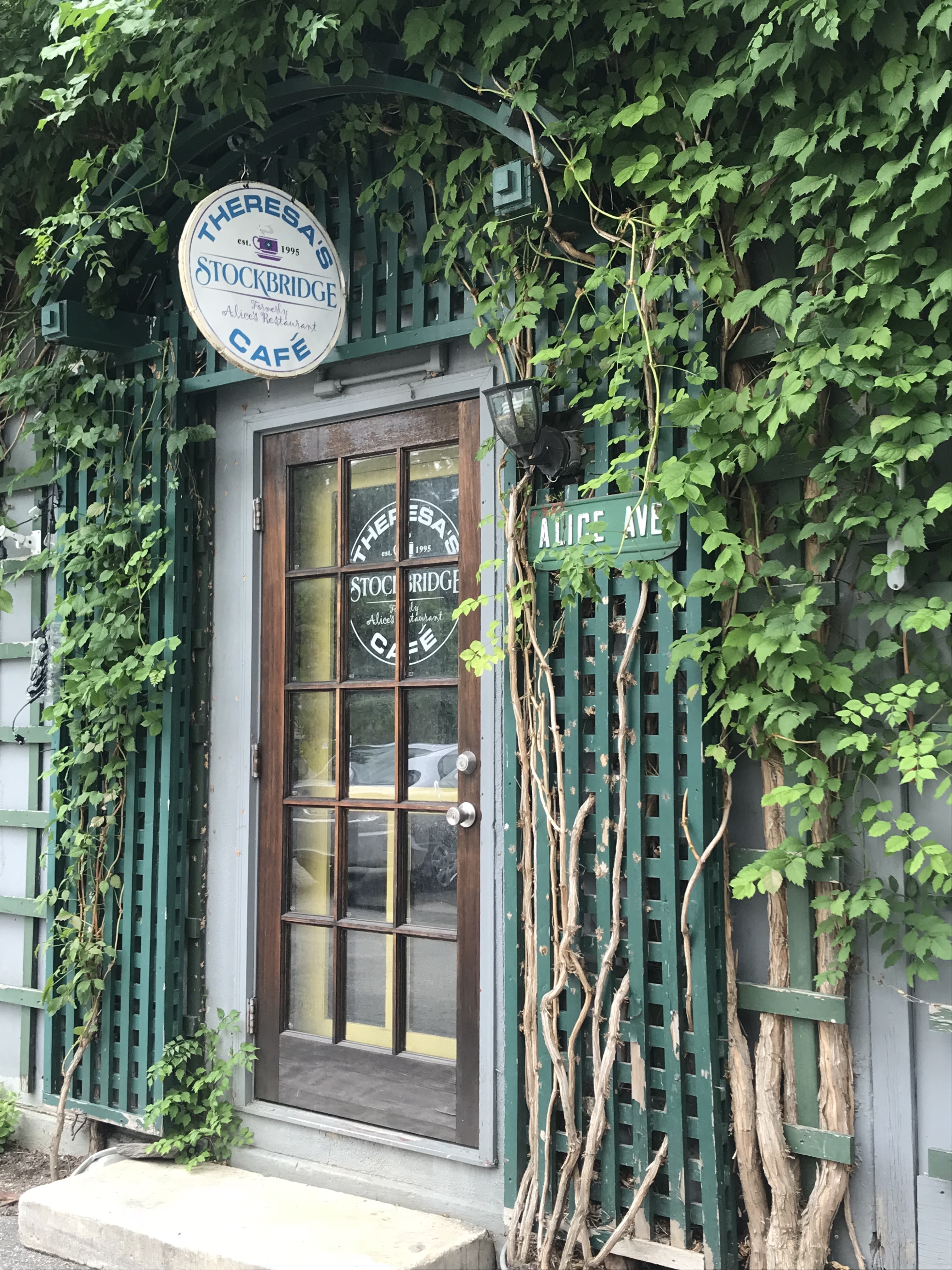
After lovely lunch in Albany with old friends, Heather and Norm Mendel, we stopped for coffee in Stockbridge, MA. The former Alice’s Restaurant was closed, but we had the best coffee of our trip at Stockbridge Coffee and Tea.
You can get anything you want…
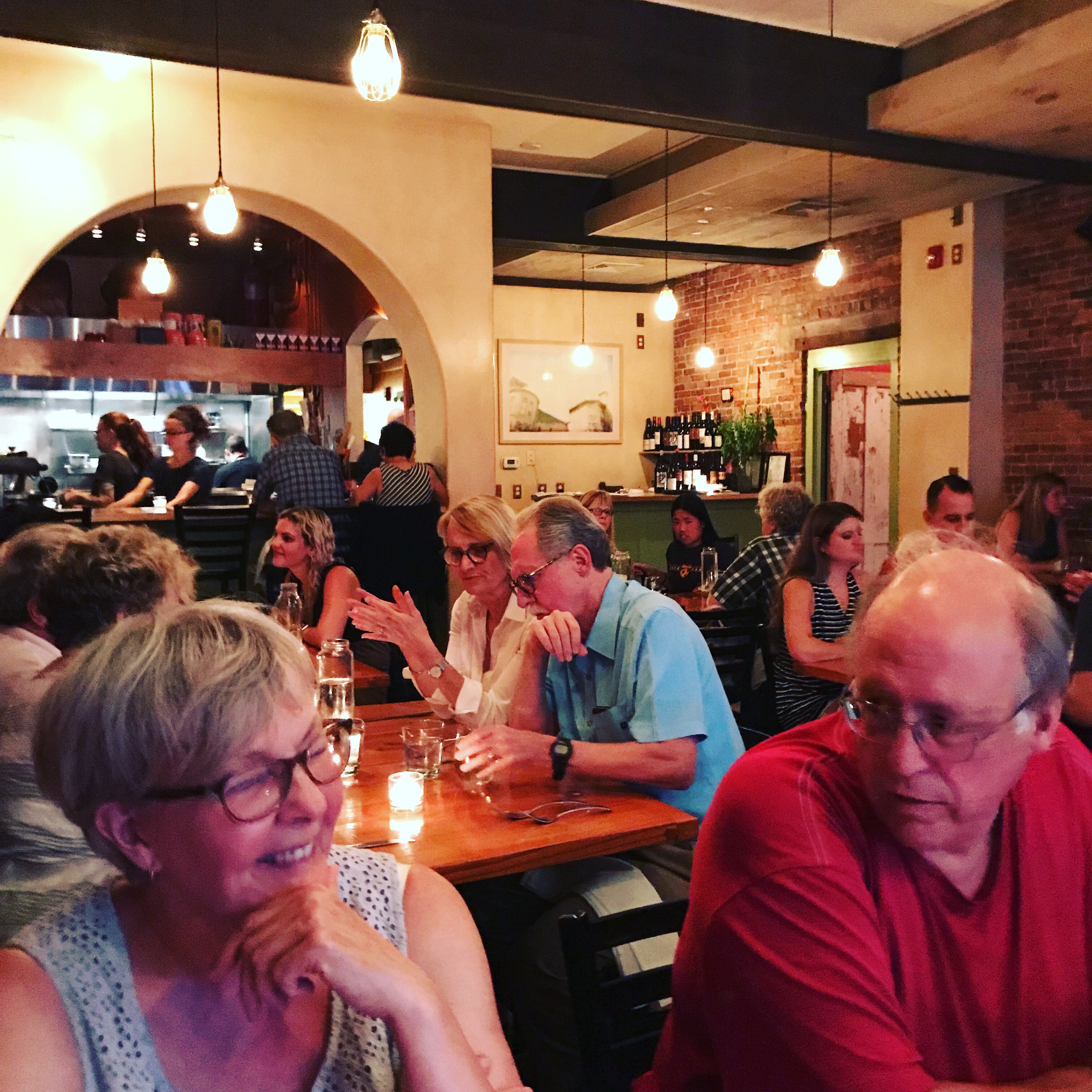
We spent the night at Kathleen Becker’s beautiful studio in Northampton. What a meal we had at Coco in Easthampton!
Dinner and the next night were spent with Tom’s Neuhaus cousins in New Canaan, CT.
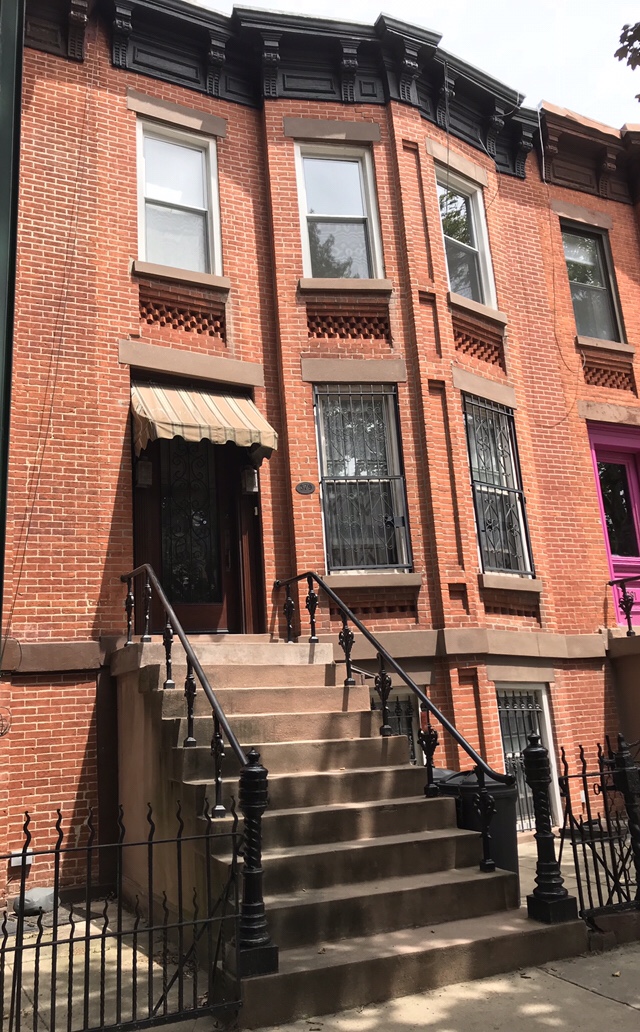
After dropping our trusty rental car in Stamford we took the train into New York City, where we stayed three nights with Elise in Park Slope.
On James’s birthday we took the ferry to Rockaway, and then back to the UN where he gave us an after hours tour.
On Wednesday we met Lenya for breakfast and then went out to Queens to see Mary Kuzma and Tomas Tisch at her studio.
And today it’s packing and organizing for our midnight flight to Bordeaux.






















































 Eve Neuhaus