In the process of writing the second volume of Two Suitcases I continually return to historical sources to check that I’m getting the story right. As I reviewed and revised a chapter in which the Revolutionary Socialist Party of Austria is introduced, I came across an article I hadn’t read before, “Thinking Cosmopolitan or How Joseph became Joe Buttinger” by Philipp Luis Strobl. What a find!
Joseph Buttinger will be making at least a cameo appearance in my new novel, but I think his story should be shared now because of its relevance to the current political situation in the US. I’ve cut and pasted the opening below. The entire article, even in its slightly flawed English translation, is worth reading. Read it here: http://www.science.usd.cas.cz/Presentations/Strobl.pdf
On May 27, 1932, the Austrian parliament approved a new government that would change the democratic course the country had pursued since the end of the First World War. The new chancellor Engelbert Dollfuß now was in charge of the country’s leadership. On October 1, he used a so‐called “emergency degree”, a wartime relict, to rule the country without the approbation of the Austrian parliament. That was the hour of birth of Austria’s first dictatorship. The consequences for the people were fatal. Unliebsame Personen as “unpleasing” persons were called at that time had more and more problems living a normal life. Particularly intellectuals who were engaged in the ideas of psychoanalysis, neopositivism, or austromarxism (socialism) had to fear reprisals from the government. Life became very hard for the government’s opponents, but for most of these persons, the situation turned from bad to worse with the incorporation of Austria into Hitler’s German Reich in 1938. So‐called “enemies of the government” were forced to emigrate ‐ and many of them did so. According to a 1941 Office of Strategic Service memorandum, more than 40,000 Austrians had immigrated to the United States during the three years since the “Anschluss” in 1938. This paper is about one of those who emigrated as a result of ideological reasons.
A yogi lives on a corner near my home. I’ve known he lives there for a long time. You have to cross the baseball diamond to get to his place. The neighborhood is all white bungalows and the streets are dusty. The yogi is an old hippie, an American with long dark hair and a long dark beard. I’ve never been to his place before, but now there’s something I want to share with him.
It’s written on a small piece of very old paper, the kind made of fabric. The paper is soft and folds around my fingers.
The guy—his name is something short—John? Russ?—lives simply. He doesn’t even label the jars he keeps his food and herbs in, he tells me, laughing.
He’s old, but not much older than me, and he is wearing a lungi.
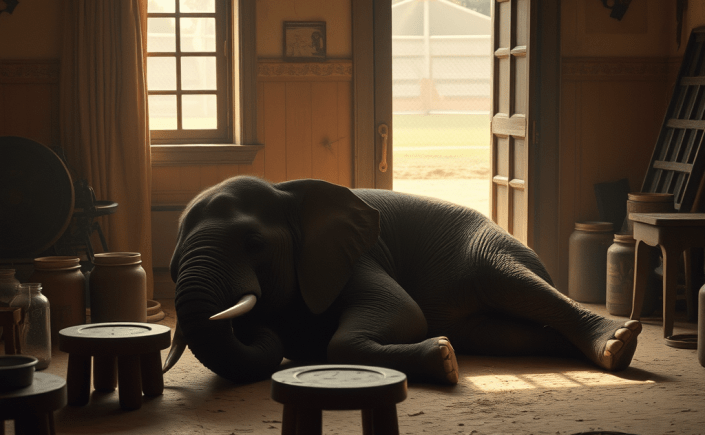
We sit on low round stools, 4 or 6 inches off the dusty floor. At first he doesn’t give me a chance to ask my question. Instead, he talks about the wonders of living there. An elephant lives in the baseball diamond. I know that. Sometimes it comes to him. Then the elephant comes. He had called it.
The elephant walks into the hut, which is now large enough to accommodate it easily. It lies down on a dusty carpet and looks at us. After a time it gets up and leaves.
I give the yogi the paper, which has a verse on it. We talk about what it says.
A white horse runs by on the street, kicking up a cloud of dust. The yogi and I laugh. “I didn’t think it was real when I first saw it around here,” I say. “But now I’ve seen it many times.”
“Yes,” he says. “It’s real.”
More people are in the room so I decide to go to the baseball diamond to use the toilet. There’s a game going on. I don’t want anyone to see me using the toilet, so I return to the yogi’s place.
I sit before him. He puts his hands on my shoulders and back and pulls me up to stand facing him. He tells me to inhale and exhale as slowly and deeply as I can. We breathe together for a while.
More people are coming, including Tom. When the yogi notices how many there are, he looks at me deeply and says, “That’s enough for now.”
I wake up.
(I remember so many details about this dream but not the message, the most important part!)
November 6, 2024, noon
Upon reflection, I think this is a dream about the American election, that archetypal battle that was just won by the elephant. The elephant stays in the baseball diamond. A vision of progress, the donkey, transformed into a white horse, rushes off into the future.
Values are changing. The words written on ancient paper, though they used to be very important, are forgotten by the dreamer, and replaced with the suggestion to focus on the wonders of the world around us. The white horse is real.
All the same, as my friend Robert Sachs said about the dream, “This is no time to piss around.”
Instead, return to the wise ones. Sit at their feet and they will lift you up.
Sometimes I have extraordinary dreams—some of them are told in the links below—and sometimes my life is filled with extraordinary synchronicity. A few weeks ago I was graced with a series of delightful synchronicities.
That weekend, Tom was still in Africa so I had plenty of time to work on my book. There were no real meals to think about, minimal shopping to do, just the dog to walk, which is good for me and almost always a pleasure. I was on a roll.
The last three chapters that I’d written were all pretty dark— the excerpt I published here a few weeks ago is part of one of them—so I decided to add in a lighter one. I gathered my characters in Gert’s parents’ sitting room for New Year’s Eve, had Gert put on some popular music with funny lyrics—it was good fun to do that research—and pretty soon everyone was singing and dancing. They couldn’t dance for all the hours before midnight though, so I figured they could play games. More interesting research. No parlor games popped up, but card games were popular. The first card games from that time and place that came up in my search were played with tarot cards. Good idea. Let the characters play the game and afterwards draw a card. Or better, I’d draw a card for each of them.
The characters probably would have used an Industrie und Glück deck, but I used what I had on hand—I’ve accumulated a good number of tarot decks over the years. The first one I found was my well-worn Waite/Rider deck from the 1970’s.
An Industrie und Glück deck:
I divided out the major arcana cards from my deck, drew one for each of the characters, and then wrote them into my story:
Gert puts one of the decks into two piles. “Pull the chairs back into a circle with a table at the center while I sort the cards.” When the chairs are in place she explains, “I’m putting the major cards, the tarocks, in one pile and the minor cards in the other. Then we’ll each draw one of the tarocks, and I’ll explain what they mean. Or at least what I think they mean.”
“Me first!” Gisi calls out. “I want to get it over with.”
“Okay.” Gert shuffles the smaller set of cards and fans them out so Gisi can choose one.
Gisi looks at the backs of the cards carefully. She runs a finger over them. “No,” she says. “I can’t do it. Someone else has to start. Sorry.” She sits back in her chair.
“I’ll do it!” volunteers Max. Gert shuffles the cards again and fans them out for Max. He doesn’t hesitate, immediately drawing a card from the center of the deck and turning it over.
“It’s Der Naar, the Fool. What does it mean?” he asks Toni.
“Well, that’s appropriate,” she laughs. “It’s the wild card in the deck. It symbolizes beginnings, innocence, spontaneity, and a free spirit.”
“Very appropriate!” Hugo agrees. “I’ll go next.” He runs his finger over the cards a few times before drawing Der Herrscher.
Gert smiles. “The Emperor. Another good fit. The Emperor represents authority, the establishment, structure, and a father figure. He’s the ultimate ruler of the world.”
“Good God,” says Hugo. “Is that how you all see me? I always wanted to be an artist. Isn’t there an artist card?”
“You are an artist,” says Anna, “but the card fits, Hugo. Accept your destiny.” Everyone laughs.
Leo volunteers next. He draws the Magician.
“Ah, my favorite,” says Gert. “Der Magier is the first of the Tarocks. It symbolizes manifestation and means that you can make your wishes come true.”
“Phew! A lucky one for me! What should I wish for?”
“That’s up to you,” Gert replies.
“Then I wish the power of Der Magier for all of us. May all our wishes come true.”
“Leo, generous as always! Thank you, my friend,” says Hugo.
The last rays of sun fill the room.
Everyone is smiling.
“Thanks!” says Anna. “I’ll go next, now that I have the power to make my wishes come true.” She takes only a moment to draw Die Sonne, the Sun.
Gert claps her hands. “I think Leo’s card worked. Die Sonne signifies enlightenment, joy, marriage, and happiness.” Anna looks at the card and grins.
“You are an excellent fortune teller, Gert,” says Gisi. “I guess I’ll risk taking a card now.”
Gert reshuffles and fans the deck out on the table. Gisi looks over the back of the cards several times, pauses, and then slowly draws out a card slowly. She studies closely, holding it up to see it better. “I have no idea what this means,” she says, turning it around so everyone can see.
“Oh, it’s der Gehenkte, the Hanged Man,” says Gert. “It’s a complicated card, but it generally points to pausing—voluntarily or involuntarily—in order to assess your situation. It can also mean that it’s time to shift your perspective. Sometimes it means you’ll have to make a sacrifice.”
“Aha!” says Max, rubbing his hands together. “I thought this would go a little deeper eventually. I think it’s an accurate reading of where you are in life, Gisi—of where we all are, no? Very interesting, Gert!”
“It is a good representation. All of our lives are held up right now, aren’t they. None of us knows where we’ll be in a year,” muses Gisi, tracing the form of the hanged man with her finger.
Hugo says, “I think all the cards have all been pretty good representations of who we are, or of who we could be.”
“I’ll go next,” Toni volunteers, and Gert lays out the cards again. Toni also takes her time to choose. Eventually she closes her eyes and stabs randomly at a card.
“The Hermit,” announces Gert. “Huh. Der Eremit isn’t a card I would have associated with you, Toni. The Hermit is a person who gains wisdom by being alone, through introspection. It also means the answer to your question will be found within.”
Toni is surprised too. “Soul-searching certainly isn’t something I’ve done much of so far in my life. All the other cards have seemed so exactly right though. Maybe I should take it up.”
“My turn now,” calls out Felix. “I’m so curious! Every one of these cards has been fascinating to consider.” Gert offers him the deck.
“Temperance. Die Mäßigkeit. Moderation,” she says when she see what he chooses. “Is that you, Felix? Or is the card advising you to be more balanced, more patient?”
“The latter,” says his brother. “Obviously.”
“I beg your pardon, Leo. I am the model of Patience. I ooze Balance from every pore.” Felix stands on one leg, extending his arms, wobbling a bit, but then holding the pose.
“Very good!” Anna claps and the rest of the group joins in.
“And now,’ Gert says. “I’ll pick one for myself.” She shuffles the cards three times and then riffles them. At last she chooses a card.
It’s Der Tod, the Death Card.
Everyone in the circle looks stricken.
“Wait, wait,” Gert cries. “It doesn’t mean death literally! None of the cards are meant to be understood literally. It symbolizes transformation or change, or an ending.”
Anna sighs audibly. “Of course, none of them is literal. Still, it’s shocking to draw it.”
Gert is shaken, but she hides it. “How about if we transition to Jause now? My parents will be home any minute. Come help me in the kitchen, ladies.”
When I had written that far, I took a break and walked the dog up the hill. It was surprisingly crowded in the village Saturday afternoon. Then I remembered that it was the day of the Witches’ Market!
There must have been half a dozen readers or sellers of Tarot readers there.
The second synchronicity occurred a week or so later. My chapter was dated January 25, 1938, so I followed my usual process of looking up what happened in Vienna at the time. It was a tense time then, six weeks before the Anschluss, when Austria merges into Germany.
In late January that year, the Northern Lights were visible in Vienna for the first time since 1805, just days before Napoleon marched into Vienna. Many Viennese saw their appearance in 1938 as an omen. Others were more hopeful—they thought it marked the birth of a princess in Holland.
I wrote the Aurora Borealis into my story by weaving together bits of whatever eyewitness reports I could find. The pictures were all in black and white, but the words were evocative. I went to bed imagining it.
In the morning, I saw that my social media was filled with pictures of the current Aurora Borealis.




 Eve Neuhaus